
Dairy ingredient documents required by importers
This practical article helps dairy manufacturers, importers and procurement teams organise the technical, quality, regulatory and shipping documents commonly reviewed before purchasing dairy ingredients from international suppliers.
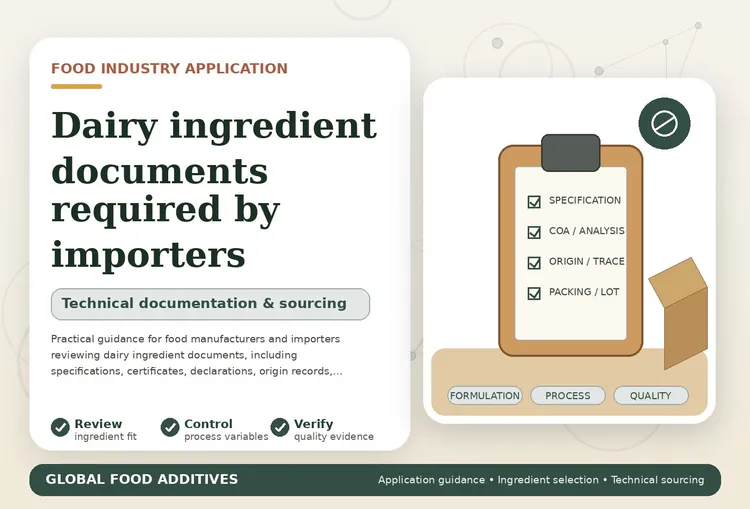
Application context
Imported dairy ingredients can include milk powders, whey products, lactose, caseinates, milk proteins, cream powders, cheese powders, butter-derived ingredients and specialised dairy preparations. Each product may have different compositional, microbiological, allergen, storage and regulatory requirements.
A complete documentation package allows quality, regulatory, procurement, logistics and customs teams to confirm that the offered product matches the approved grade and can be imported, received, stored and used correctly. Documents should therefore be requested and reviewed before the purchase order is finalised, rather than only after the goods have been produced or dispatched.
The required records depend on the ingredient type, animal origin, production country, destination market, intended food application and customer standard. Some markets may also require official veterinary, health, sanitary or establishment-approval documents in addition to the supplier's normal technical file.
Supplier and product selection points
- Confirm the exact product identity. Record the commercial name, technical description, grade, manufacturer, production site and country of origin.
- Define the dairy application. Explain whether the material will be used in beverages, yoghurt, ice cream, cheese, bakery, confectionery, infant nutrition, sports nutrition or another product category.
- Review composition. Compare protein, fat, lactose, moisture, ash, mineral content and other relevant analytical parameters.
- Check microbiological requirements. Confirm the applicable limits for total count, coliforms, yeast, mould and relevant pathogens.
- Verify animal-origin controls. Review species, milk source, production country and any veterinary or sanitary requirements that apply to the destination market.
- Confirm allergen status. Dairy ingredients normally require a clear milk-allergen declaration, together with information about other allergens or cross-contact risks.
- Review packaging and storage. Check bag or container material, net weight, pallet configuration, temperature conditions and protection from moisture, odours and contamination.
- Agree on minimum remaining shelf life. Define the minimum shelf life required at dispatch or arrival before confirming the order.
Core technical and quality documents
The final document list should be prepared according to the dairy ingredient and destination market. A typical supplier package may include:
- Product specification or technical data sheet: identifies the product, composition, analytical limits, microbiological criteria, physical properties, storage conditions and shelf life.
- Certificate of analysis: reports batch-specific results and should include the product name, lot number, production or testing date and agreed specification limits.
- Safety data sheet: provides handling, storage and safety information where applicable.
- Ingredient or composition statement: identifies dairy solids, carriers, standardising ingredients, processing aids or other components used in the commercial product.
- Allergen declaration: confirms milk content and identifies any additional allergens or cross-contact risks.
- Country-of-origin statement: identifies the country where the ingredient was manufactured and may distinguish raw-material origin from final production origin.
- GMO declaration: explains the supplier's position regarding genetically modified raw materials, cultures, enzymes or processing inputs where relevant.
- Microbiological specification: provides target or maximum limits for indicator organisms and pathogens appropriate to the ingredient.
- Contaminant information: may include heavy metals, pesticide residues, veterinary drug residues, melamine, mycotoxins or other product-specific controls.
- Certification documents: may include halal, kosher, food-safety management, organic or other certifications requested by the customer.
Animal-origin and official documents
Because dairy ingredients are derived from animals, some destinations require official documents beyond the supplier's standard quality package. The exact format may depend on bilateral agreements, customs classification and the competent authority in the importing country.
- Veterinary or health certificate issued or endorsed by the relevant authority where required.
- Certificate confirming the approved status of the manufacturing establishment.
- Statement of animal species and country of milk origin.
- Heat-treatment or processing declaration where required for sanitary approval.
- Free-sale, sanitary or export certificate for specific destinations.
- Declaration relating to animal diseases or restricted regions where applicable.
Commercial and shipping records
Technical approval does not complete the import file. Commercial and logistics teams may also require documents identifying the shipment, declared value, package count, transport route and origin.
- Commercial invoice with the agreed product description, quantity, currency, price and delivery term.
- Packing list showing bag or container count, pallet count, net weight and gross weight.
- Certificate of origin or preferential origin document where required.
- Bill of lading, airway bill or road consignment note.
- Insurance certificate when required under the agreed delivery term.
- Container, seal, production and batch details needed for traceability.
- Temperature records or cold-chain information for temperature-sensitive materials where applicable.
Document consistency checks
Buyers should compare all technical, quality, official and commercial documents before shipment. Even small differences in names, batch references or origin details can delay internal approval, customs clearance or warehouse receipt.
- Confirm that the product name and grade are consistent across the specification, certificate of analysis, health certificate, invoice and packing list.
- Check that batch numbers on certificates match the labels and packages prepared for shipment.
- Compare the manufacturer, production site and country of origin across all relevant records.
- Verify that package count, net weight and gross weight are internally consistent.
- Check production date, expiry date and remaining shelf life against the purchase agreement.
- Confirm that official certificates are valid, signed, stamped or endorsed where required.
- Review whether originals, legalised copies, electronic certificates or translations are required.
Internal approval and document control
Companies should define which department approves each document. Quality teams may review specifications and certificates, regulatory teams may check permitted use and official requirements, procurement may confirm commercial terms, and logistics teams may verify customs and shipping records.
Approved documents should be stored with a version date and linked to the correct supplier, manufacturer, plant, grade and origin. Changes to composition, production site, origin, packaging or certification may require a new approval before additional orders are placed.
Related quality and procurement support
This topic is connected to Quality & Procurement. Documentation controls can apply to many dairy and dairy-related ingredient groups, including:
- Milk powders and cream powders used for solids, fat and dairy flavour.
- Whey powders, whey proteins and lactose used in food and nutrition products.
- Casein, caseinates and milk protein concentrates used for protein enrichment and functionality.
- Cheese powders and dairy flavour preparations used in sauces, snacks and ready meals.
- Stabilisers, emulsifiers, phosphates and hydrocolloids used in processed dairy products.
- Vitamins, minerals, cultures and enzymes used in fortified or fermented dairy applications.
The exact documentation package should always be adapted to the ingredient, manufacturing process, intended application and destination market.
How to turn this topic into an inquiry
Send the article title, dairy ingredient name, required grade, intended application, estimated quantity, destination country, packaging preference, delivery term and expected shipment timing.
Include the complete document checklist required by your quality, regulatory, veterinary, customs or customer-approval teams. If you have an existing specification, certificate template, supplier questionnaire or official health-certificate format, share the key details so the proposed product and document package can be assessed more accurately.