
How to request samples without slowing down a project
A well-prepared sample request helps suppliers identify the correct grade, prepare suitable documents and arrange shipment without repeated clarification. This practical article explains what information to provide so product development, quality review and commercial sourcing can move forward efficiently.
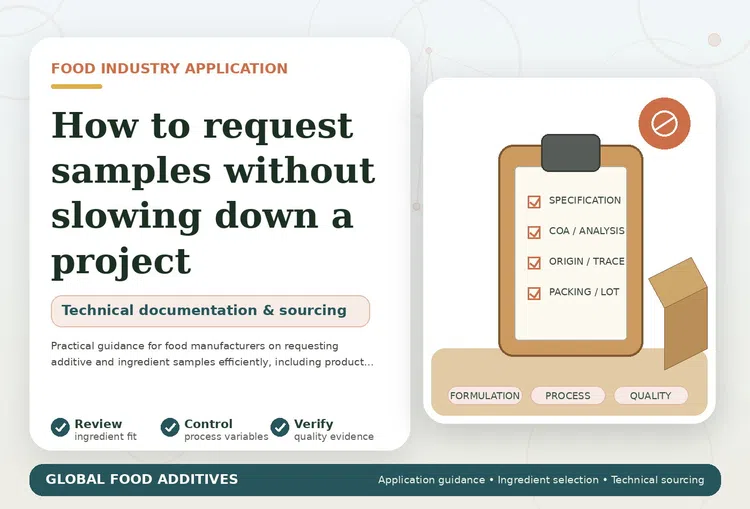
Application context
Sample requests often involve several teams at once. Product developers need enough material for laboratory or pilot trials, quality teams need technical documents, procurement teams need commercial information and logistics teams need accurate shipping details.
Delays commonly occur when the request identifies only a broad product name without explaining the intended function, application or target specification. Many food additives are available in different purities, concentrations, particle sizes, carriers, viscosity grades or packaging formats, so the supplier may not know which version should be sampled.
A useful request should connect the sample to the complete project: food category, formulation objective, processing conditions, destination market, required documents, trial timing and possible commercial demand. This allows technical and commercial suitability to be reviewed before the sample is dispatched.
Information to include in the first request
- Exact product name or target function: provide the known product name, additive category or required function, such as thickening, preservation, emulsification, colour adjustment or mineral fortification.
- Food application: identify the intended product, such as a dairy beverage, bakery mix, sauce, confectionery product, meat preparation or supplement.
- Target specification: include relevant purity, viscosity, concentration, particle size, colour, origin or microbiological requirements.
- Processing conditions: mention important factors such as pH, heat treatment, hydration temperature, mixing order, freezing, baking or retorting.
- Destination market: state the country where the finished food will be manufactured, sold or imported.
- Project stage: explain whether the sample is for initial screening, formulation development, pilot production, customer approval or supplier replacement.
- Commercial expectation: provide an estimated annual or order volume where possible so the supplier can confirm availability and suitable packaging.
Choose a realistic sample quantity
The sample quantity should match the planned evaluation. A small laboratory screening may require only a limited amount, while repeated trials, shelf-life studies or pilot-scale production may require a larger sample.
- Estimate the dosage per batch and the number of planned trials.
- Include enough material for control, repeat and optimization tests.
- Allow for analytical checks or customer samples where required.
- State whether the sample will be used in laboratory, pilot or factory equipment.
- Avoid requesting a large quantity without explaining the testing purpose.
Where the required quantity is unusually large, the supplier may treat the request as a trial order rather than a free sample. Clarifying this early can prevent delays caused by later discussions about sample cost, freight or customs paperwork.
Request documents at the same time
Technical approval can be delayed when samples arrive before the supporting documents. Buyers should identify the required document set in the initial request so the quality team can begin reviewing the product while the sample is in transit.
- Current product specification or technical data sheet
- Typical or batch-specific certificate of analysis, where available
- Safety data sheet where applicable
- Ingredient, composition or carrier information where relevant
- Country of origin and manufacturing-site information
- Shelf-life and storage guidance
- Allergen, GMO, halal, kosher or gluten declarations where required
- Regulatory or food-use statement for the destination market
- Packaging information and available commercial pack sizes
The product name and grade shown on the documents should match the sample label. If a temporary laboratory label or internal code is used, the supplier should make the relationship to the commercial product clear.
Prepare complete shipping information
International sample shipments can be delayed by incomplete consignee details, unclear product descriptions or missing import instructions. The receiving company should confirm whether samples can be delivered directly or must pass through a nominated customs broker, purchasing office or laboratory.
- Provide the full company and recipient name.
- Include a complete delivery address, postal code and telephone number.
- State the recipient’s email address for courier notifications.
- Confirm whether a tax, importer or registration number is required.
- Explain any preferred courier account or shipping instruction.
- Confirm whether the shipment requires a pro forma invoice or special declaration.
- Identify any temperature, moisture or light-protection requirements.
Define the evaluation plan before the sample arrives
A sample creates value only when the receiving team knows how it will be tested. Product development and quality teams should agree on the trial formula, process, comparison standard and acceptance criteria before the material is delivered.
- Identify the current product or control sample used for comparison.
- Define the starting use level and any planned dosage range.
- Confirm the mixing order, temperature and processing conditions.
- List the technical measurements and sensory observations to be recorded.
- Include shelf-life or stability checks where the function develops over time.
- Record the sample lot number and exact product grade used in each trial.
- Set an internal date for reviewing and communicating the results.
Useful acceptance criteria may include target viscosity, colour, flavour, texture, yield, stability, process tolerance, label compatibility or cost-in-use. A clear test plan also helps suppliers respond more effectively if the first trial does not meet the target.
Follow up with useful results
Suppliers can provide better technical support when trial feedback is specific. Instead of reporting only that a sample “worked” or “did not work,” describe the dosage, process conditions and observed result.
- Confirm whether the sample dispersed and processed as expected.
- Report any differences in viscosity, colour, flavour, texture or stability.
- Explain whether the result was too weak, too strong or otherwise unsuitable.
- Share relevant measurements and photographs where appropriate.
- State whether a different grade, dosage or process recommendation is required.
- Confirm the next decision date and expected commercial quantity if approved.
Common causes of sample-project delays
- Unclear product identity: the request uses a generic name without a grade, function or specification.
- Missing documents: the quality team cannot approve the sample because required declarations were not requested.
- Incorrect quantity: the amount sent is insufficient for the planned trials or unnecessarily large for initial screening.
- Incomplete address: the courier or customs team cannot identify the correct consignee or importer.
- No testing schedule: the sample arrives but remains unused while equipment, raw materials or staff are unavailable.
- No feedback: the project pauses because the supplier does not know whether a revised grade or commercial quotation is needed.
Related quality and procurement support
This topic is commonly connected to Quality & Procurement. Efficient sample coordination usually requires review of the following areas:
- Exact product and grade identification
- Application and target-function description
- Suitable sample quantity
- Technical and regulatory document availability
- Courier, customs and consignee information
- Testing schedule and acceptance criteria
- Commercial volume, packaging and lead time
- Trial feedback and next-step communication
How to turn this topic into an inquiry
Send the article title, requested product or function, food application, target specification, sample quantity, destination country, full delivery details, required documents and preferred shipment timing.
It is also useful to include the project stage, planned test date, expected commercial quantity and whether the sample is intended to replace an existing grade.
If you have a current supplier specification, certificate of analysis, product label or target document checklist, include the key details so the most appropriate sample can be identified and prepared.