
Quality-control questions for phosphate deliveries
This practical article helps meat and seafood manufacturers connect receiving inspection, batch documentation and application requirements with phosphate identity, specification limits, packaging condition, supplier controls and storage practices.
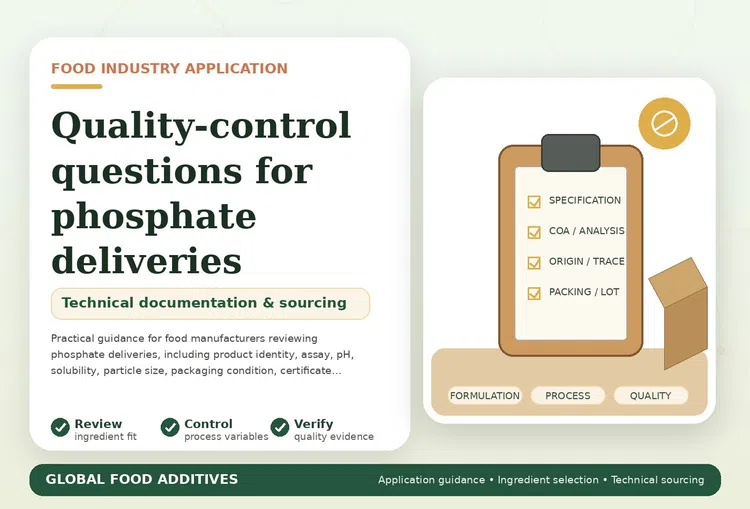
Application context
Quality control for phosphate deliveries should begin with the exact product identity and intended application. Sodium, potassium and calcium phosphates, as well as blended phosphate systems, can differ in pH, solubility, buffering capacity, mineral contribution and performance in meat or seafood processing.
A delivery should not be approved only because the product name appears correct. The receiving team should compare the label, batch number, supplier, manufacturing site, specification, certificate of analysis and packaging condition with the approved purchasing information.
Small differences in phosphate composition, hydration state, particle size or blend ratio may influence dissolution speed, brine clarity, water binding, protein extraction, yield, texture and flavour. Change control is therefore important when suppliers, grades or manufacturing sites are updated.
Receiving and packaging checks
- Product name and grade: confirm that the delivered phosphate or blend matches the purchase order and approved specification.
- Batch traceability: record the batch or lot number and compare it with the certificate of analysis.
- Packaging integrity: inspect bags, liners, drums or other containers for tears, moisture, contamination or broken seals.
- Label details: review net weight, manufacturer, production date, expiry or retest date and storage instructions.
- Physical appearance: check colour, powder condition, caking, visible foreign matter and unusual odour.
- Transport condition: investigate signs of water exposure, excessive heat, damaged pallets or unsuitable co-loading.
- Quantity verification: confirm delivered units, bag weights and pallet counts against the shipping documents.
- Document consistency: ensure the product description is consistent across the label, invoice, packing list and certificate.
Specification and certificate review points
- Assay or phosphate content: confirm that the batch result is within the approved range.
- Identity: verify the chemical form or blend composition against the product specification.
- pH: review the stated test concentration and method because pH results depend on sample preparation.
- Loss on drying or moisture: confirm limits that may affect flow, storage stability and concentration.
- Particle size: assess whether the grade will disperse and dissolve appropriately in the intended process.
- Insoluble matter: review limits where brine clarity, injection equipment or visible residue are important.
- Heavy metals and impurities: confirm the relevant purity limits and test methods for the destination market.
- Microbiological criteria: review any applicable limits, particularly for blended or carrier-containing products.
Incoming testing, handling and storage
Incoming testing should follow a documented, risk-based plan. Some manufacturers verify only identity and packaging for approved suppliers, while others perform additional testing such as pH, moisture, solubility, sieve analysis or assay depending on product risk and supplier history.
Sampling should be conducted with clean, dry equipment and a procedure designed to obtain a representative sample. Sample containers should be labelled with the product name, batch number, date and sampler identity.
Phosphate solubility tests should use a consistent water temperature, concentration, mixing time and observation method. Differences in test conditions can make results difficult to compare between batches or suppliers.
Storage areas should remain dry, clean and protected from water, condensation and strong odours. Opened bags should be resealed or transferred to suitable closed containers to reduce moisture uptake and contamination.
Information commonly recorded during incoming control
- Supplier, manufacturer and manufacturing site.
- Product name, grade and approved specification number.
- Batch number, production date and expiry or retest date.
- Packaging type, seal condition and pallet condition.
- Appearance, caking, odour and foreign-matter observations.
- Certificate results and specification comparison.
- Incoming test results and test methods.
- Release, quarantine or rejection decision.
Documents and quality checks
Before confirming an order, buyers commonly review a current product specification or technical data sheet, certificate of analysis, safety data sheet where applicable, food-grade declaration, country of origin, shelf-life statement, storage conditions, label details and packing information.
For blended phosphates, the buyer should understand whether the composition is fixed or adjusted within an approved range. Carriers, anti-caking agents or secondary ingredients should be identified where they affect labelling, performance or regulatory review.
Additional declarations may be required depending on the destination market and customer standard. These can include allergen, non-GMO, halal, kosher, vegan, irradiation, heavy-metal and raw-material-origin statements.
Questions to ask during supplier qualification
- What is the exact chemical identity or blend composition?
- Which parameters are tested on every production batch?
- Which test methods are used for assay, pH and solubility?
- Are particle-size and insoluble-matter limits controlled?
- How are out-of-specification results investigated?
- How are changes to composition, site or process communicated?
- What storage conditions and shelf life are recommended?
- Which destination-market declarations are available?
Related quality and procurement support
Phosphate receiving control is connected to the complete supplier-approval, application and traceability process. Common review areas include:
- Exact phosphate identity, hydration state or blend composition.
- Approved specification and certificate-of-analysis limits.
- Application pH, solubility and dissolution requirements.
- Particle size, flowability and caking tendency.
- Packaging, liner and moisture-protection requirements.
- Batch traceability and retained-sample procedures.
- Food-grade, origin and destination-market declarations.
- Supplier change-control and complaint-handling procedures.
How to turn this topic into an inquiry
To receive a more useful quotation, send the phosphate name or blend, intended meat or seafood application, target function, required specification, expected quantity, destination country, packaging preference and delivery timing.
Include any required limits for assay, pH, solubility, particle size, moisture, insoluble matter, heavy metals and microbiological quality.
If you have a current supplier specification, certificate of analysis, incoming-control checklist or batch concern, include the relevant details so product and documentation options can be compared more accurately.