
Supplier qualification checklist for food manufacturers
Supplier qualification helps food manufacturers reduce quality, regulatory, food-safety and supply-continuity risks before commercial purchasing begins. This practical checklist covers the supplier, manufacturing site, product specification, documentation, logistics and ongoing performance.
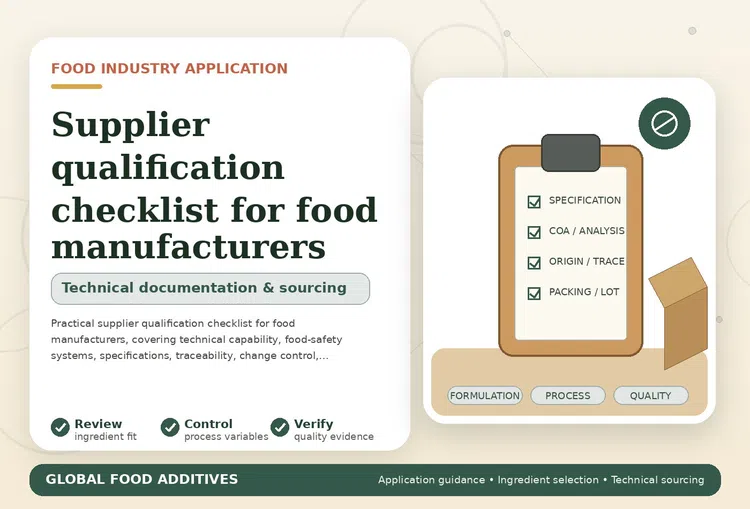
Application context
Supplier qualification should be completed before a new ingredient, additive, processing aid or packaging-related material is approved for routine production. The review should confirm that the supplier can consistently provide the correct product, from the approved manufacturing site, with suitable quality controls and documentation.
The qualification process should consider more than unit price. Product failure, delayed delivery, incomplete documents, undeclared changes or unsuitable regulatory status can create production interruptions, customer complaints, rejected shipments or recalls.
Supplier approval is normally a shared responsibility. Procurement may assess commercial and logistics capability, while quality, regulatory and technical teams review specifications, food-safety controls, legal suitability and application performance.
Start with a risk classification
A risk-based process allows manufacturers to apply more detailed controls to critical materials and simpler controls to lower-risk purchases. Risk classification may consider the ingredient function, likelihood of contamination, use level, allergen status, country of origin, supply-chain complexity and whether the material receives a later kill step.
- High-risk or critical materials: may require a detailed questionnaire, current certification, audit review, product testing and formal approval by several departments.
- Medium-risk materials: may require specification review, certificates, supplier questionnaire, samples and defined monitoring.
- Lower-risk materials: may be approved through a simplified document and identity review, depending on company procedures.
The risk rating should be documented and reviewed when the product, supplier, manufacturing site, destination market or intended use changes.
Supplier qualification points
1. Supplier identity and legal status
- Confirm the full legal company name, registered address and contact details.
- Identify whether the company is the manufacturer, distributor, trader or authorized agent.
- Record the exact manufacturing site and warehouse locations.
- Confirm business registration, tax information and export capability where relevant.
- Check how long the supplier has handled the product category.
2. Manufacturing and technical capability
- Confirm that the site can manufacture the required grade and specification.
- Review production capacity, batch size and normal lead time.
- Ask whether the product is routinely manufactured or made only against order.
- Review process controls for weighing, mixing, drying, milling, blending and packing as applicable.
- Confirm how rework, carryover and cross-contamination risks are controlled.
- Ask how critical parameters and finished-product release decisions are documented.
3. Food-safety and quality systems
- Request current food-safety or quality-management certificates where applicable.
- Confirm the certified company name, site address, scope and expiry date.
- Review whether the certification scope includes the exact product category.
- Check the supplier's hazard analysis, foreign-body controls and sanitation program.
- Review pest control, environmental monitoring and personal hygiene controls where relevant.
- Ask how nonconforming products, deviations and corrective actions are managed.
4. Product specification and consistency
- Agree a written specification before the first commercial order.
- Include identity, assay, physical properties, microbiological limits and contaminants as relevant.
- Confirm test methods, units and acceptance limits.
- Review typical values as well as formal minimum and maximum limits.
- Check whether particle size, colour, viscosity, solubility or bulk density affect production performance.
- Define how out-of-specification results and retesting are handled.
5. Traceability and recall readiness
- Confirm that each shipment is linked to a unique batch or lot number.
- Review traceability from incoming raw materials to finished product and shipment.
- Ask whether the supplier performs mock recall or traceability exercises.
- Confirm the expected time needed to provide traceability records.
- Record emergency, complaint and recall contact details.
6. Allergen and cross-contact controls
- Request a current allergen declaration for the exact product and site.
- Review intentionally added allergens and potential cross-contact risks.
- Confirm cleaning, scheduling and verification procedures.
- Check whether allergen statements are consistent across specification, label and certificate documents.
- Review customer-specific allergen restrictions before approval.
7. Origin and supply-chain transparency
- Confirm the country of manufacture and, where required, raw-material origin.
- Identify brokers, subcontractors, repackers or external warehouses in the supply chain.
- Ask whether the manufacturing site or raw-material source may change without notice.
- Review supply-chain length and vulnerability to substitution or fraud.
- Confirm whether origin statements can be supported by documentation.
8. Regulatory and market suitability
- Confirm that the product is suitable for the intended food category and destination market.
- Review ingredient naming, additive status and identification numbers where applicable.
- Check maximum use levels, purity criteria and customer restrictions.
- Request GMO, irradiation, nanomaterial or processing-aid statements where relevant.
- Confirm whether halal, kosher, vegan, vegetarian or other certifications are required.
- Review any import, customs or market-specific documentation needs.
Documents and quality checks
The exact document set depends on product risk and destination market. Buyers should request current, legible and product-specific documents rather than generic corporate brochures.
- Product specification or technical data sheet.
- Recent representative certificate of analysis.
- Safety data sheet where applicable.
- Ingredient composition and carrier declaration.
- Allergen and cross-contact statement.
- Country-of-origin and manufacturing-site information.
- Food-safety and quality certificates.
- GMO, irradiation and nanomaterial declarations where required.
- Halal, kosher, vegan or other certification where relevant.
- Shelf-life, storage and transport guidance.
- Packaging specification and pallet information.
- Microbiological, contaminant and heavy-metal limits where relevant.
Document dates and expiry periods should be recorded. A system should be established to obtain renewed certificates and updated declarations before existing documents expire.
Sample and trial approval
Document approval does not confirm application performance. A representative sample should normally be evaluated before commercial purchase, especially where the ingredient affects texture, colour, flavour, solubility, yield or shelf life.
- Confirm that the sample represents the intended commercial grade and manufacturing site.
- Record the sample lot number and production date.
- Compare key analytical and physical properties with the current material.
- Complete laboratory or pilot-scale application trials.
- Check processing behaviour, sensory performance and finished-product stability.
- Retain approved reference samples where appropriate.
Audit and questionnaire review
A supplier questionnaire can provide structured information on quality systems, production controls, traceability and regulatory status. Higher-risk suppliers may also require a remote or on-site audit.
Audit decisions should consider product risk, certification status, supplier history, customer requirements and the ability to verify critical controls through documentation. Any findings should have agreed corrective actions, responsible persons and completion dates.
Change-control expectations
Suppliers should notify customers before changes that may affect product quality, legality, labelling or application performance. The notification period and change categories should be agreed during qualification.
- Manufacturing-site changes.
- Raw-material source or country-of-origin changes.
- Specification or analytical-method changes.
- Ingredient, carrier or processing-aid changes.
- Packaging, shelf-life or storage changes.
- Certification or regulatory-status changes.
- Significant process or equipment changes.
Major changes may require new documents, samples, validation trials or formal reapproval before the revised product is accepted.
Commercial and supply review
Technical approval should be supported by a clear commercial assessment. Low unit price may not provide good value if the supplier cannot meet lead time, quantity, documentation or delivery requirements.
- Minimum order quantity and standard pack size.
- Price basis, currency and price-validity period.
- Production and documentation lead time.
- Incoterm, freight responsibility and delivery location.
- Payment terms and credit requirements.
- Normal stock availability and safety-stock options.
- Remaining shelf life required at delivery.
- Alternative manufacturing sites or business-continuity arrangements.
- Complaint, return and replacement procedures.
Packaging and logistics review
Packaging should protect the material through storage and transport. The supplier should confirm the package material, closure, net weight, pallet pattern and any special handling conditions.
- Check food-contact suitability of inner packaging.
- Confirm tamper evidence and lot identification.
- Review moisture, oxygen, light and odour protection where relevant.
- Check whether packaging is suitable for stacking and international transport.
- Confirm temperature or humidity limits during shipment.
- Review container loading and pallet-treatment requirements.
Ongoing supplier monitoring
Qualification is not a one-time activity. Approved suppliers should be monitored using measurable quality, service and compliance indicators.
- On-time and in-full delivery performance.
- Specification and certificate accuracy.
- Incoming inspection or laboratory results.
- Complaint frequency and severity.
- Response time and corrective-action quality.
- Documentation renewal and change notifications.
- Audit findings and certification status.
- Price stability, lead time and supply continuity.
Poor performance may lead to increased testing, corrective-action requests, conditional approval, audit, temporary suspension or removal from the approved-supplier list.
Supplier approval outcome
The final decision should be documented clearly. Approval status may include approved, conditionally approved, trial-only, restricted to a particular grade or site, suspended or rejected.
The approval record should identify the product, supplier, manufacturer, site, approved specification, supporting documents, review date, responsible approvers and any special purchasing conditions.
Related quality and procurement topic
This article belongs to the Quality & Procurement application group. The same qualification principles can be adapted for food additives, ingredients, cultures, enzymes, proteins, colours, sweeteners, processing aids and packaging-related materials.
A consistent supplier approval process supports product quality, regulatory compliance, traceability and supply continuity across the complete purchasing portfolio.
How to turn this topic into an inquiry
Send the article title, product name, target specification, application, quantity, destination country, required certifications, documentation requirements, preferred packaging and shipment timing.
Useful inquiry information may include:
- Exact product and grade required.
- Target specification and critical quality limits.
- Food application and intended use level.
- Required manufacturer or country of origin.
- Allergen, GMO, halal, kosher or other restrictions.
- Required food-safety and quality certificates.
- Minimum remaining shelf life at delivery.
- Order quantity, destination and preferred delivery term.
If you have a supplier questionnaire, approved specification, document checklist or current certificate of analysis, include the relevant requirements so potential suppliers can be compared more accurately.