
Traceability expectations from batch to shipment
Effective traceability connects the manufacturer’s production batch with product labels, certificates, warehouse records and final shipment documents. This practical guide outlines the information food manufacturers and buyers should expect when sourcing food additives and ingredients.
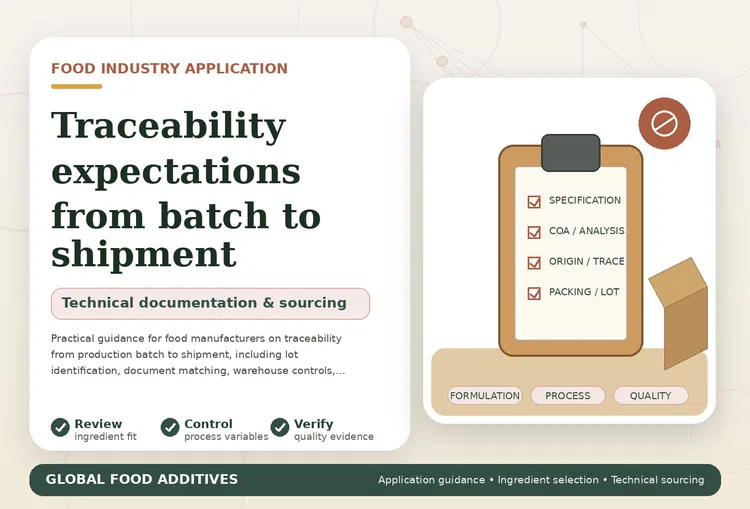
Application context
Traceability allows a food business to identify where a material came from, which production batch was supplied, how it was handled and which customer or destination received it. For food additives and ingredients, this connection should remain clear from manufacturing through packing, storage, order preparation and shipment.
A reliable traceability system supports routine receiving checks, investigation of quality complaints, stock control, supplier review and product recall procedures. It also helps buyers confirm that the certificate of analysis and other documents relate to the exact material delivered.
Traceability is not created by one document alone. It depends on consistent identifiers across the supplier’s production records, package labels, certificates, warehouse system and commercial shipping documents.
Batch and lot identification
A batch or lot number is the main link between a physical product and its manufacturing history. The format may vary by supplier, but it should uniquely identify a defined quantity produced or packed under controlled conditions.
The supplier should be able to use this identifier to retrieve relevant information such as production date, raw-material records, quality-control results, packaging activity and release status. If a product is repacked, relabelled or consolidated, the relationship between the original manufacturing lot and the new packing lot should remain documented.
- Product identity: product name, grade and manufacturer product code.
- Lot identifier: a unique batch or lot number shown clearly on each package.
- Manufacturing information: production, packing or release date where applicable.
- Shelf-life information: expiry, best-before or retest date according to the product system.
- Quantity: package count, package weight and total quantity assigned to the lot.
- Site identification: manufacturing or packing location where more than one facility may supply the product.
Package and pallet traceability
Individual bags, drums, cartons or intermediate bulk containers should carry enough information to identify the product and lot without relying solely on an outer pallet label. Labels should remain readable throughout normal storage and transport.
Pallet labels may summarize product code, lot number, package count, net weight and pallet number. When a pallet contains more than one lot, the different lots and corresponding quantities should be clearly separated in warehouse and shipment records.
- Confirm that every package carries the approved product and lot identification.
- Check that labels are secure, legible and protected from normal handling damage.
- Avoid mixing unidentified or differently labelled packages on the same pallet.
- Record any repacking, relabelling, damaged packaging or partial-pallet activity.
- Maintain the link between package-level and pallet-level identifiers.
Traceability review points
- Supplier identity: confirm the legal supplier, manufacturer and manufacturing site where relevant.
- Product consistency: verify that quotations, purchase orders, labels and certificates use the same product name and code.
- Lot matching: confirm that the certificate of analysis refers to the exact lot shipped.
- Quantity reconciliation: compare ordered, packed, dispatched and received quantities.
- Warehouse movement: maintain records for receipt, storage location, picking and dispatch.
- Split shipments: document when one production lot is divided across several deliveries or customers.
- Mixed-lot shipments: identify the quantity and package numbers associated with each lot.
- Change control: record changes in manufacturer, production site, grade, packaging or product code.
- Record retention: retain traceability and quality records for an appropriate period based on shelf life and company requirements.
Warehouse and order-picking controls
Traceability can be weakened after manufacturing if warehouse records do not accurately capture receipts, internal movements and dispatches. Each inbound lot should be recorded before the product is released for picking.
Warehouse systems should allow staff to identify the current location and status of each lot. Where first-expired, first-out or another stock-rotation method is used, the chosen lot should still match customer requirements for remaining shelf life and documentation.
- Record the received supplier lot and internal receipt reference.
- Identify quarantine, approved, rejected or blocked stock status.
- Maintain storage-location records for each lot.
- Document stock transfers, repacking or sampling activity.
- Verify the selected lot before loading or dispatch.
- Retain dispatch records showing which customer received each lot.
Documents and quality checks
Shipment documents should collectively create a clear link between the commercial order and the physical product. The required document set depends on the product, destination market, delivery term and customer standard.
- Product specification: identifies the approved product, grade and quality limits.
- Certificate of analysis: reports batch-specific analytical results or conformity.
- Packing list: identifies package count, weights, lot numbers and shipment configuration.
- Commercial invoice: states the sold product, quantity and commercial transaction details.
- Transport document: records the carrier, shipment reference and transport route.
- Origin documents: identify product origin where required for import or customer approval.
- Health or regulatory certificates: may be required for certain products or destinations.
- Temperature records: may be needed for products requiring controlled storage and transport.
The certificate of analysis should identify the same product code and lot number shown on the package. If a shipment includes several lots, the supplier should provide a certificate for each lot or a document that clearly separates the results and quantities.
Traceability during transport
Transport records should identify when and where the shipment was loaded, the carrier or container used and the destination. Seal numbers may be recorded for full-container or sealed-trailer shipments to support shipment integrity.
Where temperature, humidity or special handling conditions apply, the transport arrangement should be appropriate to the product specification. Any delay, damage, seal discrepancy or exposure event should be documented and reviewed before product acceptance.
Receiving checks at destination
The receiving team should verify the delivered material before it is released into usable stock. Physical labels, documents and purchase-order details should agree.
- Confirm supplier, product name, grade and product code.
- Match lot numbers to the certificate of analysis and packing list.
- Check package count, net weight and total quantity.
- Inspect packaging for damage, moisture, contamination or tampering.
- Review manufacturing and expiry or retest dates.
- Confirm the required remaining shelf life.
- Record any discrepancy before the product is used or distributed.
Recall and traceability testing
Traceability systems should be tested periodically rather than reviewed only during an actual incident. A mock traceability exercise can check whether the business can identify the origin, location and distribution of a selected lot within an appropriate time.
The exercise should reconcile the quantities received, held, used, repacked, returned and shipped. Unexplained quantity differences or missing records should be investigated and corrected.
Related quality and procurement topic
This article belongs to the Quality & Procurement application group. The same traceability principles apply across acidulants, preservatives, sweeteners, emulsifiers, hydrocolloids, colours, enzymes, nutrients, proteins and processing aids.
Traceability expectations should be included in supplier approval, purchase specifications, receiving procedures, warehouse controls, complaint handling and recall planning.
How to turn this topic into an inquiry
Send the exact product name, grade, quantity, destination country, packaging preference, required remaining shelf life and document requirements. State whether lot numbers must appear on the certificate of analysis, packing list, invoice or other shipment records.
Useful inquiry information may include:
- Manufacturer and product code requirements.
- Whether single-lot supply is preferred or required.
- Required batch-specific analytical results.
- Package-level and pallet-level label expectations.
- Minimum remaining shelf life at delivery.
- Origin, health, regulatory or certification documents.
- Temperature-control or transport-monitoring requirements.
- Preferred package size, order quantity and shipment timing.
If you have a current certificate of analysis, packing list, package label or traceability questionnaire, include the key details so the supplier can confirm compliance before shipment.