
Acetic Acid
Acetic Acid is a food-grade acidulant and acidity regulator used by food manufacturers for pH control, pickling, curing, vinegar-style acidity, flavor balance, preservative-system support, buffering and process stability. It is a key organic acid in condiments, relishes, sauces, dressings, marinades, prepared foods and acidic preservation systems. Because acetic acid can be supplied as glacial material, diluted food-grade solution, fermentation-derived acid or vinegar-style ingredient, industrial buyers should define both the chemical specification and the intended food use before requesting quotations. This page is prepared for purchasing, R&D, quality assurance and regulatory teams that need a practical starting point for grade selection, supplier comparison, specification review, document collection and quotation requests.
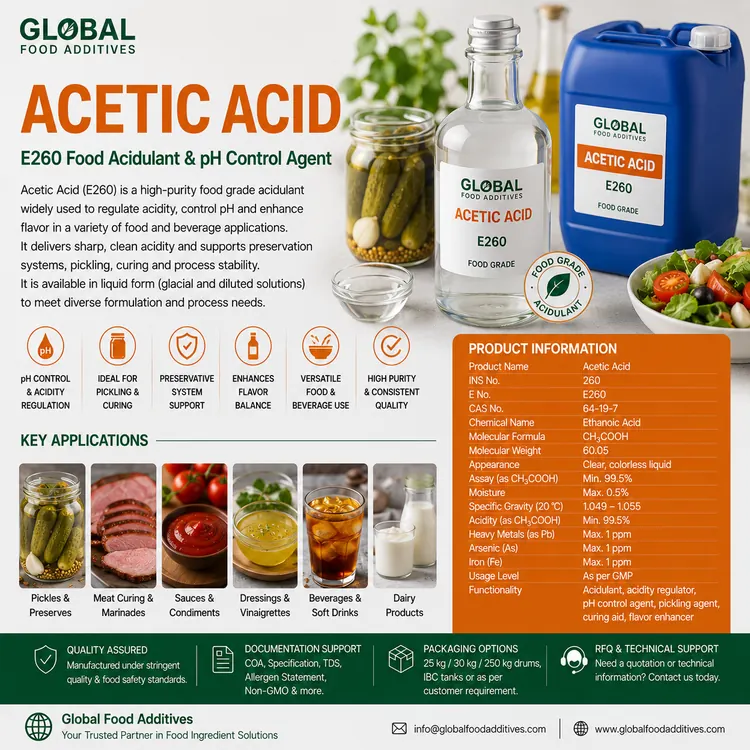
Product identity
| Product | Acetic Acid |
|---|---|
| Also known as | Ethanoic acid, E260, INS 260, vinegar acid |
| Category | Acidulants & Acidity Regulators |
| Function | Acidity regulator, acidulant, pH control agent, pickling agent, curing support, flavor enhancer and solvent / vehicle where permitted |
| E / INS number | E260 / INS 260; permitted use and declaration language must be verified by destination market |
| CAS / identity | 64-19-7 |
| Chemical formula | C2H4O2 |
| Chemical name | Ethanoic acid |
| Typical form | Glacial acetic acid, aqueous solution, diluted food-grade solution, fermentation-derived liquid or vinegar-based ingredient |
| Industrial selection basis | Concentration, assay, source route, odor profile, food-grade status, packaging compatibility, regulatory status, purity and required documentation |
Application fit
Potential use areas may include:
- Pickles, relishes, condiments and acidified vegetables
- Sauces, dressings, marinades, ketchup-style systems and vinegar sauces
- Meat products, brines, curing systems and prepared protein applications
- Cheeses, dairy analogues and cultured-style products
- Beverage bases, acidified beverage systems and flavor solutions
- Baked goods, fillings, gravies, prepared meals and ready-to-eat foods
- Fats, oils, seasoning systems and flavor-carrier applications where permitted
Technical purchasing notes
Acetic Acid should be purchased by concentration, grade and intended application, not by product name only. Industrial performance depends on assay, water content, purity, odor, source route, packaging material, handling system, pH target, titratable acidity, food category, process conditions and destination-market rules. For purchasing teams, the most useful inquiry normally includes target concentration, glacial or diluted form, fermentation-derived or synthetic preference, food application, pH target, packaging size, annual quantity, destination country, delivery term and document requirements.
How Acetic Acid works in food systems
Acetic Acid contributes sourness, vinegar-like aroma, acidity and pH reduction. It is especially valuable in acidified foods because pH control affects flavor, microbial stability, preservative effectiveness, enzyme activity, color stability and shelf-life behaviour. In many products, acetic acid is not used alone; it may be balanced with salt, sugar, spices, vinegar, citric acid, lactic acid, malic acid, phosphates, preservatives or buffering salts to achieve a defined sensory and preservation target.
The effect of acetic acid depends on both pH and total titratable acidity. Two products can have a similar pH but different perceived sharpness, vinegar impact, sourness persistence and preservative effect because total acid concentration, buffering ingredients, salt, sugar, proteins, fats and flavor systems all influence performance. For this reason, product developers should evaluate Acetic Acid in the final formulation and not only in water.
Functional performance areas
- pH control: helps adjust acidity and finished-product pH within the required range.
- Pickling and curing support: contributes acidity in pickled vegetables, relishes, brines and cured-style systems.
- Flavor balance: provides vinegar-like sharpness, sourness and brightness in savory and acidic foods.
- Preservative-system support: helps create acidic conditions that can support microbial hurdle strategies when validated.
- Buffering design: can be used with acetate salts or other acids to shape pH and acidity profile.
- Solvent / vehicle role: may support selected flavor, extract or process applications where permitted.
- Process consistency: helps standardize acidity in industrial batches when concentration and dosing are controlled.
Critical formulation variables
- Target pH and total titratable acidity
- Acetic acid concentration and dosing accuracy
- Vinegar flavor target versus neutral acidification target
- Salt, sugar, fat, protein, spice and preservative system
- Food category, water activity, heat process and packaging format
- Interaction with colors, flavors, hydrocolloids, proteins and emulsifiers
- Packaging compatibility with acidic liquids
- Whether the buyer needs glacial acid, diluted acid, fermentation-derived acid or vinegar
- Local food additive permissions, category limits and declaration language
Application guidance by food category
| Food system | Potential technical role | Review points before approval |
|---|---|---|
| Pickles, relishes and acidified vegetables | Pickling acidity, pH control, sourness profile and preservation hurdle support | Final pH, brine strength, salt level, sugar level, heat process, vinegar declaration, packaging corrosion and shelf-life validation |
| Sauces, dressings and condiments | Acidity regulation, flavor balance, preservative-system support and vinegar-style character | Oil phase, emulsion stability, pH, titratable acidity, salt, sweetness, spice profile, preservative system and label declaration |
| Meat products and marinades | pH adjustment, flavor impact, marinade acidity and curing-style process support | Protein functionality, water holding, texture, salt, phosphate use, microbial validation, local meat regulations and sensory profile |
| Cheeses and dairy analogues | Acidity adjustment, flavor balance and pH control | Protein stability, mineral balance, texture, culture system, heat process, flavor impact and category-specific permission |
| Beverage bases and acidified drinks | pH correction, sourness design and flavor balancing | Acid profile, aroma impact, preservative system, color stability, carbonation, heat process and consumer taste acceptance |
| Baked goods and bakery fillings | pH adjustment, flavor support and process control | Leavening balance, dough or filling pH, flavor, moisture migration, bake stability and interaction with starches or gums |
| Gravies, prepared meals and ready-to-eat foods | pH control, flavor enhancement and shelf-life formulation support | Heat process, final pH, viscosity system, protein stability, packaging compatibility and sensory balance after storage |
| Fats, oils and flavor systems | Flavor balancing, acid vehicle or process support where suitable | Solubility, phase distribution, odor impact, packaging, oxidation control and local permitted-use status |
Industrial specification checklist
A complete Acetic Acid sourcing request should define measurable parameters. The same product name can refer to glacial acetic acid, a diluted solution, fermentation-derived acetic acid, vinegar, or an application-specific acid blend. Specification clarity helps purchasing and QA teams compare offers correctly and avoid concentration, source, labeling or handling mismatches.
Physical and chemical criteria
- Assay or acetic acid concentration by approved test method
- Identity confirmation and CAS number
- Appearance, color, odor and taste profile where relevant
- Density or specific gravity at stated temperature
- Water content for glacial or concentrated grades
- Nonvolatile residue or residue on evaporation
- Chloride, sulfate, iron or other impurity limits where specified
- Heavy metals, lead and arsenic limits according to destination-market requirements
- Residual solvent or process-route declarations where relevant
- Fermentation-derived, synthetic or vinegar-origin statement where required
Food safety and compliance criteria
- Food-grade statement and intended-use declaration
- E260 / INS 260 confirmation and local label-declaration guidance
- Certificate of analysis with lot-specific concentration
- Allergen statement and cross-contamination declaration
- GMO status and identity-preserved options where required
- Halal, kosher, vegan or other certification statements
- Country of origin, manufacturing site and traceability information
- Safety data sheet and transport classification information
- Packaging compatibility statement and shelf-life information
Concentration and grade selection
Acetic Acid concentration is a critical purchasing parameter. Glacial acetic acid is highly concentrated and requires careful dilution, corrosion-resistant handling and worker safety controls. Diluted food-grade acetic acid solutions can simplify dosing and reduce dilution error in some factories, but they increase freight volume and storage space. Vinegar and fermentation-derived acid ingredients may be required where the product concept, label, origin claim or customer specification demands a fermentation-based profile.
| Supply option | Why it may be selected | Purchasing and processing note |
|---|---|---|
| Glacial acetic acid | High active concentration, efficient freight and flexible dilution | Requires controlled dilution, corrosion-compatible equipment, trained handling and SDS-based safety procedures. |
| Diluted food-grade acetic acid | Simpler plant dosing and lower dilution risk | Confirm exact concentration, microbial suitability, packaging, shelf life and freight economics. |
| Fermentation-derived acetic acid | Useful when origin or process route matters to the customer | Request origin statement, production route declaration, certification and label-review support. |
| Vinegar or vinegar concentrate | Provides acetic acid plus vinegar flavor and consumer-recognizable positioning | Not identical to purified acetic acid; confirm acidity, flavor profile, color, source and legal definition in the target market. |
| Buffered acetate system | Useful where pH control and acidity profile need balancing | Evaluate sodium or potassium contribution, flavor impact, label declaration and regulatory status. |
pH, titratable acidity and preservation design
Acetic Acid is frequently used in acidic preservation systems, but it should not be treated as a stand-alone preservative without validation. Microbial safety and shelf life depend on final pH, undissociated acid level, water activity, salt, sugar, heat treatment, preservative system, packaging, hygiene, storage temperature and target organisms. For acidified foods, food safety teams should use validated processes, documented critical limits and appropriate regulatory review.
| Design target | Why Acetic Acid may be reviewed | Validation method |
|---|---|---|
| Pickling brine | Provides characteristic acid profile and pH reduction | Measure brine acidity, final equilibrium pH, salt, sugar, heat process and shelf-life stability. |
| Condiment preservation support | Helps establish acidic hurdle conditions | Confirm final pH, preservative efficacy, water activity and microbial validation. |
| Flavor balance | Provides vinegar-like sharpness and brightness | Run sensory panels against target products after processing and storage. |
| Protein marinade | Adjusts acidity and flavor impact | Check texture, water holding, purge, cooking yield and regulatory suitability. |
| Acidified sauce or dressing | Supports pH control and sourness design | Measure pH, titratable acidity, emulsion stability, viscosity and sensory profile. |
Comparison with other acidulants
| Ingredient | Why it may be compared | Selection note |
|---|---|---|
| Acetic Acid | Vinegar-like acidity, pickling function, curing support, pH control and savory flavor balance | Best suited when acetic profile, acidified preservation design or vinegar-style flavor is desired. |
| Citric Acid | Bright citrus-like acidity and broad pH adjustment use | Often selected for beverages, fruit systems and general acidification without vinegar flavor. |
| Lactic Acid | Milder dairy-like acidity and fermentation-style flavor | Useful in dairy, meat, sauces and fermented-style foods where softer acidity is preferred. |
| Malic Acid | Fruit-like sourness and longer-lasting tartness | Common in fruit beverages, confectionery and reduced-sugar systems. |
| Fumaric Acid | Strong acidulant with low solubility and delayed release | Reviewed for dry blends, bakery and sour coatings where slow dissolution is useful. |
| Adipic Acid | Controlled acid profile and selected dry-blend or leavening applications | Different from acetic acid in taste, solubility and application behaviour. |
| Phosphoric Acid | Strong acidulant often used in cola-style beverages | Liquid handling, mineral interaction and local regulatory status should be reviewed. |
U.S. food-use reference points
In the United States, 21 CFR 184.1005 lists Acetic Acid as a direct food substance affirmed as generally recognized as safe when used according to the regulation. The regulation identifies functions including curing and pickling agent, flavor enhancer, flavoring agent and adjuvant, pH control agent, solvent and vehicle, and boiler water additive where applicable. These values are useful technical reference points for U.S. projects, but they do not replace destination-market review for other countries.
| Food category reference | Listed maximum level, as served | Purchasing and formulation note |
|---|---|---|
| Baked goods | 0.25% | Confirm dough or batter pH, leavening interaction, flavor and local category permission. |
| Cheeses and dairy product analogues | 0.8% | Evaluate protein stability, flavor impact, pH and process conditions. |
| Chewing gum | 0.5% | Review flavor release, acidity profile, gum base compatibility and label declaration. |
| Condiments and relishes | 9.0% | Verify final pH, titratable acidity, preservative system, vinegar profile and sensory balance. |
| Fats and oils | 0.5% | Review phase distribution, odor impact, packaging compatibility and oxidation control. |
| Gravies and sauces | 3.0% | Evaluate pH, viscosity system, protein or starch stability and flavor after storage. |
| Meat products | 0.6% | Review meat regulations, texture, water holding, purge, microbial validation and sensory impact. |
| All other food categories | 0.15% or less | Use only after confirming the applicable category, target use and destination-market rules. |
Processing and handling notes
Acetic Acid performance depends on concentration, dilution method, addition point, mixing, pH target, temperature, packaging and the full formulation. In concentrated form, it must be handled as a corrosive liquid according to the supplier safety data sheet. In food formulation, it should be dosed with calibrated equipment and verified by pH and titratable-acidity checks. Strong local acid addition can destabilize proteins, emulsions, hydrocolloids or starch systems, so addition sequence and mixing intensity should be validated.
- Confirm whether the requirement is glacial acetic acid, diluted food-grade acetic acid, fermentation-derived acetic acid or vinegar.
- Use compatible tanks, pumps, gaskets, valves, closures and packaging materials for acidic liquid handling.
- Control dilution procedure carefully; add acid and water according to site safety procedures and supplier SDS guidance.
- Measure both pH and titratable acidity when flavor, preservation or acidified-food safety is important.
- Validate final pH after full mixing, heat processing, cooling and shelf-life storage.
- Check interaction with proteins, gums, starches, emulsifiers, colors, preservatives, minerals and flavor systems.
- For pickles and brines, confirm equilibrium pH after the acid has penetrated the food matrix.
- For concentrated grades, review ventilation, spill control, operator protection and transport classification.
Quality assurance and incoming inspection
For recurring supply, incoming quality control should confirm that every lot matches the approved supplier specification, regulatory file and trial-approved reference. Acetic Acid is a high-impact formulation ingredient because small concentration differences or dosing errors can change pH, flavor, preservative performance, corrosion risk and finished-product repeatability.
- Check product name, concentration, lot number, production date, expiry date and country of origin against the certificate of analysis.
- Confirm assay, density, residue, heavy metals and impurity values against the approved specification.
- Inspect packaging integrity, seal condition, leakage, odor, discoloration and transport damage.
- Confirm E260 / INS 260 reference and local declaration language against the approved regulatory file.
- Run internal concentration, pH or titratable-acidity checks where applicable.
- For fermentation-derived or vinegar-style materials, compare sensory profile and origin documentation against the approved reference.
- Keep retained samples and COA records for traceability, complaint handling and supplier performance review.
Regulatory and label review
Acetic Acid is associated with the E260 / INS 260 food additive reference, but permitted uses, maximum levels, food categories, purity criteria and label declaration depend on the destination market. Finished-product manufacturers should verify whether the ingredient is allowed in the intended food category and whether the correct local declaration is “Acetic Acid,” “E260,” “INS 260,” “ethanoic acid,” “acidity regulator,” “acidulant,” “pH control agent,” “flavoring agent,” “vinegar” or another market-specific wording.
For export projects, regulatory review should follow the country where the final food will be sold, not only the country where the ingredient is purchased. This is especially important for private-label products, acidified foods, pickled vegetables, meat products, child-oriented foods, vinegar-related claims, natural-origin claims, organic programs, retailer standards and multi-market label artwork.
Documents to request
- Product specification or technical data sheet with test methods
- Certificate of analysis for the available batch or lot
- Safety data sheet and corrosive-liquid handling guidance
- Food-grade statement and intended-use declaration
- Origin, manufacturer, production site and traceability information
- Shelf-life, storage condition and retest-date information
- Allergen, GMO, gluten, halal, kosher, vegan and other declarations where required
- Assay / concentration, density, residue and impurity data
- Heavy-metal declaration, including lead and other required metals
- Residual solvent or process-route statement where required
- Fermentation-derived, synthetic or vinegar-origin declaration where required
- Label declaration guidance and E / INS number confirmation
- Packaging details, net weight, pallet configuration and container loading estimate
- Transport classification, UN number or dangerous-goods documentation where applicable
- Market-specific declarations required by the destination country
Packaging, logistics and storage
Acetic Acid may be supplied in drums, IBCs, cans, jerrycans, tankers or diluted food-grade solution packaging depending on concentration, supplier and destination. Industrial buyers should confirm net weight, active concentration, packaging material, closure system, palletization, leak protection, temperature limits, shelf life at dispatch, dangerous-goods classification, container loading quantity and whether the packaging format is suitable for acidic liquid handling in the receiving factory.
Supplier qualification workflow
- Define the application: food category, pH target, titratable acidity, flavor target, process, shelf life and destination market.
- Define the grade: glacial, diluted, fermentation-derived, synthetic, vinegar-based or customer-specific acid solution.
- Share the benchmark: existing specification, COA, sample, acid blend, formula note, label declaration or approved supplier reference.
- Screen documents: review TDS, COA, SDS, origin, allergen, GMO, certification, assay, purity and regulatory declarations.
- Run bench trials: evaluate pH, titratable acidity, sourness profile, vinegar note, flavor balance, preservation target and compatibility.
- Validate plant performance: test dosing, dilution, mixing, pH control, corrosion compatibility, packaging and shelf-life stability.
- Approve commercially: confirm final specification, packaging, lead time, minimum order quantity, incoterm and recurring documentation.
How to request this product
Send the product name, target concentration, grade or reference specification, intended application, quantity, destination country, packaging preference, expected shipment date, delivery term and required documents. If you already purchase Acetic Acid, attach or describe your existing specification, certificate of analysis, concentration, label declaration, pH target, acidity target, source-route requirement or benchmark sample so supplier options can be compared more accurately.
Useful answers
What is Acetic Acid used for in food manufacturing?
Acetic Acid is typically discussed for pH control, pickling, curing support, flavour balance, acidity regulation, preservative-system support, buffering and process stability. Exact suitability depends on concentration, grade, application, process conditions, dosage, regulations and supplier documents.
Is Acetic Acid the same as vinegar?
No. Vinegar contains acetic acid, water and other components depending on its source and fermentation process. Food-grade Acetic Acid E260 is the acid ingredient itself and may be supplied as glacial acetic acid or as a diluted solution. Buyers should specify whether they need purified acetic acid, fermentation-derived acid, vinegar or a vinegar-style blend.
Can Acetic Acid support preservation?
Acetic Acid can support preservation by lowering pH and contributing to acidic hurdle systems, especially in pickles, condiments, sauces and dressings. It should be validated with the full formulation, heat process, water activity, packaging and target shelf life.
Can Global Food Additives source Acetic Acid?
Global Food Additives can review sourcing options for Acetic Acid according to target concentration, grade, application, quantity, destination, packaging, delivery term and required documentation.
Which documents should be requested?
Buyers commonly request a technical data sheet or specification, certificate of analysis, safety data sheet, origin statement, shelf-life information, allergen and GMO declarations, assay or concentration data, impurity limits, label guidance, transport documentation and packing details.
Is this product permitted in every country?
No. Food additive use depends on destination-market rules, food category, use level, purity criteria, label requirements and buyer responsibility. Always verify local regulation before commercial use.
Tell us which food additive or ingredient you need.
Send product names, target specifications, quantity, destination country, packaging preference, delivery term, and document requirements. Our team will review your inquiry and respond from orders@foodgradeadditives.com.
Your message has been received. You will be redirected to the home page.