
Activated Carbon
Activated Carbon is a food-grade carbon material used by food and beverage manufacturers for adsorption, decolorization, purification, filtration, odor reduction, taste correction, removal of trace impurities, black colorant use where permitted, powder handling and dry-blend process support. It is not a generic commodity in technical applications: performance depends heavily on raw material source, activation method, pore structure, particle size, ash level, pH, surface chemistry and compatibility with the target food process. This page is prepared for purchasing, R&D, quality assurance and regulatory teams that need a practical starting point for grade selection, supplier comparison, specification review, documentation and quotation requests.
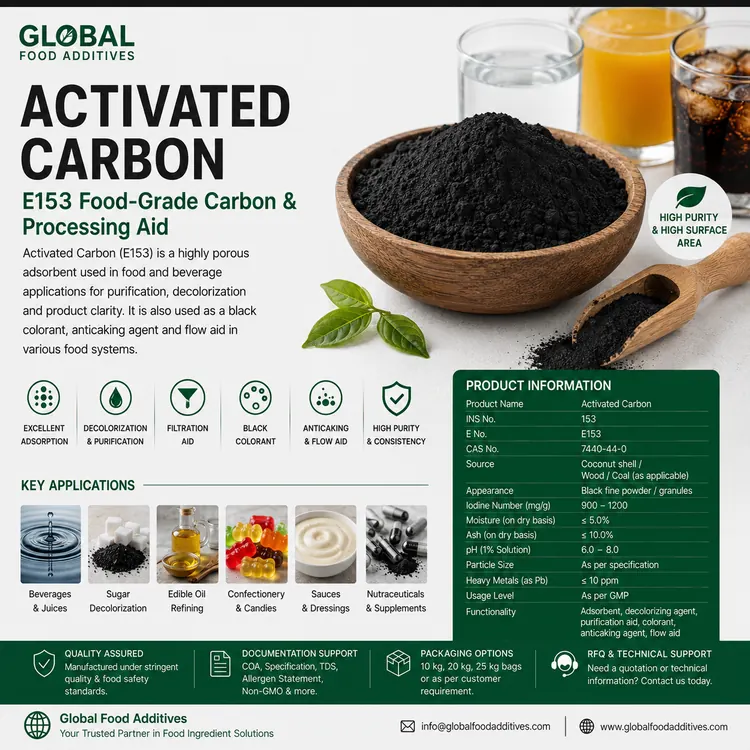
Product identity
| Product | Activated Carbon |
|---|---|
| Also known as | Activated charcoal, vegetable carbon, food-grade carbon, adsorption carbon |
| Category | Anticaking, Flow & Mineral Carriers |
| Function | Adsorption aid, decolorizing agent, purification aid, filtration aid, processing aid, black colorant where permitted and dry-blend handling support |
| E / INS number | E153 / INS 153; permitted use, colorant status and label declaration must be verified by destination market |
| CAS / identity | 7440-44-0 |
| Chemical nature | Porous carbon material with adsorption capacity controlled by pore structure, surface area and surface chemistry |
| Possible source materials | Coconut shell, wood, bamboo, peat, coal or other carbonaceous materials depending on grade and food-grade approval |
| Typical form | Powdered activated carbon, granular activated carbon, pelletized carbon, de-dusted grade or formulated carrier blend |
| Industrial selection basis | Iodine number, methylene blue value, molasses number, decolorizing power, particle size, pH, ash, moisture, dusting, filtration rate, purity and documentation |
Application fit
Potential use areas may include:
- Sugar syrups, glucose syrups and liquid sweetener purification
- Beverage bases, juices, wine, spirits and process-liquid polishing where permitted
- Edible oils, fats and specialty lipid purification
- Gelatin, hydrolysates, fermentation broths and protein-process liquids
- Flavor, extract and botanical purification or color adjustment
- Black-colored foods, confectionery, bakery decorations and specialty products where E153 is permitted
- Powdered beverages, premixes, seasonings, bakery mixes and dry-blend systems
- Tablet dusting, mineral carriers and dry manufacturing process support
Technical purchasing notes
Activated Carbon should be selected by adsorption performance and food-grade compliance, not only by product name. A carbon grade that performs well for decolorizing sugar syrup may not be the best grade for odor removal, oil purification, black coloration, dry-blend handling or powder-flow support. In industrial purchasing, the most useful inquiry normally includes application, target contaminant or color body, liquid or powder matrix, treatment dose, contact time, temperature, pH, filtration system, particle-size requirement, target regulatory market, packaging preference, quantity and required documentation.
How Activated Carbon works in food systems
Activated Carbon works mainly by adsorption. Its internal pore network and surface chemistry allow selected molecules to attach to the carbon surface. In food manufacturing, this can help remove color bodies, odor compounds, off-flavors, residual organics, trace process impurities, pigments or other adsorbable materials from liquids and process streams. The result depends on the size and chemistry of the target molecules, pore-size distribution, contact time, pH, temperature, mixing, dose and the presence of competing ingredients.
For colorant use, Activated Carbon or vegetable carbon may be used to deliver black, grey or dark visual effects in products where the ingredient is permitted and correctly declared. This is different from processing-aid use, where the carbon is normally removed by filtration and is not intended to remain in the finished product. Buyers should define the intended role clearly before requesting offers, because the correct specification, regulatory file and supplier qualification route can be different.
Functional performance areas
- Adsorption: removes selected color, odor, taste or organic compounds by surface interaction.
- Decolorization: helps polish syrups, extracts, gelatin, beverages and process liquids where technically suitable.
- Purification: supports removal of trace impurities or process residues according to validated process conditions.
- Filtration support: selected grades can be integrated into treatment and filter systems with controlled pressure drop.
- Colorant use: vegetable carbon grades may provide black color where permitted and correctly declared.
- Dry-blend handling: carbon-containing blends may be reviewed for flow, carrier and powder-processing functions.
Critical formulation and process variables
- Target function: adsorption, decolorization, odor control, colorant use, carrier use or flow support
- Liquid matrix, dry matrix or finished-food system
- Target compound size, polarity and concentration
- Contact time, mixing energy, treatment temperature and pH
- Carbon dosage, regeneration plan or single-use disposal route
- Powdered, granular or pelletized form requirement
- Filtration system, filter aid, pressure drop and carbon breakthrough risk
- Carry-over limits, final clarity, black color intensity or removal requirement
- Food additive, colorant or processing-aid status in the destination market
Application guidance by food category
| Food system | Potential technical role | Review points before approval |
|---|---|---|
| Sugar syrups and liquid sweeteners | Decolorization, odor reduction, trace impurity removal and polishing | Color-removal target, Brix, pH, contact time, carbon dosage, filtration rate, ash contribution and taste neutrality |
| Beverages and beverage bases | Color correction, off-note reduction, clarification and process-stream treatment | Flavor stripping risk, acidity, alcohol content where applicable, aroma retention, turbidity, filtration and regulatory use status |
| Edible oils and fats | Color-body removal, odor control and trace contaminant reduction support | Oil temperature, contact time, filterability, retention of desirable flavor compounds, oxidation risk and carbon removal |
| Gelatin and protein hydrolysates | Decolorization, deodorization and impurity adsorption | Protein loss, viscosity, pH, foam, filtration, ash, microbiological status and final sensory profile |
| Fermentation products and extracts | Broth polishing, pigment reduction and off-odor control | Active compound loss, yield impact, pH, competing organics, adsorption selectivity and process validation |
| Black foods and decorations | Black color, visual differentiation and dark decorative effect where permitted | Color intensity, particle fineness, dispersibility, mouthfeel, staining, declaration language and market approval |
| Dry mixes, seasonings and premixes | Carrier function, flow support, visual effect or dry handling support | Dusting, particle-size match, segregation, color transfer, caking, moisture pickup and operator handling |
| Tablets and compressed food formats | Coloring, dusting control, carrier effect or process support | Compression behaviour, flowability, black specking, uniformity, abrasion, tablet hardness and label status |
Industrial specification checklist
A strong Activated Carbon purchasing specification should describe both the carbon properties and the target use. For adsorption and decolorization applications, performance tests such as iodine number, methylene blue value, molasses number or application-specific color removal may be more useful than a generic carbon percentage. For colorant use, particle fineness, dispersibility, purity and regulatory status become especially important.
Physical and adsorption criteria
- Iodine number as an indicator of micropore adsorption capacity
- Methylene blue value for larger-molecule adsorption comparison
- Molasses number or decolorizing power where relevant
- BET surface area and pore-size distribution where available
- Particle-size distribution, fines level and dusting tendency
- Bulk density, tapped density and flowability
- Moisture content and volatile matter
- Ash content and acid-soluble ash
- pH, water-soluble matter and acid-soluble matter
- Filterability, sedimentation behaviour and pressure-drop performance
Food safety and compliance criteria
- Food-grade statement and intended-use declaration
- E153 / INS 153 confirmation where used as a permitted colorant
- Processing-aid statement where carbon is removed from the process stream
- Heavy metals, including lead, arsenic, cadmium and mercury where required
- PAH-related limits where required by customer or destination-market specification
- Dioxin, PCB or contaminant statements where relevant to source and market
- Microbiological limits or suitability statement for food processing
- Allergen, GMO, vegan, halal and kosher declarations where required
- Raw material source, activation method and country of origin
- Traceability, lot coding and change-control expectations
Adsorption performance selection
Activated Carbon is not equally effective for every target compound. Microporous carbons are often associated with adsorption of small molecules, while mesoporous or macroporous structures may be more suitable for larger color bodies and complex organic materials. For food applications, supplier screening should include an application test using the actual product stream whenever possible, because sugar, protein, fat, salts, acidity, viscosity and competing natural compounds can reduce adsorption efficiency.
| Selection target | Useful performance indicator | Practical validation |
|---|---|---|
| Small organic impurity removal | Iodine number and micropore structure | Measure target compound reduction before and after treatment under real process conditions. |
| Large color-body removal | Methylene blue value, molasses number or decolorizing index | Run color-removal tests in the actual syrup, extract, oil or process liquid. |
| Odor and off-flavor correction | Surface chemistry, pore distribution and sensory test results | Use trained sensory comparison to confirm off-note reduction without stripping desired aroma. |
| Fast filtration after treatment | Particle size, fines level, filterability and sedimentation | Check filtration rate, pressure rise, cake formation and final turbidity. |
| Black colorant use | Color intensity, particle fineness, dispersibility and purity | Evaluate shade, specking, mouthfeel, staining, homogeneity and label acceptance. |
Colorant use versus processing-aid use
Activated Carbon can appear in food projects under very different regulatory and technical roles. When used as a black colorant, the carbon is intentionally present in the finished product and must be permitted for the target food category and market. When used as a processing aid, the carbon is normally added during manufacture to adsorb unwanted compounds and then removed by filtration or separation. In this case, the buyer must validate removal, carry-over status, documentation and destination-market interpretation.
When used as a colorant
- Confirm E153 / INS 153 approval for the target market and food category.
- Confirm declaration wording, maximum level and claim restrictions.
- Evaluate particle size for smooth mouthfeel and uniform black color.
- Check color migration, staining and visual consistency during shelf life.
- Verify contaminant limits and purity criteria for direct food addition.
When used as a processing aid
- Define the compound or color body to be removed.
- Validate dose, contact time, pH, temperature and mixing conditions.
- Confirm removal method and filtration performance.
- Measure carry-over, final turbidity, sensory impact and yield loss.
- Maintain documentation for process validation, customer audits and regulatory review.
Comparison with related processing materials
| Material | Why it may be compared | Selection note |
|---|---|---|
| Activated Carbon | Adsorption of color, odor, taste and organic impurities | Best selected by target molecule, pore structure, dose, filtration behaviour and purity requirements. |
| Diatomaceous Earth | Filtration aid and solids removal | Useful for mechanical filtration but not equivalent to carbon adsorption. |
| Bentonite | Clarification and protein or haze reduction in selected beverages | Often reviewed for wine, juice or beverage clarification rather than broad organic adsorption. |
| Ion Exchange Resin | Removal of ionic species and mineral control | Better for ion-selective treatment; requires regeneration and resin-specific compliance. |
| PVPP | Polyphenol removal and beverage stabilization | Common in beverage processing but different from broad activated-carbon adsorption. |
| Silica Gel | Moisture control, clarification or adsorption in selected applications | Selection depends on polarity, target compound and regulatory status. |
| Calcium Silicate or Silicon Dioxide | Anticaking and flow support in powders | More typical for powder flow; not a substitute for decolorizing carbon. |
Processing and handling notes
Activated Carbon performance is highly process-dependent. Powdered grades offer fast adsorption because of high contact area, but they can generate dust and may require robust filtration. Granular grades can be used in beds or columns, but require attention to flow distribution, pressure drop, bed life and breakthrough. For direct colorant use, the grade must disperse evenly and must not create unacceptable grittiness, specking or staining.
- Define whether the carbon will remain in the finished food or be removed during processing.
- Run trials at the same pH, temperature, contact time, Brix, viscosity and mixing energy expected in production.
- Measure both target-compound removal and loss of desirable flavor, color, aroma or active compounds.
- Control carbon dose carefully to avoid over-treatment and unnecessary yield loss.
- Validate filtration, centrifugation or separation to prevent carbon carry-over where removal is required.
- For dry blends, check dusting, segregation, color transfer, caking and pack staining.
- For color applications, evaluate mouthfeel, shade, dispersion, black intensity and shelf-life appearance.
- Review SDS guidance, dust-control measures and operator protection for powder-handling areas.
Quality assurance and incoming inspection
For recurring supply, incoming quality control should confirm that every lot matches the approved supplier specification, regulatory file and trial-approved reference. Activated Carbon lots can differ in adsorption behaviour even when basic appearance is similar, so performance checks should be tied to the application. In a syrup plant, color reduction may be the key test; in a black-colorant application, shade, fineness and purity may matter more.
- Check product name, lot number, production date, expiry date and country of origin against the certificate of analysis.
- Confirm iodine number, methylene blue value, molasses number, ash, moisture, pH and particle size against the approved specification.
- Inspect packaging integrity, seal condition, odour, dust leakage, moisture exposure and foreign-material risk.
- Confirm E153 / INS 153 reference or processing-aid status against the approved regulatory file.
- Run an application-specific adsorption, decolorization or shade test when performance is critical.
- For filtration use, compare filterability and fines level against the approved reference sample.
- For direct food color use, check color strength, specking, mouthfeel and contaminant documentation.
- Keep retained samples for traceability, complaint handling and supplier performance review.
Regulatory and label review
Activated Carbon is associated with E153 / INS 153 where it is used as vegetable carbon or black food color in markets that permit that use. However, the exact permitted food categories, maximum levels, purity criteria, label declaration, carry-over rules and processing-aid interpretation depend on the destination market. Finished-product manufacturers should verify whether the ingredient is allowed in the intended food category and whether the correct declaration is “Activated Carbon,” “Vegetable Carbon,” “E153,” “INS 153,” “color,” “processing aid,” “filtration aid” or another market-specific wording.
For export projects, regulatory review should follow the country where the finished food will be sold, not only the country where the ingredient is purchased. This is especially important for products making natural-color, detox, charcoal, clean-label, vegan, organic, health-related or functional claims. Marketing claims around activated charcoal can be sensitive and should be reviewed separately from ingredient compliance.
Contaminant and purity review
Food-grade Activated Carbon should be reviewed carefully for contaminants because the raw material source and activation route can influence impurity profile. Buyers commonly request heavy-metal data, ash values, soluble matter, PAH-related information where required, microbiological suitability and statements covering the absence of non-food contamination. For direct food-color use, purity review is especially important because the carbon is intended to remain in the finished product.
| Review area | Why it matters | Typical document or test |
|---|---|---|
| Heavy metals | Carbon raw materials and processing can influence metal profile | COA values for lead, arsenic, cadmium, mercury or customer-specified metals. |
| PAH-related impurities | Carbon materials may require review for polycyclic aromatic hydrocarbon concerns | Supplier declaration or analytical data according to customer and market requirements. |
| Ash and soluble matter | Mineral residues may affect taste, pH, clarity, filterability or purity profile | Specification limits for ash, acid-soluble ash and water-soluble substances. |
| Microbiological suitability | Food plants need controlled microbiological risk, especially for direct addition | Microbiological specification, heat-treatment statement or suitability declaration. |
| Raw material origin | Source affects regulatory status, sustainability position and impurity profile | Origin statement, source material declaration and traceability documentation. |
Documents to request
- Product specification or technical data sheet with test methods
- Certificate of analysis for the available batch or lot
- Safety data sheet and powder-handling guidance
- Food-grade statement and intended-use declaration
- E153 / INS 153 confirmation where used as a permitted food color
- Processing-aid statement where carbon is used for treatment and removed by filtration
- Raw material source, activation method, origin, manufacturer and production-site information
- Shelf-life, storage condition and retest-date information
- Iodine number, methylene blue value, molasses number or decolorizing performance data
- Particle-size distribution, bulk density, dusting and filterability information
- Moisture, ash, pH, acid-soluble matter and water-soluble matter data
- Heavy-metal declaration and PAH-related information where required
- Allergen, GMO, gluten, halal, kosher, vegan and other declarations where required
- Microbiological statement or limits for food-grade supply
- Packaging details, net weight, pallet configuration and container loading estimate
- Market-specific declarations required by the destination country
Packaging, logistics and storage
Activated Carbon is commonly supplied in sealed food-grade bags, PE-lined bags, multiwall paper bags, drums, cartons, big bags or export pallet configurations depending on supplier, particle size and dust-control requirements. Industrial buyers should confirm net weight, inner liner, moisture barrier, pallet type, batch coding, shelf life at dispatch, dust leakage controls, container loading quantity and whether the packaging format is suitable for food-ingredient handling in the receiving factory.
Supplier qualification workflow
- Define the role: colorant, processing aid, decolorizing agent, odor-control agent, filtration aid, carrier or flow-support material.
- Define the target: color body, odor compound, off-flavor, impurity, process stream, dry-blend handling issue or visual color target.
- Share process conditions: pH, temperature, contact time, dose, Brix, viscosity, mixing, filtration and final carry-over expectation.
- Screen documents: review TDS, COA, SDS, origin, food-grade statement, contaminant data, certification and regulatory declarations.
- Run bench trials: evaluate adsorption, color removal, odor reduction, flavor impact, filtration, carbon carry-over and yield loss.
- Validate plant performance: test dosing, dust control, mixing, contact time, filterability, pressure drop, waste handling and cleaning.
- Approve commercially: confirm final specification, packaging, lead time, minimum order quantity, incoterm and recurring documentation.
How to request this product
Send the product name, target grade or reference specification, intended application, target adsorption or color requirement, quantity, destination country, packaging preference, expected shipment date, delivery term and required documents. If you already purchase Activated Carbon, attach or describe your existing specification, certificate of analysis, particle-size target, iodine number, methylene blue value, molasses number, decolorization target, label declaration or benchmark sample so supplier options can be compared more accurately.
Useful answers
What is Activated Carbon used for in food manufacturing?
Activated Carbon is typically discussed for adsorption, decolorization, purification, odor reduction, taste correction, filtration, black colorant use where permitted, powder flow, caking prevention, mineral carriers, tablet dusting and dry-blend handling. Exact suitability depends on grade, application, process, regulations and supplier documents.
Is Activated Carbon a food color or a processing aid?
It can be reviewed under different roles. E153 vegetable carbon may be used as a black food color in markets and food categories where permitted. Activated Carbon may also be used as a processing aid for adsorption or decolorization and then removed by filtration. The buyer must confirm the intended role and destination-market rules.
Which performance value is most important?
There is no single universal value. Iodine number, methylene blue value, molasses number, BET surface area, particle size, ash, pH and filterability all matter differently depending on the application. The best validation is usually a trial in the real food matrix or process stream.
Can Global Food Additives source Activated Carbon?
Global Food Additives can review sourcing options for Activated Carbon according to target specification, application, adsorption target, quantity, destination, packaging, delivery term and required documentation.
Which documents should be requested?
Buyers commonly request a technical data sheet or specification, certificate of analysis, safety data sheet, origin statement, shelf-life information, food-grade declaration, heavy-metal data, PAH-related information where required, adsorption-performance data, label guidance and packing details.
Is this product permitted in every country?
No. Food additive use, colorant status, processing-aid interpretation, carry-over rules, food category permissions, purity criteria and label requirements depend on the destination market. Always verify local regulation before commercial use.
Tell us which food additive or ingredient you need.
Send product names, target specifications, quantity, destination country, packaging preference, delivery term, and document requirements. Our team will review your inquiry and respond from orders@foodgradeadditives.com.
Your message has been received. You will be redirected to the home page.