
Advantame
Advantame is a food-grade high-intensity sweetener and flavor enhancer used by food and beverage manufacturers for sweetness design, sugar reduction, calorie reduction, sweetener blending and flavor-profile optimization. Because it is used at very low dosage, it should be evaluated as part of a complete sweetener and texture system rather than as a direct one-to-one replacement for sugar. This page is prepared for purchasing, R&D, quality assurance and regulatory teams that need a technical starting point for grade selection, supplier comparison, specification review, document collection and quotation requests.
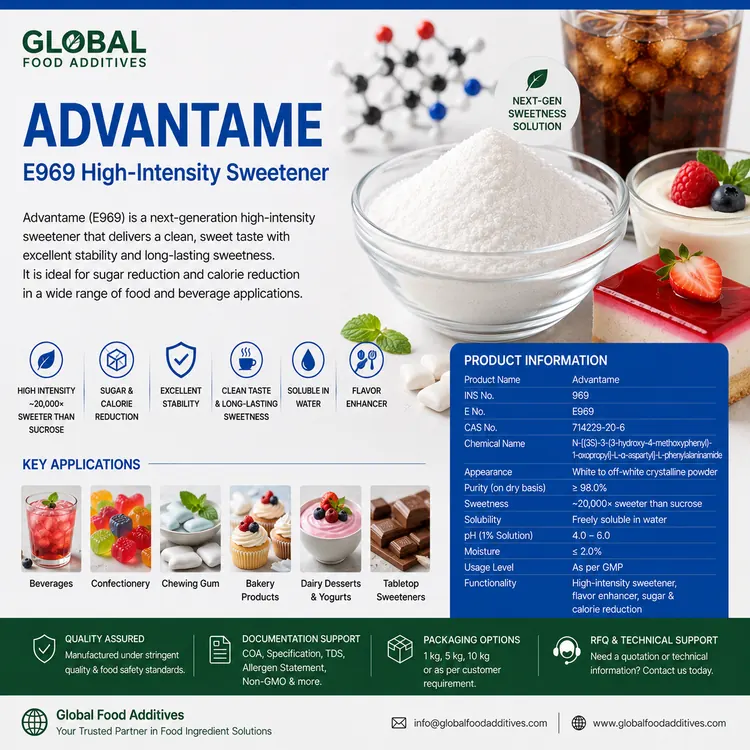
Product identity
| Product | Advantame |
|---|---|
| Category | Sweeteners & Polyols |
| Function | High-intensity sweetener, non-nutritive sweetener and flavor enhancer |
| E / INS number | E969 / INS 969; declaration language and approval must be verified by destination market |
| CAS / identity | 714229-20-6 |
| Chemical identity | N-[N-[3-(3-hydroxy-4-methoxyphenyl)propyl]-alpha-aspartyl]-L-phenylalanine 1-methyl ester, monohydrate |
| Typical form | White to off-white crystalline powder, fine powder, granule or formulated premix |
| Industrial selection basis | Assay, related substances, water, specific rotation, particle size, solubility, sensory profile, stability, documentation and regulatory status |
Application fit
Potential use areas may include:
- Carbonated and still beverages
- Powdered drink mixes and instant beverages
- Confectionery, candies, gums and compressed tablets
- Chewing gum and breath-freshening systems
- Bakery products, fillings, toppings and icings
- Dairy desserts, frozen desserts and dessert powders
- Fruit preparations, jams, jellies and sweet sauces
- Tabletop sweeteners and sweetener blends
Technical purchasing notes
Advantame should be purchased and approved by specification, not only by product name. Industrial performance depends on assay, impurity profile, particle size, solubility, dispersion, carrier system, sensory profile, pH stability, heat exposure, processing route and the final sweetness target. Because Advantame is a high-potency ingredient, small weighing errors can cause significant sweetness variation. For manufacturing, many buyers evaluate whether to purchase pure Advantame or a pre-diluted sweetener blend with a carrier for easier dosing, safer handling and more consistent plant-scale addition.
How Advantame works in food systems
Advantame is designed for very high sweetness intensity at low use levels. In practical formulation work, it is commonly evaluated for sweetness lift, sugar reduction, lingering sweetness control, flavor enhancement and blending with other sweeteners. The final sensory profile depends on dosage, product pH, acidity, flavor system, serving temperature, sugar level, solids content, carbonation, fat content and the presence of other high-intensity sweeteners.
Because the ingredient contributes almost no bulk at normal use levels, R&D teams usually design Advantame together with other formulation tools such as erythritol, maltitol, sorbitol, isomalt, soluble fibres, maltodextrin, polydextrose, modified starches, hydrocolloids, acids, flavors, masking agents and sweetness modulators. The goal is not only to match sweetness, but also to rebuild mouthfeel, viscosity, body, texture release and processing behaviour.
Functional performance areas
- High-intensity sweetness: delivers sweetness at very low dosage, supporting reduced-sugar and low-calorie concepts.
- Flavor enhancement: can help round certain flavor systems when used correctly within permitted conditions.
- Sweetener blending: may be combined with other high-intensity sweeteners to adjust onset, peak and linger.
- Calorie reduction: supports lower sugar use when paired with appropriate bulking and texture systems.
- Process flexibility: may be reviewed for beverages, bakery, confectionery, dairy-style desserts and dry mixes.
- Low dosage logistics: reduces active sweetener mass but increases the need for accurate weighing and premix control.
Critical formulation variables
- Target sucrose equivalence and sweetness intensity
- Sweetness onset, peak, linger and aftertaste target
- pH, acidity and buffer system of the finished product
- Thermal process, baking, pasteurization, hot fill or retort exposure
- Presence of carbonation, fruit acids, dairy proteins, fats or minerals
- Use with other sweeteners such as sucralose, acesulfame K, aspartame, stevia, neotame or polyols
- Bulking system required after sucrose reduction
- Label requirements, claims, warning statements and destination-market limits
- Weighing accuracy, premix homogeneity and plant-scale dosing control
Application guidance by food category
| Food system | Potential technical role | Review points before approval |
|---|---|---|
| Carbonated and still beverages | High-intensity sweetness, calorie reduction, flavor enhancement and sweetness balancing | pH, acidity, carbonation, pasteurization, hot fill, shelf life, flavor profile, solubility and sweetness linger |
| Powdered drink mixes | Sweetness in dry blend systems and instant beverages | Premix uniformity, particle size, carrier selection, segregation risk, dissolution speed and serving-size accuracy |
| Confectionery and candies | Sweetness lift, sugar reduction and flavor rounding | Cooking temperature, acid addition, solids level, bulking system, crystallization, texture, cooling profile and label claims |
| Chewing gum | Long-lasting sweetness, flavor enhancement and sugar-free positioning | Gum base compatibility, release profile, particle size, encapsulation, coating system, polyol blend and shelf-life stability |
| Bakery products | Sweetness contribution in reduced-sugar baked products | Heat exposure, dough or batter pH, browning loss from sugar reduction, texture rebuilding, humectancy and water activity |
| Dairy desserts and frozen desserts | Sweetness, flavor balance and calorie reduction | Protein interaction, fat level, freezing point, ice-crystal control, body, stabilizer system and sweetness at serving temperature |
| Jams, jellies and fruit preparations | Sweetness enhancement and reduced-sugar formulation support | Fruit acidity, pectin system, soluble solids, heat process, color stability, microbial stability and regulatory category limits |
| Tabletop sweeteners | Intense sweetness in sachets, tablets or spoonable blends | Carrier system, dosage accuracy, flowability, compression, tablet disintegration, perceived sweetness and serving-size labeling |
Industrial specification checklist
A strong Advantame purchasing specification should define measurable chemical, physical, safety and regulatory criteria. Because the ingredient is used at very low levels, supplier consistency and analytical documentation are especially important. Buyers should confirm the supplier’s test methods and compare each batch against the approved reference specification.
Physical and chemical criteria
- Assay on a dry basis according to supplier or regulatory method
- Free related substance limits and total related substances
- Water content or loss on drying
- Residue on ignition or sulphated ash where specified
- Specific rotation and identity confirmation
- Appearance, colour and odour
- Particle-size distribution, flowability and dusting tendency
- Solubility or dispersion profile in the target application
- Bulk density and compatibility with premix carriers
- Stability data under heat, humidity, light and pH conditions where available
Food safety and compliance criteria
- Lead and heavy-metal limits according to destination-market requirements
- Residual solvent or processing-aid declarations where applicable
- Microbiological limits for food-grade supply
- Allergen statement and cross-contamination declaration
- GMO status and identity-preserved options where required
- Halal, kosher, vegan or other certification statements
- Country of origin, manufacturing site and traceability information
- Food additive compliance statement for the target market
- Specification alignment with customer, retailer or private-label requirements
Dosing, premixing and plant-scale control
Advantame’s high sweetening power makes accurate dosing essential. Pure active powder may be difficult to dose directly into large production systems unless the plant has appropriate micro-weighing controls. Many industrial users evaluate pre-diluted blends, carrier systems or controlled premixes to improve dosing accuracy, operator handling, distribution uniformity and batch repeatability.
| Control point | Why it matters | Recommended review |
|---|---|---|
| Weighing accuracy | Small weighing errors can produce noticeable sweetness differences | Use calibrated microbalances, approved premix procedures or pre-diluted commercial blends. |
| Premix homogeneity | Low-dose ingredients may segregate in dry systems | Validate carrier selection, mixing time, particle-size compatibility and sampling uniformity. |
| Solubility and dispersion | Incomplete distribution can cause inconsistent sweetness | Confirm addition point, liquid temperature, mixing energy and dissolution time. |
| Sweetness calibration | Relative sweetness changes by matrix and concentration | Run sensory panels against sucrose-equivalent targets in the real food matrix. |
| Carry-over and cleaning | Trace residues may affect subsequent low-sweetness products | Review line clearance, cleaning validation and allergen-style segregation controls for potent ingredients. |
Sweetener-system design
Advantame is normally evaluated as part of a sweetener system. A complete sugar-reduction design may require sweetness, bulk, browning, viscosity, water activity, freezing point, fermentation control, mouthfeel and flavor balance to be solved separately. For example, a beverage may need only sweetness and flavor balance, while a baked product may also need bulking, humectancy, browning and texture rebuilding.
Common formulation partners
- Acesulfame K for sweetness profile adjustment
- Sucralose for high-intensity sweetness blends
- Steviol glycosides for natural-positioned sweetener systems where permitted
- Erythritol, maltitol, sorbitol, xylitol or isomalt for bulk and mouthfeel
- Soluble fibres, polydextrose or maltodextrin for solids replacement
- Hydrocolloids and modified starches for viscosity and texture rebuilding
- Acids, flavors and masking systems for sensory balance
Typical development targets
- Reduced sugar or no-added-sugar positioning
- Lower calorie contribution from sweetener system
- Similar sweetness onset and finish to sucrose
- Reduced bitterness, metallic notes or lingering aftertaste
- Stable sweetness through processing and shelf life
- Improved flavor impact at low use levels
- Compatible label declaration for the intended sales market
Comparison with other sweeteners
| Ingredient | Why it may be compared | Selection note |
|---|---|---|
| Advantame | Very high-intensity sweetness and flavor-enhancement role | Useful where extremely low dosage is desired, but accurate premixing and market approval must be confirmed. |
| Aspartame | Established high-intensity sweetener with sugar-like profile | Often compared because Advantame is structurally related, but stability, dosage and labeling may differ. |
| Neotame | High-intensity sweetener with very low use levels | Compared for potency, sensory profile, stability and regional approval status. |
| Sucralose | High-intensity sweetener used in beverages, bakery and tabletop blends | Often selected for broad familiarity and heat-process applications, depending on formulation and rules. |
| Acesulfame K | Fast sweetness onset and common blending sweetener | Frequently blended with other sweeteners to improve sweetness profile and reduce off-notes. |
| Steviol glycosides | Plant-derived high-intensity sweeteners | Compared where natural-origin positioning is important, but taste and label expectations differ. |
| Polyols | Bulk sweeteners with texture and solids contribution | Useful for replacing part of sugar’s bulk, but digestive tolerance and local labeling must be reviewed. |
| Sugar | Reference sweetness, bulk, browning, fermentation substrate and mouthfeel | Removing sugar usually requires multiple ingredients to replace its full technical role. |
Processing and stability notes
Advantame suitability should be confirmed under the exact process used by the customer. Product developers should test the ingredient after real thermal exposure, pH adjustment, storage time and packaging conditions. A short bench trial is not enough for products that undergo hot fill, baking, long ambient storage, acidic conditions, high humidity or exposure to light.
- Confirm the correct addition stage to protect sweetness and improve distribution.
- Validate solubility and dispersion in the actual liquid, syrup, dry blend, gum base or fat-containing system.
- Test sweetness after processing, after cooling and after shelf-life storage.
- Use sensory panels to compare sweetness onset, peak, linger, bitterness, metallic notes and flavor release.
- Evaluate interaction with acids, flavors, colors, preservatives, minerals, proteins and other sweeteners.
- Control humidity exposure during storage and handling because powder quality and flowability can affect dosing.
- For dry blends, check segregation risk during transport, vibration and hopper discharge.
- For low-dose premixes, validate blend uniformity using an appropriate sampling plan.
Quality assurance and incoming inspection
For recurring supply, incoming quality control should confirm that every lot matches the approved supplier specification, regulatory file and trial-approved reference. Since Advantame is used at low dosage, inconsistent assay, impurity profile, particle size or premix homogeneity can produce practical problems in sweetness, labeling, handling and finished-product repeatability.
- Check product name, lot number, production date, expiry date and country of origin against the certificate of analysis.
- Confirm assay, related substances, water, residue on ignition, specific rotation and heavy-metal values against the specification.
- Inspect packaging integrity, seal condition, odour, colour, moisture exposure and foreign-material risk.
- Confirm E969 / INS 969 reference and local declaration language against the approved regulatory file.
- For pre-diluted blends, verify carrier, dilution ratio, blend uniformity and allergen status.
- Run a standard sensory or sucrose-equivalence check when the application is highly sensitive.
- Keep retained samples for traceability, complaint handling and supplier performance review.
Regulatory and label review
Advantame is associated with the E969 food additive reference, but permitted uses, maximum levels, food categories, purity criteria, dietary-use labeling and declaration language depend on the destination market. Finished-product manufacturers should verify whether Advantame is allowed in the intended food category and whether the correct local declaration is “Advantame,” “E969,” “INS 969,” “sweetener,” “flavor enhancer” or another required wording.
For export projects, regulatory review should follow the country where the finished food will be sold, not only the country where the ingredient is purchased. This is especially important for private-label products, sugar-free claims, reduced-calorie claims, child-oriented foods, tabletop sweeteners, dietary-use products, retailer standards and markets with positive lists for sweeteners.
Documents to request
- Product specification or technical data sheet with test methods
- Certificate of analysis for the available batch or lot
- Safety data sheet where applicable
- Food-grade statement and intended-use declaration
- Origin, manufacturer, production site and traceability information
- Shelf-life, storage condition and retest-date information
- Allergen, GMO, halal, kosher, vegan and other declarations where required
- Assay, related substances, water, residue on ignition and specific rotation data
- Heavy-metal declaration, including lead limit where required
- Microbiological statement or limits for food-grade supply
- Label declaration guidance and E / INS number confirmation
- Particle size, solubility, stability or application data where available
- Packaging details, net weight, pallet configuration and container loading estimate
- Market-specific declarations required by the destination country
Packaging, logistics and storage
Advantame may be supplied in sealed food-grade bags, foil-lined packs, drums, cartons or controlled premix packaging depending on supplier and grade. Industrial buyers should confirm net weight, inner liner, moisture barrier, tamper evidence, batch coding, shelf life at dispatch, pallet configuration, storage temperature and whether the packaging format is suitable for low-dose ingredient handling in the receiving factory.
Supplier qualification workflow
- Define the application: food category, sugar-reduction target, sweetness target, pH, process, shelf life and destination market.
- Share the benchmark: existing sweetener system, sucrose-equivalence target, COA, label declaration or approved supplier reference.
- Screen documents: review TDS, COA, SDS, allergen, GMO, certification, origin, specification and regulatory declarations.
- Run bench trials: evaluate sweetness onset, peak, linger, aftertaste, flavor release, solubility and stability.
- Validate texture system: rebuild body, bulk, viscosity, browning, water activity or freezing point if sugar is removed.
- Validate plant performance: test weighing, premixing, dosing, dispersion, processing, packaging and shelf-life performance.
- Approve commercially: confirm final specification, packaging, lead time, minimum order quantity, incoterm and recurring documentation.
How to request this product
Send the product name, target grade or reference specification, intended application, quantity, destination country, packaging preference, expected shipment date, delivery term and required documents. If you already purchase Advantame, attach or describe your existing specification, certificate of analysis, sweetener blend, label declaration, sensory target or benchmark sample so supplier options can be compared more accurately.
Useful answers
What is Advantame used for in food manufacturing?
Advantame is typically reviewed for high-intensity sweetness, sugar reduction, calorie reduction, sweetener blending and flavor enhancement. Exact suitability depends on grade, dosage, application, process, pH, sensory target, regulations and supplier documents.
Is Advantame a direct replacement for sugar?
No. Advantame can replace sweetness, but it does not replace sugar’s bulk, solids, browning, water activity, fermentation substrate, crystallization behaviour, freezing-point effect or texture contribution. Most reduced-sugar formulas need additional ingredients to rebuild those functions.
Can Advantame be used in heat-processed foods?
Advantame may be evaluated for heat-processed applications, but suitability must be confirmed in the actual food matrix. Baking, hot fill, pasteurization, acidity, humidity and long storage can affect final sweetness and sensory performance.
Can Global Food Additives source Advantame?
Global Food Additives can review sourcing options for Advantame according to target specification, application, quantity, destination, packaging, delivery term and required documentation.
Which documents should be requested?
Buyers commonly request a technical data sheet or specification, certificate of analysis, safety data sheet where applicable, origin statement, shelf-life information, allergen and GMO declarations, assay and related-substance data, label guidance and packing details.
Is this product permitted in every country?
No. Food additive use depends on destination-market rules, food category, use level, purity criteria, label requirements and buyer responsibility. Always verify local regulation before commercial use.
Tell us which food additive or ingredient you need.
Send product names, target specifications, quantity, destination country, packaging preference, delivery term, and document requirements. Our team will review your inquiry and respond from orders@foodgradeadditives.com.
Your message has been received. You will be redirected to the home page.