
Allulose for low-calorie sweetness, sugar replacement and texture-support formulation.
Allulose is a food-grade rare sugar ingredient considered for sweetness design, calorie reduction, sugar replacement, bulk solids contribution, browning, humectancy and texture support where permitted by the destination market. This page supports industrial sourcing, crystalline and syrup grade comparison, specification review, supplier documentation collection and quotation preparation for food and beverage manufacturers.
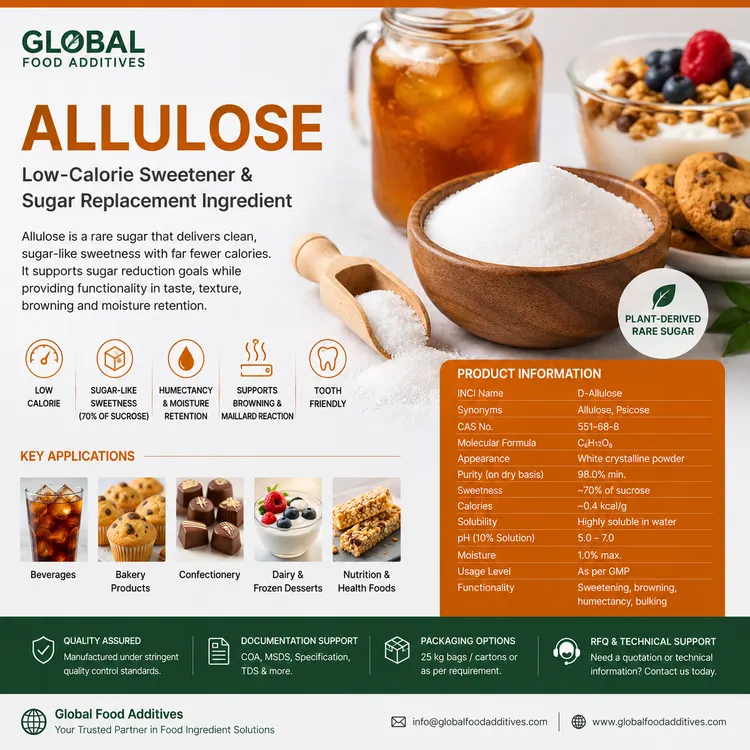
Product identity
| Product | Allulose |
|---|---|
| Common identification | D-Allulose, D-Psicose, rare sugar, low-calorie sugar replacement |
| Category | Sweeteners & Polyols |
| Function | Sweetener / bulking ingredient / sugar-reduction ingredient |
| E / INS number | Confirm by destination market and supplier documentation |
| CAS / identity | 551-68-8 |
| Ingredient type | Rare monosaccharide used where permitted for reduced-sugar and low-calorie formulation |
| Typical sweetness profile | Mild sucrose-like sweetness with lower sweetness intensity than sucrose; usually blended with high-intensity sweeteners when full sugar replacement is required |
| Typical form | Crystalline powder, granule, syrup or liquid grade |
| Primary buying concern | Regulatory suitability, assay, crystalline or syrup form, dry solids, residual sugars, colour, flavour neutrality, microbiology, packaging, shelf life and document availability |
Application fit
Potential use areas may include food categories where Allulose is legally permitted and technically suitable. Final approval depends on local legislation, nutrition labeling, finished-product category, dosage, customer policy and label requirements.
- Beverages, syrups, flavour systems and reduced-sugar drink bases
- Confectionery, gummies, caramels, chocolate systems, fillings and chewing gum concepts
- Bakery products, cookies, cakes, bars, pastries and browning-sensitive formulations
- Dairy desserts, frozen desserts, ice cream-style products and spoonable desserts
- Sauces, spreads, fruit preparations, nutritional products and reduced-sugar dry blends
Technical overview
Allulose is typically evaluated as a sugar-reduction ingredient because it can contribute sweetness, bulk, browning behaviour and humectancy while supporting lower-calorie formulation where regulations allow. Unlike high-intensity sweeteners, Allulose can contribute physical solids and process functionality. Unlike many polyols, it is a rare sugar rather than a sugar alcohol, so buyers should avoid assuming that it behaves exactly like erythritol, sorbitol, maltitol or xylitol in processing, labeling or sensory performance.
In industrial purchasing, the term “Allulose” should be defined by physical form, assay, residual sugar profile, dry solids, particle size, syrup concentration, colour, flavour neutrality, origin, production process, packaging and regulatory documents. Supplier options may include crystalline Allulose for dry blending and bakery applications, syrup grades for beverages and sauces, or customer-specific blends designed for sweetness balance, mouthfeel or processing stability.
Industrial performance considerations
Sweetness and flavour balance
Allulose delivers a mild sweetness profile and is often combined with stevia, monk fruit, sucralose, acesulfame K or other sweeteners to reach full sucrose-equivalent sweetness. Blending should be tested for lingering sweetness, bitterness, cooling perception and flavour release.
Bulk solids and texture
Because Allulose contributes solids, it may help maintain body, viscosity, chew, softness or mouthfeel in reduced-sugar products. The effect depends on water activity, formulation solids, hydrocolloids, proteins, fats and processing conditions.
Browning and heat processing
Allulose can participate in browning reactions during baking, cooking or thermal processing. Bakery and confectionery developers should validate crust colour, caramelization, Maillard browning, flavour development and over-browning risk.
Water activity and humectancy
Allulose may influence moisture retention, softness and water activity. Shelf-life trials should evaluate texture stability, microbial control, stickiness, crystallization and packaging barrier requirements.
Crystallization behaviour
Crystallization, graining and texture changes should be checked in confectionery, syrups, fillings, frostings and frozen desserts. The final result depends on solids level, pH, temperature profile, cooling rate and other sugars or polyols.
Digestive tolerance and serving size
Formulators should evaluate serving size, intended use level and customer requirements for digestive tolerance statements or internal limits. Any tolerance communication should be reviewed by regulatory and labeling teams.
Typical specification parameters to compare
Before approving a supplier, request a current specification and compare it with your internal quality standard, customer specification and destination-market requirements. Common technical parameters may include:
- Food-grade identity, CAS number and ingredient declaration name
- Allulose assay or D-allulose content
- Physical form: crystalline powder, granule, syrup or liquid grade
- Dry solids, Brix, viscosity and density for syrup grades
- Moisture, particle size, bulk density and flowability for crystalline grades
- Residual sugars such as fructose, glucose or other saccharides where specified
- Colour, odour, taste and flavour neutrality
- pH, ash, conductivity, insoluble matter and clarity where relevant
- Microbiological limits including total plate count, yeast and mould, coliforms, E. coli and Salmonella where specified
- Heavy metal limits such as lead, arsenic, mercury or cadmium according to applicable criteria
- Production process, enzymatic conversion information or substrate origin where required
- Batch coding, shelf life, retest period and recommended storage conditions
- Packaging type, net weight, closure system, inner liner, pallet configuration and traceability format
Application-specific purchasing notes
Beverages and syrups
For beverages, confirm solubility, clarity, flavour impact, pH stability, microbial specification, preservative compatibility, sweetness balance and whether syrup or crystalline grade offers better process efficiency.
Bakery and baked snacks
For bakery, test browning rate, spread, softness, moisture retention, crust colour, flavour development and shelf-life texture. Allulose may brown differently from sucrose and should be tested under the real bake profile.
Confectionery and gummies
For confectionery, evaluate chew, graining, stickiness, crystallization, water activity, gel strength, drying profile and compatibility with gelatin, pectin, starch, polyols, acids and high-intensity sweeteners.
Dairy and frozen desserts
For dairy desserts and frozen products, assess freezing point, scoopability, iciness, sweetness balance, stabilizer compatibility, protein interaction, heat treatment and storage stability.
Sauces, fillings and spreads
For sauces and spreads, check viscosity, gloss, water activity, browning during cooking, sweetness release, microbial stability, pH compatibility and package performance after storage.
Dry mixes and nutritional products
For dry blends, compare particle size, flowability, dusting, hygroscopicity, blend uniformity, flavour compatibility, anticaking need and performance after storage in humid conditions.
Formulation and plant trial guidance
A meaningful Allulose trial should compare the selected grade against the current sugar system, target nutrition profile and finished-product quality standard. Useful trial measurements may include sweetness equivalence, solids contribution, water activity, pH, viscosity, colour development, browning rate, texture, stickiness, crystallization, freezing behaviour, sensory profile and shelf-life stability.
For reduced-sugar reformulation, Allulose is often one part of a broader sweetener system. The final formula may require adjustment of high-intensity sweeteners, fibres, hydrocolloids, acids, flavours, humectants, polyols, preservatives or process conditions. A supplier comparison should evaluate cost-in-use, dosage efficiency, sensory quality, processing performance, regulatory suitability, nutrition-label impact and document package rather than unit price alone.
Quality and regulatory review
Allulose should be reviewed by quality, regulatory, nutrition and formulation teams before commercial use. A supplier quotation does not confirm that the ingredient is permitted in the buyer’s destination market or final product category. Buyers should verify food ingredient authorization, label declaration, calorie treatment, total carbohydrate or sugar labeling treatment, claim wording, import conditions and customer-specific restrictions.
For products positioned as reduced sugar, keto, low calorie, diabetic-friendly, natural, non-GMO, vegan, organic or clean-label, buyers should clarify source material, production method, certification status, residual sugar profile, label implications and any market-specific communication requirements. Claims and nutrition statements should be reviewed by qualified regulatory professionals before launch.
Documents to request
A complete document package helps quality, regulatory, purchasing, formulation and import teams evaluate supplier suitability before order placement. Depending on supplier availability and destination requirements, request:
- Product specification or technical data sheet
- Certificate of analysis for an available or representative batch
- Safety data sheet where applicable
- Food-grade statement and ingredient identity confirmation
- Allulose assay, dry solids or syrup Brix confirmation
- Origin statement and manufacturer or production-site information where available
- Production process, substrate origin or enzymatic conversion declaration where required
- Residual sugar profile and carbohydrate-composition information where available
- Allergen statement, GMO statement, vegan statement and irradiation statement
- Heavy metals declaration and contaminant statement
- Halal, kosher, non-GMO, organic or other certification documents where required and available
- Shelf-life, retest period and recommended storage conditions
- Packaging specification, label information and pallet configuration
- Market-specific declaration requested by the destination country or customer
- Shipping documents such as invoice, packing list and certificate of origin when applicable
Packaging, storage and handling
Allulose may be supplied in bags, lined cartons, fibre drums, big bags, bottles, jerrycans, drums, IBCs or other sealed food-grade packaging depending on physical form and order quantity. For export sourcing, confirm net weight, gross weight, closure type, moisture barrier, tamper evidence, pallet count, batch coding, expiry or retest date and whether packaging is suitable for long-distance transport.
Crystalline grades should be protected from moisture, humidity, odour pickup, contamination and damaged packaging. Syrup grades should be protected from contamination, leakage, temperature abuse and microbiological risk after opening. Storage and handling should follow the supplier specification, and production teams should verify whether warming, mixing, filtration or controlled transfer is needed before use.
Commercial sourcing factors
MOQ and order size
Minimum order quantities may differ for crystalline powder, syrup, sample, trial batch, bag, drum, pallet, IBC or full-container supply. Include first-order quantity and annual forecast to support realistic supplier matching.
Lead time and availability
Lead time depends on supplier stock, grade, production campaign, packaging, documentation, certification requirements, export route and destination-country import procedures.
Cost-in-use comparison
Compare offers by assay, dry solids, sweetness contribution, processing performance, label impact, required dosage, sensory quality, packaging, document package, shelf life and logistics cost.
Incoterms and shipping
State the preferred delivery term such as EXW, FCA, FOB, CFR, CIF, CPT, DAP or DDP, plus delivery port, city, warehouse or forwarder details if available.
How to request this product
Send the product name, CAS number, required physical form, assay or dry solids target, quantity, destination country, packaging preference, intended application, nutrition or sugar-reduction target, delivery term, expected shipment date and required documents. If you already purchase Allulose, attach or describe your existing specification, certificate of analysis, label declaration, current dosage, reformulation target or production issue so supplier options can be compared more accurately.
Useful answers for Allulose sourcing.
What is Allulose used for in food manufacturing?
Allulose is typically discussed for sweetness design, calorie reduction, sugar replacement, texture support, browning, bulk solids and humectancy. Exact suitability depends on grade, application, process, regulation, nutrition-label treatment and supplier documents.
Is Allulose a polyol?
No. Allulose is generally treated as a rare sugar rather than a sugar alcohol. It is grouped with sweeteners for sourcing purposes, but formulators should not assume it behaves exactly like erythritol, sorbitol, maltitol or other polyols.
Can Global Food Additives source Allulose?
Global Food Additives can review sourcing options for Allulose according to target specification, crystalline or syrup form, assay, quantity, destination, packaging, delivery term and required documentation.
Which documents should be requested?
Buyers commonly request a technical data sheet or specification, certificate of analysis, safety data sheet where applicable, food-grade statement, origin statement, shelf-life information, storage guidance, allergen and GMO statements and packaging details.
Is this product permitted in every country?
No. Allulose use, nutrition-panel treatment, claim wording, label declaration and import acceptance vary by destination market. Regulatory status must be checked before use or import.
What is important when comparing suppliers?
Compare assay, physical form, syrup solids, residual sugar profile, colour, flavour neutrality, microbiological limits, packaging, batch traceability, shelf life, lead time, origin, certifications and document availability.
How should Allulose be tested in production?
Test it in the actual formulation and process. Evaluate sweetness, browning, water activity, texture, stickiness, crystallization, viscosity, freezing behaviour, sensory profile and shelf-life stability against a control batch.
What should I include in a quotation request?
Include product name, CAS number, crystalline or syrup form, assay or dry solids requirement, application, sugar-reduction target, quantity, annual demand, destination country, packaging preference, Incoterms, shipment timing and required documents.
Request Allulose with the right technical and commercial details.
Send your required physical form, assay or dry solids target, intended application, sugar-reduction objective, quantity, destination country, packaging preference, delivery term and document requirements. Our team will review your inquiry and respond from [email protected].
If you are replacing sucrose, glucose syrup, fructose, polyols or another sweetener system, include the current formula target, sweetness requirement, texture problem, certificate of analysis, packaging format and any local regulatory or customer restrictions.
Your message has been received. You will be redirected to the home page.