
Alpha-Tocopherol E307 for oxidation control in fats, oils and sensitive food systems.
Alpha-Tocopherol is a food-grade antioxidant and vitamin E-related ingredient considered for protection of fats, oils, colours, flavours, vitamins and sensitive finished products against oxidative deterioration. This page supports industrial sourcing, tocopherol grade comparison, specification review, supplier documentation collection and quotation preparation for food and beverage manufacturers.
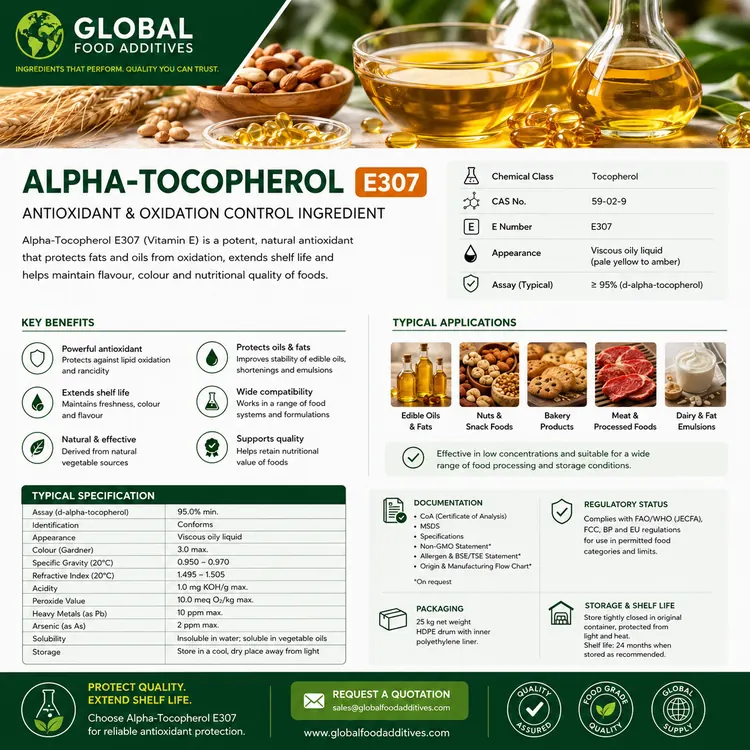
Product identity
| Product | Alpha-Tocopherol |
|---|---|
| Common identification | Alpha-Tocopherol E307, vitamin E antioxidant, food-grade tocopherol |
| Category | Antioxidants & Oxidation Control |
| Function | Antioxidant / oxidation-control ingredient |
| E / INS number | E307 |
| CAS / identity | 59-02-9 |
| Material type | Fat-soluble tocopherol antioxidant, available in natural or synthetic forms depending on supplier grade |
| Typical form | Powder, oil-dispersible liquid, viscous oil, beadlet, dispersion or antioxidant blend |
| Typical technical role | Helps delay lipid oxidation, rancidity, flavour loss, colour degradation and degradation of oxidation-sensitive nutrients |
| Primary buying concern | Assay, natural or synthetic origin, d-alpha or dl-alpha form, carrier, solubility, odour, peroxide value, residual solvents, certifications, packaging and regulatory suitability |
Application fit
Potential use areas may include food systems where oxidation control, fat stability, flavour protection or nutrient protection is important. Final suitability depends on local rules, food category, dosage, processing conditions, packaging and customer specification.
- Edible oils, frying oils, shortening, margarine and fat-based preparations
- Snacks, nuts, extruded products and savoury seasoning systems containing oil
- Meat systems, poultry products, seafood applications and lipid-containing prepared foods
- Bakery fats, fillings, icings, cream systems and laminated dough applications
- Beverages, emulsions, nutritional products and vitamin-sensitive finished products
Technical overview
Alpha-Tocopherol E307 is typically evaluated as a lipid-phase antioxidant for food systems that contain unsaturated fats, flavour oils, sensitive colours or fat-soluble vitamins. Its industrial value is linked to its ability to help interrupt oxidative chain reactions and slow the development of rancid odours, off-flavours, colour fading and nutrient degradation. Performance depends on the oil type, fatty-acid profile, oxygen exposure, heat history, metal ions, light exposure, moisture, packaging barrier and distribution temperature.
In purchasing and formulation work, “Alpha-Tocopherol” should be defined clearly because supplier grades may differ by optical form, natural or synthetic origin, active content, carrier, concentration, dispersion system and physical format. Common commercial presentations may include d-alpha-tocopherol, dl-alpha-tocopherol, tocopherol concentrates, oil-dispersible liquids, spray-dried powders, beadlets and premixed antioxidant systems. Buyers should confirm the grade required for antioxidant function, vitamin fortification, label positioning or customer specification before requesting pricing.
Industrial performance considerations
Oxidation-control target
Define whether the product is needed to protect bulk oil, flavour oil, finished snack, meat lipid, bakery fat, colour system, vitamin premix or emulsion. The required grade and dosage can differ significantly by application.
Oil type and fatty-acid profile
Oils rich in polyunsaturated fatty acids normally oxidize faster than more saturated systems. Alpha-Tocopherol performance should be tested in the actual oil phase, not only in a model system.
Thermal exposure
Heat treatment, frying, baking, spray drying, pasteurisation and hot filling can reduce antioxidant effectiveness or change oxidation kinetics. Additive timing and processing sequence should be validated during plant trials.
Synergy with other antioxidants
Alpha-Tocopherol may be evaluated alone or with synergists such as ascorbyl palmitate, citric acid, phosphates, rosemary extract or metal-chelating systems, depending on formulation goals and regulatory limits.
Packaging and oxygen exposure
Antioxidant performance is strongly affected by headspace oxygen, packaging barrier, light exposure and storage temperature. Tocopherol use should be evaluated together with packaging design, nitrogen flushing or oxygen control where relevant.
Sensory impact
Supplier grades can differ in odour, colour, carrier and flavour impact. Sensitive applications such as beverages, flavour oils, dairy alternatives and nutritional products should include sensory evaluation.
Typical specification parameters to compare
Before approving a supplier, request a current specification and compare it with your internal quality standard, customer specification and destination-market purity criteria. Common technical parameters may include:
- Food-grade identity, E number, CAS number and regulatory reference grade
- Alpha-tocopherol assay, total tocopherols or active antioxidant concentration
- Natural or synthetic origin, d-alpha or dl-alpha form and stereoisomer profile where required
- Carrier oil, carrier powder, encapsulation system or dispersion matrix
- Appearance, colour, odour, taste and physical form
- Acid value, peroxide value, anisidine value or oxidation indicators where included
- Solubility, dispersibility and compatibility with oil, emulsion or powder systems
- Moisture, loss on drying, particle size or bulk density for powder grades
- Residual solvents, processing aids or carrier declarations where applicable
- Heavy metal limits such as lead, arsenic, mercury or cadmium according to applicable criteria
- Microbiological limits for powder, beadlet or spray-dried preparations where required
- Batch coding, shelf life, retest period and recommended storage conditions
- Packaging type, net weight, closure system, nitrogen blanketing and traceability format
Application-specific purchasing notes
Edible oils and frying systems
For edible oils, confirm solubility, dosage, effect on peroxide value development, heat stability, smoke-point expectations, compatibility with other antioxidants and performance during storage or repeated thermal exposure.
Snacks and savoury coatings
For snacks, test tocopherol in the actual coating oil and finished product. Evaluate flavour stability, rancidity delay, colour stability, oil distribution, seasoning compatibility and shelf-life performance in the final pack.
Meat and prepared food systems
For lipid-containing meat or prepared foods, assess fat oxidation, warmed-over flavour, colour stability, metal-catalysed oxidation, brine or marinade compatibility and interaction with packaging atmosphere.
Bakery fats and fillings
For bakery fats, fillings and creams, compare performance under baking, aeration, lamination, storage temperature fluctuation and exposure to light or oxygen in display packaging.
Beverages and emulsions
For emulsified beverages, nutritional drinks and flavour emulsions, confirm dispersion system, droplet stability, turbidity, ring formation, sedimentation, sensory impact and compatibility with emulsifiers.
Vitamin and nutrient premixes
For premixes, verify carrier compatibility, active content, particle size, flowability, blend uniformity, nutrient stability, allergen status and whether the ingredient is used for antioxidant function or nutritional vitamin E contribution.
Oxidation testing and plant trial guidance
Industrial antioxidant evaluation should be based on the real formulation and packaging system. Useful tests may include peroxide value, anisidine value, TOTOX value, oxidative stability index, accelerated shelf-life study, sensory evaluation, headspace oxygen measurement, colour retention, vitamin retention and comparison against control batches. The most useful plant trial normally includes a control product, the selected Alpha-Tocopherol grade, target dosage levels and storage under realistic distribution conditions.
For existing oxidation problems, share details about the oil type, fat content, process temperature, oxygen exposure, packaging type, shelf-life target, storage temperature, light exposure, metal-contact surfaces and observed failure mode. A good supplier comparison should evaluate cost-in-use, dosage efficiency, sensory neutrality, document package, regulatory acceptance and stability performance rather than unit price alone.
Quality and regulatory review
Alpha-Tocopherol E307 should be reviewed by quality, regulatory and formulation teams before commercial use. A supplier quotation does not confirm that the additive is permitted in the buyer’s destination market or final product category. Buyers should verify food additive authorization, maximum permitted level, purity criteria, label declaration, nutritional claim rules, import conditions and customer-specific restrictions.
For products positioned as natural, non-GMO, allergen-controlled, vegan, organic, clean-label or fortified, buyers should clarify the source, carrier, manufacturing process, certification status and label implications. If Alpha-Tocopherol is used as a vitamin E source rather than only as an antioxidant, nutritional regulations and claim requirements should be reviewed separately.
Documents to request
A complete document package helps quality, regulatory, purchasing, formulation and import teams evaluate supplier suitability before order placement. Depending on supplier availability and destination requirements, request:
- Product specification or technical data sheet
- Certificate of analysis for an available or representative batch
- Safety data sheet where applicable
- Food-grade statement and additive identity confirmation
- Origin statement and manufacturer or production-site information where available
- Natural or synthetic origin declaration and d-alpha or dl-alpha identity confirmation
- Carrier oil, carrier powder, encapsulation or processing aid declaration
- Residual solvent declaration and contaminant statement where required
- Allergen statement, GMO statement, vegan statement and irradiation statement
- Heavy metals declaration and purity criteria confirmation
- Halal, kosher, organic, non-GMO or other certification documents where required and available
- Shelf-life, retest period and recommended storage conditions
- Packaging specification, label information and pallet configuration
- Market-specific declaration requested by the destination country or customer
- Shipping documents such as invoice, packing list and certificate of origin when applicable
Packaging, storage and handling
Alpha-Tocopherol products may be supplied in bottles, jerrycans, drums, pails, IBCs, foil bags, cartons, fibre drums or sealed containers depending on concentration and physical form. For export sourcing, confirm net weight, gross weight, closure type, oxygen protection, nitrogen blanketing, light protection, inner liner, pallet count, batch coding, expiry or retest date and whether packaging is suitable for long-distance transport.
Storage should normally protect the product from heat, oxygen, light, moisture and incompatible materials. Liquid grades should be kept tightly closed after opening, and powder or beadlet grades should be protected from humidity and physical damage. For high-value antioxidant grades, inventory teams should follow first-expiry-first-out control and avoid unnecessary exposure during weighing, dosing and transfer.
Commercial sourcing factors
MOQ and order size
Minimum order quantities may differ for sample, laboratory trial, small drum, carton, pallet, drum lot or container supply. Include first-order quantity and annual forecast to support realistic supplier matching.
Lead time and availability
Lead time depends on supplier stock, tocopherol form, concentration, packaging, certification requirements, documentation, export route and destination-country import procedures.
Cost-in-use comparison
Compare offers by active content, dosage efficiency, antioxidant performance, carrier system, sensory neutrality, document package, shelf life, packaging, regulatory suitability and logistics cost.
Incoterms and shipping
State the preferred delivery term such as EXW, FCA, FOB, CFR, CIF, CPT, DAP or DDP, plus delivery port, city, warehouse or forwarder details if available.
How to request this product
Send the product name, E number, target grade or reference specification, required Alpha-Tocopherol form, natural or synthetic preference, assay, carrier system, quantity, destination country, packaging preference, intended application, delivery term, expected shipment date and required documents. If you already purchase Alpha-Tocopherol, attach or describe your existing specification, label declaration, certificate of analysis, current dosage or oxidation-control issue so supplier options can be compared more accurately.
Useful answers for Alpha-Tocopherol E307 sourcing.
What is Alpha-Tocopherol used for in food manufacturing?
Alpha-Tocopherol E307 is typically discussed for protection of fats, oils, colours, flavours, vitamins and sensitive finished products from oxidative deterioration. Exact suitability depends on grade, application, dosage, process, packaging, regulation and supplier documents.
Is Alpha-Tocopherol the same as mixed tocopherols?
No. Alpha-Tocopherol refers specifically to the alpha form, while mixed tocopherols contain a profile of tocopherol isomers. The best option depends on the target function, label requirement, source preference, antioxidant performance and regulatory market.
Can Global Food Additives source Alpha-Tocopherol?
Global Food Additives can review sourcing options for Alpha-Tocopherol according to target specification, assay, tocopherol form, quantity, destination, packaging, delivery term and required documentation.
Which documents should be requested?
Buyers commonly request a technical data sheet or specification, certificate of analysis, safety data sheet where applicable, food-grade statement, origin statement, shelf-life information, storage guidance, allergen and GMO statements, carrier declaration and packaging details.
Is this product permitted in every country?
No. Food additive use depends on destination-market rules, food category, use level, purity criteria, label requirements, nutritional claim rules and buyer responsibility. Regulatory status must be checked before use or import.
What is important when comparing suppliers?
Compare food-grade status, assay, tocopherol profile, natural or synthetic origin, carrier, peroxide value, odour, colour, residual solvents, heavy metals, packaging, batch traceability, shelf life, lead time, certifications and document availability.
How should Alpha-Tocopherol be tested in production?
Test it in the actual formulation, processing conditions and packaging system. Evaluate peroxide value, sensory stability, colour retention, flavour stability, vitamin retention, headspace oxygen and shelf-life performance against a control sample.
What should I include in a quotation request?
Include product name, E number, CAS number, target grade, natural or synthetic preference, d-alpha or dl-alpha form, assay, carrier, application, quantity, annual demand, destination country, packaging preference, Incoterms, shipment timing and required documents.
Request Alpha-Tocopherol E307 with the right technical and commercial details.
Send your required grade, natural or synthetic preference, assay, carrier system, intended application, oxidation-control target, quantity, destination country, packaging preference, delivery term and document requirements. Our team will review your inquiry and respond from orders@foodgradeadditives.com.
If you are replacing an existing antioxidant or vitamin E ingredient, include the current supplier grade, dosage, specification, certificate of analysis, production issue, packaging format and any local regulatory or customer restrictions.
Your message has been received. You will be redirected to the home page.