
Aluminium Silicate E559 for powder flow, anticaking and dry-blend handling.
Aluminium Silicate is a food-grade mineral additive considered for anticaking performance, moisture management, powder flow improvement, mineral carrier use, dry-blend processing and tablet dusting where permitted. This page supports industrial sourcing, technical grade comparison, specification review, supplier documentation collection and quotation preparation for food and beverage manufacturers.
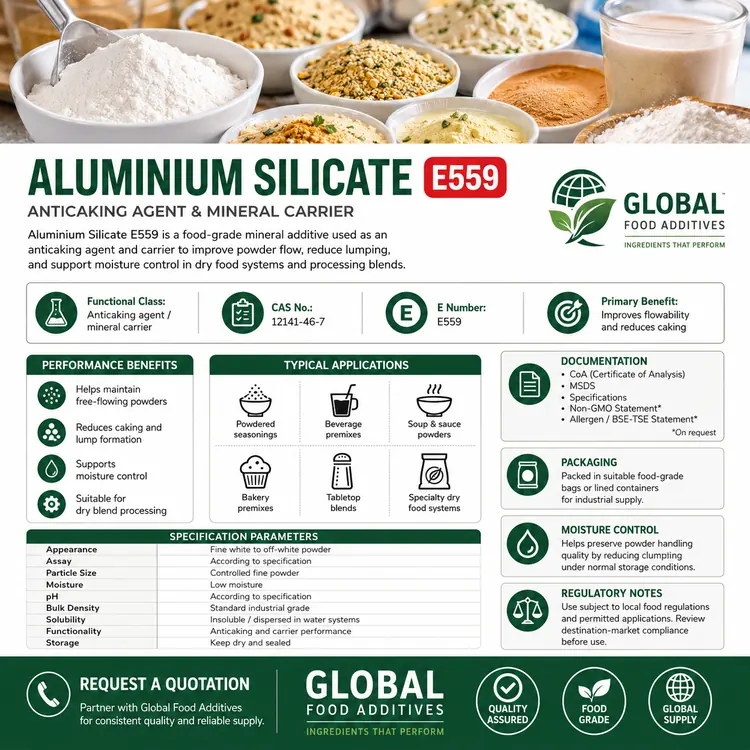
Product identity
| Product | Aluminium Silicate |
|---|---|
| Common identification | Aluminium Silicate E559, aluminum silicate, mineral anticaking agent |
| Category | Anticaking, Flow & Mineral Carriers |
| Function | Anticaking agent / flow aid / carrier or mineral processing aid |
| E / INS number | E559 |
| CAS / identity | 12141-46-7 |
| Material type | Inorganic mineral silicate powder or carrier grade |
| Typical form | Fine powder, granule or carrier grade |
| Typical technical role | Reduces caking, improves flow, supports dry blending and may act as a carrier for powdered ingredients |
| Primary buying concern | Food-grade status, particle size, bulk density, moisture profile, flow performance, heavy metals, dust handling, regulatory suitability and document availability |
Application fit
Potential use areas may include dry food systems where powder flow, caking control, carrier performance or production handling is important. Final suitability depends on local rules, finished-product category, dosage, formulation matrix and customer specification.
- Powdered beverages, instant drink mixes and dry nutritional blends
- Seasonings, spice blends, savoury powders and flavour premixes
- Bakery mixes, leavening systems, dry dough improver blends and flour-based premixes
- Salt products, mineral blends and hygroscopic dry ingredients
- Tablets, compressed food supplements and dry carrier systems where permitted
Technical overview
Aluminium Silicate E559 is typically evaluated as a mineral-based anticaking and flow-support additive for dry ingredient systems. Its industrial value is linked to moisture adsorption, particle spacing, reduction of powder bridging, improvement of hopper discharge, reduction of clumping during storage and more consistent flow through dosing, weighing, blending, sachet filling and packaging equipment.
In purchasing and formulation work, the name “Aluminium Silicate” alone is not enough to compare supplier offers. Different grades may vary in particle size distribution, bulk density, specific surface area, moisture content, pH, whiteness, oil absorption, dustiness, flowability, purity profile and carrier performance. Buyers should define the target application, required flow improvement, dosage range, regulatory market, packaging format and quality-document expectations before requesting pricing.
Industrial performance considerations
Anticaking performance
Performance depends on the moisture sensitivity of the base powder, humidity exposure, storage time, packaging barrier, particle size of the main ingredient and the dosage of the flow aid. Testing should compare caking tendency before and after storage under realistic warehouse and distribution conditions.
Powder flow and discharge
Aluminium Silicate may improve flow through hoppers, feeders, screw dosing systems, sachet fillers and dry blend packaging lines. Useful evaluation parameters include angle of repose, flow-through-orifice, Hausner ratio, Carr index and practical line-performance observations.
Particle size distribution
Fine grades may improve surface coverage and anticaking performance but can increase dusting. Coarser grades may support handling with lower dust but may be less effective in fine powders. Matching particle size to the base powder is critical.
Moisture adsorption
The material can help reduce free moisture effects in powders, but it cannot replace appropriate formulation design, water activity control, packaging barrier selection or dry warehouse storage. Hygroscopic ingredients require dedicated stability testing.
Carrier functionality
As a mineral carrier, Aluminium Silicate may be evaluated for carrying flavours, colours, acids, enzymes, vitamins, minerals or processing aids. Carrier suitability depends on surface area, oil absorption, compatibility, release profile and label acceptance.
Dust and plant hygiene
Fine mineral powders can create dust during tipping, transfer, weighing and mixing. Manufacturing sites should review the safety data sheet, ventilation, local exhaust, operator protection, housekeeping and contamination-control procedures.
Typical specification parameters to compare
Before approving a supplier, request a current specification and compare it with your internal quality standard, customer specification and destination-market purity criteria. Common technical parameters may include:
- Food-grade identity, E number, CAS number and regulatory reference grade
- Appearance, colour, odour and physical form
- Particle size distribution, sieve residue and fineness
- Bulk density, tapped density and flowability indicators
- Moisture content, loss on drying and water adsorption characteristics
- pH of aqueous suspension where specified by supplier method
- Oil absorption or carrier capacity where relevant for flavour or colour carriers
- Whiteness, brightness or colour value where visual impact matters
- Acid-soluble matter, insoluble matter or mineral composition where included in the specification
- Heavy metal limits such as lead, arsenic, mercury or cadmium according to applicable criteria
- Microbiological limits where the application or customer specification requires microbiological review
- Batch coding, shelf life, retest period and recommended storage conditions
- Packaging type, net weight, inner liner, pallet configuration and traceability format
Application-specific purchasing notes
Powdered beverages
For instant drinks, confirm dispersion behaviour, sedimentation, mouthfeel impact, colour impact, compatibility with acids, sweeteners, flavours and minerals, and whether the final beverage must remain visually clear or opaque.
Seasonings and spice blends
For seasoning systems, evaluate humidity resistance, flow after storage, adhesion to snacks, blend uniformity, dusting behaviour and interaction with salt, sugar, acids, flavours, oils and high-colour spices.
Bakery mixes
For bakery premixes, check compatibility with flour, leavening acids, bicarbonates, enzymes, emulsifiers and fat powders. Also confirm that the additive does not negatively affect dough hydration, texture or finished-product appearance.
Salt and mineral blends
For salt products and mineral blends, anticaking performance should be tested under high-humidity exposure, storage compression, pallet stacking, bag handling and real transport conditions.
Dry premixes and sachets
For sachet and stick-pack lines, flowability, dosing accuracy, dusting, seal contamination and filling-speed consistency should be evaluated during line trials.
Tablet and compression systems
For compressed food or supplement formats where permitted, assess flow into dies, sticking, dusting, tablet appearance, friability, hardness and compatibility with other excipients.
Powder processing and plant trial guidance
Plant trials should be designed around the real processing problem. A laboratory flow test is useful, but industrial performance should also be verified on the actual blending, conveying, dosing and packing equipment. Recommended trial observations include blend time, discharge behaviour, dust level, feeder consistency, filling weight variation, caking after storage, packaging seal cleanliness and product appearance after distribution simulation.
For existing products with caking issues, share details about the current formulation, moisture level, water activity if available, packaging type, storage temperature, relative humidity exposure, shelf-life target and failure mode. A good supplier comparison should examine not only the additive price but also dosage efficiency, production yield, line downtime, reduced rejects, improved pack filling and improved customer experience after storage.
Quality and regulatory review
Aluminium Silicate E559 should be reviewed by quality, regulatory and formulation teams before commercial use. A supplier quotation does not confirm that the additive is permitted in the buyer’s destination market or final product category. Buyers should verify food additive authorization, maximum permitted level, purity criteria, label declaration, import conditions, contaminant limits and customer-specific restrictions.
For retailer supply, contract manufacturing, export products or private-label programs, the customer specification may be stricter than general legislation. Buyers should confirm whether aluminium-containing additives, mineral carriers, insoluble silicates or anti-caking agents are acceptable under the final product’s brand policy, claim position and target market requirements.
Documents to request
A complete document package helps quality, regulatory, purchasing, safety and import teams evaluate supplier suitability before order placement. Depending on supplier availability and destination requirements, request:
- Product specification or technical data sheet
- Certificate of analysis for an available or representative batch
- Safety data sheet with handling, storage and dust-control information
- Food-grade statement and additive identity confirmation
- Origin statement and manufacturer or production-site information where available
- Heavy metals declaration and purity criteria confirmation
- Allergen statement, GMO statement and irradiation statement
- Residual impurities, mineral composition or contaminant declaration where required
- Crystalline silica or respirable dust declaration where relevant to the supplier grade and workplace-safety review
- Halal, kosher or other certification documents where required and available
- Shelf-life, retest period and recommended storage conditions
- Packaging specification, label information and pallet configuration
- Market-specific declaration requested by the destination country or customer
- Shipping documents such as invoice, packing list and certificate of origin when applicable
Packaging, storage and handling
Aluminium Silicate is commonly supplied in bags, lined bags, cartons, fibre drums, big bags or palletized industrial packaging depending on grade, supplier and order quantity. For export sourcing, confirm net weight, gross weight, inner liner, moisture barrier, pallet count, stacking limits, closure system, batch coding, expiry or retest date and whether packaging is suitable for long-distance transport.
Storage should protect the material from moisture, contamination, direct water contact, odour pickup and damaged packaging. Fine powders should be handled with suitable dust controls, closed transfer where practical, good housekeeping and operator protection according to the site’s safety procedures and the supplier safety data sheet.
Commercial sourcing factors
MOQ and order size
Minimum order quantities may differ for sample, trial, bag, pallet, big-bag and full-container supply. Include first-order quantity and annual forecast to support realistic supplier matching.
Lead time and availability
Lead time depends on supplier stock, grade, packaging, documentation, export route, certification requirements and destination-country import procedures.
Cost-in-use comparison
Compare offers by required dosage, anticaking performance, bulk density, packaging, line efficiency, document package, shelf life, lead time and regulatory suitability rather than unit price alone.
Incoterms and shipping
State the preferred delivery term such as EXW, FCA, FOB, CFR, CIF, CPT, DAP or DDP, plus delivery port, city, warehouse or forwarder details if available.
How to request this product
Send the product name, E number, target grade or reference specification, particle size requirement, bulk density target, quantity, destination country, packaging preference, intended application, delivery term, expected shipment date and required documents. If you already purchase Aluminium Silicate, attach or describe your existing specification, label declaration, certificate of analysis, current dosage or production issue so supplier options can be compared more accurately.
Useful answers for Aluminium Silicate E559 sourcing.
What is Aluminium Silicate used for in food manufacturing?
Aluminium Silicate E559 is typically discussed for powder flow, caking prevention, mineral carrier use, tablet dusting and dry-blend handling. Exact suitability depends on grade, application, dosage, process, regulation and supplier documents.
Is Aluminium Silicate used like a soluble ingredient?
No. Aluminium Silicate is generally evaluated as an insoluble mineral flow aid or carrier. It should be tested for dispersion, mouthfeel impact, dusting, visual effect and compatibility with the target dry blend or finished product.
Can Global Food Additives source Aluminium Silicate?
Global Food Additives can review sourcing options for Aluminium Silicate according to target specification, particle size, quantity, destination, packaging, delivery term and required documentation.
Which documents should be requested?
Buyers commonly request a technical data sheet or specification, certificate of analysis, safety data sheet, food-grade statement, origin statement, shelf-life information, storage guidance, heavy metals declaration and packaging details.
Is this product permitted in every country?
No. Food additive use depends on destination-market rules, food category, use level, purity criteria, label requirements and buyer responsibility. Regulatory status must be checked before use or import.
What is important when comparing suppliers?
Compare food-grade status, particle size distribution, bulk density, moisture, flowability, oil absorption, heavy metals, dust handling, packaging, batch traceability, shelf life, lead time, origin, certifications and document availability.
How should Aluminium Silicate be tested in production?
Test it in the actual dry blend, equipment and packaging system. Evaluate flow, dosing accuracy, caking after storage, dusting, visual effect, mouthfeel, packaging seal cleanliness and stability under expected humidity and transport conditions.
What should I include in a quotation request?
Include product name, E number, CAS number, target grade, particle size, bulk density, application, food category, quantity, annual demand, destination country, packaging preference, Incoterms, shipment timing and required documents.
Request Aluminium Silicate E559 with the right technical and commercial details.
Send your required grade, particle size, bulk density, intended application, powder-flow issue, quantity, destination country, packaging preference, delivery term and document requirements. Our team will review your inquiry and respond from [email protected].
If you are replacing an existing anticaking agent or carrier, include the current supplier grade, dosage, specification, certificate of analysis, production issue, packaging format and any local regulatory or customer restrictions.
Your message has been received. You will be redirected to the home page.