
Aluminium E173 metallic food colour for industrial sourcing and decorative application review.
Aluminium is a food-grade metallic colour additive considered for silver, reflective and decorative surface effects where permitted by the destination market. This page is prepared as a technical sourcing guide for food manufacturers, confectionery producers, coating specialists, importers and distributors that need specification comparison, supplier documentation review, safe handling information and quotation support.
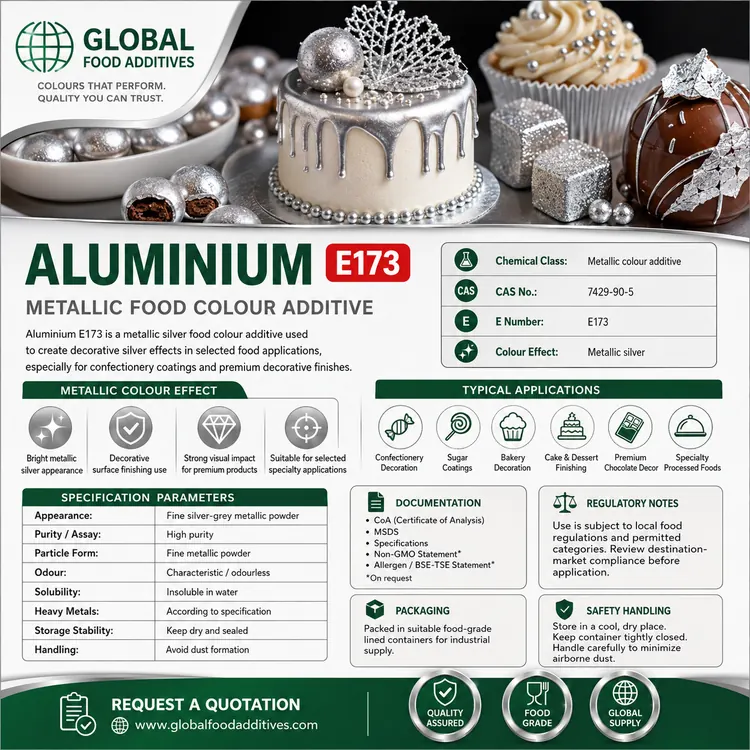
Product identity
| Product | Aluminium |
|---|---|
| Common identification | Aluminium E173, food-grade aluminium, metallic silver food colour |
| Category | Colours & Colouring Foods |
| Function | Metallic food colour / decorative colour effect ingredient |
| E / INS number | E173 |
| CAS / identity | 7429-90-5 |
| Material type | Metallic aluminium pigment or preparation for food applications where permitted |
| Typical colour effect | Silver, metallic, reflective or pearlescent-like decorative surface appearance depending on grade and application method |
| Typical form | Fine powder, flakes, paste, suspension or application-ready dispersion depending on supplier grade |
| Primary buying concern | Correct regulatory status, food-grade purity, particle size, carrier system, heavy metal limits, SDS, dust handling, application method and supplier traceability |
Application fit
Potential use areas may include selected food applications where metallic surface decoration is legally permitted and technically suitable. Final suitability depends on regulation, food category, finished-product format and customer policy.
- Confectionery decorations, dragees, coated chocolates and sugar decorations
- Specialty bakery decorations, toppings and visual finishing systems
- Decorative coatings, edible surface finishes and premium product detailing
- Dry decoration systems, dusting applications and application-ready colour preparations
- Limited specialty applications where metallic silver effect is required and permitted
Technical overview
Aluminium E173 is not a conventional soluble colour used to tint an entire food matrix. It is typically evaluated as a metallic colour material for decorative, reflective and surface-effect applications. In industrial use, performance depends strongly on particle morphology, particle size distribution, surface area, carrier system, application method, coating substrate, moisture exposure, storage condition and the appearance required in the finished product.
For purchasing and formulation teams, the word “Aluminium” alone is not enough to compare offers. Supplier proposals should be reviewed against food-grade status, purity criteria, physical form, colour effect, particle size, heavy metals, residual impurities, carrier or solvent system, microbiological status where applicable, safety data, shelf life, packaging, origin, batch traceability and destination-market regulatory requirements.
Industrial performance considerations
Metallic effect and visual finish
The final appearance depends on particle size, platelet structure, reflectivity, application thickness, substrate colour, surface smoothness, coating uniformity and lighting conditions. A grade that appears bright on a dry confectionery surface may perform differently in a wet or acidic matrix.
Particle size and coverage
Particle size distribution influences coverage, brilliance, surface smoothness, dusting behaviour, mouthfeel risk and suspension stability. Fine grades may disperse differently from flake grades and should be tested with the intended coating or decoration process.
Solubility and matrix compatibility
Aluminium metallic pigment is not used like a water-soluble dye. It should be evaluated as an insoluble decorative material or formulated preparation. Compatibility with water, alcohol systems, fat-based coatings, shellac systems, gum systems and carrier liquids should be confirmed before purchase.
pH and chemical exposure
Strongly acidic, alkaline or reactive systems can affect aluminium stability and appearance. Buyers should provide pH, water activity, acid type, salt level, processing temperature and expected shelf-life conditions for application review.
Surface application method
Application may involve spraying, brushing, tumbling, panning, dusting, coating or use in a prepared dispersion. The selected grade should match equipment, viscosity target, deposition rate, drying time and cleaning procedure.
Handling and plant hygiene
Fine aluminium powders can create dusting and safety concerns. Manufacturing sites should review the safety data sheet, dust control, grounding, ventilation, ignition-source control, protective equipment and colour carryover cleaning procedures.
Typical specification parameters to compare
Before approving a supplier, request a current specification and compare it with your internal quality standard, regulatory requirement and customer specification. Common technical parameters may include:
- Food-grade identity, E number, CAS number and regulatory reference grade
- Appearance, colour effect, brightness, reflectivity and visual finish
- Particle size distribution, flake morphology and dispersibility
- Purity of aluminium and limits for non-aluminium impurities
- Heavy metal limits such as lead, arsenic, mercury or cadmium according to applicable criteria
- Moisture, volatile matter, ash or insoluble matter where included in the supplier method
- Carrier type for paste, liquid or dispersion grades
- Residual solvent, mineral oil, wax, shellac, gum, ethanol or other carrier declarations where relevant
- Microbiological limits where the form or application requires microbiological review
- Batch coding, shelf life, retest period and recommended storage conditions
- Packaging type, net weight, inner liner, tamper evidence and pallet configuration
- Safety data, dust classification and handling guidance for powder grades
Application-specific purchasing notes
Confectionery coatings
For dragees, coated chocolates, hard candies and sugar decorations, test surface adhesion, shine, rub resistance, drying time, colour transfer, cracking behaviour and visual consistency after storage.
Bakery decorations
For decorative toppings and bakery finishing, confirm heat exposure, moisture migration, oil migration, adhesion, final appearance and whether the material is suitable for post-bake or pre-bake application.
Spray and liquid systems
For sprayable preparations, specify carrier, viscosity, nozzle compatibility, suspension stability, sedimentation behaviour, drying profile, flammability considerations and cleaning requirements.
Dry dusting systems
For dry dusting, compare particle size, dustiness, flowability, operator exposure, adhesion to the surface, colour transfer, packaging contamination risk and plant hygiene controls.
Premium visual effects
For luxury confectionery or specialty decorations, evaluate brightness, reflective effect, shade uniformity, surface smoothness and compatibility with other decorative colours or coating agents.
Replacement projects
When replacing an existing metallic colour, provide the current supplier grade, application method, dosage, finished-product photos, coating recipe, regulatory market and required document package.
Quality and regulatory review
Aluminium E173 should be reviewed by quality, regulatory, safety and formulation teams before commercial use. A supplier quotation does not confirm that the additive is permitted in the buyer’s destination market or final product category. Buyers should verify food additive authorization, maximum permitted level, purity criteria, label declaration, warning or advisory requirements where applicable, import conditions and customer-specific restrictions.
For export, private label manufacturing, retailer supply or contract manufacturing, buyers should also confirm whether the final customer accepts metallic aluminium colour. Some retailers and brands may apply stricter internal policies than local law, especially for products positioned as clean label, natural, child-focused, organic or minimally processed.
Safety, storage and handling considerations
Aluminium powder and fine metallic pigments require careful industrial handling. Buyers should review the supplier safety data sheet before sampling, warehousing or production use. Powder grades may require dust-control measures, suitable ventilation, grounding and bonding, avoidance of ignition sources, controlled transfer procedures and personal protective equipment according to site safety rules.
Storage should normally protect the material from moisture, contamination, direct sunlight, incompatible chemicals and excessive heat. For paste or dispersion grades, confirm carrier stability, freezing sensitivity, sedimentation behaviour, recommended mixing before use, closure integrity and shelf-life conditions. Packaging should be kept tightly closed when not in use to protect quality and reduce contamination risk.
Documents to request
A complete document package helps quality, regulatory, purchasing, safety and import teams evaluate supplier suitability before order placement. Depending on supplier availability and destination requirements, request:
- Product specification or technical data sheet
- Certificate of analysis for an available or representative batch
- Safety data sheet with handling, storage, transport and dust-control information
- Food-grade statement and additive identity confirmation
- Origin statement and manufacturer or production-site information where available
- Heavy metals declaration and purity criteria confirmation
- Carrier, solvent or processing aid declaration for paste or dispersion grades
- Allergen statement, GMO statement and irradiation statement
- Halal, kosher or other certification documents where required and available
- Shelf-life, retest period and recommended storage conditions
- Packaging specification, label information and pallet configuration
- Transport classification or non-dangerous-goods statement where applicable
- Market-specific declaration requested by the destination country or customer
- Shipping documents such as invoice, packing list and certificate of origin when applicable
Packaging and logistics
Packaging may vary by supplier and grade, including small jars, bottles, bags, lined cartons, drums, tins, pails, fibre drums or bulk cartons. For industrial sourcing, confirm net weight, gross weight, inner liner, tamper evidence, closure type, pallet count, moisture protection, lot coding, expiry date and whether the packaging is suitable for long-distance export shipments.
For powders, logistics teams should confirm transport classification, SDS requirements, dust-control precautions and whether the material needs special handling. For liquid or paste preparations, confirm leakage risk, temperature sensitivity, freezing risk, settling behaviour, shelf-life after opening and whether mixing or homogenisation is required before use.
Commercial sourcing factors
MOQ and order size
Minimum order quantities may differ for powder, paste, liquid dispersion, sample, trial batch, pallet or full-container supply. Include trial demand and annual forecast to support realistic supplier selection.
Lead time and availability
Lead time depends on supplier stock, grade, packaging, documentation, safety classification, export route, certification requirements and destination-country import procedures.
Price comparison
Compare offers by food-grade status, purity, particle size, visual effect, usable dosage, carrier system, document package, shelf life, packaging, transport cost and regulatory suitability.
Incoterms and shipping
State the preferred delivery term such as EXW, FCA, FOB, CFR, CIF, CPT, DAP or DDP, plus delivery port, city, warehouse or forwarder details if available.
How to request this product
Send the product name, E number, target form, particle size or reference grade, purity requirement, quantity, destination country, packaging preference, intended application, delivery term, expected shipment date and required documents. If you already purchase Aluminium E173, attach or describe your existing specification, label declaration, certificate of analysis, SDS or supplier grade so sourcing options can be compared more accurately.
Useful answers for Aluminium E173 sourcing.
What is Aluminium used for in food manufacturing?
Aluminium E173 is typically discussed for metallic silver surface effects, decorative coatings, visual identity and specialty finishing applications where permitted. Exact suitability depends on grade, particle size, application method, food category, process, regulation and supplier documents.
Is Aluminium E173 a normal soluble food colour?
No. Aluminium E173 is generally reviewed as a metallic pigment or preparation for decorative effect, not as a normal water-soluble dye for colouring an entire food matrix. The required form should be confirmed before sourcing.
Can Global Food Additives source Aluminium?
Global Food Additives can review sourcing options for Aluminium E173 according to target specification, form, particle size, quantity, destination, packaging, delivery term and required documentation.
Which documents should be requested?
Buyers commonly request a technical data sheet or specification, certificate of analysis, safety data sheet, food-grade statement, origin information, shelf-life information, storage guidance, heavy metals declaration, carrier declaration and packaging details.
Is this product permitted in every country?
No. Food additive use depends on destination-market rules, food category, maximum use level, purity criteria, label requirements and buyer responsibility. Regulatory status must be checked before use or import.
What is important when comparing suppliers?
Compare food-grade status, purity, particle size, metallic effect, carrier system, heavy metals, SDS details, packaging, batch traceability, shelf life, lead time, origin, certifications and document availability.
Can Aluminium be supplied as a paste or liquid preparation?
Some metallic colour programs may require paste, suspension, dispersion or application-ready preparations rather than dry powder. Availability depends on supplier capability, application, MOQ, regulation and destination requirements.
What should I include in a quotation request?
Include product name, E number, CAS number, target form, particle size, purity requirement, application method, food category, quantity, annual demand, destination country, packaging preference, Incoterms, shipment timing and required documents.
Request Aluminium E173 with the right technical, safety and commercial details.
Send your required form, particle size, purity requirement, application method, finished product category, quantity, destination country, packaging preference, delivery term and document requirements. Our team will review your inquiry and respond from orders@foodgradeadditives.com.
If you are replacing an existing metallic colour, include the current supplier grade, application method, dosage, specification, certificate of analysis, SDS, finished-product photos and any local regulatory or customer restrictions.
Your message has been received. You will be redirected to the home page.