
Ammonium Hydroxide E527
Ammonium Hydroxide is a food-grade aqueous ammonia solution used as an alkaline pH-control agent, acidity regulator, processing aid, leavening support ingredient and surface-treatment or process-adjustment chemical where permitted. It is selected when manufacturers need controlled alkalisation, neutralisation, pH adjustment or ammonia-based functionality in a carefully managed industrial process. This page is prepared as a technical starting point for sourcing, concentration selection, specification review, safety planning, documentation collection and quotation requests.
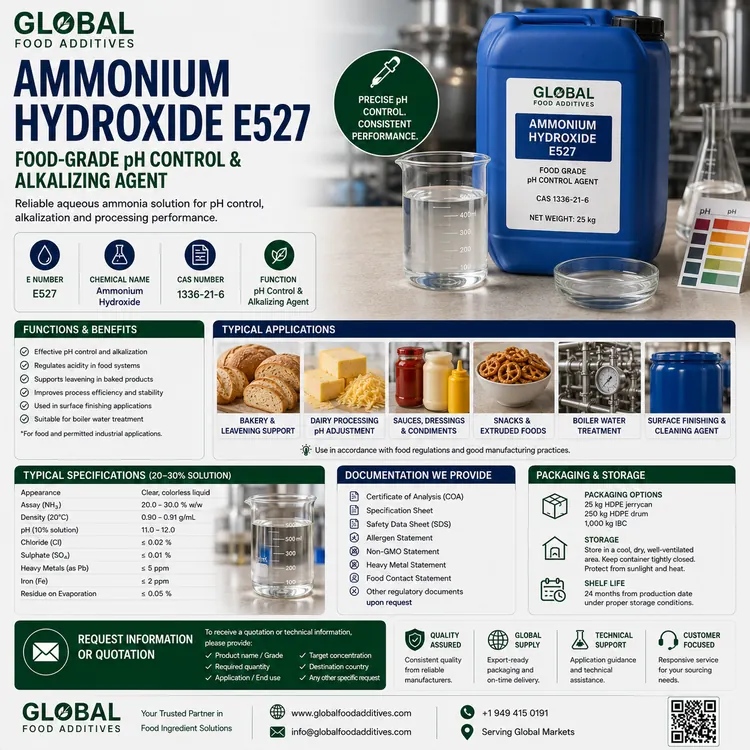
Product identity
| Product | Ammonium Hydroxide |
|---|---|
| Common names | Ammonium hydroxide E527, aqueous ammonia, ammonia solution, ammonia water |
| Category | Acidulants & Acidity Regulators |
| Function | Alkalizing agent / pH control agent / acidity regulator / processing aid |
| E / INS number | E527 |
| CAS / identity | 1336-21-6 |
| Chemical identity | Ammonia dissolved in water |
| Formula commonly used | NH4OH / NH3(aq), depending on specification convention |
| Typical appearance | Clear, colourless liquid with characteristic pungent ammonia odour |
| Typical form | Aqueous solution; concentration and density depend on supplier grade |
| Technical nature | Volatile alkaline solution; concentration can change if ammonia is lost during storage or handling |
| Key safety point | Corrosive and ammonia-releasing; requires suitable ventilation, PPE, compatible packaging and SDS-based handling |
Application fit
Ammonium Hydroxide is most relevant where the manufacturing objective is controlled pH increase, alkalinity adjustment, neutralisation, leavening support or process treatment under validated food-grade conditions.
- pH adjustment and neutralisation in selected food-processing operations
- Leavening-system support where ammonium-based functionality is permitted
- Cocoa, caramel, colour, flavour or ingredient-processing applications where pH control is required
- Surface-finishing or surface-treatment processes where legally permitted
- Process-water or boiler-water applications under applicable food-contact rules
- Fermentation, protein, starch or ingredient-processing pH adjustment where approved by the buyer
- Industrial trials requiring volatile alkalinity or ammonia-based pH adjustment
- Export-oriented production requiring documented food-grade alkaline processing aid
Technical purchasing notes
When reviewing Ammonium Hydroxide, compare the supplier specification against the intended food application, target pH, final ammonium contribution, processing temperature, volatility losses, ventilation controls, packaging compatibility, dosing system, label expectations and local rules. Although it may appear in an acidity-regulator category, Ammonium Hydroxide is alkaline and should not be treated as an acidulant. Its role is pH increase, alkalisation, neutralisation or ammonia-based processing functionality.
For industrial purchasing, the most useful inquiry normally includes required ammonia concentration, specification limits, expected monthly consumption, packaging format, dosing system, destination country, delivery term, storage conditions, safety-document requirements and whether the product will be used directly in food processing, as a processing aid, as a surface-finishing agent or in boiler-water applications.
Functional role in food processing
Ammonium Hydroxide provides alkalinity through aqueous ammonia. In processing, it can raise pH, neutralize acids, support controlled alkaline treatment, contribute to leavening-related chemistry or adjust process conditions where an ammonia-based solution is specifically permitted. Because ammonia is volatile, the practical effect depends on concentration, addition point, temperature, mixing, exposure time, ventilation and the buffering capacity of the food matrix.
Unlike mineral alkalis such as sodium hydroxide or potassium hydroxide, Ammonium Hydroxide may partially volatilize as ammonia during processing or storage. This can be useful in selected applications, but it also creates process-control and safety considerations. Manufacturers should validate pH endpoint, ammonia odour, residual ammonium, final sensory impact and workplace exposure controls.
Industrial application guidance
pH control and neutralisation
- Used where an alkaline solution is required to raise pH or neutralize acidity under permitted conditions.
- Requires accurate dosing because small additions can produce significant pH changes in low-buffer systems.
- Should be added through controlled metering, dilution or inline dosing rather than uncontrolled manual addition.
- Process teams should monitor final pH, ammoniacal odour, product flavour and batch-to-batch consistency.
- Compatibility with acids, salts, proteins, colours, flavours and preservatives should be validated.
Leavening, surface and process uses
- Can be evaluated in permitted leavening or processing contexts where ammonia release or pH effect is desired.
- May be used in controlled surface-finishing or treatment systems where the function is legally accepted.
- Relevant to certain processing-water or boiler-water applications under applicable rules and specifications.
- Volatility means addition point, exposure time and temperature can change final functionality.
- Finished product should be checked for odour, taste, residual alkalinity and regulatory compliance.
Concentration, dosing and process control
Ammonium Hydroxide is purchased as a solution, so concentration control is central to specification and dosing. Industrial buyers should confirm whether the supplier expresses strength as ammonia content, ammonium hydroxide content, weight percentage, density, normality or another basis. Purchasing and production teams should use the same basis to prevent dosing errors.
- Concentration: specify ammonia content or solution strength clearly, including analytical method.
- Density: use density checks as a practical receiving-control tool where appropriate.
- Dilution: define dilution procedure, water quality, mixing order and operator protection.
- Dosing: use calibrated metering systems for consistent pH endpoints.
- Volatility: minimize open handling because ammonia loss can reduce strength and create exposure hazards.
- Temperature: higher temperatures can increase ammonia vapour release and change process behaviour.
- Endpoint: verify pH after mixing and after equilibration, not only immediately at addition.
- Records: document lot number, concentration, dose, pH target, actual pH and corrective actions.
Application-specific considerations
- Beverage and liquid processing: pH adjustment must be validated carefully because ammonia odour and flavour impact may be noticeable at low levels.
- Confectionery and colour systems: alkalinity can alter colour, flavour and Maillard reactions; trials should monitor shade, pH, flavour and storage stability.
- Cocoa and ingredient processing: alkaline treatment can affect colour and flavour development, but process legality and final declaration must be confirmed.
- Protein systems: pH adjustment can affect solubility, water binding, texture, emulsification and heat stability.
- Starch and carbohydrate processing: alkalinity may alter viscosity, browning, texture and reaction pathways.
- Boiler-water or process-water use: food-contact compliance, carryover controls and applicable boiler-water additive rules should be reviewed.
- Surface finishing: verify that the intended surface application is permitted and that residual ammonia, odour and worker exposure are controlled.
Specification checklist for buyers
A professional Ammonium Hydroxide specification should define concentration, purity, impurities, packaging compatibility and safety requirements. Because the product is volatile and alkaline, storage and handling conditions are as important as analytical values.
- Ammonia assay or Ammonium Hydroxide concentration
- Assay method and accepted concentration range
- Density or specific gravity at a stated temperature
- Appearance, colour and odour
- Non-volatile residue or residue on evaporation
- Iron, heavy metals, lead, arsenic and other elemental impurities where required
- Chloride, sulphate, carbonate and other ionic impurities where specified
- Oil, organic impurities or oxidizable substances where relevant to buyer standard
- Microbiological specification where required by application or customer policy
- Food Chemicals Codex or equivalent food-grade compliance statement where applicable
- Allergen, GMO, halal, kosher, vegan or vegetarian declarations where required
- Packaging material, venting, closure type and tamper-evidence details
- Shelf life, storage temperature, strength-loss guidance and batch traceability
- Safety data sheet, transport classification and emergency response information
Quality control and factory handling
Ammonium Hydroxide requires controlled receiving, storage and use. It is corrosive, strongly odorous and capable of releasing ammonia vapour. Manufacturing plants should review engineering controls, ventilation, dosing equipment, PPE, spill response, emergency showers, eyewash stations and operator training before use.
- Approve each lot against COA, concentration, packaging integrity and SDS before production release.
- Inspect containers for swelling, leakage, odour release, corrosion, damaged caps or missing labels.
- Store in compatible, tightly closed containers in a cool, well-ventilated area.
- Keep away from acids, oxidizers, chlorine-containing chemicals and incompatible metals or materials.
- Use corrosion-resistant pumps, gaskets, hoses, valves and dosing lines recommended for aqueous ammonia.
- Provide local exhaust ventilation where opening, transferring or diluting the product.
- Use suitable PPE including eye, face, hand and respiratory protection as required by the SDS and site risk assessment.
- Document concentration checks, dose, pH endpoint, corrective actions and batch traceability.
Safety, storage and compatibility
Safe handling is a major purchasing and operational requirement. Ammonium Hydroxide can cause chemical burns and respiratory irritation, and ammonia vapour can accumulate in poorly ventilated areas. A food plant should treat the product as both a food-grade processing material and a hazardous chemical requiring strict EHS controls.
- Ventilation: use in well-ventilated areas and avoid breathing vapours.
- Closed transfer: use closed or semi-closed transfer systems where possible.
- Temperature: avoid unnecessary heat exposure because vapour pressure and ammonia release can increase.
- Incompatibilities: avoid contact with acids, oxidizing agents, chlorine products and reactive metals.
- Spill control: prepare neutralisation, containment and emergency-response procedures before receiving product.
- Labelling: containers and day tanks should be clearly identified with concentration and hazard information.
- Training: operators should be trained on vapour hazards, dilution, first aid and emergency shutdown.
Performance testing and validation
Approval should include both incoming-material testing and process validation. Because Ammonium Hydroxide changes pH rapidly and can volatilize, industrial trials should track pH over time, not only at the moment of addition. Finished products should be checked for sensory impact, ammonia odour, regulatory compliance and process consistency.
- Run bench trials to establish dose-response curve and buffering behaviour.
- Confirm pH endpoint at production temperature and after holding time.
- Measure final product pH, sensory quality and any ammoniacal odour.
- Validate compatibility with colours, proteins, flavours, preservatives and packaging.
- Check whether alkalinity affects browning, colour development, texture or microbial-control systems.
- Confirm that the final use level does not exceed GMP, legal or customer limits.
- Document the approved addition point, dilution method, concentration and operator procedure.
Comparison with related pH-control ingredients
Ammonium Hydroxide belongs to a wider group of pH-control and alkalizing ingredients. The correct choice depends on required pH, flavour impact, volatility, sodium or potassium contribution, final label, safety requirements and local regulations.
- Ammonium Hydroxide E527: volatile alkaline aqueous ammonia solution for pH control and ammonia-specific processing uses.
- Sodium Hydroxide E524: strong non-volatile alkali used where sodium contribution and caustic handling are acceptable.
- Potassium Hydroxide E525: strong non-volatile alkali used where potassium contribution is preferred.
- Calcium Hydroxide E526: alkaline mineral ingredient used in selected firming, processing and pH-control applications.
- Ammonium Bicarbonate: solid leavening agent releasing ammonia and carbon dioxide during heating; not equivalent to Ammonium Hydroxide solution.
- Carbonates and bicarbonates: milder alkaline systems often selected for leavening or buffering rather than volatile ammonia solution control.
Regulatory and labelling review
Ammonium Hydroxide is identified as E527 in many additive-number systems and is used as a pH-control or acidity-regulating ingredient where permitted. However, permitted food categories, maximum levels, processing-aid treatment, declaration wording and safety obligations vary by destination market. Buyers should confirm whether the finished product must declare Ammonium Hydroxide, E527, acidity regulator, pH control agent, processing aid or another locally accepted term.
If the ingredient is used in a process-water, boiler-water, surface-treatment or processing-aid context, the buyer should verify both food-additive rules and any process-specific regulations. Export products should be checked against the destination country’s additive list, customer standards and retailer requirements before production.
Packaging, storage and logistics
Ammonium Hydroxide is commonly supplied in compatible plastic drums, jerrycans, IBCs, totes, tankers or bulk systems depending on concentration and order volume. Packaging must be compatible with alkaline aqueous ammonia and should account for pressure, vapour release, venting, closure integrity and transport classification.
- Request concentration, net weight, gross weight, drum or IBC size and pallet configuration before confirming freight.
- Confirm packaging material compatibility, vented closure design and tamper-evidence details.
- Check whether the product is supplied in drums, IBCs, totes, tanker loads or bulk storage systems.
- Confirm production date, batch number, expiry date and expected concentration stability during storage.
- Store away from acids, oxidizers, chlorine chemicals, heat sources and poorly ventilated rooms.
- Request packing photos, label draft and pre-shipment COA when import clearance or customer approval requires them.
- For export orders, confirm HS code guidance, transport classification, document legalization needs and destination import requirements.
Documents to request
- Product specification or technical data sheet
- Certificate of analysis for the offered batch or lot
- Safety data sheet with transport, storage and emergency-response details
- Food-grade statement and intended-use declaration
- Ammonium Hydroxide / E527 compliance statement where available
- Assay method, ammonia concentration and density information
- Impurity profile including residue, heavy metals, iron, chloride and sulphate where specified
- Packaging compatibility, closure and venting information
- Allergen, GMO, halal, kosher, vegan or vegetarian declarations where required
- Storage, shelf-life and concentration-stability information
- Regulatory compliance statement for the destination country where available
- Transport classification and dangerous-goods documentation where applicable
- Label draft, packaging details, pallet configuration and lot-coding format
- Market-specific declarations required by the buyer, retailer or importing country
How to request this product
Send the product name, required concentration, target specification, intended application, expected dose or pH target, quantity, destination country, packaging preference, delivery term, expected shipment date and required documents. If you already purchase Ammonium Hydroxide, attach or describe your current specification, concentration, COA, packaging type, dosing system, label declaration and regulatory requirement so supplier options can be compared accurately.
Useful answers
What is Ammonium Hydroxide used for in food manufacturing?
Ammonium Hydroxide is used as an alkaline pH-control agent, acidity regulator, processing aid, leavening-support ingredient, surface-finishing agent and process-adjustment material where permitted. Exact suitability depends on concentration, application, process, regulations and supplier documents.
Is Ammonium Hydroxide an acidulant?
No. Ammonium Hydroxide is alkaline, not acidic. It may be grouped with acidity regulators because it adjusts acidity, but it raises pH and supports alkalisation or neutralisation rather than acidification.
Is Ammonium Hydroxide supplied as powder?
No. Food-grade Ammonium Hydroxide is normally supplied as a clear aqueous ammonia solution. Buyers should specify ammonia concentration, density, packaging type and required documentation.
Which concentration should be requested?
The required concentration depends on the process, dosing equipment, safety controls, transport rules and supplier availability. Buyers should define ammonia assay or solution strength clearly and ensure that purchasing, QA and production use the same concentration basis.
What are the main handling risks?
Ammonium Hydroxide is corrosive and can release ammonia vapour. Plants should use suitable PPE, ventilation, compatible containers, closed transfer where possible, spill procedures, eyewash and emergency showers, and operator training based on the supplier safety data sheet.
Which documents should be requested?
Buyers commonly request a technical data sheet, product specification, certificate of analysis, safety data sheet, food-grade statement, assay method, concentration and density information, impurity profile, regulatory statement, packaging details, transport classification and shelf-life information.
Can Global Food Additives source Ammonium Hydroxide?
Global Food Additives can review sourcing options for Ammonium Hydroxide according to concentration, specification, application, quantity, destination, packaging preference, delivery term and required documentation.
Is this product permitted in every country?
No. Food additive and processing-aid use depends on destination-market rules, food category, use level, label declaration, safety obligations and buyer responsibility. The buyer should verify regulatory status and final suitability before commercial use.
What should be checked during supplier qualification?
Supplier qualification should include ammonia concentration, assay method, density, impurity limits, food-grade status, packaging compatibility, SDS quality, transport documentation, batch traceability, remaining shelf life, regulatory declarations and delivery reliability.
Tell us which food additive or ingredient you need.
Send product names, target specifications, quantity, destination country, packaging preference, delivery term, and document requirements. Our team will review your inquiry and respond from orders@foodgradeadditives.com.
Your message has been received. You will be redirected to the home page.