
Annatto Extract E160b
Annatto Extract is a plant-derived yellow-orange food colour obtained from the seed coating of Bixa orellana. It is used by food manufacturers for warm yellow, golden, orange and cheese-orange shade development in dairy, cheese, butter, margarine, bakery, snacks, sauces, seasonings, confectionery and colour-standardisation programs. Industrial selection depends heavily on whether the target application needs an oil-soluble bixin grade, a water-soluble norbixin grade, an emulsion, a dispersion, a powder or a custom shade blend.
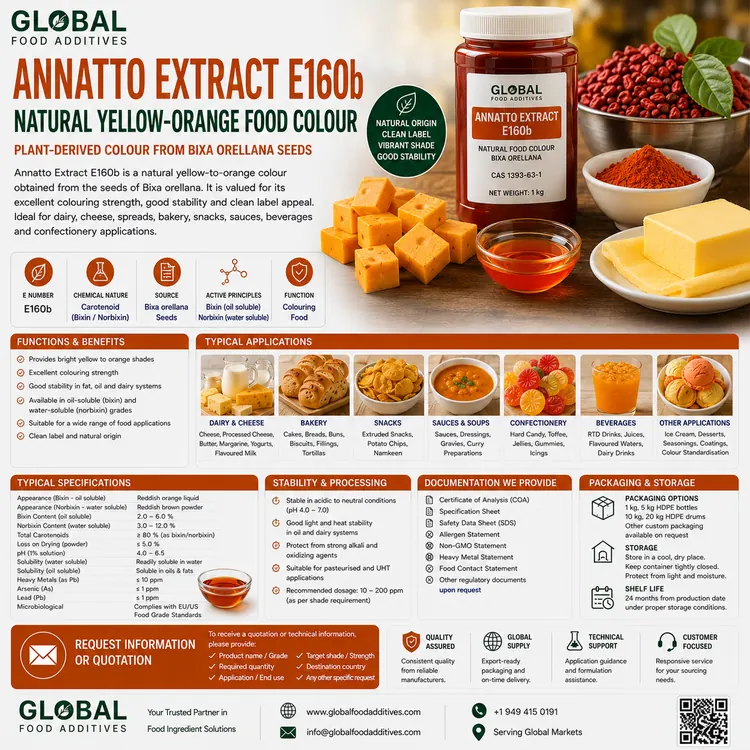
Product identity
| Product | Annatto Extract |
|---|---|
| Common names | Annatto Extract E160b, annatto colour, bixin colour, norbixin colour, achiote colour |
| Category | Colours & Colouring Foods |
| Function | Food colour / colouring food / colour standardisation ingredient |
| E / INS number | E160b |
| CAS / identity | 1393-63-1 |
| Botanical source | Seed coating of Bixa orellana |
| Main colour compounds | Bixin and norbixin carotenoid pigments |
| Typical shade range | Yellow, golden yellow, orange, reddish-orange and cheese-orange depending on grade and dosage |
| Typical form | Powder, liquid, emulsion, dispersion, lake, beadlet, extract grade or custom colour blend |
| Key purchasing point | Confirm whether the application requires bixin, norbixin, an emulsion, a water-soluble preparation or an oil-soluble preparation |
Application fit
Annatto Extract is selected where a warm yellow-orange natural colour is required and the selected pigment system is compatible with the food matrix.
- Cheese, processed cheese, cheese sauces and cheese powders
- Butter, margarine, spreads, shortenings and bakery fats
- Snacks, extruded products, chips, crackers and seasoning coatings
- Bakery products, cakes, fillings, icings and dessert systems
- Sauces, dressings, condiments, soups and savoury preparations
- Confectionery, gummies, jelly products and sugar confectionery
- Dairy desserts, custards, ice cream and plant-based alternatives
- Colour replacement, shade matching and natural colour conversion projects
Technical purchasing notes
When reviewing Annatto Extract, compare the supplier specification against the intended application, target shade, colour strength, pH, fat content, protein content, heat process, light exposure, packaging format, label expectations and destination-market rules. Annatto is not one universal colour grade. Bixin-based products are normally used where oil solubility or fat-phase distribution is needed, while norbixin-based products are usually evaluated for water-based, protein-containing or aqueous systems.
For industrial purchasing, the most useful inquiry normally includes target shade, bixin or norbixin preference, colour strength, application matrix, pH, process temperature, required declaration, carrier restrictions, sample requirement, annual quantity, destination country and document requirements. If you are replacing beta-carotene, paprika, curcumin, synthetic yellow/orange colours or another annatto grade, provide the current dosage, shade target and approved reference sample.
Bixin vs norbixin: grade selection
Annatto Extract is mainly selected by pigment chemistry and solubility. Bixin is the principal oil-soluble carotenoid pigment in annatto seed coating and is commonly used for fat-rich systems such as cheese, butter, margarine and oil-based coatings. Norbixin is produced from bixin through alkaline processing and is more suitable for water-based or protein-containing systems where aqueous distribution is required.
Bixin-based grades
- Oil-soluble or oil-dispersible pigment system.
- Typically selected for cheese, butter, margarine, fats, oils, snack coatings and fat-based fillings.
- Often gives stronger orange to reddish-orange tones depending on concentration and matrix.
- Requires good dispersion in fat or a compatible carrier to prevent specking and shade inconsistency.
- Performance should be tested under heat, light, oxygen and storage conditions.
Norbixin-based grades
- Water-soluble or water-dispersible pigment system.
- Often selected for sauces, cheese brines, dairy systems, confectionery, dry blends and aqueous applications.
- Can provide yellow to orange shades depending on pH, concentration and formulation.
- Requires review of protein interaction, salt level, pH, calcium, acids and thermal process.
- Shade and stability should be validated in the final product rather than in water only.
Industrial application guidance
- Cheese and dairy: annatto is widely evaluated for cheddar-type cheese, processed cheese, cheese sauces and dairy spreads. Buyers should test colour distribution, whey loss, curd retention, pH, salt level and storage shade stability.
- Butter and margarine: oil-soluble grades can help standardize golden yellow shade across seasonal fat-colour variation.
- Snack seasonings: powder or dispersion grades may support orange cheese, barbecue, spicy, savoury and roasted seasoning shades.
- Bakery and fillings: annatto may be used in cakes, icings, fillings, creams and fat-based bakery systems where heat stability and shade retention are acceptable.
- Sauces and condiments: water-soluble or emulsified grades can support yellow-orange sauces, dressings, soups, spice blends and savoury bases.
- Confectionery: compatibility with acids, gel systems, cooking temperature, water activity and packaging must be checked.
- Meat and savoury systems: annatto can contribute warm yellow-orange tones to selected sausages, coatings, marinades, soups and prepared meals where permitted.
- Plant-based foods: useful for cheese alternatives, vegan spreads, sauces and meat analogues that require dairy-like or cooked-orange shades.
Colour strength and shade standardisation
Annatto products should be purchased by colour performance, not only by price per kilogram. Supplier specifications may express strength as bixin percentage, norbixin percentage, colour value, absorbance, optical density, E1% value, extract solids or application-standard strength. Buyers should confirm the measurement basis before comparing offers.
- Request colour strength method, wavelength, solvent, dilution, pH and calculation basis.
- Compare shade in the final product matrix, not only in water, oil or laboratory solvent.
- Use an approved colour standard, L*a*b* target, reference product or retained production sample.
- Confirm batch-to-batch colour tolerance and supplier standardisation process.
- Evaluate cost-in-use based on the dose required to match target shade.
- Check whether the offered grade is single-source, blended, emulsified, plated, beadletized or custom-standardised.
Stability and processing considerations
Annatto pigments are carotenoid-based and can be affected by oxidation, light, heat, pH, metals, emulsifier system, carrier oil quality and packaging oxygen barrier. Stability should be validated over the full process and shelf life. A colour that matches immediately after mixing may fade, brown, separate, stain packaging, migrate into fat, bind to protein or shift shade during storage.
- pH: check final product pH and pH drift during storage, especially for norbixin grades.
- Heat: validate pasteurization, cooking, baking, extrusion, spray drying or hot-fill conditions.
- Light: use light-exposure testing for transparent packaging, retail display and surface-coloured foods.
- Oxygen: control headspace oxygen and packaging oxygen transmission where oxidative fading is a risk.
- Metals: iron, copper and other trace metals may accelerate colour degradation.
- Proteins and salts: dairy, meat and sauce systems may require testing for binding, precipitation or shade change.
- Emulsifiers: emulsified annatto grades should be validated for droplet stability, ring formation and phase separation.
- Acids and preservatives: test interaction with citric acid, lactic acid, acetic acid, sorbates, benzoates and sulphites where relevant.
Specification checklist for buyers
A professional Annatto Extract specification should define pigment basis, source, colour strength, physical form, carrier system, contaminants and application guidance. Because annatto grades can differ significantly in colour strength and solubility, supplier qualification should combine technical documents with application trials.
- Botanical source and raw-material origin
- Colour basis: bixin, norbixin, mixed carotenoids, emulsion or standardised blend
- Colour strength, bixin content, norbixin content or colour value
- Analytical method for pigment content or absorbance
- Shade description and application-standard colour target
- Physical form: liquid, powder, oil solution, water solution, dispersion, emulsion, lake or beadlet
- Carrier, diluent, emulsifier, stabilizer, solvent or anticaking agent declaration
- Solubility, dispersibility, sedimentation, clarity or emulsion stability where relevant
- pH, heat, light and oxygen stability guidance
- Moisture, solids, viscosity, bulk density or particle size depending on grade
- Residual solvent information where solvent extraction is used
- Sulphite status and preservative declaration where relevant
- Microbiological limits including total plate count, yeast and mould, coliforms, E. coli and Salmonella
- Heavy metals, pesticide residues, mycotoxins or other contaminants where required
- Allergen, GMO, halal, kosher, vegan or vegetarian declarations where required
- Shelf life, storage conditions, packaging format and batch traceability
Quality control and factory handling
Annatto Extract should be controlled as a sensitive colour preparation. Liquid grades may settle or separate, powder grades may dust or clump, and emulsions may require controlled mixing before use. Manufacturing teams should validate the addition point, dispersion method, mixing time and dosing accuracy before scale-up.
- Approve each lot against COA, colour strength and retained reference sample before release to production.
- Check appearance, odour, separation, sediment, caking, container integrity and expiry date on receipt.
- Mix or homogenize liquid concentrates according to supplier guidance before dosing.
- Pre-disperse powders or beadlets where needed to prevent specking or uneven shade.
- Use food-compatible pumps, hoses, vessels and dosing equipment that can be cleaned effectively.
- Protect opened containers from light, oxygen, heat and contamination.
- Monitor finished-product colour visually and, where possible, by L*a*b* measurement.
- Retain production samples under normal and accelerated storage conditions for shade tracking.
Regulatory and labelling review
Annatto Extract is identified as E160b in many additive systems, but the exact regulatory treatment depends on source, extraction method, food category, dosage, carrier system and destination-market rules. Buyers should confirm whether the finished product should declare Annatto Extract, annatto colour, E160b, colour, colouring food, vegetable extract, spice extract or another locally accepted term.
Claims such as “natural colour”, “no artificial colours”, “colouring food”, “plant-based”, “vegan”, “clean label”, “non-GMO”, “halal” or “kosher” should be reviewed against the exact supplier grade, carrier system, processing method and market-specific legislation. Some markets distinguish between colour additives and colouring foods, so the same botanical source may not always have the same declaration.
Packaging, storage and logistics
Annatto Extract may be supplied in jerrycans, drums, bottles, bag-in-box packs, bags, cartons, pails or light-protective containers depending on the form. Packaging should protect against light, oxygen, heat, moisture and contamination. Buyers should confirm storage temperature, remaining shelf life, transport conditions and opened-container handling before purchasing.
- Request net weight, gross weight, pallet configuration and container loading quantity before confirming freight.
- Confirm whether the grade requires ambient, cool, refrigerated or frozen transport.
- Ask whether the product is packed in light-protective or oxygen-protective packaging.
- Confirm production date, expiry date, batch number and remaining shelf life before shipment.
- Check whether opened-pack storage differs from unopened-pack storage.
- Request packing photos, label draft and pre-shipment COA when import clearance or customer approval requires them.
- For export orders, confirm HS code guidance, document legalization needs and destination import requirements.
Documents to request
- Product specification or technical data sheet
- Certificate of analysis for the offered batch or lot
- Safety data sheet where applicable
- Food-grade statement and intended-use declaration
- Botanical source, raw-material origin and manufacturing-process statement where available
- Colour strength, bixin content, norbixin content or absorbance method
- Solubility, dispersion and application guidance
- Carrier, emulsifier, solvent, stabilizer and anticaking-agent declaration
- Residual solvent, sulphite and preservative statements where relevant
- Microbiological specification and pathogen statement
- Pesticide residue, heavy metal and mycotoxin statements where required
- Allergen, GMO, halal, kosher, vegan or vegetarian declarations where required
- Shelf-life, storage and packaging information
- Regulatory compliance statement for the destination country where available
- Label draft, packaging details, pallet configuration and lot-coding format
- Market-specific declarations required by the buyer, retailer or importing country
How to request this product
Send the product name, target shade, bixin or norbixin preference, required colour strength, application, finished-product pH, fat or water phase, process conditions, packaging type, expected use level, quantity, destination country, delivery term, expected shipment date and required documents. If you already purchase Annatto Extract, attach or describe your current specification, target colour standard, supplier grade, label declaration, dosage, certificate of analysis or application trial result so available supplier options can be compared accurately.
Useful answers
What is Annatto Extract used for in food manufacturing?
Annatto Extract is used as a yellow to orange food colour in cheese, dairy, butter, margarine, bakery, snacks, confectionery, sauces, seasonings, soups, meat systems and plant-based foods. Exact suitability depends on grade, pigment basis, application, process, regulations and supplier documents.
What is the difference between bixin and norbixin?
Bixin is the oil-soluble annatto pigment usually selected for fat-containing systems such as cheese, butter, margarine and oil coatings. Norbixin is the more water-soluble pigment system often used in aqueous or protein-containing products. The final selection should be validated in the actual product matrix.
Can Annatto Extract replace synthetic yellow or orange colours?
It can support natural-colour replacement projects, but it is not a universal replacement. Shade, strength, heat stability, light stability, pH behaviour, cost-in-use and label declaration should be tested against the target product and shelf-life conditions.
Is Annatto Extract suitable for beverages?
Some water-soluble or emulsified annatto grades may be evaluated in beverages, but the product pH, clarity, sedimentation, ring formation, light exposure, preservatives and packaging must be tested carefully. Not every annatto grade is beverage-suitable.
Which documents should be requested?
Buyers commonly request a technical data sheet, product specification, certificate of analysis, food-grade statement, pigment content or colour-strength method, source declaration, carrier and solvent declaration, microbiological specification, allergen and GMO declarations, shelf-life information and packaging details.
Can Global Food Additives source Annatto Extract?
Global Food Additives can review sourcing options for Annatto Extract according to target shade, bixin or norbixin requirement, colour strength, application, quantity, destination, packaging preference, delivery term and required documentation.
Is this product permitted in every country?
No. Food colour use depends on destination-market rules, food category, source material, extraction method, use level, label declaration and buyer responsibility. The buyer should verify regulatory status and final suitability before commercial use.
What should be checked during supplier qualification?
Supplier qualification should include pigment basis, colour strength, source material, carrier system, bixin or norbixin content, solubility, heat and light stability, residual solvents, sulphite status, microbiology, pesticide residues, heavy metals, allergen status, GMO status, batch traceability, packaging integrity, lead time, remaining shelf life and export-document support.
Tell us which food additive or ingredient you need.
Send product names, target specifications, quantity, destination country, packaging preference, delivery term, and document requirements. Our team will review your inquiry and respond from orders@foodgradeadditives.com.
Your message has been received. You will be redirected to the home page.