
Bentonite
Bentonite, identified in many food-additive systems as E558, is a food-grade mineral clay ingredient used by industrial food and beverage manufacturers as an anticaking agent, powder-flow aid, mineral carrier, adsorbent and processing aid where permitted. It is especially relevant in dry blends, powdered beverages, seasonings, premixes, bakery mixes, salt products and selected clarification or adsorbent-processing systems.
This page is prepared as a technical sourcing reference for purchasing teams, R&D technologists, QA departments, regulatory teams and import managers who need to compare Bentonite type, particle size, swelling behaviour, adsorption capacity, contaminant profile, documentation, packaging and supplier suitability before quotation or approval.
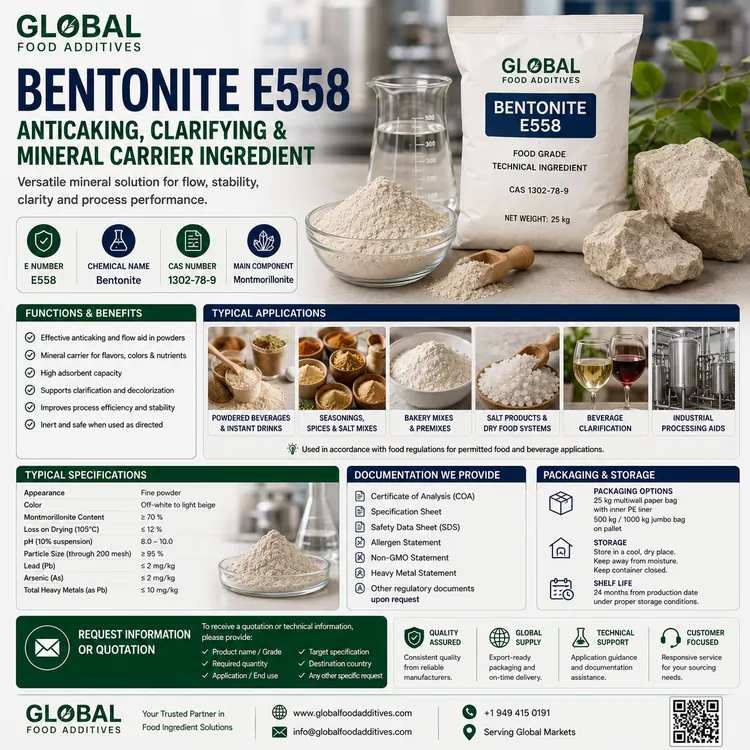
Product identity
| Product | Bentonite |
|---|---|
| Common names | Food-grade bentonite, E558, montmorillonite clay, smectite clay, sodium bentonite, calcium bentonite, activated bentonite |
| Category | Anticaking, Flow & Mineral Carriers |
| Function | Anticaking agent / flow aid / mineral carrier / adsorbent processing aid / clarification support |
| E / INS number | E558 |
| CAS / identity | 1302-78-9 |
| Material family | Natural clay mineral, typically rich in montmorillonite or related smectite clay minerals |
| Grade types | Sodium Bentonite, calcium Bentonite, activated Bentonite, low-grit grade, high-swelling grade, adsorbent grade or carrier grade depending on supplier specification |
| Typical form | Fine powder, micronized powder, granule, agglomerated grade, activated grade or mineral carrier grade |
| Typical grade focus | Food grade, beverage-clarification grade, anticaking grade, flow-aid grade, salt grade, premix-carrier grade or destination-market compliant grade |
Application fit
Bentonite is evaluated where manufacturers need improved powder handling, moisture management, mineral carrier functionality, adsorption or process clarification. Suitability depends on particle size, swelling index, adsorption profile, impurity limits, microbial quality, dusting, flow behaviour, pH, grit content and destination-market rules.
- Powdered beverages, instant drink bases, dry mixes and soluble powder systems
- Seasonings, savoury powders, spice blends, flavour carriers and coating powders
- Vitamin, mineral, enzyme, colour, flavour and functional-ingredient premixes
- Bakery mixes, dry dough improver systems, flour blends and industrial baking powders
- Salt products, mineral blends and hygroscopic granular ingredients where permitted
- Clarification or fining systems for selected beverages and liquid food processes where allowed
- Processing-aid adsorption systems for removal of haze-forming proteins or selected impurities
- Tablet dusting, dry granulation and mineral carrier use after regulatory and customer review
Technical function in food systems
Bentonite is a mineral clay with high surface area and adsorption potential. In dry food systems it may support powder flow, reduce caking tendency, absorb minor surface moisture and act as a mineral carrier for other ingredients. In selected beverage and liquid-processing applications, Bentonite may be used as a processing aid for clarification, fining or adsorption of haze-forming components, depending on local rules and process design.
Functional performance depends heavily on clay type and specification. Sodium Bentonite grades typically show stronger swelling and hydration behaviour, while calcium Bentonite grades may behave differently in adsorption, clarification and powder applications. Activated grades may be modified to improve certain industrial properties. For this reason, Bentonite should not be purchased by name alone; the buyer should define the intended function and compare technical parameters such as particle size, swelling index, moisture, adsorption capacity, grit, heavy metals and food-grade documentation.
Key functional properties
- Anticaking support: Helps improve handling of hygroscopic powders by absorbing surface moisture and reducing lump formation where permitted.
- Powder-flow improvement: Can reduce sticking, bridging and clumping in selected dry blends when particle size and dosage are appropriate.
- Mineral carrier function: Can act as a carrier for flavours, colours, enzymes, vitamins, minerals or other dry ingredients where suitable.
- Adsorbent behaviour: High surface area and clay structure can adsorb selected compounds in process applications.
- Clarification support: Selected grades may be used in beverage or liquid-food fining systems where permitted and validated.
- Moisture management: Can support dry-blend stability where surface moisture contributes to caking or poor flow.
- Processing-aid flexibility: May be evaluated as a removable aid in selected liquid processes, with use and labelling dependent on local rules.
Process variables to control
- Sodium, calcium, activated or supplier-specific Bentonite type
- Particle size distribution, fines content and dusting behaviour
- Swelling index, hydration rate and water absorption
- Moisture content, storage humidity and packaging barrier
- pH of slurry, mineral profile and possible interaction with acidic systems
- Adsorption capacity, clarification performance or carrier loading capacity
- Bulk density, flowability, segregation risk and dry-blend uniformity
- Heavy metals, grit, crystalline silica statement and contaminant-control documentation where required
Grade selection and formulation guidance
For industrial purchasing and R&D work, Bentonite should be selected by application target rather than generic mineral name. A high-swelling sodium Bentonite may be useful where hydration and swelling are required, but it may not be the best choice for every dry-blend or clarification system. A calcium Bentonite or activated grade may provide different adsorption, filtration or handling behaviour. The correct grade depends on whether the target is flow improvement, carrier function, moisture absorption, beverage clarification, haze removal, ingredient standardisation or process adsorption.
Dry-blend and anticaking evaluation
- Define the target problem: caking, bridging, poor flow, moisture pick-up, sticking, dusting or segregation.
- Test Bentonite in the real powder blend, not only as a single ingredient.
- Evaluate flow through hoppers, feeders, sachet lines, augers, mixers and packaging equipment.
- Measure caking tendency after humidity exposure and shipping simulation.
- Check sensory impact, colour impact, mouthfeel, insoluble residue and dispersion behaviour in the final product.
- Confirm legal use level, label declaration and customer acceptance before commercial use.
Clarification and processing-aid evaluation
- Define whether the application requires protein haze reduction, clarification, adsorption or process impurity removal.
- Prepare Bentonite slurry according to supplier guidance and plant process requirements.
- Evaluate contact time, dosage, mixing energy, settling time, filterability and residue removal.
- Measure clarity, turbidity, haze stability, colour change, flavour impact and yield loss.
- Verify whether the Bentonite is used as a processing aid and whether removal or residual limits apply.
- Confirm destination-market rules for use in beverages, juices, wine, vinegar or other liquid food processes.
Industrial formulation guidance
Bentonite can improve handling in powder systems, but excessive use or the wrong particle profile can create dust, dull colour, gritty mouthfeel, poor dispersion or equipment buildup. In liquid systems, excessive dosage can remove desirable colour, aroma, proteins or texture components. Therefore, development trials should evaluate both technical benefit and finished-product quality.
Recommended use evaluation
- Define the intended role: anticaking, flow aid, carrier, mineral processing aid, adsorbent or clarification aid.
- Confirm the food-grade status, E558 reference, CAS 1302-78-9 and destination-market permission.
- Select sodium, calcium, activated or supplier-specific grade according to functional requirement.
- Run handling trials under realistic humidity, packaging, transport and plant conditions.
- Measure flow rate, angle of repose, caking index, moisture uptake, bulk density and segregation risk where relevant.
- For clarification use, measure turbidity, haze stability, filterability, sediment volume and sensory impact.
- Review heavy metals, crystalline silica, grit and contaminant declarations before production approval.
Common processing risks
- Dusting: Fine mineral powders can create airborne dust and handling concerns without proper controls.
- Grittiness: Inadequate particle-size control may create mouthfeel or residue issues in finished products.
- Over-adsorption: In liquid systems, excessive Bentonite can remove desirable colour, flavour or functional components.
- Poor hydration: In clarification applications, poor slurry preparation can reduce performance or create clumps.
- Moisture pick-up: Poor packaging or humid storage can reduce flow performance and create caking in the additive itself.
- Contaminant risk: Natural mineral ingredients require careful heavy-metal, grit and impurity review.
- Regulatory mismatch: Use as additive, carrier or processing aid may be treated differently by market and food category.
Application-specific value
Bentonite is used across selected powder-handling and processing-aid applications where mineral adsorption, moisture management and powder flow are commercially important. It may be compared with silicon dioxide, calcium silicate, magnesium silicate, talc, kaolin, cellulose, tricalcium phosphate, starches or other anticaking and carrier systems. The best choice depends on label strategy, permitted use, particle behaviour, sensory impact, humidity exposure and cost-in-use.
Powdered beverages and instant mixes
- Can be evaluated to improve dry-flow behaviour and reduce caking in selected powdered beverage systems where permitted.
- Useful where hygroscopic acids, sugars, flavours, colours or minerals create poor flow or packaging difficulty.
- Requires testing for dispersibility, sediment, turbidity, grit, mouthfeel and visual impact after reconstitution.
- Finished products should be evaluated after humidity exposure, shipping simulation and shelf-life storage.
Seasonings, spices and savoury powders
- Can support flow in seasoning powders, spice blends, savoury bases and dry coating systems where allowed.
- May help reduce clumping caused by moisture, oil-coated flavour particles, salt or hygroscopic ingredients.
- Requires review of colour impact, flavour adsorption, dusting, shaker performance and blend uniformity.
- Finished systems should be checked for flow through dosing equipment, sachets, drums and consumer packs.
Premixes, mineral carriers and bakery mixes
- Can act as a carrier or flow aid in selected vitamin, mineral, enzyme, colour or flavour premixes where permitted.
- May support dry-blend handling in bakery mixes, dough improver systems and flour-based preparations.
- Requires review of interaction with enzymes, vitamins, colours, acids, leavening systems and moisture-sensitive ingredients.
- Premixes should be validated for uniformity, segregation, dusting, assay recovery and finished-product performance.
Salt products and mineral blends
- Can be evaluated as an anticaking or flow-support ingredient in salt or mineral blends where local rules permit.
- Useful where salt humidity, particle-size distribution and storage conditions create hardening or lumping.
- Requires comparison with other anticaking systems for flow, taste, colour, residue and label requirements.
- Finished products should be tested for moisture pick-up, caking, flow after compression and packaging performance.
Typical specification points to review
For industrial purchasing, the most useful comparison is not only price per kilogram. Bentonite grades may differ in clay type, montmorillonite content, particle size, swelling index, moisture, colour, grit, pH, heavy metals, microbiological quality, adsorption capacity and documentation package. Buyers should request the supplier’s actual specification and certificate of analysis before approval.
Technical parameters
| Identity | Confirm Bentonite, E558 and CAS 1302-78-9 alignment with specification and regulatory documentation. |
|---|---|
| Clay type | Confirm sodium Bentonite, calcium Bentonite, activated grade or supplier-defined mineral type. |
| Montmorillonite content | Useful for comparing clay quality and functional consistency where specified. |
| Particle size | Affects flow, dusting, dispersion, grittiness, filtration and carrier performance. |
| Moisture / loss on drying | Important for flowability, caking risk, microbial stability and shelf-life comparison. |
| Swelling index | Important for sodium Bentonite and applications requiring hydration or swelling behaviour. |
| Methylene blue value / CEC | May be used as an indicator of clay activity, adsorption potential or montmorillonite content where specified. |
| pH of slurry | Relevant for beverage, clarification, dry-blend and acid-sensitive applications. |
| Bulk density | Important for packaging, dosing, dry blending and warehouse planning. |
| Colour and odour | Important for light-coloured powders, beverages and flavour-sensitive applications. |
| Grit / insoluble coarse particles | Critical for mouthfeel, filtration and equipment-wear concerns. |
| Heavy metals | Review arsenic, lead, cadmium, mercury and other market-specific limits. |
| Crystalline silica statement | Request where required by worker-safety, customer or destination-market policy. |
| Microbiology | Review total plate count, yeast and mold, coliforms, Salmonella and other organisms according to buyer requirement. |
Commercial parameters
| Packaging | Commonly supplied in PE-lined bags, multiwall paper bags, cartons, drums, fibre drums, pails or big bags depending on grade and supplier. |
|---|---|
| Net weight | Confirm available pack sizes according to supplier, particle form, order volume and destination logistics. |
| Palletization | Confirm pallet type, wrapping, stack height, bag count, container loading and moisture protection. |
| Shelf life | Confirm from supplier documents; mineral products may be stable but still require controlled storage and packaging integrity. |
| Storage | Store tightly closed in a clean, dry, cool and well-ventilated area away from moisture, strong odours, pests and contamination. |
| Handling | Use dust control, accurate weighing, clean utensils and appropriate personal protection according to the safety data sheet. |
| MOQ | Depends on supplier, grade, particle size, stock position, documentation package, packaging format and destination logistics. |
| Lead time | Depends on mining, activation or milling schedule, quality release, documentation, inspection and freight route. |
| Cost-in-use | Compare performance, dosage efficiency, flow improvement, contaminant profile and regulatory fit rather than kilogram price alone. |
Quality, food safety and compliance notes
Bentonite for food manufacturing should be purchased only with clear food-grade documentation, mineral identity, traceability and contaminant-control support. Because Bentonite is a natural mineral material, the buyer should pay particular attention to heavy metals, arsenic, lead, cadmium, mercury, grit, crystalline silica statements, microbial quality and mining-origin controls. Where the product is used as a processing aid, the buyer should also verify whether removal, residue or declaration requirements apply.
QA team checklist
- Confirm product name, E/INS number, CAS number, mineral identity and food-grade status.
- Check whether the requirement is sodium Bentonite, calcium Bentonite, activated Bentonite, carrier grade or clarification grade.
- Compare supplier specification with internal purchasing and application requirements.
- Review actual batch COA before shipment or release.
- Confirm particle size, moisture, pH, swelling index, grit, heavy metals and microbiological limits.
- Verify allergen, GMO, halal, kosher, vegan or other buyer-required statements where applicable.
- Review crystalline silica, mining origin, contaminant and environmental statements where required.
- Check production date, expiry or retest date, batch number, label information and packaging integrity.
- Conduct application trials before changing supplier, grade, particle size or use level.
Regulatory review points
- Destination-market permission for Bentonite / E558 in the relevant food category
- Classification as additive, anticaking agent, carrier, mineral aid or processing aid
- Maximum permitted use level, quantum satis principle, residue requirement or customer-specific limit where applicable
- Finished-product label declaration as Bentonite, E558, anticaking agent, carrier or local required name
- Use in beverage clarification, wine/juice fining, salt products, premixes or powdered foods where relevant
- Heavy metal and mineral-contaminant limits for food-contact or food-additive use
- Worker-safety requirements for dust, respirable particles or crystalline silica statements
- Import documentation, customs description and local registration requirements
Documents to request
A complete Bentonite inquiry should include both technical and commercial document requirements. This helps reduce delays during supplier qualification, sample approval, customer audits, customs clearance, plant safety review and first production trials.
Core documents
- Product specification or technical data sheet
- Certificate of analysis for available batch or representative lot
- Safety data sheet
- Food-grade statement or regulatory compliance declaration
- Statement confirming Bentonite / E558 / CAS 1302-78-9 identity where applicable
- Mineral source, clay type and origin statement where available
- Heavy-metal statement and contaminant-control declaration
- Particle-size, swelling-index or adsorption-performance information where relevant
- Shelf-life or retest-date and recommended storage conditions
- Product label, packaging details and pallet configuration
Optional buyer-specific documents
- Halal certificate, kosher certificate or other market-specific certification
- Allergen statement and cross-contamination declaration
- GMO status declaration
- Vegan or vegetarian suitability statement where required
- Crystalline silica statement or respirable dust information where required
- Microbiological specification and pathogen statement
- Wine, juice, beverage or processing-aid suitability statement where applicable
- Mining-origin, sustainability or environmental statement where requested
- Country-specific import, customs or registration documents
How to request this product
Send the product name, target grade, function, particle size, application, quantity, destination country, packaging preference, delivery term, expected shipment date and required documents. If you already purchase Bentonite, attach or describe your existing specification, label, certificate of analysis, particle size, swelling index, heavy-metal limits, application trial target and finished-product process so supplier options can be compared more accurately.
Information that improves quotation accuracy
- Target application and finished-product or process type
- Required function: anticaking, flow aid, carrier, clarification, adsorption or processing aid
- Required grade: sodium Bentonite, calcium Bentonite, activated Bentonite, carrier grade or clarification grade
- Required particle size, swelling index, colour, pH, moisture or reference specification
- Powder blend composition, moisture sensitivity, packaging format and shelf-life target
- For liquid processing: product pH, turbidity target, contact time, filtration method and residue requirement
- Current Bentonite grade, dosage, specification or reference COA
- Required annual volume and first-order quantity
- Preferred packaging size and pallet requirement
- Destination port, warehouse or delivery city
- Required Incoterms such as EXW, FOB, CFR, CIF or DAP
- Required certificates and destination-market declarations
- Sample quantity and expected approval timeline
Supplier comparison criteria
- Food-grade documentation completeness
- Mineral identity, clay type and source traceability
- Particle-size consistency and low-grit performance
- Flow improvement, adsorption or clarification performance in the buyer’s real application
- Heavy-metal, crystalline silica and contaminant-control documentation
- Dusting, handling and worker-safety support
- Regulatory fit for the target destination market and food category
- Packaging strength, moisture protection and contamination control
- Batch traceability and shelf-life or retest period remaining at shipment
- Total landed cost and performance cost-in-use
Useful answers
What is Bentonite used for in food manufacturing?
Bentonite E558 is used as an anticaking agent, flow aid, mineral carrier, adsorbent clay and processing aid in selected dry blends, powders, seasonings, premixes, salt products and clarification systems. Exact suitability depends on grade, application, process, regulations and supplier documents.
Is Bentonite the same as montmorillonite?
Bentonite is typically a natural clay material rich in montmorillonite or related smectite minerals. Supplier specifications should confirm mineral identity, clay type, source and food-grade suitability.
What is the difference between sodium Bentonite and calcium Bentonite?
Sodium Bentonite generally has stronger swelling and water-absorption behaviour, while calcium Bentonite may show different adsorption, clarification and powder-handling properties. The correct grade depends on the target function and process conditions.
Can Bentonite be used for beverage clarification?
Selected Bentonite grades may be used as clarification or fining processing aids in certain beverage or liquid food applications where permitted. Buyers should verify grade suitability, filtration performance, residue requirements and destination-market rules.
Which technical parameters should be checked before purchasing?
Buyers should compare identity, clay type, particle size, moisture, swelling index, pH, bulk density, colour, odour, grit, adsorption capacity, heavy metals, crystalline silica statement where required, microbiological limits, packaging type, shelf life and destination-market compliance.
Can Global Food Additives source Bentonite?
Global Food Additives can review sourcing options for Bentonite according to target specification, function, grade type, particle size, application, quantity, destination, packaging preference, delivery term and required documentation.
Which documents should be requested?
Buyers commonly request a technical data sheet, product specification, certificate of analysis, safety data sheet, food-grade statement, origin statement, heavy-metal declaration, allergen or GMO declaration where required, shelf-life or retest information, label details and packing configuration.
Is this product permitted in every country?
No. Food additive and processing-aid use depends on destination-market rules, food category, use level, residue expectations, label requirements, customer restrictions and buyer responsibility. The buyer should confirm local regulations and customer standards before commercial use.
What should be tested during factory trials?
Factory trials should evaluate powder flow, caking, dusting, segregation, moisture pick-up, dispersion, mouthfeel, residue, clarification effect, filterability, sensory impact, heavy-metal compliance, packaging performance and finished-product regulatory compliance.
Tell us which food additive or ingredient you need.
Send product names, target specifications, quantity, destination country, packaging preference, delivery term, and document requirements. Our team will review your inquiry and respond from orders@foodgradeadditives.com.
Your message has been received. You will be redirected to the home page.