
Benzoic Acid
Benzoic Acid, identified in many food-additive systems as E210, is a food-grade preservative and antimicrobial shelf-life support ingredient used by industrial food and beverage manufacturers to help control yeast, mould and selected bacteria in acidic products where permitted. It is especially relevant for beverages, sauces, condiments, fruit preparations, bakery fillings, pickled products, syrups and other low-pH or acidified systems that require microbial-stability design.
This page is prepared as a technical sourcing reference for purchasing teams, R&D technologists, QA departments, regulatory teams and import managers who need to compare Benzoic Acid assay, particle form, solubility behaviour, food-category fit, documentation, packaging and supplier suitability before quotation or approval.
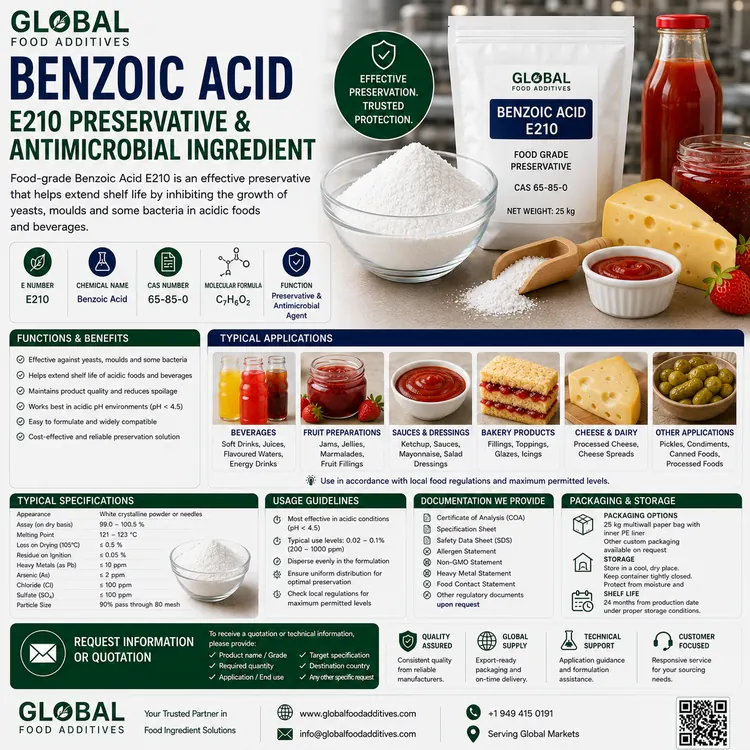
Product identity
| Product | Benzoic Acid |
|---|---|
| Common names | Benzenecarboxylic acid, phenylcarboxylic acid, food-grade benzoic acid, preservative E210 |
| Category | Preservatives & Antimicrobials |
| Function | Preservative / antimicrobial shelf-life support / yeast and mould control ingredient |
| E / INS number | E210 |
| CAS / identity | 65-85-0 |
| Chemical family | Aromatic carboxylic acid |
| Preservative system | Weak-acid preservative; performance is strongly influenced by finished-product pH and microbial challenge |
| Typical form | White crystalline powder, flakes, granules or formulated preparation depending on supplier specification |
| Typical grade focus | Food grade, beverage grade, sauce grade, preservative grade, low-odour grade, fine-powder grade or destination-market compliant grade |
Application fit
Benzoic Acid is evaluated where a food manufacturer needs antimicrobial shelf-life support in acidic or acidified systems. Suitability depends on pH, water activity, preservative solubility, product microflora, heat process, packaging, storage temperature, legal use level and customer label policy.
- Carbonated and still beverages, juice drinks, syrups and drink bases where permitted
- Sauces, dressings, condiments, ketchup-style systems, marinades and relishes
- Fruit preparations, jams, toppings, fillings and acidified dessert systems
- Bakery fillings, glazes and intermediate fruit-based ingredients
- Cheese, dairy-adjacent and processed cheese-style systems where permitted
- Pickled products, vinegar-based foods and acidified vegetable systems
- Snack seasonings, savoury bases and processed foods where local rules allow
- Selected meat-processing or prepared-food systems only after strict category-specific regulatory review
Technical function in food systems
Benzoic Acid supports microbial stability mainly through its weak-acid preservative action. In acidic foods, a larger proportion of benzoic acid remains in the undissociated form, which is generally the form associated with antimicrobial performance. This is why pH is one of the most important formulation variables. A product with a suitable total benzoate level but a poorly controlled pH may not deliver the intended preservative performance.
Benzoic Acid is generally considered for yeast and mould control, with activity against selected bacteria depending on product conditions. It should be designed as part of a full hurdle system that may include pH control, heat treatment, hygienic filling, water activity control, packaging barrier, cold-chain management, oxygen management and compatibility with other preservatives such as sorbates where permitted.
Key functional properties
- Yeast and mould control: Helps support shelf-life stability in acidic foods susceptible to yeast and mould spoilage.
- Acidic-system performance: Best evaluated in low-pH or acidified formulations where the preservative form is more active.
- Shelf-life support: Can contribute to longer commercial life when combined with good hygiene, heat process and packaging.
- Preservative standardisation: Supports repeatable preservative input in sauces, beverages, fillings and intermediate ingredients.
- Blend flexibility: May be evaluated with sorbates, organic acids, heat treatment and other hurdles where permitted.
- Dry ingredient handling: Powder or granular forms can be used in dry premixes or dissolved into suitable process streams.
- Known additive identity: E210 and CAS 65-85-0 provide clear specification references for purchasing and QA documentation.
Process variables to control
- Finished-product pH and buffer capacity
- Water activity, sugar level, salt level and soluble solids
- Target spoilage organisms: yeast, mould or selected bacteria
- Solubility, dispersion and order of addition
- Heat process, hot fill, pasteurization or aseptic handling conditions
- Packaging oxygen barrier, headspace and closure integrity
- Storage temperature, distribution time and expected shelf life
- Interaction with ascorbic acid, colours, flavours, minerals and other preservatives
Formulation and preservative-system guidance
For industrial purchasing and R&D work, Benzoic Acid should be selected by specification, solubility behaviour, particle form, intended pH range and application fit. Because Benzoic Acid has lower water solubility than many benzoate salts, some manufacturers compare Benzoic Acid with sodium benzoate, potassium benzoate or calcium benzoate depending on solubility, sodium/potassium policy, label requirements and process design. The correct choice depends on finished-product conditions and local rules.
Recommended use evaluation
- Define the target spoilage risk: yeast growth, mould growth, refermentation, gas formation, turbidity or microbial shelf-life drift.
- Confirm pH, water activity, soluble solids, preservative level and expected storage temperature.
- Check whether Benzoic Acid, sodium benzoate, potassium benzoate or a mixed preservative system is the best technical fit.
- Confirm dissolution and mixing before filling, especially in cold processes or concentrated systems.
- Run preservative assay and microbiological testing on the finished product, not only on the premix.
- Evaluate flavour impact, aftertaste, pH drift, colour interaction and packaging compatibility.
- Confirm local permitted use level, label declaration and customer restrictions before commercial use.
Common processing risks
- High pH: Preservative performance can drop significantly if the finished-product pH is too high for the intended system.
- Poor dissolution: Incomplete dissolution can create non-uniform preservative distribution and inconsistent microbial control.
- Late addition: Adding preservative after contamination or poor hygiene cannot reliably correct a weak process.
- Flavour impact: Excessive or poorly balanced preservative systems can contribute flavour or aftertaste concerns.
- Compatibility issues: Certain colours, flavours, vitamin systems and minerals should be reviewed for interaction risk.
- Regulatory mismatch: Food-category permissions and use limits vary by destination market.
- Customer policy restrictions: Some brands or retailers restrict certain preservatives despite legal permission.
Application-specific value
Benzoic Acid is used across selected food categories where pH, water activity and product design support preservative performance. It may be compared with sodium benzoate, potassium benzoate, sorbic acid, potassium sorbate, calcium propionate, acetic acid systems, vinegar-based systems, cultured dextrose, natamycin, thermal processing or other preservation strategies. The best choice depends on food category, microbial risk, label expectations, process capability, legal status and cost-in-use.
Beverages and drink bases
- Can support shelf-life design in acidic beverages, drink bases, syrups and concentrates where permitted.
- Useful where yeast growth, refermentation, cloud instability or spoilage risk must be controlled.
- Requires review of pH, carbonation, heat process, ascorbic acid, flavours, colours and packaging light exposure.
- Finished products should be tested for preservative level, microbial stability, sensory impact and storage performance.
Sauces, condiments and dressings
- Can be evaluated in acidic sauces, condiments, dressings, marinades, relishes and ketchup-style products.
- Performance depends on pH, vinegar or acid system, salt, sugar, solids, oil phase and mixing uniformity.
- Preservative design should consider yeast, mould and post-process contamination risk.
- Finished products should be reviewed for pH drift, phase separation, preservative distribution and sensory balance.
Bakery fillings and fruit preparations
- Can support mould and yeast control in acidic fruit fillings, glazes, toppings and bakery intermediates where allowed.
- Useful in high-sugar systems where water activity and pH work together with the preservative strategy.
- Requires review of fruit solids, pectin, starch, acid level, heat process and packaging hygiene.
- Finished systems should be evaluated for microbial stability, flavour impact, colour change and storage texture.
Cheese, dairy-adjacent and processed foods
- May be considered in selected cheese, processed cheese-style, dairy-adjacent or prepared food systems where local rules permit.
- Requires strict review of food category, pH, salt, water activity, fat phase, heat process and label declaration.
- Compatibility with cultures, enzymes, flavours, colours and packaging atmosphere should be checked.
- Finished products should be validated through microbial testing and regulatory review before commercial use.
Typical specification points to review
For industrial purchasing, the most useful comparison is not only price per kilogram. Benzoic Acid grades may differ in assay, purity, particle size, odour, colour, solubility, related substances, residue on ignition, heavy metals, packaging and documentation package. Buyers should request the supplier’s actual specification and certificate of analysis before approval.
Technical parameters
| Assay | Key purchasing parameter; confirm purity, basis and analytical method from supplier documentation. |
|---|---|
| Identification | Confirm Benzoic Acid identity, E210 reference and CAS 65-85-0 alignment with specification. |
| Appearance | Typically white crystalline powder, flakes or granules depending on supplier grade. |
| Particle size | Affects dissolution speed, dusting, dosing accuracy and dry-blend uniformity. |
| Odour | Important for beverages, sauces and flavour-sensitive applications. |
| Melting range | Useful identity and purity indicator where included in the specification. |
| Moisture / loss on drying | Important for storage stability, flowability and caking risk. |
| Residue on ignition / ash | Useful purity parameter for comparing food-grade lots. |
| Related substances | Review according to food-grade, FCC, pharmacopeial or customer-specific requirements where applicable. |
| Chloride and sulfate | May be specified for purity control and destination-market compliance. |
| Solubility | Important for process design, premix preparation and comparison with benzoate salts. |
| Heavy metals | Should comply with food-grade and destination-market limits. |
| Microbiology | Often less critical than for nutrient ingredients, but may still be requested by buyer policy or application category. |
Commercial parameters
| Packaging | Commonly supplied in PE-lined bags, cartons, fibre drums, pails or big bags depending on supplier and grade. |
|---|---|
| Net weight | Confirm available pack sizes according to supplier, particle form, order volume and destination logistics. |
| Palletization | Confirm pallet type, wrapping, stack height, bag count, container load and moisture protection. |
| Shelf life | Confirm from supplier documents; depends on packaging, storage and quality system. |
| Storage | Store tightly closed in a clean, dry, cool and well-ventilated area away from moisture, strong odours and incompatible materials. |
| Handling | Use dust control, accurate weighing, clean utensils and appropriate personal protection according to the safety data sheet. |
| MOQ | Depends on supplier, grade, stock position, documentation package, packaging format and destination logistics. |
| Lead time | Depends on production schedule, quality release, documentation, inspection and freight route. |
| Cost-in-use | Compare assay, effective preservative contribution, solubility, regulatory fit and shelf-life performance rather than kilogram price alone. |
Quality, food safety and compliance notes
Benzoic Acid for food manufacturing should be purchased only with clear food-grade documentation, traceability and regulatory support. The buyer should verify that the material is suitable for the intended food category, destination market, use level, customer standard and finished-product label. Where the product is used for beverages, child-focused products, export items, private label goods, special nutrition products or preservative-sensitive customer policies, regulatory confirmation should be completed before commercial use.
QA team checklist
- Confirm product name, E/INS number, CAS number, chemical identity and food-grade status.
- Check whether the requirement is Benzoic Acid E210 or a benzoate salt such as sodium benzoate, potassium benzoate or calcium benzoate.
- Compare supplier specification with internal purchasing and application requirements.
- Review actual batch COA before shipment or release.
- Confirm assay, appearance, particle size, odour, moisture, ash and impurity limits.
- Verify allergen, GMO, halal, kosher, vegan or other buyer-required statements where applicable.
- Review safety data sheet, storage conditions and handling precautions before plant use.
- Check production date, expiry date, batch number, label information and packaging integrity.
- Conduct preservative assay, pH verification and microbiological validation before changing supplier, grade or use level.
Regulatory review points
- Destination-market permission for Benzoic Acid / E210 in the relevant food category
- Maximum permitted use level, carry-over rules and customer-specific limits where applicable
- Finished-product label declaration as preservative, Benzoic Acid, E210 or local required name
- Use in beverages, sauces, bakery fillings, cheese systems, meat products or special nutrition categories where relevant
- Interaction review for products containing ascorbic acid, colour systems or other sensitive ingredients
- Customer standards, retailer restricted lists and clean-label preservative policies
- Import documentation, customs description and local registration requirements
- Finished-product safety, microbial stability, label accuracy and compliance responsibility
Documents to request
A complete Benzoic Acid inquiry should include both technical and commercial document requirements. This helps reduce delays during supplier qualification, sample approval, customer audits, customs clearance, safety review and first production trials.
Core documents
- Product specification or technical data sheet
- Certificate of analysis for available batch or representative lot
- Safety data sheet
- Food-grade statement or regulatory compliance declaration
- Statement confirming Benzoic Acid / E210 / CAS 65-85-0 identity where applicable
- Origin statement and manufacturer information where available
- Shelf-life and recommended storage conditions
- Product label, packaging details and pallet configuration
Optional buyer-specific documents
- Halal certificate, kosher certificate or other market-specific certification
- Allergen statement and cross-contamination declaration
- GMO status declaration
- Vegan or vegetarian suitability statement where required
- Heavy metal statement or contaminant declaration
- Residual solvent or impurity statement where applicable
- Microbiological statement where required by customer policy
- FCC, pharmacopeial or market-specific compliance statement where requested
- Country-specific import, customs or registration documents
How to request this product
Send the product name, target specification, assay requirement, application, quantity, destination country, packaging preference, delivery term, expected shipment date and required documents. If you already purchase Benzoic Acid, attach or describe your existing specification, label, certificate of analysis, preservative system, use level, finished-product pH, target shelf life and microbial challenge so supplier options can be compared more accurately.
Information that improves quotation accuracy
- Target application and finished-product type
- Required identity: Benzoic Acid, E210 or CAS 65-85-0
- Required form: powder, fine powder, flakes, granules or formulated preparation
- Required assay, purity or reference specification
- Finished-product pH, water activity, soluble solids, heat process and target shelf life
- Target microbial risk: yeast, mould, refermentation, gas formation or selected bacteria
- Current preservative system, dosage or reference COA
- Required annual volume and first-order quantity
- Preferred packaging size and pallet requirement
- Destination port, warehouse or delivery city
- Required Incoterms such as EXW, FOB, CFR, CIF or DAP
- Required certificates and destination-market declarations
- Sample quantity and expected approval timeline
Supplier comparison criteria
- Food-grade documentation completeness
- Assay consistency and impurity control
- Regulatory fit for the target destination market and food category
- Dissolution and handling performance in the buyer’s process
- Preservative effectiveness in the buyer’s real product matrix
- Compatibility with pH system, flavours, colours and packaging strategy
- Odour neutrality, particle-size consistency and dust control
- Packaging strength, moisture protection and contamination control
- Batch traceability and shelf-life remaining at shipment
- Total landed cost and preservation cost-in-use
Useful answers
What is Benzoic Acid used for in food manufacturing?
Benzoic Acid E210 is used as a preservative and antimicrobial shelf-life support ingredient, especially in acidic food and beverage systems where yeast, mould and selected bacteria must be controlled. Exact suitability depends on pH, water activity, process, regulations and supplier documents.
Why is pH important for Benzoic Acid?
Benzoic Acid is a weak-acid preservative and is typically more effective in acidic products. Finished-product pH, buffer capacity and pH drift during storage should be verified during development and routine production.
Is Benzoic Acid the same as sodium benzoate?
No. Benzoic Acid is E210, while sodium benzoate is a salt of benzoic acid and is typically referenced as E211. Benzoate salts may be selected for solubility or processing reasons, but the correct choice depends on formula, label policy and destination-market rules.
Which products commonly evaluate Benzoic Acid?
Common review areas include acidic beverages, syrups, sauces, condiments, dressings, pickled products, fruit preparations, bakery fillings and selected processed foods where local regulations allow its use.
Which technical parameters should be checked before purchasing?
Buyers should compare assay, identification, E210 and CAS 65-85-0 alignment, appearance, particle size, odour, moisture or loss on drying, residue on ignition, related substances, chloride, sulfate, heavy metals, solubility, packaging type, shelf life and destination-market compliance.
Can Global Food Additives source Benzoic Acid?
Global Food Additives can review sourcing options for Benzoic Acid according to target specification, assay, application, grade form, quantity, destination, packaging preference, delivery term and required documentation.
Which documents should be requested?
Buyers commonly request a technical data sheet, product specification, certificate of analysis, safety data sheet, food-grade statement, origin statement, regulatory compliance declaration, allergen or GMO declaration where required, shelf-life information, label details and packing configuration.
Is this product permitted in every country?
No. Food additive use depends on destination-market rules, food category, permitted use level, carry-over rules, label requirements, customer restrictions and buyer responsibility. The buyer should confirm local regulations and customer standards before commercial use.
What should be tested during factory trials?
Factory trials should evaluate dissolution, dosing accuracy, preservative distribution, finished-product pH, pH drift, preservative assay, microbial stability, challenge-test performance, sensory impact, colour or flavour interaction, packaging performance and finished-product regulatory compliance.
Tell us which food additive or ingredient you need.
Send product names, target specifications, quantity, destination country, packaging preference, delivery term, and document requirements. Our team will review your inquiry and respond from orders@foodgradeadditives.com.
Your message has been received. You will be redirected to the home page.