
Beta-Glucan
Beta-Glucan is a food-grade functional fibre and texture-building ingredient used by industrial food, beverage and nutrition-product manufacturers for fibre enrichment, viscosity development, water binding, mouthfeel improvement, clean-label formulation support and selected nutrition-positioning applications. Source and specification are critical because oat, barley, yeast and mushroom beta-glucans can differ significantly in structure, solubility, viscosity, purity, label declaration and regulatory claim potential.
This page is prepared as a technical sourcing reference for purchasing teams, R&D technologists, QA departments, regulatory teams and import managers who need to compare beta-glucan source, assay, molecular weight, viscosity, functionality, documentation, packaging and supplier suitability before quotation or approval.
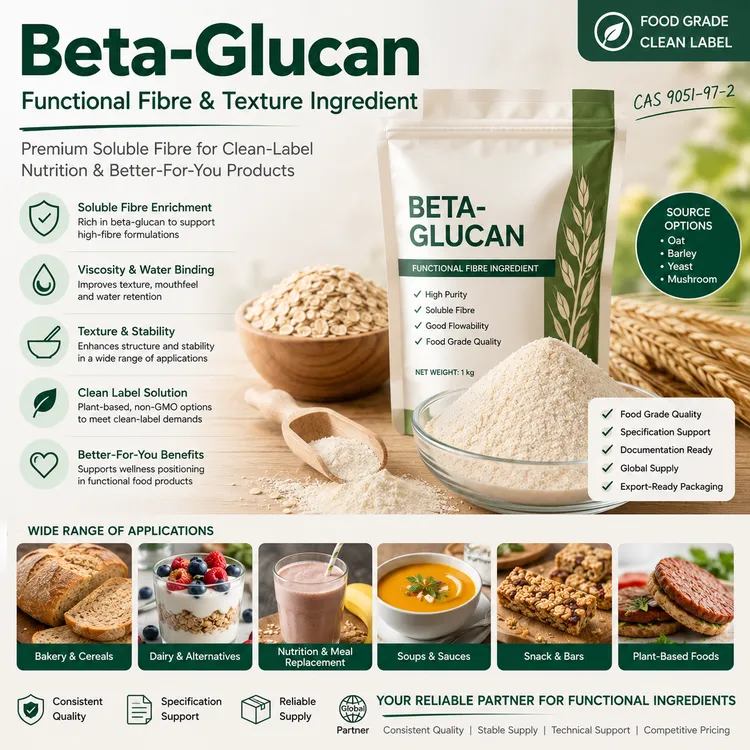
Product identity
| Product | Beta-Glucan |
|---|---|
| Common names | Beta glucan, β-glucan, oat beta-glucan, barley beta-glucan, yeast beta-glucan, mushroom beta-glucan, functional fibre ingredient |
| Category | Proteins, Texturizers & Functional Ingredients |
| Function | Functional fibre / soluble fibre ingredient / texture-building ingredient / water-binding and viscosity-support ingredient |
| E / INS number | Confirm by destination market and supplier documentation |
| CAS / identity | 9051-97-2; exact identity depends on source, linkage structure and supplier specification |
| Possible sources | Oat, barley, yeast, mushroom or other supplier-defined beta-glucan source |
| Typical linkage focus | Cereal beta-glucans are commonly mixed-linkage beta-glucans; yeast and mushroom beta-glucans may be structurally different depending on species and process |
| Typical form | Powder, fine powder, flake, granule, agglomerated powder, soluble fibre concentrate, textured granule or premix-ready blend |
| Typical grade focus | Food grade, soluble fibre grade, high-viscosity grade, oat/barley grade, yeast grade, beverage grade, bakery grade, nutrition grade or customer-specific premix grade |
Application fit
Beta-Glucan is evaluated where manufacturers need fibre enrichment, viscosity, water binding, satiety-positioned formulation, mouthfeel, texture design or clean-label functional support. Suitability depends on source, beta-glucan content, solubility, molecular weight, process shear, heat treatment, pH, hydration method, regulatory claims and finished-product sensory target.
- Plant-based foods, meat alternatives, dairy alternatives and hybrid protein systems
- Bakery products, breads, biscuits, muffins, bars, tortillas and fibre-enriched mixes
- Dairy alternatives, fermented plant-based products, smoothies and spoonable systems
- Meat products, poultry systems, seafood preparations and prepared food systems
- Nutrition products, meal replacements, instant powders, sachets and supplement blends
- Beverages, beverage powders, fibre drinks and functional drink bases after validation
- Cereals, extruded products, granolas, snacks and high-fibre food concepts
- Soups, sauces, dressings and culinary systems requiring body or water management
Technical function in food systems
Beta-Glucan is a polysaccharide ingredient whose functional performance depends on botanical or microbial source, molecular structure, concentration, molecular weight and processing history. In cereal-derived grades, particularly oat and barley beta-glucan, manufacturers often evaluate viscosity, soluble fibre contribution, water binding and texture. In yeast or mushroom-derived grades, the focus may be different and can include insoluble fibre behaviour, particle functionality, label positioning or specific nutrition-product design.
In food manufacturing, Beta-Glucan can support body, mouthfeel, thickening, water retention, fibre enrichment and clean-label texture design. However, performance is strongly affected by hydration, shear, heat, pH, salt, sugar, protein systems and enzymatic degradation. A high-beta-glucan ingredient may not perform as expected if molecular weight is reduced or if processing conditions break down viscosity.
Key functional properties
- Fibre enrichment: Supports dietary fibre formulation and fibre-positioned products where permitted by local rules.
- Viscosity development: Soluble cereal beta-glucan grades can increase viscosity and improve body in selected systems.
- Water binding: Helps manage moisture, reduce dryness and improve eating quality in bakery, meat and plant-based applications.
- Mouthfeel improvement: Can provide smoothness, fullness and creaminess in beverages, dairy alternatives and nutrition products.
- Texture support: May help build structure in plant-based foods, bakery products, sauces and prepared meals.
- Clean-label formulation: Can support fibre-based texture design where manufacturers want alternatives to some gums or synthetic texturizers.
- Nutrition positioning: Enables selected fibre, soluble fibre or source-specific nutrition concepts where regulations allow.
Process variables to control
- Source: oat, barley, yeast, mushroom or supplier-specific source
- Beta-glucan content, soluble fibre content and assay method
- Molecular weight, viscosity profile and processing sensitivity
- Hydration temperature, mixing speed, shear exposure and order of addition
- pH, acidity, salt, sugar, minerals, protein and fat content
- Heat exposure during baking, extrusion, UHT, retort, pasteurization or drying
- Enzyme activity from cereal, fruit, malt or microbial ingredients
- Finished-product storage, freeze-thaw exposure and shelf-life texture stability
Source selection and formulation guidance
The source of Beta-Glucan is one of the most important purchasing decisions. Cereal beta-glucans from oat or barley are commonly evaluated for soluble fibre, viscosity, water binding and permitted fibre-related labelling where applicable. Yeast and mushroom beta-glucans may be used for different product concepts and can have different solubility, particle behaviour and label positioning. Supplier documentation should clearly state source, processing method, purity and intended use.
Oat and barley beta-glucan
- Commonly selected for soluble fibre enrichment, viscosity and cereal-based nutrition positioning.
- May support fibre or source-specific claims where the finished product meets legal conditions.
- Requires review of gluten status, cereal allergen declarations and cross-contact controls.
- Viscosity depends on molecular weight, hydration, process shear and enzymatic degradation.
- Often used in cereals, bakery, beverages, bars, nutrition powders and dairy-alternative systems.
Yeast and mushroom beta-glucan
- May be selected for functional nutrition concepts, fibre enrichment or specific label positioning.
- Often differs from cereal beta-glucan in solubility, particle behaviour and structural linkage profile.
- Requires confirmation of species/source, extraction method, purity and carrier system.
- May have stronger flavour, colour or dispersibility considerations depending on grade.
- Health or immune-related claims require strict market-specific regulatory review and substantiation.
Industrial formulation guidance
For industrial purchasing and R&D work, Beta-Glucan should be selected by source, beta-glucan content, soluble fibre level, molecular weight and application performance rather than name alone. Two products may both be sold as Beta-Glucan but differ in viscosity, hydration speed, flavour, colour, gluten status, microbial source, carrier system, particle size, dusting, bulk density and finished-product claim suitability.
Recommended use evaluation
- Define the target function: fibre enrichment, viscosity, water binding, mouthfeel, texture support or nutrition positioning.
- Confirm source, beta-glucan assay, soluble fibre content and molecular weight before formulation approval.
- Test the ingredient in the real food matrix, not only in water.
- Evaluate hydration behaviour at the plant’s actual mixing temperature and shear conditions.
- Measure viscosity, water binding, texture, sensory impact and storage stability after processing.
- Check interaction with proteins, gums, starches, emulsifiers, minerals, acids and enzymes.
- Confirm fibre declarations, nutrition claims and source-related label wording before commercial launch.
Common processing risks
- Lumping: Poor dispersion can create fish-eyes, hydration defects or uneven texture.
- Viscosity loss: Excessive shear, enzymes or harsh processing may reduce molecular weight and lower viscosity.
- Source mismatch: Oat, barley, yeast and mushroom grades are not automatically interchangeable.
- Flavour impact: Some high-fibre or yeast-derived grades can contribute cereal, bitter, earthy or fermented notes.
- Texture overbuild: Excess dosage can create slimy, gummy, sticky or overly thick mouthfeel.
- Label mismatch: Fibre claims, soluble-fibre claims and health claims depend on source, dose and jurisdiction.
- Allergen concern: Oat and barley sources may require gluten, cereal or cross-contact review depending on market and supplier controls.
Application-specific value
Beta-Glucan is used across food and nutrition categories where fibre enrichment, texture and body are commercially important. It may be compared with oat fibre, barley fibre, resistant dextrin, inulin, psyllium, cellulose, guar gum, xanthan gum, pectin, modified starches, pea fibre and other functional fibres. The best choice depends on fibre claim target, viscosity requirement, sensory profile, process tolerance, label strategy, allergen position and cost-in-use.
Plant-based foods and meat alternatives
- Can support juiciness, water binding, bite and mouthfeel in plant-based meat or hybrid protein systems.
- May help reduce dryness in high-protein formulations containing pea, soy, wheat or other plant proteins.
- Requires testing with salt, fat, methylcellulose alternatives, starches, fibres and heat-processing conditions.
- Finished products should be evaluated for cooking loss, texture, chew, purge, flavour impact and storage stability.
Bakery, cereals and bars
- Supports fibre enrichment in breads, biscuits, muffins, cereals, bars and dry mixes.
- Can influence dough water absorption, viscosity, softness, crumb structure and shelf-life texture.
- Requires review of gluten status, cereal source, dough handling, proofing, baking and moisture migration.
- Finished products should be checked for volume, spread, bite, dryness, gumminess and label fibre contribution.
Dairy alternatives and beverages
- Can provide body, creaminess and fibre enrichment in oat drinks, plant-based dairy alternatives, smoothies and nutrition drinks.
- Solubility, viscosity, sediment, grittiness and heat stability are critical for beverage applications.
- Requires testing with proteins, minerals, stabilizers, emulsifiers, UHT or pasteurization and package storage.
- Finished products should be evaluated for mouthfeel, phase separation, viscosity drift and sensory neutrality.
Nutrition products and supplements
- Used in meal replacements, instant powders, sachets, capsules, tablets and functional nutrition blends.
- Can contribute fibre content, viscosity, satiety-positioned formulation and powder-body improvement where permitted.
- Powder products require evaluation of flowability, caking, dusting, hydration and scoop accuracy.
- Finished products should be tested for serving-level fibre content, solubility, sensory impact and label compliance.
Typical specification points to review
For industrial purchasing, the most useful comparison is performance in the real application, not only price per kilogram. Beta-Glucan grades may differ in source, assay, molecular weight, viscosity, soluble fibre, purity, colour, flavour, particle size, microbiological quality, allergen status and packaging. Buyers should request the supplier’s actual specification and certificate of analysis before approval.
Technical parameters
| Source | Confirm oat, barley, yeast, mushroom or other source because function, labeling and claims can differ. |
|---|---|
| Beta-glucan content | Key purchasing parameter; confirm assay method and whether value is on dry basis or as-is basis. |
| Soluble fibre content | Important for cereal-derived beta-glucans and fibre declaration strategy. |
| Molecular weight | Strongly influences viscosity, hydration behaviour and selected nutrition-claim requirements. |
| Viscosity | Critical for beverages, sauces, dairy alternatives, nutrition products and satiety-positioned formulas. |
| Linkage type | Important for differentiating cereal, yeast, mushroom and other beta-glucan sources. |
| Moisture | Important for shelf life, powder flowability, caking risk and dry-solids comparison. |
| Particle size | Affects dispersion, dusting, hydration speed, mouthfeel and dry-blend uniformity. |
| Bulk density | Relevant for filling, dosing, packaging and warehouse planning. |
| Protein, fat and ash | Useful for comparing purity, nutrition profile and source-related composition. |
| Colour, flavour and odour | Important for light-coloured foods, beverages and delicate flavour systems. |
| Heavy metals | Should comply with food-grade and destination-market limits. |
| Microbiology | Review total plate count, yeast and mold, coliforms, Salmonella and other pathogens according to buyer requirement. |
Commercial parameters
| Packaging | Commonly supplied in PE-lined bags, cartons, drums, fibre drums, pails or big bags depending on grade and supplier. |
|---|---|
| Net weight | Confirm available pack sizes according to source, grade, concentration and destination logistics. |
| Palletization | Confirm pallet type, wrapping, stack height, bag count, container loading and moisture protection. |
| Shelf life | Confirm from supplier documents; depends on moisture, packaging, source, microbial control and storage conditions. |
| Storage | Store tightly closed in a clean, dry, cool and well-ventilated area away from moisture, strong odours, pests and heat. |
| Handling | Use dust control, controlled dry addition and suitable dispersion methods to reduce lumping and airborne powder. |
| MOQ | Depends on supplier, source, beta-glucan content, grade, stock position, packaging format and destination logistics. |
| Lead time | Depends on raw material supply, extraction or concentration process, testing, documentation and freight route. |
| Cost-in-use | Compare beta-glucan content, viscosity contribution, dosage, application performance and label value rather than kilogram price alone. |
Quality, food safety and compliance notes
Beta-Glucan for food manufacturing should be purchased only with clear food-grade documentation, source identity and traceability. The buyer should verify that the material is suitable for the intended product category, destination market, customer standard and finished-product label. Where the product is used for fibre claims, soluble fibre claims, cholesterol-related claims, blood-glucose claims, prebiotic claims, immune claims or special nutrition products, regulatory confirmation should be completed before commercial use.
QA team checklist
- Confirm product name, source, CAS identity reference, beta-glucan content and food-grade status.
- Check whether the requirement is oat, barley, yeast, mushroom or another source-specific grade.
- Compare supplier specification with internal purchasing and application requirements.
- Review actual batch COA before shipment or release.
- Confirm beta-glucan assay, soluble fibre content, viscosity, moisture, particle size and microbiological limits.
- Verify allergen, gluten, GMO, halal, kosher, vegan or other buyer-required statements where applicable.
- Review pesticide, mycotoxin, heavy metal and contaminant declarations where required.
- Check production date, expiry date, batch number, label information and packaging integrity.
- Conduct incoming QC and application trials before changing supplier, source, dosage or grade.
Regulatory review points
- Destination-market classification as fibre ingredient, food ingredient, additive or novel ingredient where applicable
- Permitted source, food category and use level for the intended product
- Fibre, soluble fibre, high-fibre or source-specific label declaration rules
- Health claim wording, minimum dose, molecular-weight requirements and substantiation where applicable
- Gluten, cereal allergen or source-declaration requirements for oat or barley grades
- Carrier, diluent, processing aid or extraction-residue declaration rules
- Import documentation, customs description and local registration requirements
- Finished-product safety, texture, sensory quality and compliance responsibility
Documents to request
A complete Beta-Glucan inquiry should include both technical and commercial document requirements. This helps reduce delays during supplier qualification, sample approval, customer audits, customs clearance, regulatory review and first production trials.
Core documents
- Product specification or technical data sheet
- Certificate of analysis for available batch or representative lot
- Safety data sheet where applicable
- Food-grade statement or regulatory compliance declaration
- Source declaration: oat, barley, yeast, mushroom or other specified source
- Beta-glucan assay method and content declaration
- Soluble fibre, molecular weight or viscosity information where relevant
- Origin statement and manufacturer information where available
- Shelf-life and recommended storage conditions
- Product label, packaging details and pallet configuration
Optional buyer-specific documents
- Halal certificate, kosher certificate or other market-specific certification
- Allergen statement and cross-contamination declaration
- Gluten-free statement where required and supported by testing
- GMO status declaration
- Vegan or vegetarian suitability statement where required
- Heavy metal statement or contaminant declaration
- Pesticide, mycotoxin or raw-material contaminant statement where required
- Clinical, nutritional or claim-support documentation where permitted and requested
- Country-specific import, customs or registration documents
How to request this product
Send the product name, required source, beta-glucan content, application, target function, quantity, destination country, packaging preference, delivery term, expected shipment date and required documents. If you already purchase Beta-Glucan, attach or describe your existing specification, label, certificate of analysis, fibre target, viscosity method, source requirement or factory trial result so supplier options can be compared more accurately.
Information that improves quotation accuracy
- Target application and finished-product type
- Required source: oat, barley, yeast, mushroom or supplier-specific source
- Required beta-glucan content, soluble fibre content or purity target
- Required function: fibre enrichment, viscosity, water binding, mouthfeel, texture support or claim positioning
- Required particle size, molecular weight, viscosity or hydration behaviour, if available
- Process conditions: dry blending, baking, extrusion, UHT, retort, fermentation, hydration or cold mixing
- Current beta-glucan grade, dosage or reference COA
- Required annual volume and first-order quantity
- Preferred packaging size and pallet requirement
- Destination port, warehouse or delivery city
- Required Incoterms such as EXW, FOB, CFR, CIF or DAP
- Required certificates and destination-market declarations
- Sample quantity and expected approval timeline
Supplier comparison criteria
- Food-grade documentation completeness
- Source consistency and raw-material traceability
- Beta-glucan assay consistency between batches
- Viscosity, molecular weight and hydration performance
- Application performance in the buyer’s real product matrix
- Allergen, gluten and GMO status aligned with finished-product requirements
- Microbiological and contaminant control
- Powder flow, low lumping risk and packaging moisture protection
- Batch traceability and shelf-life remaining at shipment
- Total landed cost and performance cost-in-use
Useful answers
What is Beta-Glucan used for in food manufacturing?
Beta-Glucan is used as a functional fibre and texture-building ingredient for fibre enrichment, viscosity, water binding, mouthfeel improvement, clean-label formulation support and nutrition-positioning applications in selected foods, beverages, plant-based products, bakery, dairy alternatives, meat products and nutrition systems.
Is Beta-Glucan a protein?
No. Beta-Glucan is a polysaccharide fibre, not a protein. It may be used alongside proteins in plant-based, meat, dairy-alternative and nutrition systems to improve texture, water binding or fibre content.
Why does the source of Beta-Glucan matter?
Source affects functionality, solubility, viscosity, linkage structure, label declaration, allergen status and regulatory claims. Oat and barley beta-glucans are commonly associated with soluble fibre and viscosity, while yeast and mushroom beta-glucans can behave differently in food systems.
Can Beta-Glucan be used for fibre claims?
Possibly, but fibre claims depend on source, amount per serving, analytical method, finished-product composition and destination-market regulations. Health-related claims require additional legal and scientific review before use.
Which technical parameters should be checked before purchasing?
Buyers should compare source, beta-glucan content, soluble fibre content, molecular weight, viscosity, linkage type, purity, moisture, particle size, bulk density, colour, flavour, water-binding capacity, solubility or dispersibility, protein, fat, ash, microbiological limits, heavy metals, allergen status, GMO status, packaging type and shelf life.
Can Global Food Additives source Beta-Glucan?
Global Food Additives can review sourcing options for Beta-Glucan according to source, target specification, beta-glucan content, application, function, quantity, destination, packaging preference, delivery term and required documentation.
Which documents should be requested?
Buyers commonly request a technical data sheet, product specification, certificate of analysis, safety data sheet where applicable, food-grade statement, source declaration, origin statement, allergen or GMO declaration where required, shelf-life information, label details and packing configuration.
Is this product permitted in every country?
No. Food ingredient use, fibre claims, health claims, source declarations and label wording depend on destination-market rules, food category, use level, processing method and buyer responsibility. The buyer should confirm local regulations and customer standards before commercial use.
What should be tested during factory trials?
Factory trials should evaluate hydration, lumping, viscosity, water binding, texture, mouthfeel, flavour impact, colour, processing stability, enzyme sensitivity, shelf-life texture stability, powder flow, caking, compatibility with proteins, starches and gums, and finished-product label compliance.
Tell us which food additive or ingredient you need.
Send product names, target specifications, quantity, destination country, packaging preference, delivery term, and document requirements. Our team will review your inquiry and respond from orders@foodgradeadditives.com.
Your message has been received. You will be redirected to the home page.