
Bromelain
Bromelain is a food-grade pineapple-derived protease enzyme preparation used by industrial food manufacturers for controlled protein hydrolysis, meat tenderization, dough rheology adjustment, brewing protein management, seafood processing and selected texture-modification applications. It is valued where a proteolytic processing aid can improve tenderness, reduce protein haze, modify protein networks or support process efficiency without becoming a major finished-product ingredient.
This page is prepared as a technical sourcing reference for purchasing teams, R&D technologists, QA departments, regulatory teams and import managers who need to compare enzyme activity, activity method, source, application fit, documentation, packaging and supplier suitability before quotation or approval.
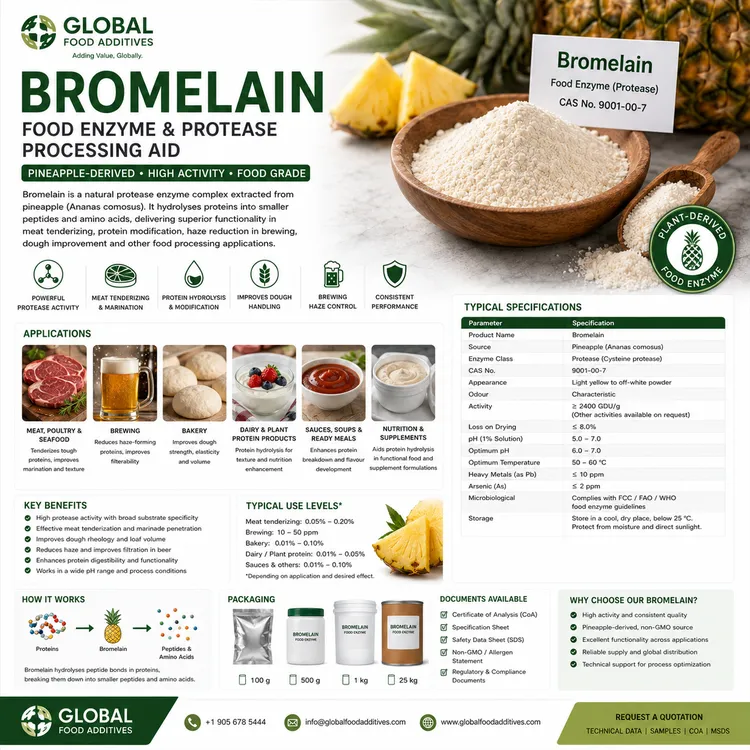
Product identity
| Product | Bromelain |
|---|---|
| Common names | Pineapple protease, pineapple enzyme, stem bromelain, fruit bromelain, bromelin |
| Category | Enzymes & Processing Aids |
| Function | Food enzyme / protease processing aid / protein hydrolysis enzyme / texture modifier |
| E / INS number | Confirm by destination market and supplier documentation |
| CAS / identity | 9001-00-7 |
| Enzyme family | Proteolytic enzyme preparation containing cysteine proteases |
| Typical source | Pineapple stem, fruit, peel or pineapple processing by-products depending on supplier process |
| Typical form | Enzyme powder, granulate, tablet, liquid preparation or standardized enzyme blend |
| Typical grade focus | Food grade, meat tenderizing grade, brewing grade, protein hydrolysis grade, bakery processing grade or customer-specific enzyme activity grade |
Application fit
Bromelain is evaluated where controlled proteolysis can improve process performance or finished-product texture. Suitability depends on enzyme activity, substrate protein, pH, temperature, contact time, salt level, water availability, process sequence and inactivation conditions.
- Meat, poultry and seafood tenderizing systems
- Marinades, injection brines and tumble-processing applications
- Protein hydrolysates, savory bases and peptide-generation processes
- Bakery dough systems where protease action may improve extensibility
- Brewing and beverage systems requiring protein haze management
- Plant-protein modification for texture, solubility or processing performance
- Dairy or dairy-alternative systems where controlled protein breakdown is required after validation
- Industrial enzyme blends where bromelain is combined with other proteases or processing aids
Technical function in food systems
Bromelain functions by hydrolyzing peptide bonds in proteins. In meat and seafood systems, this can weaken muscle protein structures and connective-tissue-related texture, improving tenderness when dosage and contact time are controlled. In bakery systems, limited proteolysis can reduce dough resistance and improve extensibility, but excessive protease activity may weaken structure and reduce volume. In brewing and beverage systems, bromelain may be evaluated for protein-haze reduction and clarity support, depending on product type and process conditions.
Because Bromelain is an enzyme, performance is not defined only by addition rate. The same dosage can perform differently under different pH, temperature, time and substrate conditions. Industrial users should therefore compare enzyme activity units, assay method, temperature profile, pH profile, carrier system and inactivation behavior before approving a grade.
Key functional properties
- Proteolytic activity: Hydrolyzes food proteins and modifies texture, solubility, viscosity or clarity depending on the matrix.
- Meat tenderization: Helps soften meat, poultry and seafood when dosage, time and temperature are controlled.
- Protein hydrolysis: Supports production of hydrolysates, savory bases, functional peptides and modified protein ingredients.
- Dough modification: Can improve dough extensibility and machinability in selected bakery systems.
- Haze reduction: May reduce haze-forming proteins in selected beverage or brewing processes after application validation.
- Texture design: Helps adjust bite, firmness, chew, juiciness perception and protein network structure.
- Processing efficiency: Can reduce mechanical or thermal intensity needed to reach target texture in selected processes.
Process variables to control
- Enzyme activity units and assay method used by the supplier
- Substrate protein type, particle size, surface area and moisture level
- pH of the product matrix and buffer capacity
- Processing temperature, enzyme contact time and residence time
- Salt, phosphate, acid, sugar, oil and seasoning levels
- Order of addition, mixing intensity, tumbling or marination method
- Thermal inactivation step or finished-product heat process
- Sensory impact, texture uniformity and over-softening risk
Industrial formulation guidance
For industrial purchasing and R&D work, Bromelain should be selected by enzyme activity and application performance rather than name alone. Two food-grade Bromelain products may differ in source, purification level, protease activity, carrier, particle size, microbial specification, solubility, dusting behavior, storage stability and activity-retention profile. Application trials are essential before changing supplier, form or activity grade.
Recommended use evaluation
- Define the target function: tenderizing, hydrolysis, dough softening, protein-haze reduction or texture modification.
- Confirm enzyme activity unit, assay method and conversion basis before comparing offers.
- Test the enzyme in the real product matrix, not only in water or laboratory buffer.
- Establish dosage, contact time and temperature window during pilot trials.
- Determine whether enzyme activity must be stopped by heat or other process conditions.
- Evaluate finished-product texture, flavor, color, yield, purge, haze, viscosity and shelf life.
- Review local food-enzyme and processing-aid regulations before commercial use.
Common processing risks
- Over-tenderization: Excess dosage or contact time can create mushy, pasty or non-uniform meat texture.
- Weak dough: Too much protease activity may reduce dough strength, gas retention and finished bakery volume.
- Bitter peptides: Protein hydrolysis can generate bitter notes depending on substrate and degree of hydrolysis.
- Incomplete inactivation: Residual enzyme activity may continue changing texture during storage.
- Uneven distribution: Poor mixing, marination or injection can create localized soft spots.
- Activity mismatch: Supplier activity units may not be directly comparable if methods differ.
- Regulatory mismatch: Food-enzyme permission and labeling can vary by destination market and final use.
Application-specific value
Bromelain is commonly compared with papain, ficin, microbial proteases, fungal proteases, bacterial proteases and specialty enzyme blends. The best enzyme choice depends on target protein, desired texture, processing time, temperature profile, regulatory status, label expectations, activity cost and inactivation strategy.
Meat, poultry and seafood
- Supports tenderizing in beef, poultry, seafood and processed meat systems.
- Can be used in marinades, tumble systems, injection brines or surface treatments after validation.
- Requires careful control of enzyme activity, dosage, contact time and temperature.
- Factory trials should measure tenderness, purge, cooking yield, sliceability, texture uniformity and sensory acceptance.
Bakery and dough systems
- May improve dough extensibility, sheeting behavior and machinability in selected bakery processes.
- Can help reduce excessive dough toughness in crackers, biscuits, wafers, flatbreads and specialty dough systems.
- Must be balanced against gluten weakening, sticky dough, reduced oven spring or low finished volume.
- Trials should evaluate mixing tolerance, fermentation behavior, spread, bite, break strength and shelf life.
Brewing and beverage processing
- May be evaluated for protein modification and haze-control support in selected beverage or brewing systems.
- Can help manage protein-related instability where the process allows enzyme contact and later inactivation or removal.
- Compatibility with pH, alcohol, heat treatment, filtration and product clarity should be checked.
- Finished products should be tested for haze, sediment, flavor impact, foam behavior and storage stability.
Protein hydrolysis and savory systems
- Supports controlled breakdown of animal, plant or dairy proteins to modify solubility, viscosity and mouthfeel.
- Can be used in savory bases, marinades, protein ingredients and peptide-generation processes.
- Degree of hydrolysis must be controlled to avoid bitterness, excessive thinning or off-flavors.
- Hydrolysate production should monitor pH, temperature, enzyme-to-substrate ratio, time and inactivation method.
Typical specification points to review
For industrial purchasing, the most useful comparison is enzyme performance per unit cost, not simply price per kilogram. Bromelain grades may differ in activity, assay basis, source, carrier, solubility, microbial profile, particle size and storage stability. Buyers should request the supplier’s actual specification and certificate of analysis before approval.
Technical parameters
| Enzyme activity | Key selection parameter; confirm activity units, assay method, substrate, pH, temperature and calculation basis. |
|---|---|
| Protease activity profile | Important for predicting performance in meat, dough, beverage or protein hydrolysis systems. |
| Source | Confirm pineapple stem, fruit or other pineapple-derived source where required by customer policy. |
| Carrier system | Powder or granule grades may contain carriers or standardizing agents; confirm label and allergen impact. |
| Appearance | Typically powder, granule, tablet or liquid preparation; should be consistent and free from visible contamination. |
| Particle size | Affects dry blending, dusting, dissolution speed, dispersion and worker exposure control. |
| Solubility / dispersibility | Important for brines, marinades, beverages, enzyme solutions and uniform dosing. |
| Moisture | Important for activity retention, flowability, caking risk and shelf life. |
| pH range | Review operating pH range and optimum pH relative to the target food matrix. |
| Temperature range | Review active temperature range and heat-inactivation behavior for process control. |
| Heavy metals | Should comply with food-grade and destination-market limits. |
| Microbiology | Review total plate count, yeast and mold, coliforms, Salmonella and other pathogens according to buyer requirement. |
| Enzyme side activities | Check whether other enzyme activities are present and whether they affect the target application. |
Commercial parameters
| Packaging | Commonly supplied in foil bags, PE-lined cartons, drums, jars or liquid containers depending on form and activity grade. |
|---|---|
| Net weight | Confirm available pack sizes according to supplier, activity level, form and destination logistics. |
| Palletization | Confirm pallet type, wrapping, temperature exposure, stacking limits and moisture protection. |
| Shelf life | Confirm from supplier documents; depends on activity grade, moisture, packaging and storage temperature. |
| Storage | Store tightly closed in a cool, dry, clean and well-ventilated area; refrigerated storage may be required for some grades. |
| Handling | Use dust control and appropriate worker protection because enzyme powders can be respiratory sensitizers. |
| MOQ | Depends on supplier, activity grade, stock position, packaging format and destination logistics. |
| Lead time | Depends on production schedule, activity testing, documentation, inspection and freight route. |
| Cost-in-use | Compare enzyme activity delivery, dosage efficiency, process result and activity stability, not only kilogram price. |
Quality, food safety and compliance notes
Bromelain for food manufacturing should be purchased only with clear food-grade documentation, enzyme activity information and supplier traceability. The buyer should verify that the material is suitable for the intended food category, processing conditions, destination market and finished-product label. Where the product is used as a processing aid, local rules may determine whether it must be declared on the final product label.
QA team checklist
- Confirm product name, CAS number, enzyme type, food-grade status and source.
- Compare enzyme activity units and assay method before comparing supplier prices.
- Review actual batch COA before shipment or release.
- Confirm carrier, standardizing agents and any processing aids used in the enzyme preparation.
- Review microbiological limits, heavy metals and purity parameters.
- Verify allergen, GMO, halal, kosher, vegan or other buyer-required statements where applicable.
- Check production date, expiry date, batch number, label information and packaging integrity.
- Conduct incoming QC and application trials before changing source, activity grade or dosage.
- Confirm storage temperature and activity-retention conditions during transport and warehousing.
Regulatory review points
- Destination-market food-enzyme permission and processing-aid status
- Finished-product labeling requirement for enzymes or processing aids
- Food category, dosage, residual activity and inactivation considerations
- Carrier, diluent and standardizing-agent declaration rules
- Import documentation, customs description and local registration requirements
- Customer standards, retailer policies and enzyme-origin requirements
- Occupational handling requirements for enzyme powder exposure
- Finished-product safety, quality and compliance responsibility
Documents to request
A complete Bromelain inquiry should include both technical and commercial document requirements. This helps reduce delays during supplier qualification, sample approval, customer audits, customs clearance and first production trials.
Core documents
- Product specification or technical data sheet
- Certificate of analysis for available batch or representative lot
- Safety data sheet
- Food-grade statement or regulatory compliance declaration
- Enzyme activity method and declared activity unit
- Source and manufacturing origin statement where available
- Carrier, diluent or standardizing-agent declaration
- Shelf-life and recommended storage conditions
- Product label, packaging details and pallet configuration
Optional buyer-specific documents
- Halal certificate, kosher certificate or other market-specific certification
- Allergen statement and cross-contamination declaration
- GMO status declaration
- Vegan or vegetarian suitability statement where required
- Heavy metal statement or contaminant declaration
- Microbiological specification and pathogen statement
- Residual solvent or processing-aid statement where required
- Enzyme origin, pineapple source or plant-origin declaration
- Country-specific import, customs or food-enzyme registration documents
How to request this product
Send the product name, target function, required enzyme activity, application, dosage range, quantity, destination country, packaging preference, delivery term, expected shipment date and required documents. If you already purchase Bromelain, attach or describe your existing specification, label, certificate of analysis, activity method or factory trial result so supplier options can be compared more accurately.
Information that improves quotation accuracy
- Target application and finished-product type
- Required function: meat tenderizing, protein hydrolysis, dough modification, haze reduction or texture adjustment
- Required enzyme activity unit and assay method, if available
- Powder, granule, tablet or liquid requirement
- Process pH, temperature, contact time and inactivation step
- Current enzyme grade, dosage or reference COA
- Required annual volume and first-order quantity
- Preferred packaging size and pallet requirement
- Destination port, warehouse or delivery city
- Required Incoterms such as EXW, FOB, CFR, CIF or DAP
- Required certificates and destination-market declarations
- Sample quantity and expected approval timeline
Supplier comparison criteria
- Food-grade documentation completeness
- Consistency of enzyme activity between batches
- Clear activity method and comparable unit basis
- Application performance in the buyer’s real product matrix
- Microbiological and contaminant control
- Carrier suitability and label impact
- Packaging strength, moisture protection and cold-chain suitability where needed
- Batch traceability and shelf-life remaining at shipment
- Export experience and document responsiveness
- Total landed cost and performance cost-in-use
Useful answers
What is Bromelain used for in food manufacturing?
Bromelain is used as a food-grade protease enzyme and processing aid for controlled protein hydrolysis, meat tenderizing, dough modification, brewing protein management, seafood processing, plant-protein modification and selected texture-improvement applications.
How does Bromelain work?
Bromelain hydrolyzes peptide bonds in proteins. In practice, this can soften meat, modify dough strength, reduce protein haze, change viscosity or generate protein hydrolysates. The result depends on enzyme activity, dosage, pH, temperature, contact time and substrate protein.
Is Bromelain the same as papain?
No. Bromelain is pineapple-derived, while papain is papaya-derived. Both are plant proteases and can be used for tenderizing or protein hydrolysis, but they may differ in activity profile, flavor impact, temperature behavior, pH behavior, regulatory status and customer acceptance.
Can Bromelain be used for meat tenderizing?
Yes, Bromelain is commonly evaluated for meat, poultry and seafood tenderizing. Dosage, time, temperature and distribution must be controlled carefully because excessive proteolysis can create mushy texture, high purge or inconsistent bite.
Which technical parameters should be checked before purchasing?
Buyers should compare enzyme activity units, assay method, source, carrier, particle size, solubility, moisture, pH range, temperature range, microbial limits, heavy metals, allergen status, GMO status, packaging type, shelf life and food-grade compliance.
Can Global Food Additives source Bromelain?
Global Food Additives can review sourcing options for Bromelain according to target specification, activity grade, application, form, quantity, destination, packaging preference, delivery term and required documentation.
Which documents should be requested?
Buyers commonly request a technical data sheet, product specification, certificate of analysis, safety data sheet, food-grade statement, enzyme activity method, origin statement, allergen or GMO declaration where required, shelf-life information, label details and packing configuration.
Is this product permitted in every country?
No. Food enzyme and processing-aid use depends on destination-market rules, food category, use level, residual activity, label requirements and buyer responsibility. The buyer should confirm local regulations and customer standards before commercial use.
What should be tested during factory trials?
Factory trials should evaluate enzyme dispersion, activity performance, contact time, pH, temperature, inactivation, texture, tenderness, purge, yield, dough behavior, haze, flavor impact, bitterness, storage stability and compatibility with other ingredients or processing aids.
Tell us which food additive or ingredient you need.
Send product names, target specifications, quantity, destination country, packaging preference, delivery term, and document requirements. Our team will review your inquiry and respond from orders@foodgradeadditives.com.
Your message has been received. You will be redirected to the home page.