
Buffered Vinegar
Buffered Vinegar is a food-grade vinegar-derived preservative and acidity-regulating ingredient used by industrial food manufacturers for microbial stability, mould control, yeast inhibition, pH management, shelf-life design and clean-label preservation strategies. It is especially relevant in applications where acetate-based preservation is required but the sharp acidity of standard vinegar would negatively affect taste, texture, dough handling, protein functionality or final product balance.
This page is prepared as a technical sourcing reference for purchasing teams, R&D technologists, QA departments, regulatory teams and import managers who need to compare Buffered Vinegar grades, acetate content, sensory impact, application fit, documentation and supplier suitability before quotation or approval.
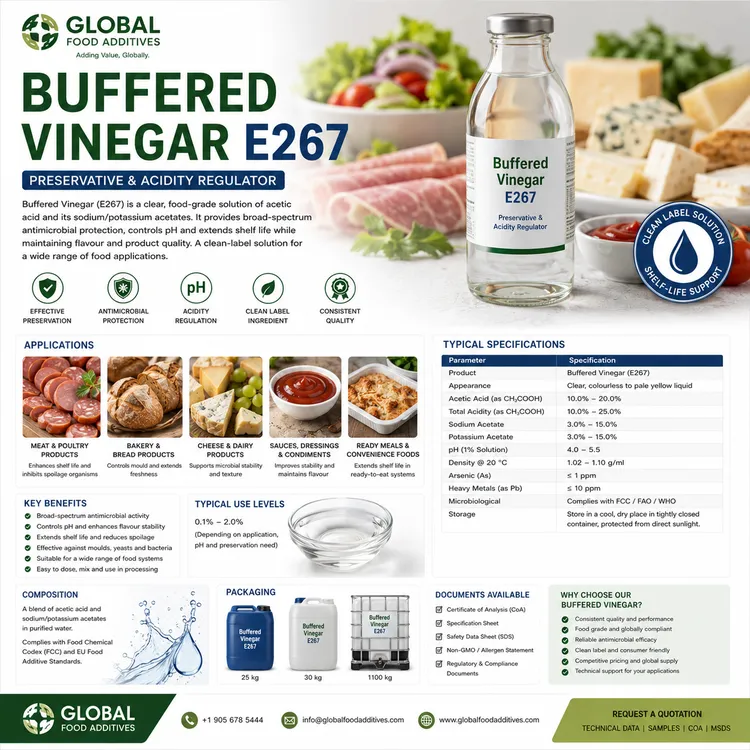
Product identity
| Product | Buffered Vinegar |
|---|---|
| Common names | Buffered vinegar powder, buffered vinegar liquid, vinegar-based preservative, clean-label vinegar preservative |
| Category | Preservatives & Antimicrobials |
| Function | Preservative / antimicrobial shelf-life support / acidity regulator / pH-buffering ingredient |
| E / INS number | E267 |
| CAS / identity | Varies by vinegar source and buffering composition |
| Material type | Vinegar-derived ingredient buffered with sodium or potassium compounds, depending on supplier formulation |
| Typical form | Powder, granule or liquid, depending on product and carrier system |
| Typical grade focus | Food grade, meat grade, bakery grade, sauce grade, cheese grade, low-sodium grade or application-specific preservation blend |
Application fit
Buffered Vinegar is evaluated where manufacturers need acetate-based antimicrobial support with less direct sourness than conventional vinegar. Suitability depends on pH, water activity, salt level, moisture, fat content, packaging, heat treatment, storage temperature and the target spoilage organisms.
- Bakery products requiring mould inhibition and shelf-life extension
- Meat, poultry and cured-meat systems requiring microbial stability support
- Cheese, processed cheese and dairy-based savoury systems after validation
- Sauces, dressings, dips, condiments, marinades and ready-to-use culinary bases
- Ready meals, refrigerated foods, prepared salads and convenience foods
- Beverages and acidified food systems where pH and taste must be balanced
- Seafood, deli products and protein-based refrigerated applications
- Clean-label preservation programs replacing or reducing conventional preservatives
Technical function in food systems
Buffered Vinegar provides preservation value mainly through acetate chemistry and pH management. In foods, acetate species can help inhibit selected spoilage microorganisms, including yeasts, moulds and certain bacteria, depending on the product matrix and processing conditions. Because the ingredient is buffered, it can deliver vinegar-derived functionality with a milder acid profile than standard vinegar, making it useful where formulators need preservation without excessive sourness.
In industrial product development, Buffered Vinegar is normally evaluated as part of a complete hurdle system. It works best when combined with appropriate pH, water activity, salt level, thermal processing, hygienic design, packaging, cold-chain control and validated shelf-life testing. It should not be used as a substitute for good manufacturing practice or microbiological validation.
Key functional properties
- Microbial stability: Supports inhibition of selected spoilage organisms when used in a validated product system.
- Mould control: Often evaluated in bakery, flatbread, tortillas, cheese and surface-sensitive products.
- Yeast inhibition: Useful in sauces, dressings, fillings, refrigerated foods and moisture-containing applications where yeast growth is a concern.
- Acidity regulation: Helps manage pH and buffering capacity without the same sharp acid impact as unbuffered vinegar.
- Clean-label positioning: Can support vinegar-based ingredient declarations depending on local labeling rules and product formulation.
- Flavour balance: Provides acetate functionality while helping reduce excessive sourness in mild-flavour systems.
- Process flexibility: Available as powder or liquid grades for dry blending, brine preparation, marinade systems, dough addition or sauce processing.
Process variables to control
- Target pH, titratable acidity and buffering capacity of the final product
- Water activity, moisture level, salt level and sugar level
- Protein, starch, fat, hydrocolloid and mineral interactions
- Thermal process, cooling speed and post-process contamination risk
- Packaging atmosphere, oxygen exposure and barrier properties
- Storage temperature, cold-chain stability and distribution route
- Dosage method, mixing efficiency and product uniformity
- Sensory balance, aftertaste, salt perception and vinegar note
Industrial formulation guidance
For industrial purchasing and R&D work, Buffered Vinegar should be evaluated by active acetate contribution and performance in the actual food matrix. Two materials may both be sold as Buffered Vinegar, but can differ in vinegar source, buffering salt, sodium or potassium level, pH, carrier, solubility, particle size, flavour profile and preservation performance. For this reason, pilot trials and shelf-life studies are essential before changing supplier or grade.
Recommended use evaluation
- Define the target function: mould inhibition, yeast control, pH adjustment, shelf-life extension or clean-label preservative replacement.
- Identify the main spoilage risk: mould, yeast, lactic acid bacteria, psychrotrophic bacteria or mixed flora.
- Measure product pH, water activity, salt, moisture, fat and protein content before selecting the grade.
- Test the ingredient in the real product matrix, not only in water or model systems.
- Run accelerated and real-time shelf-life studies under expected storage and abuse conditions.
- Evaluate sensory impact at the intended dosage and at the upper practical dosage limit.
- Confirm local label declaration and permitted use before commercial launch.
Common processing risks
- Under-dosing: Insufficient acetate contribution may not deliver the required shelf-life improvement.
- Over-dosing: Excess addition may create vinegar taste, saltiness, bitterness or texture changes.
- pH mismatch: Preservation performance may be reduced if the final pH and buffer profile are not aligned with the target organism.
- Uneven distribution: Poor mixing can create local areas with weak preservative coverage.
- Texture impact: Acetate salts and pH changes can affect proteins, dough systems, starch gels and emulsions.
- Regulatory mismatch: Permission, naming and maximum use level can vary by country and food category.
Application-specific value
Buffered Vinegar is widely considered in product categories where shelf-life performance, label simplicity and sensory balance are important. It may be compared with vinegar, acetic acid, sodium acetate, potassium acetate, sodium diacetate, lactates, diacetates, cultured sugars, fermentates, propionates, sorbates, benzoates and other preservation systems. The best choice depends on microbial target, label policy, regulatory status, taste impact, sodium target and cost-in-use.
Bakery and tortillas
- Supports mould inhibition in bread, buns, flatbreads, tortillas, wraps and filled bakery products.
- Can be useful where manufacturers want vinegar-based preservation with less direct acidic taste.
- Should be tested for dough handling, yeast activity, proofing, volume, crumb texture and flavour.
- Works best with controlled moisture, packaging, hygienic cooling and validated shelf-life testing.
Meat, poultry and seafood
- Can support antimicrobial hurdle systems in cooked meats, sausages, deli meats, poultry, seafood and ready-to-eat protein products.
- May help manage spoilage organisms when combined with salt, pH, thermal process, packaging and refrigeration.
- Requires testing for purge, texture, protein bind, cure colour, flavour, sodium contribution and cooking yield.
- Finished products should be validated by microbiological challenge or shelf-life studies where required.
Cheese and dairy-style systems
- Can be evaluated for surface mould control, pH management and shelf-life support in selected cheese applications.
- May be used in process cheese, cheese sauces, dairy-based dips and savoury dairy systems after validation.
- Compatibility with milk proteins, minerals, emulsifying salts and heat treatment should be checked.
- Sensory testing should evaluate vinegar note, salt perception, bitterness and texture changes.
Sauces, dressings and ready meals
- Supports yeast and mould control in sauces, dips, dressings, marinades, condiments and prepared foods.
- Can help adjust pH while maintaining a milder acid profile than direct vinegar addition.
- Should be evaluated for emulsion stability, viscosity, flavour release, colour and storage behavior.
- Useful in refrigerated, ambient-stable or heat-processed systems where formulation hurdles are validated.
Typical specification points to review
For industrial purchasing, the most useful comparison is not only price per kilogram. Buffered Vinegar grades may differ in acetate content, acetic acid equivalent, pH, buffering salt, sodium or potassium level, sensory profile, form, carrier and microbiological specification. Buyers should request the supplier’s actual specification and COA before approval.
Technical parameters
| Acetate content | Key parameter for comparing preservation contribution and cost-in-use between grades. |
|---|---|
| Acetic acid equivalent | Useful for formulation comparison against vinegar, acetic acid, acetates or diacetates. |
| pH | Important for acidity regulation, flavour balance and microbial control strategy. |
| Buffering system | Confirm sodium-based, potassium-based or mixed buffering system depending on label and nutritional targets. |
| Vinegar source | May affect label declaration, origin statement, allergen review, GMO status and customer acceptance. |
| Form | Powder, granule or liquid; selection affects dosing, mixing, dissolution, storage and plant handling. |
| Carrier system | Powder grades may use carriers; confirm carrier identity and label impact. |
| Particle size | Important for dry blending, dusting, dissolution speed and uniform distribution. |
| Moisture | Important for powder flowability, caking risk, shelf life and active content comparison. |
| Sodium / potassium contribution | Relevant for nutrition labeling, low-sodium claims and taste balance. |
| Microbiology | Review total plate count, yeast and mold, coliforms and pathogens according to buyer requirement. |
| Heavy metals | Should comply with food-grade and destination-market limits. |
Commercial parameters
| Packaging | Powder grades may be supplied in bags, cartons or drums; liquid grades may be supplied in drums, IBCs or bulk formats. |
|---|---|
| Net weight | Confirm available pack sizes according to supplier, form, origin and destination logistics. |
| Palletization | Confirm pallet type, wrapping, stack height, container loading and moisture protection. |
| Shelf life | Confirm from supplier documents; depends on form, packaging, moisture control and storage conditions. |
| Storage | Store tightly closed in a clean, dry, cool and well-ventilated area away from moisture, heat and strong odors. |
| Handling | Powder grades require dust and caking control; liquid grades may require mixing before use. |
| MOQ | Depends on supplier, stock position, grade, packaging and destination logistics. |
| Lead time | Depends on sample approval, production schedule, documentation, inspection and freight route. |
| Cost-in-use | Compare active acetate delivery, dosage efficiency, sensory impact and shelf-life performance, not only kilogram price. |
Quality, food safety and compliance notes
Buffered Vinegar for food manufacturing should be purchased only with clear food-grade documentation, traceability and regulatory support. The buyer should verify that the material is suitable for the intended food category, destination market, customer standard and finished-product label. Where the product is used in export, retail, private-label or customer-branded production, regulatory confirmation and product-specific validation should be completed before commercial use.
QA team checklist
- Confirm product name, E/INS number, food-grade status and intended function.
- Check whether the grade is sodium-buffered, potassium-buffered or blended.
- Compare supplier specification with internal purchasing and application requirements.
- Review actual batch COA before shipment or release.
- Confirm acetate content, pH, moisture, sodium or potassium contribution and microbiological limits.
- Verify allergen, GMO, halal, kosher, vegan or other buyer-required statements where applicable.
- Check production date, expiry date, batch number, label information and packaging integrity.
- Run application trials before changing supplier, dosage, carrier or product form.
- Validate shelf life with real product conditions, not only supplier general guidance.
Regulatory review points
- Destination-market permission for Buffered Vinegar / E267 in the relevant food category
- Maximum use level, quantum satis principle or customer-specific limit where applicable
- Finished-product label declaration, additive class and ingredient naming rules
- Clean-label claim acceptability under local legislation and customer policy
- Nutrition impact from sodium or potassium contribution
- Import documentation, customs description and local registration requirements
- Customer standards, retailer restricted lists and preservative-replacement targets
- Finished-product safety, shelf-life validation and compliance responsibility
Documents to request
A complete Buffered Vinegar inquiry should include both technical and commercial document requirements. This helps reduce delays during supplier qualification, sample approval, customer audits, customs clearance and first production trials.
Core documents
- Product specification or technical data sheet
- Certificate of analysis for available batch or representative lot
- Safety data sheet
- Food-grade statement or regulatory compliance declaration
- Statement confirming E267 identity where applicable
- Vinegar source and buffering system declaration
- Origin statement and manufacturer information where available
- Shelf-life and recommended storage conditions
- Product label, packaging details and pallet configuration
Optional buyer-specific documents
- Halal certificate, kosher certificate or other market-specific certification
- Allergen statement and cross-contamination declaration
- GMO status declaration
- Vegan or vegetarian suitability statement where required
- Heavy metal statement or contaminant declaration
- Microbiological specification and pathogen statement
- Carrier, processing-aid or residual solvent statement where applicable
- Sodium or potassium contribution statement for nutrition review
- Country-specific import, customs or registration documents
How to request this product
Send the product name, target function, required form, acetate content or acetic acid equivalent, application, quantity, destination country, packaging preference, delivery term, expected shipment date and required documents. If you already purchase Buffered Vinegar, attach or describe your existing specification, label, certificate of analysis, shelf-life target or microbial challenge requirement so supplier options can be compared more accurately.
Information that improves quotation accuracy
- Target application and finished-product type
- Required function: mould control, yeast inhibition, pH adjustment or general shelf-life support
- Powder, granule or liquid requirement
- Required acetate content or acetic acid equivalent, if available
- Final product pH, water activity, moisture and storage temperature
- Current preservative system and desired replacement target
- Required annual volume and first-order quantity
- Preferred packaging size and pallet requirement
- Destination port, warehouse or delivery city
- Required Incoterms such as EXW, FOB, CFR, CIF or DAP
- Required certificates and destination-market declarations
- Sample quantity and expected approval timeline
Supplier comparison criteria
- Food-grade documentation completeness
- Consistency of acetate content and pH between batches
- Application performance in the buyer’s real product matrix
- Microbiological and contaminant control
- Sensory impact at practical dosage levels
- Packaging strength, leakage protection and moisture control
- Batch traceability and shelf-life remaining at shipment
- Export experience and document responsiveness
- Total landed cost and performance cost-in-use
Useful answers
What is Buffered Vinegar used for in food manufacturing?
Buffered Vinegar is used as a vinegar-derived preservative and acidity regulator for microbial stability, mould control, yeast inhibition, pH management and shelf-life support in selected bakery, meat, cheese, sauce, ready-meal, refrigerated food and prepared food systems.
How does Buffered Vinegar work?
Buffered Vinegar provides acetate-based preservation and pH-management functionality. Its effectiveness depends on product pH, water activity, salt level, moisture, temperature, packaging, processing hygiene and the target spoilage organisms. It should be validated inside the final food system.
Is Buffered Vinegar the same as regular vinegar?
No. Regular vinegar is acidic and has a strong vinegar taste. Buffered Vinegar is partially neutralized or buffered, which can raise pH and reduce harsh sourness while still providing vinegar-derived acetate functionality. Exact composition depends on the supplier grade.
Can Buffered Vinegar replace sorbate, propionate or benzoate?
It may be evaluated as part of a preservative-replacement or clean-label program, but direct replacement should not be assumed. The finished product must be tested for pH, water activity, taste, texture, microbial stability and shelf life under real storage conditions.
Which technical parameters should be checked before purchasing?
Buyers should compare acetate content, acetic acid equivalent, pH, buffering system, vinegar source, carrier, particle size, solubility, moisture, sodium or potassium contribution, sensory impact, microbiological limits, heavy metals, packaging type, shelf life and food-grade compliance.
Can Global Food Additives source Buffered Vinegar?
Global Food Additives can review sourcing options for Buffered Vinegar according to target specification, function, application, form, acetate content, quantity, destination, packaging preference, delivery term and required documentation.
Which documents should be requested?
Buyers commonly request a technical data sheet, product specification, certificate of analysis, safety data sheet, food-grade statement, origin statement, vinegar source declaration, allergen or GMO declaration where required, shelf-life information, label details and packing configuration.
Is this product permitted in every country?
No. Food additive use depends on destination-market rules, food category, use level, label requirements and buyer responsibility. The buyer should confirm local regulations and customer standards before commercial use.
What should be tested during factory trials?
Factory trials should evaluate dispersion, dosage uniformity, pH, water activity, microbial stability, mould and yeast inhibition, flavour impact, salt perception, texture, colour, packaging compatibility, storage stability, shelf-life performance and compatibility with other preservatives or functional ingredients.
Tell us which food additive or ingredient you need.
Send product names, target specifications, quantity, destination country, packaging preference, delivery term, and document requirements. Our team will review your inquiry and respond from orders@foodgradeadditives.com.
Your message has been received. You will be redirected to the home page.