
Calcium Ascorbate
Calcium Ascorbate, also known as E302 or INS 302, is a food-grade mineral ascorbate used as an antioxidant, oxidation-control ingredient and vitamin C source in selected food and beverage applications. For industrial buyers, the purchasing value depends on much more than the product name: grade, assay basis, calcium contribution, particle size, solubility, colour stability, impurity profile, documentation quality and regulatory fit all need to be reviewed before approval.
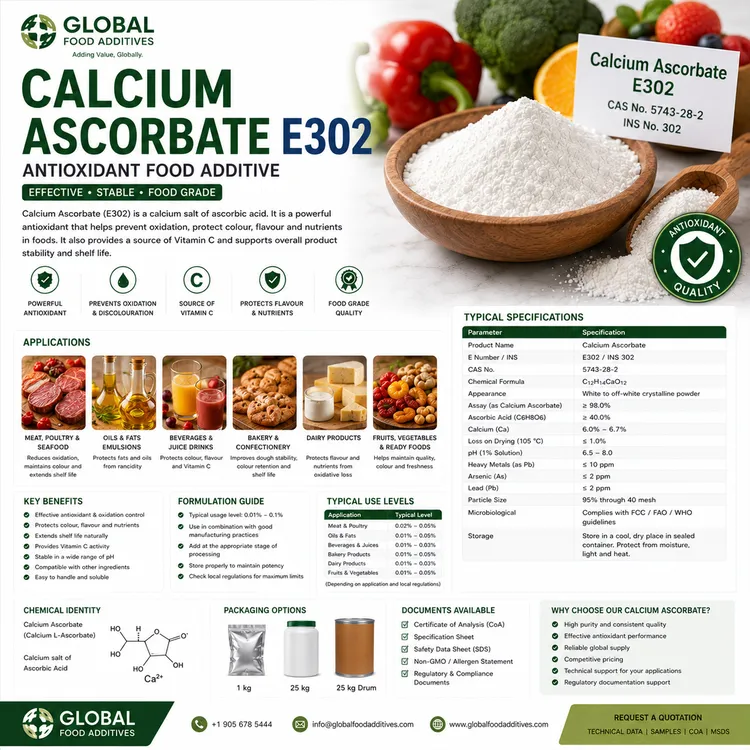
Food additive use, claims and maximum levels must be checked against the destination market, food category and final label requirements.
Product identity
| Product | Calcium Ascorbate |
|---|---|
| Alternative names | Calcium L-Ascorbate; calcium salt of ascorbic acid; mineral ascorbate |
| Category | Antioxidants & Oxidation Control |
| Function | Antioxidant / oxidation-control ingredient |
| E / INS number | E302 / INS 302 |
| CAS / identity | 5743-28-2 as listed in buyer reference; confirm CAS, hydrate form and identity on supplier COA/SDS |
| Chemical family | Calcium salt of ascorbic acid |
| Formula reference | Often expressed as Ca(C6H7O6)2; confirm hydrate basis on specification |
| Typical appearance | White to slightly yellowish powder, crystalline powder or granule depending on grade and particle size |
| Typical use character | Water-phase antioxidant, dry-blend antioxidant and vitamin C source depending on application |
| Key buying point | Confirm whether the offer is food grade, supplement grade, pharmaceutical grade, feed grade or technical grade before price comparison |
Industrial buying value
Calcium Ascorbate is usually evaluated when a manufacturer wants antioxidant performance from an ascorbate source with calcium contribution and a less acidic profile than ascorbic acid. It is relevant for R&D, procurement and quality teams that need a documented material for oxidation control, colour protection, nutrient positioning or sensitive product stabilisation.
- Supports oxidation-control design in selected water-phase, dry and premix systems
- Can contribute vitamin C activity and calcium depending on dosage and regulatory rules
- Useful where ascorbic acid acidity, pH impact or mineral profile must be evaluated
- May support colour, flavour and nutrient stability when process conditions are suitable
- Requires specification-based buying because assay, moisture and hydrate form affect calculations
Technical overview
Calcium Ascorbate is an ascorbate antioxidant. In food systems, ascorbate compounds can help control oxidative reactions by acting as reducing agents and oxygen-scavenging contributors. This can support protection of sensitive colours, flavours, vitamins, fruit components and selected lipid-containing systems, but effectiveness depends on the whole formulation and process design.
In industrial use, Calcium Ascorbate should not be treated as a universal antioxidant solution. It is typically most relevant in water-containing systems, dry mixes and premixes where dissolution, dispersion and interaction with other ingredients can be controlled. For oil-dominant systems, procurement teams should confirm whether a different antioxidant system, oil-dispersible blend, encapsulated format or synergist package is more suitable.
Functional role in food systems
Calcium Ascorbate may be selected for several technical reasons. In many formulas it is used for antioxidant activity; in others it is part of a nutrient-fortification or quality-protection strategy. The final claim and label position should be reviewed by the buyer's regulatory team.
- Helps reduce oxidation risk in selected oxygen-sensitive foods
- Can support vitamin C contribution where permitted and analytically verified
- May reduce enzymatic browning in selected fruit and vegetable systems
- Can support colour and flavour protection in suitable water-phase applications
- May be evaluated as an alternative to ascorbic acid when pH impact is a concern
Formulation behaviour
Performance depends on dosage, pH, oxygen exposure, trace metals, process temperature, light exposure, packaging and storage conditions. Ascorbate can also participate in oxidation-reduction reactions, so excessive dosage or poor metal control may not always improve shelf life.
- Review pH and buffer capacity of the finished product
- Control exposure to oxygen, heat, light and catalytic trace metals
- Evaluate chelators, acidity regulators and packaging as part of the antioxidant system
- Confirm dissolution and distribution before filling or packing
- Validate performance through shelf-life testing, not only theoretical dosage
Application fit
Potential use areas may include the applications below, subject to destination-market rules, food-category permission, finished-product design and customer specification. These examples are practical formulation contexts, not a universal approval list.
| Application area | Technical reason to evaluate | Buyer / R&D checks |
|---|---|---|
| Beverages and beverage bases | Vitamin C contribution, oxidation control, flavour protection and colour support in selected formulas | Solubility, pH, clarity, mineral balance, heat process, light exposure, dissolved oxygen and label rules |
| Fruit preparations, purees and toppings | Support against browning and quality loss in oxygen-sensitive fruit systems | Fruit type, pH, enzyme activity, Brix, heat treatment, packaging oxygen and sensory profile |
| Meat and poultry systems | Colour and oxidation-control support in selected processed systems where permitted | Regulatory status, nitrite/nitrate system, pH, salt level, water activity, process temperature and residual ascorbate |
| Bakery mixes and dry premixes | Dry-blend antioxidant or vitamin C source for controlled formulations | Particle size, blend uniformity, humidity control, calcium contribution, storage stability and ingredient compatibility |
| Confectionery and jelly systems | Colour and flavour protection in selected water-phase or gel systems | pH, gel system, calcium-sensitive hydrocolloids, heat exposure and final texture impact |
| Nutritional powders and fortified foods | Vitamin C source with mineral contribution in fortified formulas | Assay over shelf life, nutrient declaration, overage strategy, humidity protection and regulatory claim rules |
| Snack seasonings and powder blends | Dry antioxidant or nutrient component in seasoning systems where technically suitable | Hygroscopicity, flowability, taste impact, premix uniformity, packaging barrier and shelf-life target |
| Specialty sensitive products | Case-by-case oxidation-control review for products exposed to oxygen, heat or light | Challenge conditions, accelerated shelf-life testing, analytical method and customer specification |
Quality and specification parameters
For industrial purchasing, Calcium Ascorbate should be compared by specification and batch documentation rather than by product name alone. Assay basis, hydrate form, moisture, calcium content and impurity limits can affect both dosage calculation and customer approval.
| Specification area | What to request | Why it matters |
|---|---|---|
| Identity | Product name, E/INS number, CAS number, chemical name, identification method and grade statement | Confirms that the offered material matches the intended additive and customer reference standard |
| Assay | Assay result, test method and basis of calculation, including ascorbic acid equivalent if used | Prevents dosage errors and allows accurate supplier comparison |
| Calcium content | Calcium percentage, test method and declaration basis | Required for mineral contribution, nutrition calculations and formulation balance |
| Moisture / loss on drying | Moisture, loss on drying, hydrate status or water content limit | Affects assay, stability, caking tendency, shelf life and cost comparison |
| Appearance and colour | Visual standard, colour range and signs of oxidation or discoloration | Discoloration may indicate age, storage exposure or quality deterioration |
| Solubility / clarity | Water solubility, clarity of solution, insoluble matter and filtration performance where relevant | Critical for beverages, syrups, liquid premixes and transparent products |
| Particle size | Mesh size, particle-size distribution, bulk density and flowability | Affects dry blending, dosing accuracy, dissolution speed and dust generation |
| Impurities | Heavy metals, lead, arsenic, mercury, cadmium and related impurities according to buyer standard | Supports food-grade approval, export compliance and customer audit requirements |
| Microbiology | Total plate count, yeast and mould, coliforms, E. coli, Salmonella and other limits when required | Important for high-care factories, dry blends and nutritional applications |
| Compliance | Food-grade declaration, allergen statement, GMO statement, vegan/vegetarian statement, halal/kosher if required | Reduces regulatory, customer and label-approval delays |
| Traceability | Manufacturer, country of origin, batch number, production date, retest date and shelf life | Enables supplier qualification, recall readiness and audit-trail control |
Formulation and performance checklist
- Dosage basis: confirm whether the formula is calculated as Calcium Ascorbate, ascorbic acid equivalent, vitamin C content or calcium contribution.
- Finished-product pH: review pH impact and buffering capacity, especially where the product must meet a tight sensory or stability target.
- Oxygen control: evaluate dissolved oxygen, headspace oxygen, packaging barrier and filling conditions.
- Metal control: review iron, copper and other trace metals because they can accelerate oxidative pathways.
- Heat exposure: check thermal process severity, hold time and addition point to reduce unnecessary degradation.
- Light exposure: consider light-protective packaging when formulas contain sensitive colours, flavours or vitamins.
- Ingredient interactions: assess interactions with acids, minerals, phosphates, hydrocolloids, proteins, colours and flavour compounds.
- Sensory review: confirm that the intended dosage does not create unwanted taste, mouthfeel or mineral notes.
- Analytical verification: define a method to verify vitamin C or ascorbate level during shelf-life studies where required.
- Commercial validation: approve through pilot trial, production trial and shelf-life testing before full-scale launch.
Comparison with related antioxidant options
Calcium Ascorbate is part of a wider antioxidant toolbox. The right choice depends on water/oil phase, pH, processing conditions, label target, cost-in-use and regulatory status.
| Option | Typical reason to compare | Industrial note |
|---|---|---|
| Ascorbic acid / E300 | Strong vitamin C and reducing-agent profile | More acidic; may affect pH and taste depending on dosage and buffer system |
| Sodium ascorbate / E301 | Ascorbate source with sodium counter-ion | Useful where sodium contribution is acceptable and formulation pH requires review |
| Calcium ascorbate / E302 | Ascorbate source with calcium contribution and less acidic character | Requires calcium contribution, hydrate basis and assay basis to be confirmed |
| Ascorbyl palmitate / E304 | Oil-phase antioxidant option | Often more relevant than Calcium Ascorbate for fat-dominant systems |
| Tocopherols / E306-E309 | Lipid oxidation control in fats and oils | Frequently evaluated for edible oils, snacks and fat-based applications |
| Erythorbic acid / erythorbates | Processing and colour-stability applications in selected food systems | Check regulatory status, label declaration and application-specific performance |
Processing and addition guidance
Calcium Ascorbate should be introduced through a controlled process that protects the material from unnecessary oxygen, heat, humidity and metal exposure. In liquid systems, the best addition point often depends on dissolution time, temperature, pH adjustment and downstream processing. In dry systems, uniform blending and moisture protection are normally the main operational concerns.
Liquid-system considerations
- Pre-dissolve or disperse according to the supplier's recommended procedure
- Use appropriate water quality and avoid unnecessary exposure to catalytic metals
- Define addition point relative to acidification, heating, cooling and filling
- Check solution clarity, sediment and reaction with minerals or hydrocolloids
- Monitor vitamin C or ascorbate retention during pilot and shelf-life trials
Dry-blend considerations
- Match particle size with the premix and carrier system to reduce segregation
- Control humidity during blending, packing and storage
- Use suitable packaging barrier for moisture and oxygen protection
- Validate blend uniformity when dosage is low or claims depend on nutrient level
- Apply first-expiry-first-out warehouse control for sensitive grades
Handling, storage and warehouse control
Calcium Ascorbate should be handled according to the supplier safety data sheet, food-safety plan and local workplace rules. Because ascorbate materials may be sensitive to moisture, heat, oxygen and light exposure, buyers should confirm storage recommendations and shelf-life conditions before importing or stocking bulk quantities.
| Control point | Recommended buyer action |
|---|---|
| Storage environment | Confirm cool, dry and well-ventilated storage conditions with supplier-specific limits |
| Moisture protection | Keep packaging sealed until use and protect opened bags from humidity and condensation |
| Light and oxygen | Review packaging barrier and avoid unnecessary open-air exposure during handling |
| Odour and cross-contact | Store away from odorous, volatile, allergenic or incompatible materials |
| Lot traceability | Record lot number, production date, supplier COA and internal release status before use |
| Opened packaging | Define resealing, relabelling, retest and maximum-open-time procedures |
Packaging and logistics options
Packaging depends on supplier standard, order size and destination requirements. Common industrial requests include small sample packs, trial quantities, 20-25 kg cartons or bags, fibre drums, inner PE liners, aluminium-lined bags, palletised export packaging and container-load supply. For export projects, buyers should request pallet dimensions, net and gross weight, storage conditions, batch coding system, document language, HS code guidance and shipping marks before confirming the order.
Regulatory and label diligence
Calcium Ascorbate should be managed as a regulated food additive and, in some applications, as a nutrient source. The buyer is responsible for verifying whether E302 / INS 302 is permitted in the destination market, whether it is allowed in the finished food category, how it must be declared, whether a vitamin C or calcium claim is allowed, and whether analytical verification is required.
When Calcium Ascorbate is used mainly for antioxidant function, the label route may differ from a formula using it primarily for nutrient fortification. The final declaration should be reviewed according to local food law, product category, dosage, function in the finished product and brand-owner policy.
Documents to request
- Product specification or technical data sheet with grade, assay and test methods
- Certificate of analysis for available batch or representative lot
- Safety data sheet where applicable
- Food-grade declaration and additive identity confirmation
- CAS, E/INS number and hydrate-form clarification where required by buyer specification
- Origin statement, manufacturer information and traceability declaration
- Shelf-life, retest date and recommended storage conditions
- Allergen, GMO, vegan/vegetarian, BSE/TSE and irradiation statements where required
- Halal and kosher certificates when required by customer or destination market
- Heavy metals, microbiology and impurity statements aligned with the buyer's internal standard
- Particle size, bulk density, solubility and moisture data where process performance matters
- Label draft, packaging details, pallet configuration and net/gross weight
- Market-specific declarations required by the importing country
How to request this product
Send the product name, target grade or reference specification, quantity, destination country, packaging preference, expected shipment date, delivery term and required documents. If you already purchase Calcium Ascorbate, attach or describe your current specification, label, certificate of analysis or supplier grade so alternative options can be compared accurately.
For faster technical review, include the intended application, target function, finished-product pH, whether the material is used for antioxidant function or vitamin C contribution, required assay basis, packaging preference and any customer-specific compliance standard.
Useful answers
What is Calcium Ascorbate used for in food manufacturing?
Calcium Ascorbate is typically discussed for oxidation control, vitamin C contribution, colour protection, flavour stability and quality preservation in selected foods and beverages. Exact suitability depends on grade, application, process, regulations and supplier documents.
How is Calcium Ascorbate different from ascorbic acid?
Calcium Ascorbate is the calcium salt of ascorbic acid. It may be preferred where a mineral ascorbate, calcium contribution or less acidic profile is useful, but the correct choice depends on pH target, solubility, sensory impact, label plan and regulatory status.
Can Calcium Ascorbate be used in oil systems?
Native Calcium Ascorbate is typically more relevant to water-phase, dry-blend and premix systems. For oil-dominant systems, buyers should evaluate ascorbyl palmitate, tocopherols, oil-dispersible antioxidant blends or encapsulated systems where permitted.
Which technical parameters should be compared between suppliers?
Buyers should compare assay, assay basis, calcium content, moisture, hydrate status, particle size, solubility, colour, heavy metals, microbiology, origin, shelf life, packaging and compliance documents.
Can Global Food Additives source Calcium Ascorbate?
Global Food Additives can review sourcing options for Calcium Ascorbate according to target specification, quantity, destination, packaging, shipment timing and required documentation.
Which documents should be requested?
Buyers commonly request a technical data sheet or specification, certificate of analysis, safety data sheet where applicable, food-grade declaration, origin statement, allergen/GMO statements, shelf-life information, label details and packing details.
Is this product permitted in every country?
No. Food additive use depends on destination-market rules, food category, use level, nutrient claims, label requirements and buyer responsibility. Always verify regulatory status before commercial use.
Tell us which food additive or ingredient you need.
Send product names, target specifications, quantity, destination country, packaging preference, delivery term, and document requirements. Our team will review your inquiry and respond from [email protected].
Your message has been received. You will be redirected to the home page.