
Calcium Diglutamate E623
Calcium Diglutamate is a food-grade glutamate flavour enhancer used in selected savoury systems to increase umami intensity, improve taste roundness, support salt-perception strategies and build a more complete flavour profile. It is especially relevant for seasonings, soups, bouillons, sauces, snacks, ready meals, meat systems and plant-based savoury products where balanced taste, low dosage efficiency and regulatory compliance are important.
Global Food Additives supports food manufacturers, seasoning houses, culinary ingredient producers, meat processors, snack manufacturers and industrial buyers with sourcing coordination, supplier document collection, specification comparison, packaging review and export-ready quotation support for Calcium Diglutamate E623 and related flavour-enhancement systems.
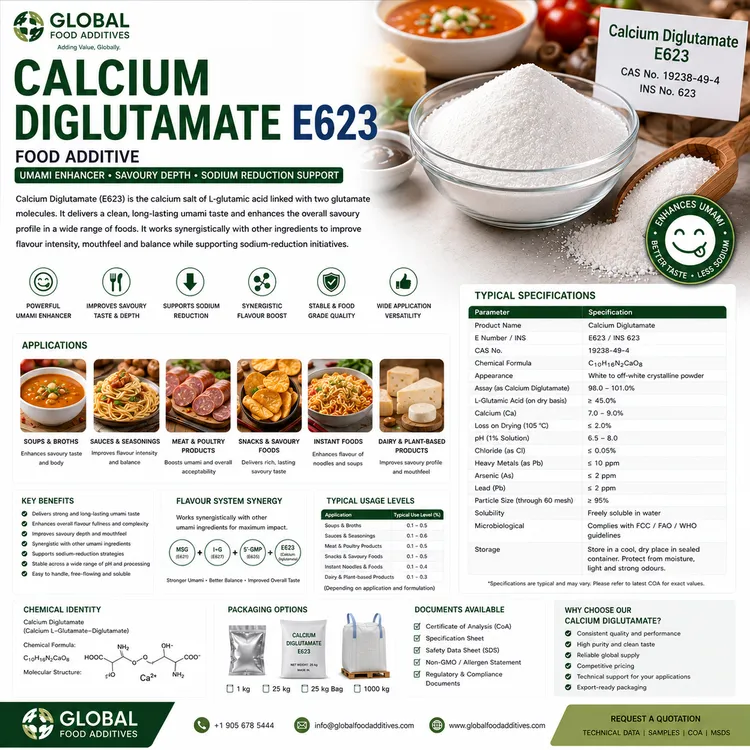
Product identity
| Product | Calcium Diglutamate |
|---|---|
| Common additive reference | E623 / INS 623 |
| CAS / identity | 19238-49-4 |
| Alternative names | Calcium glutamate, calcium biglutamate, L-glutamic acid calcium salt |
| Category | Flavour Enhancers & Taste Modifiers |
| Functional class | Flavour enhancer / umami enhancer / savoury taste modifier |
| Typical form | White to off-white powder, crystalline powder, granule or customer-specified food-grade form |
| Commercial focus | Food-grade compliance, clean sensory profile, controlled assay, lot traceability, stable supply and complete technical documentation |
Application fit
Potential use areas must be checked against destination-market rules, finished-food category, customer specifications and labelling requirements. Typical technical review areas may include:
- Dry seasonings, spice blends and savoury premixes
- Instant soups, bouillons, stock cubes and broth powders
- Sauces, gravies, marinades, dressings and culinary bases
- Savoury snacks, coated nuts, crackers and extruded products
- Meat products, poultry systems, seafood seasonings and processed meat analogues
- Plant-based meats, vegan meals and protein-based savoury systems
- Ready meals, noodle cups, frozen foods and retort culinary products
Technical function in savoury formulation
Calcium Diglutamate delivers glutamate-driven umami, a taste quality associated with savoury depth, brothiness, mouthfulness and continuity. In industrial product development, it is normally evaluated as part of a complete flavour architecture that may include salt, yeast extract, hydrolyzed vegetable protein, nucleotides, vegetable powders, meat flavours, mushroom extracts, onion-garlic systems, acids, sweeteners, fats and masking agents.
The ingredient can be useful when a formula tastes thin, flat, metallic, excessively salty, overly sweet, bitter, acidic or lacking in savoury persistence. Because taste perception depends on pH, salt level, fat content, protein base, heat process, flavour carrier and serving temperature, Calcium Diglutamate should be tested in the actual application rather than judged only in water solution.
Functional benefits to evaluate
- Improved umami intensity and savoury taste impact
- Greater flavour roundness in soups, sauces and seasonings
- Support for salt-perception and sodium-reduction strategies
- Better continuity of flavour from first taste to aftertaste
- Masking support for bitterness, metallic notes or protein off-notes
- Improved palatability in plant-based and high-protein savoury systems
- More complete taste profile in low-fat, low-salt or cost-optimized recipes
- Synergy with ribonucleotides, yeast extracts and natural savoury ingredients
Key formulation variables
| Salt level | Calcium Diglutamate may improve salt perception, but it does not replace all salt functions. |
|---|---|
| pH | Acidity affects taste release, umami perception and compatibility with sauces or marinades. |
| Fat phase | Fat level influences flavour release, mouthfeel and savoury persistence. |
| Protein base | Meat, soy, pea, wheat, dairy and yeast systems can interact differently with glutamate taste. |
| Heat process | Retort, spray drying, baking, extrusion or frying may affect final flavour balance. |
| Particle size | Powder flow, dissolution rate and seasoning distribution depend on physical grade. |
| Label strategy | Confirm additive name, class name, E-number or local declaration wording before launch. |
Industrial application guidance
Calcium Diglutamate should be selected when the product challenge is taste balance, savoury impact, sodium reduction, flavour masking or overall palatability. A successful evaluation normally includes bench trials, triangle tests, sensory ranking, salt-equivalence testing, consumer panels, accelerated storage, production trials and final label review.
Seasonings and dry blends
In dry seasonings, Calcium Diglutamate may improve savoury intensity, flavour distribution and taste roundness. Buyers should evaluate particle size, bulk density, anti-caking needs, dusting tendency, blending uniformity and compatibility with salt, spices, yeast extract and hydrolyzed proteins.
Soups, bouillons and broths
In soup and bouillon systems, Calcium Diglutamate can help build brothiness, meaty impact and flavour persistence. It may be used with nucleotides, onion-garlic systems, vegetable powders, fats and thermal process flavours to create fuller savoury profiles.
Sauces, gravies and culinary bases
In sauces and gravies, Calcium Diglutamate may support depth, salt perception and rounded aftertaste. Formulators should test it against pH, starch systems, emulsifiers, heat treatment, acidity, viscosity, colour development and storage conditions.
Savoury snacks
In chips, crackers, extruded snacks and coated nuts, Calcium Diglutamate may increase seasoning impact and reduce flatness. Performance depends on seasoning adhesion, oil pick-up, powder particle size, salt balance, spice volatility and package oxygen control.
Meat and poultry systems
In processed meat and poultry applications, Calcium Diglutamate may support savoury fullness, roasted notes and reduced-sodium formulations. The formula should be validated for cure system, phosphate use, water binding, microbial hurdles, label rules and sensory acceptance.
Plant-based and meat analogue foods
Plant proteins often carry beany, bitter, cereal, green or metallic notes. Calcium Diglutamate may help improve umami and mask negative notes when used with yeast extract, nucleotides, fats, smoke flavours, acids, spices and masking systems.
Sodium-reduction and taste-modulation strategy
Calcium Diglutamate is often evaluated in sodium-reduction projects because it can increase savoury perception without contributing sodium in the same way as monosodium glutamate. However, it should not be treated as a complete salt replacement. Sodium chloride contributes not only saltiness but also water activity control, preservation support, protein functionality, texture, fermentation control and flavour release. Any sodium-reduced formulation should therefore be validated for safety, shelf life and processing behaviour.
Useful reformulation targets
- Lower-sodium soups and instant noodles
- Reduced-salt seasonings and bouillon powders
- Plant-based meat analogues with weak savoury impact
- Low-fat sauces that lack mouthfulness
- Snack seasonings where salt reduction creates flavour gaps
- Ready meals requiring better taste persistence after reheating
Validation checks
| Salt perception | Compare perceived saltiness with control and sodium-reduced formulas. |
|---|---|
| Umami intensity | Use sensory panels to score brothiness, meatiness and savoury depth. |
| Off-note masking | Measure bitterness, metallic notes, pea/soy notes or protein aftertaste. |
| Water activity | Confirm that sodium reduction does not compromise shelf-life design. |
| Texture | Check meat, plant protein, sauce or snack texture after formula changes. |
| Label compliance | Verify additive declaration and sodium claims before commercial release. |
Specification checklist for buyers
For industrial purchasing, the most valuable comparison is not only the product name. Buyers should compare the supplier specification against the intended formula, sensory target, process conditions, destination market and internal quality standard. A strong specification helps QA, R&D, purchasing and regulatory teams confirm suitability before commercial commitment.
Chemical and physical controls
- Identity as Calcium Diglutamate / E623 / INS 623
- Assay or purity basis, including L-glutamate basis where specified
- Calcium content and glutamate content
- Appearance, colour and odour
- Moisture or loss on drying
- pH under supplier test conditions
- Solubility and solution clarity where relevant
- Particle size distribution or mesh range
- Bulk density or tapped density for automated dosing
- Flowability, caking tendency and dusting behaviour for dry blending
- Sensory profile, including umami quality and absence of foreign notes
Purity, safety and compliance checks
- Heavy metals limits according to buyer or regulatory specification
- Lead, arsenic, cadmium and mercury limits where required
- Microbiological limits for total plate count, yeast, mould and pathogens where relevant
- Residual solvents or process impurities if applicable to manufacturing route
- Food-grade statement and intended-use declaration
- Batch number, production date, retest date and shelf-life
- SDS classification and safe handling recommendations
- Allergen, GMO, halal, kosher, vegan and irradiation declarations when requested
- Country-of-origin and manufacturer traceability information
- Regulatory statement for the destination market where available
Regulatory and label review
Calcium Diglutamate is identified as E623 / INS 623 and belongs to the glutamate flavour-enhancer group. However, additive numbering alone does not guarantee permission in every market, food category or formulation. Buyers should verify whether the target country permits E623 in the intended food, what maximum level applies, how it must be declared on the label and whether the customer has additional restrictions on glutamates or flavour enhancers.
Label terminology may differ by jurisdiction. Depending on local rules, Calcium Diglutamate may need to be declared by class name, additive name, E-number, INS number or a combination of these. For products marketed with reduced-sodium, no-added-MSG, natural, clean-label or child-oriented positioning, the buyer should review the claim strategy carefully before approving the ingredient.
For export projects, confirm the formula, intended food category, use level, label declaration, customer standard and destination-market rule before ordering commercial volume. If a supplier cannot provide a market-specific regulatory statement, the buyer should obtain confirmation from a qualified regulatory consultant or the relevant local authority.
Dosage and sensory validation considerations
Use level should be based on the permitted maximum for the final food category and the actual sensory requirement. In many savoury systems, flavour-enhancer dosage is low, so accurate weighing, premix preparation and homogeneous distribution are important. Overuse can create an artificial, lingering or unbalanced taste, while underuse may fail to improve savoury depth or salt perception.
Recommended validation work
- Compare a control formula against several Calcium Diglutamate dosage levels
- Run sensory ranking for umami, saltiness, mouthfulness and aftertaste
- Evaluate synergy with yeast extract, hydrolyzed proteins and ribonucleotides
- Check masking of bitterness, metallic notes and plant-protein off-notes
- Measure sodium-reduction acceptance versus full-salt control
- Validate performance after heat treatment, retort, baking, frying or extrusion
- Run shelf-life tests for flavour stability and packaging interaction
- Confirm final label wording and legal use level before commercial launch
Common process checks
| Weighing accuracy | Low use levels require calibrated scales and controlled batching procedures. |
|---|---|
| Premix method | Preblending with salt, maltodextrin or seasoning carriers can improve distribution. |
| Dissolution | Liquid systems should be tested for solubility, clarity and sediment risk. |
| Thermal process | Confirm final taste after retort, pasteurization, frying, baking or extrusion. |
| Carrier compatibility | Check interaction with salt, spices, acids, oils, starches, gums and protein systems. |
| Finished-product testing | Use retained samples and sensory panels to verify commercial performance. |
Comparison with related flavour enhancers
Calcium Diglutamate is commonly compared with monosodium glutamate, monopotassium glutamate, yeast extract, hydrolyzed vegetable protein, autolyzed yeast, disodium inosinate, disodium guanylate and disodium 5'-ribonucleotides. The best choice depends on sodium target, flavour character, label preference, cost-in-use, regulatory status, allergen position, naturalness claims, solubility and customer acceptance.
When Calcium Diglutamate may be considered
- When a formula requires glutamate-driven umami with calcium rather than sodium contribution
- When sodium-reduction work creates a flat or incomplete savoury profile
- When plant-based proteins need better mouthfulness and taste continuity
- When soups, sauces, snacks or seasonings need stronger savoury depth
- When E623 / INS 623 is permitted in the exact food category
- When cost-in-use and flavour impact are better than alternative taste modifiers
When another solution may be better
- When E623 is not permitted in the destination food category
- When the brand avoids added glutamates or flavour enhancers
- When a yeast-extract or natural savoury profile is preferred
- When ribonucleotide synergy is needed at very low dosage
- When calcium contribution affects taste, solubility or mineral balance
- When the product claim strategy conflicts with additive declaration
Quality documentation to request
Documentation quality is often the deciding factor for food additive purchasing. Before confirming an order, request current and batch-specific documents where possible:
- Product specification or technical data sheet showing identity, grade and key limits
- Certificate of analysis for the offered batch or a representative recent lot
- Safety data sheet with handling, storage, PPE and transport information
- Food-grade declaration and intended-use statement
- Country-of-origin, manufacturer and traceability statement where available
- Shelf-life, retest period and storage-condition statement
- Allergen, GMO, irradiation, vegan/vegetarian, halal or kosher declarations when required
- Heavy metals, microbiology or impurity declaration according to buyer specification
- Packaging specification, net weight, gross weight and pallet configuration
- Regulatory statement for the destination market, if available from the supplier
- Sample CoA and pre-shipment document review for new suppliers
- Label draft or package marking information for import and warehouse control
Packaging, storage and logistics
Calcium Diglutamate should be handled as a controlled food additive with clean, sealed packaging and traceable lot identification. Because flavour enhancers are commonly used at low inclusion levels, packaging integrity, moisture protection and contamination control are important for accurate dosing and sensory consistency. Standard commercial formats may include multiwall bags, cartons, drums, inner-lined bags or palletized export packaging depending on supplier capability and order quantity.
Packaging details to confirm
| Net weight | Confirm available pack sizes such as 10 kg, 20 kg, 25 kg, drum packaging or supplier-specific formats. |
|---|---|
| Inner liner | Request food-compatible liner protection for moisture, odour and contamination control. |
| Seal integrity | Confirm closure method, tamper evidence and protection against powder leakage. |
| Palletization | Ask for bags or drums per pallet, pallet dimensions, wrapping and export pallet treatment. |
| Labeling | Confirm product name, lot number, net weight, origin, shelf-life and handling marks. |
| Container loading | Check maximum payload, moisture protection and desiccant needs for sea freight. |
Storage recommendations
- Keep containers tightly closed when not in use
- Store in a dry, cool and well-ventilated warehouse
- Protect from water, humidity, condensation and direct sunlight
- Keep away from strong odours because flavour ingredients can be sensory-sensitive
- Prevent dust generation during weighing, charging and transfer
- Use first-expiry, first-out stock rotation
- Maintain lot traceability from receipt to production batch
- Segregate food-grade additives from non-food chemicals and allergen-risk materials
Industrial purchasing notes
When sourcing Calcium Diglutamate, procurement teams should define the commercial and technical target before requesting offers. A clear inquiry improves supplier matching, reduces document delays and helps avoid comparing non-equivalent grades. The most useful inquiry normally includes additive identity, E/INS number, target specification, annual demand, first-order quantity, destination country, delivery term, packaging preference, required certifications and any buyer-specific restricted-substance limits.
For manufacturers using automated dosing, the physical grade is especially important. Particle size, dusting tendency, bulk density, flowability and caking tendency can affect weighing accuracy, dry blending, powder transfer and flavour uniformity. For export projects, document consistency between invoice, label, CoA, packing list and regulatory statement should be checked before shipment.
Supplier qualification questions
Technical questions
- Which specification standard does the material follow?
- Is the supplied grade food-grade and suitable for the intended destination market?
- Is the assay reported as calcium diglutamate, glutamate basis or another calculation?
- Can particle size distribution and bulk density be confirmed?
- Can the supplier provide representative and batch-specific certificates of analysis?
- Are heavy metals, microbiology and sensory quality routinely controlled?
- Can the supplier provide a sample for sensory and pilot-plant validation?
Commercial questions
- What is the minimum order quantity and standard lead time?
- Which packaging formats are available for export?
- Can the supplier support annual contracts or scheduled shipments?
- Which incoterms, ports and payment terms are available?
- Can documents be reviewed before shipment?
- Can the supplier provide market-specific declarations when required?
- Can the supplier support private-label, distributor or manufacturer documentation needs?
How to request this product
Send the product name, target grade or reference specification, quantity, destination country, delivery term, packaging preference, expected shipment date and required documents. If you already purchase Calcium Diglutamate, attach or describe your existing specification, label, certificate of analysis, formulation target or approved supplier standard so supplier options can be compared more accurately.
Useful answers
What is Calcium Diglutamate used for in food manufacturing?
Calcium Diglutamate E623 is used as a flavour enhancer and umami taste modifier in selected savoury applications. It helps improve savoury depth, taste roundness, salt perception, flavour continuity and overall palatability where regulations permit.
How is Calcium Diglutamate different from MSG?
Both ingredients provide glutamate-driven umami, but Calcium Diglutamate is a calcium salt of glutamic acid rather than a sodium salt. This makes it useful for formulations where sodium contribution, mineral balance or taste profile must be reviewed differently.
Can Calcium Diglutamate support sodium reduction?
It may support sodium-reduction strategies by enhancing savoury perception and taste fullness, but it does not replace every technical function of salt. Reformulation should be validated for flavour, texture, preservation, water activity and regulatory compliance.
Which foods commonly require Calcium Diglutamate review?
Buyers often review Calcium Diglutamate for seasonings, soups, bouillons, sauces, savoury snacks, instant noodles, ready meals, processed meat, seafood seasonings and plant-based savoury systems. The exact permission and maximum level must be verified for the destination market.
Is Calcium Diglutamate permitted in every country?
No. Food additive use depends on destination-market rules, food category, maximum use level, label requirements and buyer responsibility. Buyers should verify final regulatory status before use.
Which documents should be requested?
Buyers commonly request a product specification, technical data sheet, certificate of analysis, safety data sheet, origin statement, shelf-life information, storage conditions, packaging details, label information and destination-market declarations when required.
What should be checked on the certificate of analysis?
Check lot number, production date, test date, identity, assay, calcium content, glutamate basis, appearance, moisture or loss on drying, pH, solubility, particle size, heavy metals, microbiology where specified and whether the certificate matches the supplied batch and purchase specification.
Can Global Food Additives source Calcium Diglutamate?
Global Food Additives can review sourcing options according to target grade, quantity, destination, packaging, documentation, shipment schedule and regulatory expectations. Availability depends on supplier stock, origin, certification and buyer requirements.
Tell us which food additive or ingredient you need.
Send product names, target specifications, quantity, destination country, packaging preference, delivery term, and document requirements. Our team will review your inquiry and respond from [email protected].
Your message has been received. You will be redirected to the home page.