
Calcium Dihydrogen Phosphate E341
Calcium Dihydrogen Phosphate, commonly known as Monocalcium Phosphate, is a food-grade calcium phosphate used as a fast-acting leavening acid, acidity regulator, calcium source and phosphate functional ingredient in selected food applications. In bakery and dry-mix manufacturing, it is valued for controlled carbon dioxide release, batter aeration, volume development, crumb structure, processing consistency and dry-blend stability.
Global Food Additives supports food manufacturers, bakery premix producers, ingredient distributors and industrial buyers with practical sourcing, specification comparison, technical document collection, packaging review and export-ready quotation support for Calcium Dihydrogen Phosphate E341 and related phosphate systems.
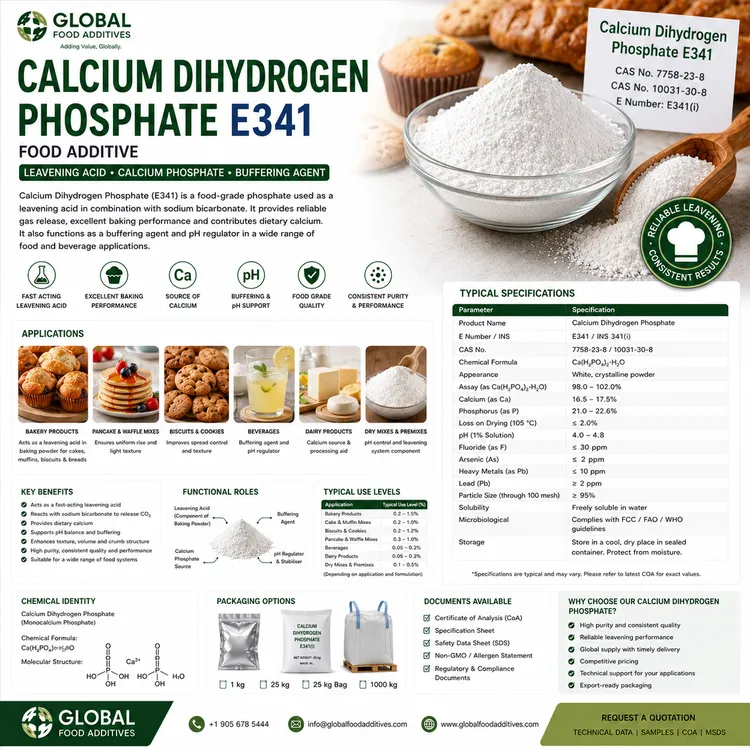
Product identity
| Product | Calcium Dihydrogen Phosphate |
|---|---|
| Common name | Monocalcium Phosphate |
| Alternative names | Acid calcium phosphate, monobasic calcium phosphate, calcium bis(dihydrogen phosphate) |
| E / INS number | E341 / E341(i) / INS 341(i) |
| CAS / identity | 7758-23-8 |
| Related hydrate identity | 10031-30-8 for monohydrate form where applicable |
| Category | Phosphates, Salts & Sequestrants |
| Functional class | Leavening acid / acidity regulator / calcium phosphate source / phosphate functional ingredient |
| Typical form | White to off-white powder, fine powder or granular grade depending on supplier specification |
| Commercial focus | Food-grade compliance, controlled neutralizing value, particle size consistency, low impurity profile, lot traceability and complete documentation |
Application fit
Potential use areas should be checked against destination-market rules, finished-food category and customer requirements. Typical technical review areas may include:
- Baking powder and double-acting leavening systems
- Pancake, waffle, muffin, cake and biscuit mixes
- Self-rising flour and dry bakery premixes
- Tortillas, crackers, cookies and chemically leavened dough systems
- Frozen, chilled or ambient bakery products requiring controlled gas release
- Calcium-fortified dry foods where calcium phosphate is permitted
- Acidity-regulation and phosphate-balancing applications where technically suitable
Technical function in bakery and dry food systems
Calcium Dihydrogen Phosphate is an acidic calcium phosphate. In chemically leavened foods, it reacts with alkaline carbonates or bicarbonates, most commonly sodium bicarbonate, to produce carbon dioxide. The released gas expands the batter or dough matrix, supporting aeration, oven spring, product volume, cell structure and eating texture. Because Calcium Dihydrogen Phosphate is generally considered a fast-acting leavening acid, much of its reaction can occur during mixing and early heating, making it useful in products where quick gas release is desirable.
The final performance depends on neutralizing value, particle size, acid solubility, bicarbonate balance, flour type, sugar level, fat system, water activity, batter viscosity, mixing time, resting time, oven profile and packaging moisture control. For industrial bakery production, Calcium Dihydrogen Phosphate should therefore be evaluated as part of the complete leavening system, not only as an isolated phosphate ingredient.
Functional benefits to evaluate
- Fast carbon dioxide release in chemically leavened systems
- Support for batter aeration and early-stage volume development
- Improved crumb structure, internal cell distribution and eating texture
- Consistent performance in pancake, cake, biscuit and muffin premixes
- pH adjustment in bakery systems where acidic phosphate functionality is required
- Calcium contribution in selected fortified or mineral-balanced formulas
- Compatibility with blended leavening systems using slower-acting acids
- Dry-blend stability when particle size and packaging are properly controlled
Key formulation variables
| Neutralizing value | Determines how much bicarbonate can be neutralized and must be matched to the formula. |
|---|---|
| Reaction rate | Fast acid release affects gas production during mixing, resting and early baking. |
| Particle size | Fine grades react faster; coarser grades may improve handling or staged release depending on process. |
| Moisture exposure | Premature reaction can occur in dry mixes if humidity control and packaging are poor. |
| Bicarbonate balance | Incorrect acid-to-soda balance can cause soapy flavor, acidic taste, poor volume or pH drift. |
| Thermal profile | Oven temperature and heating rate influence gas expansion, set point and final product structure. |
| Formula matrix | Sugar, fat, protein, starch, hydrocolloids and emulsifiers influence gas retention and texture. |
Industrial application guidance
Calcium Dihydrogen Phosphate is most valuable when the manufacturer needs a reliable acidic phosphate for controlled chemical leavening, dry-mix performance or calcium phosphate functionality. The strongest applications are products where gas release timing, final pH, crumb quality and storage stability can be measured through production trials, retained samples and quality-control testing.
Baking powder systems
In baking powder, Calcium Dihydrogen Phosphate may be used as a fast leavening acid with sodium bicarbonate. It can also be blended with slower-acting acids to create balanced gas release from mixing through baking. Buyers should confirm neutralizing value, acid rate, particle size and moisture sensitivity before approving a grade.
Pancake and waffle mixes
Fast reaction is often useful in pancake and waffle batters because gas release begins soon after hydration. Formulators should balance volume, spread, surface browning, flavor, batter viscosity and holding time to avoid gas loss before cooking.
Cake, muffin and biscuit mixes
In cake, muffin and biscuit systems, Calcium Dihydrogen Phosphate can contribute to aeration, crumb structure and product height. It should be tested against batter density, finished volume, crumb grain, pH, tenderness and shelf-life texture.
Crackers and cookies
For crackers and cookies, leavening control affects spread, bite, blistering, lamination, color and surface appearance. Calcium Dihydrogen Phosphate may be used where a fast acid response and calcium phosphate profile match the target process.
Tortillas and flatbreads
In tortilla and flatbread systems, chemical leavening influences machinability, opacity, flexibility, stack height and reheating quality. Buyers should evaluate dough handling, resting time, pH, rollability and storage stability before commercial use.
Fortified and mineral-balanced foods
Because Calcium Dihydrogen Phosphate contains calcium and phosphate, it may be reviewed for mineral-balanced dry foods or fortified systems where the form, solubility, sensory impact and regulatory status are suitable for the final product.
Specification checklist for buyers
For industrial purchasing, the most valuable comparison is not only the product name. Buyers should compare the supplier specification against the intended process, leavening system, regulatory market and customer standard. A strong specification helps QA, R&D, production and purchasing teams confirm suitability before commercial commitment.
Chemical and physical controls
- Assay or purity basis, including anhydrous or monohydrate calculation where relevant
- Identification as calcium dihydrogen phosphate / monocalcium phosphate
- Neutralizing value or leavening acid value
- Calcium content and phosphate content
- pH under supplier test conditions
- Moisture, water content or loss on drying
- Soluble and insoluble matter limits
- Appearance, color and odor
- Particle size distribution or mesh range
- Bulk density or tapped density for automated dosing
- Flowability, dusting tendency and caking tendency where relevant
Purity, safety and compliance checks
- Heavy metals limits according to buyer or regulatory specification
- Lead, arsenic, cadmium and mercury limits where required
- Fluoride limits, especially for phosphate-derived raw materials
- Acid-insoluble substances or insoluble impurities where specified
- Food-grade statement and intended-use declaration
- Residual impurities related to phosphate source and manufacturing route
- Microbiological requirements if used in sensitive dry-mix systems
- Batch number, production date, retest date and shelf-life
- SDS classification and safe handling recommendations
- Allergen, GMO, halal, kosher, vegan and irradiation declarations when requested
Regulatory and label review
Calcium Dihydrogen Phosphate is commonly associated with the E341 calcium phosphate group, more specifically E341(i) / INS 341(i) for monocalcium phosphate. However, an additive number alone does not guarantee permission in every food category or every country. Buyers should verify the exact legal status in the destination market, including whether the product is declared as calcium phosphate, monocalcium phosphate, raising agent, acidity regulator, stabilizer, mineral source or by E-number according to local label rules.
In the United States, calcium phosphate covering mono-, di- and tribasic forms is listed as generally recognized as safe when used in accordance with good manufacturing practice. For other markets, including the European Union, Middle East, Africa, Asia-Pacific and Latin America, the buyer should check the current additive regulation for the exact finished food and use level. Retailer standards, infant-food rules, school-food policies and clean-label programs may impose stricter requirements than national additive legislation.
For export projects, confirm the finished product category, formula, dosage, label declaration, additive function and customer specification before ordering commercial volume. If a supplier cannot provide a destination-specific statement, the buyer should obtain confirmation from a qualified regulatory consultant or the relevant local authority.
Leavening system design and validation
Calcium Dihydrogen Phosphate should be validated in the actual formula and process because leavening performance depends on acid rate, bicarbonate balance and matrix conditions. The same phosphate grade may behave differently in a dry pancake mix, a high-fat biscuit, a refrigerated dough, a cake batter or a tortilla line. Laboratory reaction tests are useful, but plant trials are needed to confirm finished-product performance.
Recommended validation work
- Compare current leavening acid against Calcium Dihydrogen Phosphate grade options
- Measure batter or dough pH after mixing, resting and baking
- Evaluate gas release timing during hydration and early heating
- Measure finished volume, height, spread, crumb grain and texture
- Check flavor for residual soda, excessive acidity, bitterness or mineral notes
- Run accelerated dry-mix stability tests under elevated humidity
- Confirm performance after realistic warehouse storage and distribution
- Document the approved acid-to-bicarbonate ratio in the formulation file
Common process checks
| Weighing accuracy | Low formula percentages require calibrated scales and controlled batching procedures. |
|---|---|
| Dry blending | Blend uniformity affects gas release, pH and product consistency across the batch. |
| Hydration timing | Fast-acting acids may release gas before baking if the batter rests too long. |
| Oven profile | Heating rate must allow gas expansion before the structure sets. |
| Moisture control | Humidity exposure can reduce dry-mix shelf life and cause premature reaction. |
| Packaging barrier | Moisture-resistant packaging helps protect acid-bicarbonate systems during storage. |
Comparison with related phosphate and leavening acids
Calcium Dihydrogen Phosphate is often compared with sodium acid pyrophosphate, sodium aluminum phosphate, dicalcium phosphate, tricalcium phosphate, glucono delta-lactone, cream of tartar and organic acid systems. The best selection depends on gas release profile, label strategy, aluminum-free requirements, sodium contribution, calcium contribution, final pH, texture, cost, supply stability and local regulations.
When Calcium Dihydrogen Phosphate may be considered
- When a fast-acting leavening acid is needed
- When baking powder or dry-mix performance requires early gas release
- When aluminum-free leavening positioning is preferred, subject to formula design
- When calcium contribution is useful in the finished formula
- When pH control and phosphate functionality support the target product
- When E341 / E341(i) is permitted in the intended food category
When another solution may be better
- When delayed gas release is needed for long bench time or frozen dough
- When the final market restricts phosphate additives or requires a different declaration
- When calcium-related mineral notes affect flavor
- When a slower acid is required for oven-stage carbon dioxide release
- When the product needs stronger buffering rather than leavening performance
- When clean-label positioning excludes chemical leavening acids
Quality documentation to request
Documentation quality is often the deciding factor for food additive purchasing. Before confirming an order, request current and batch-specific documents where possible:
- Product specification or technical data sheet showing identity, grade and key limits
- Certificate of analysis for the offered batch or a representative recent lot
- Safety data sheet with handling, storage, PPE and transport information
- Food-grade declaration and intended-use statement
- Country-of-origin, manufacturer and traceability statement where available
- Shelf-life, retest period and storage-condition statement
- Allergen, GMO, irradiation, vegan/vegetarian, halal or kosher declarations when required
- Heavy metals, fluoride or contaminant declaration according to buyer specification
- Packaging specification, net weight, gross weight and pallet configuration
- Regulatory statement for the destination market, if available from the supplier
- Sample CoA and pre-shipment document review for new suppliers
- Label draft or package marking information for import and warehouse control
Packaging, storage and logistics
Calcium Dihydrogen Phosphate should be handled as a controlled food additive with clean, sealed packaging and traceable lot identification. Because phosphate leavening systems are sensitive to moisture exposure, packaging and warehouse control are especially important for dry-mix manufacturers. Standard commercial formats may include multiwall bags, bags with polyethylene inner liners, cartons, drums or palletized export packaging depending on supplier capability and order quantity.
Packaging details to confirm
| Net weight | Confirm available pack sizes such as 20 kg, 25 kg, drum packaging or supplier-specific formats. |
|---|---|
| Inner liner | Request food-compatible liner protection for moisture and contamination control. |
| Seal integrity | Confirm bag closure, tamper evidence and protection against powder leakage. |
| Palletization | Ask for bags or drums per pallet, pallet dimensions, wrapping and export pallet treatment. |
| Labeling | Confirm product name, lot number, net weight, origin, shelf-life and handling marks. |
| Container loading | Check maximum payload, moisture protection and desiccant needs for sea freight. |
Storage recommendations
- Keep containers tightly closed when not in use
- Store in a dry, cool and well-ventilated warehouse
- Protect from water, humidity, condensation and direct sunlight
- Prevent contact with alkaline ingredients until controlled blending
- Avoid contamination with incompatible chemicals according to SDS guidance
- Use first-expiry, first-out stock rotation
- Maintain lot traceability from receipt to production batch
- Segregate food-grade additives from non-food chemicals and odor sources
Industrial purchasing notes
When sourcing Calcium Dihydrogen Phosphate, procurement teams should define the commercial and technical target before requesting offers. A clear inquiry improves supplier matching, reduces document delays and helps avoid comparing non-equivalent grades. The most useful inquiry normally includes additive identity, E/INS number, target specification, annual demand, first-order quantity, destination country, delivery term, packaging preference, required certifications and any buyer-specific restricted-substance limits.
For manufacturers using automated dosing, the physical grade is especially important. Particle size, dusting tendency, bulk density, flowability and caking tendency can affect weighing accuracy, powder transfer, dry blending and operator exposure controls. For export projects, document consistency between invoice, label, CoA, packing list and regulatory statement should be checked before shipment.
Supplier qualification questions
Technical questions
- Is the supplied grade anhydrous, monohydrate or another specified form?
- Which specification standard does the material follow?
- What is the neutralizing value or leavening acid value?
- Can particle size distribution and bulk density be confirmed?
- Can the supplier provide representative and batch-specific certificates of analysis?
- Are heavy metals, fluoride and phosphate-related impurities routinely controlled?
- Is the product suitable for the intended destination market and food category?
Commercial questions
- What is the minimum order quantity and standard lead time?
- Which packaging formats are available for export?
- Can the supplier support annual contracts or scheduled shipments?
- Which incoterms, ports and payment terms are available?
- Can documents be reviewed before shipment?
- Can the supplier provide market-specific declarations when required?
- Can samples be supplied for pilot trials before commercial order placement?
How to request this product
Send the product name, target grade or reference specification, quantity, destination country, delivery term, packaging preference, expected shipment date and required documents. If you already purchase Calcium Dihydrogen Phosphate, attach or describe your existing specification, label, certificate of analysis, baking powder formula requirement or approved supplier standard so supplier options can be compared more accurately.
Useful answers
What is Calcium Dihydrogen Phosphate used for in food manufacturing?
Calcium Dihydrogen Phosphate is mainly reviewed as a fast-acting leavening acid, acidity regulator and calcium phosphate source. It is commonly associated with baking powders, pancake mixes, cake mixes, biscuits, crackers, tortillas and dry bakery premixes where regulations permit.
Is Calcium Dihydrogen Phosphate the same as Monocalcium Phosphate?
Yes. Calcium Dihydrogen Phosphate is commonly called Monocalcium Phosphate or MCP. Buyers should confirm whether the supplied grade is anhydrous or monohydrate because assay basis, moisture, neutralizing value and performance can differ.
How does it work in baking powder?
It acts as an acidic phosphate that reacts with bicarbonate to generate carbon dioxide. The released gas expands the batter or dough and helps create volume, crumb structure, texture and product lift.
Is it fast acting or slow acting?
Calcium Dihydrogen Phosphate is generally considered a fast-acting leavening acid. It is often used where gas release during mixing and early heating is useful, and it may be blended with slower acids when staged carbon dioxide release is required.
Is this product suitable for processed cheese, meat or seafood in every market?
No. Calcium Dihydrogen Phosphate should not be treated as a universal replacement for emulsifying salts, meat phosphates or seafood water-binding phosphates. It should be evaluated according to its actual function, final food category, use level and local regulation.
Is Calcium Dihydrogen Phosphate permitted in every country?
No. Food additive use depends on destination-market rules, food category, maximum use level, label requirements and buyer responsibility. Buyers should verify final regulatory status before use.
Which documents should be requested?
Buyers commonly request a product specification, technical data sheet, certificate of analysis, safety data sheet, origin statement, shelf-life information, storage conditions, packaging details, label information and destination-market declarations when required.
What should be checked on the certificate of analysis?
Check lot number, production date, test date, identity, assay, calcium content, phosphate content, neutralizing value, moisture or loss on drying, pH, particle size, heavy metals, fluoride where specified and whether the certificate matches the supplied batch and purchase specification.
Can Global Food Additives source Calcium Dihydrogen Phosphate?
Global Food Additives can review sourcing options according to target grade, quantity, destination, packaging, documentation, shipment schedule and regulatory expectations. Availability depends on supplier stock, origin, certification and buyer requirements.
Tell us which food additive or ingredient you need.
Send product names, target specifications, quantity, destination country, packaging preference, delivery term, and document requirements. Our team will review your inquiry and respond from [email protected].
Your message has been received. You will be redirected to the home page.