
Calcium Stearoyl-2-Lactylate
Calcium Stearoyl-2-Lactylate, commonly referenced as CSL, E482 or INS 482, is a surface-active food emulsifier used for dough conditioning, crumb softness, loaf-volume improvement, aeration, whipping performance, fat dispersion, emulsion stability, starch interaction and processing tolerance in selected food systems. For industrial buyers, the real purchasing value depends on acid value, ester value, lactic acid content, calcium content, fatty-acid source, particle form, dispersibility, melting profile, application performance, regulatory fit, documentation quality and batch-to-batch consistency.
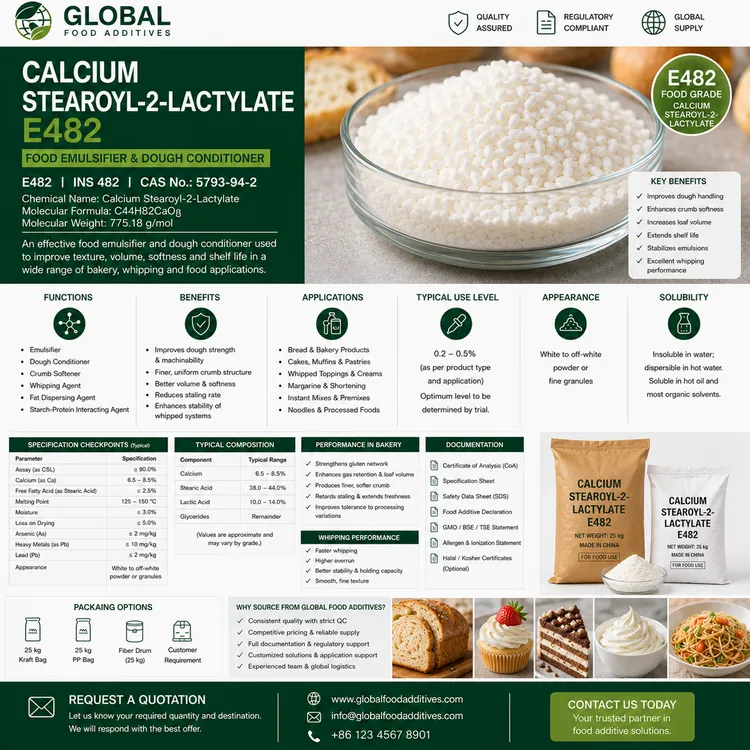
CSL performance depends on grade, particle size, flour system, fat phase, water absorption, mixing energy, fermentation, baking profile, pH, protein/starch interaction and destination-market rules.
Product identity
| Product | Calcium Stearoyl-2-Lactylate |
|---|---|
| Common abbreviation | CSL |
| Alternative names | Calcium stearoyl lactylate; calcium salts of stearoyl lactylic acids; Calcium Stearoyl-2-Lactylate E482; INS 482; food-grade CSL |
| Category | Emulsifiers & Surface Active Ingredients |
| Function | Emulsifier / surface-active food ingredient |
| E / INS number | E482 / INS 482 |
| CAS / identity | 5793-94-2; confirm exact composition, fatty-acid source, calcium content and food-grade status on supplier COA/SDS |
| Composition note | Mixture of calcium salts of stearoyl lactylic acids with minor calcium salts of related acids |
| Typical form | Powder, bead, granule, flake, pastille, spray-dried preparation, fat-coated grade, paste or application-specific emulsifier blend |
| Typical appearance | White to cream or off-white powder, bead, flake or pastille depending on grade and carrier system |
| Main technical value | Improves dough tolerance, crumb softness, starch complexing, protein network support, whipping performance and emulsion stability in suitable applications |
| Key buying point | Compare by functional performance, analytical specification, fatty-acid source, particle form and cost-in-use, not only by price per kilogram |
Industrial buying value
Calcium Stearoyl-2-Lactylate is normally evaluated when a manufacturer needs a lactylate emulsifier with strong interaction in bakery and aerated systems. It can support dough strength, gas retention, mixing tolerance, crumb softness, starch complexing, aeration and fat dispersion. In many formulas, CSL is used with enzymes, mono- and diglycerides, DATEM, SSL, lecithin, hydrocolloids or shortening systems to tune finished-product volume, softness, symmetry and shelf life.
- Supports dough conditioning and processing tolerance in selected yeast-leavened bakery systems
- Can improve crumb softness, loaf volume, sliceability and anti-staling performance when correctly dosed
- Can support whipping and foam stability in selected egg-white or topping applications where permitted
- Can improve fat dispersion and emulsion stability in suitable water-fat systems
- Requires review of grade, legal use level, flour-basis calculation, fatty-acid origin, allergen/GMO status and local label rules
Technical overview
Calcium Stearoyl-2-Lactylate is a lactylated fatty-acid salt designed to act at interfaces between water, fat, starch and protein. Its hydrophilic lactylate portion and lipophilic stearoyl portion allow it to behave as a surface-active ingredient. In bakery systems, it can interact with gluten proteins and starch fractions, helping improve dough tolerance, gas retention, crumb structure and softness. In aerated systems, it can support foam and emulsion stability when the grade and process are suitable.
For procurement and R&D teams, CSL should be evaluated through application trials rather than specification alone. Two grades with similar E482 identity can differ in particle form, dispersibility, fatty-acid source, acid value, ester value and interaction with flour or fat systems. The correct grade depends on the application, process, hydration method, dosage, regulatory route and supplier documentation.
Functional mechanism
CSL performs as an emulsifier and dough conditioner through interface control and interaction with food macromolecules. In bakery applications, its value is often measured by volume, crumb softness, dough tolerance and shelf-life texture rather than by emulsion stability alone.
- Protein interaction: can support gluten network strength and gas retention in suitable dough systems
- Starch complexing: can help manage starch retrogradation and crumb firming in selected bakery products
- Fat dispersion: improves distribution of shortening, oils or emulsified fat phases in suitable systems
- Aeration: can support foam structure and whipping performance in selected approved systems
- Processing tolerance: can improve dough handling during mixing, fermentation, sheeting, moulding and baking
Performance variables
The same CSL dose can perform differently across plants. Industrial trials should evaluate the ingredient under actual flour, fat, water, yeast, enzyme, mixing, fermentation, baking and packaging conditions.
- Flour protein, damaged starch, ash, water absorption and enzyme activity
- Shortening or oil type, fat melting profile and emulsifier blend
- Mixing energy, dough temperature, fermentation time and proofing conditions
- Process route: straight dough, sponge and dough, frozen dough, par-baked, dry mix or industrial continuous line
- Final shelf-life goals: crumb softness, sliceability, volume, symmetry, resilience and staling profile
Application fit
Potential use areas may include the applications below, subject to destination-market rules, food-category permission, maximum use level, final label declaration and customer policy. These examples are technical formulation contexts, not a universal approval list.
| Application area | Technical reason to evaluate | Buyer / R&D checks |
|---|---|---|
| Yeast-leavened bread and buns | Dough conditioning, gas retention, loaf volume, crumb softness and anti-staling support | Flour basis dosage, mixing tolerance, proof stability, oven spring, crumb grain, softness curve and local legal limits |
| Prepared bakery mixes | Dry-blend distribution, dough tolerance and repeatable bakery performance after customer reconstitution | Particle size, carrier compatibility, premix concentration, segregation, hydration, label instructions and premix labelling |
| Frozen dough and par-baked products | Processing tolerance, freeze-thaw stability, gas retention and crumb quality after delayed bake-off | Freeze/thaw cycles, yeast stress, dough strength, ice damage, proof recovery, bake volume and final softness |
| Cakes and sweet baked goods | Emulsion support, fat distribution, batter tolerance and crumb texture where formulation and regulation allow | Batter specific gravity, fat type, sugar level, eggs, leavening system, crumb softness, volume and sensory impact |
| Whipped toppings | Foam stability, aeration support, fat dispersion and processing tolerance in suitable topping systems | Fat type, protein/emulsifier system, whipping overrun, foam stability, freeze-thaw conditions and permitted use |
| Egg-white systems | Whipping support and foam performance where approved and technically suitable | Liquid, frozen or dried egg-white format, use level, pH, whipping time, foam volume and label requirements |
| Dehydrated potatoes | Conditioning, texture support, processing tolerance and reconstitution performance where permitted | Dry solids, particle size, rehydration, texture, colour, storage stability and category-specific legal limits |
| Margarine and fat spreads | Emulsion structure, water-in-oil or oil-in-water stability and fat-phase distribution in suitable systems | Fat blend, crystal network, water phase, emulsifier blend, salt, pH, spreadability, separation and label approval |
| Ice cream and frozen desserts | Emulsion support, air incorporation, meltdown control and texture improvement in selected formulations | Fat level, protein, stabilizer system, homogenisation, overrun, meltdown, heat shock and destination-market approval |
| Chocolate, coatings and compound systems | Fat dispersion or flow modification where technically and legally suitable | Compatibility with cocoa butter or compound fats, viscosity, yield value, bloom, sensory effect and customer standards |
Quality and specification parameters
For industrial purchasing, Calcium Stearoyl-2-Lactylate should be compared by both analytical criteria and application performance. A technically suitable grade should deliver the intended emulsifier effect without unacceptable off-odour, poor dispersion, caking, oxidation, incorrect fatty-acid origin, inconsistent active matter or missing regulatory documentation.
| Specification area | What to request | Why it matters |
|---|---|---|
| Regulatory identity | E482 / INS 482 confirmation, CAS number, CSL name and destination-market compliance note | Confirms correct emulsifier identity and avoids confusion with SSL / E481 or non-food lactylate grades |
| Acid value / acid number | Acid value range and analytical method | Key identity and quality parameter for lactylate emulsifier specification |
| Ester value / ester number | Ester value range and analytical method | Supports identity, reaction consistency and supplier comparison |
| Lactic acid content | Lactic acid content percentage and test method | Important for lactylate identity, performance and compliance comparison |
| Calcium content | Calcium percentage and test method | Confirms calcium salt identity and supports differentiation from sodium stearoyl lactylate |
| Fatty-acid profile | Stearic/palmitic profile, vegetable or animal origin statement and hydrogenation status where relevant | Important for functionality, halal/kosher, vegan/vegetarian and customer-policy review |
| Active matter | Declared active emulsifier content and carrier system if blended | Allows accurate dosage comparison between pure and prepared grades |
| Physical form | Powder, bead, granule, flake, paste or blend format | Determines handling, dry blending, dispersion, dusting and dosing accuracy |
| Particle size | Mesh size, D10/D50/D90 where available, fines and sieve residue | Affects dispersion, premix uniformity, dusting and dough distribution |
| Melting profile | Melting range, softening point or thermal behaviour | Important for fat systems, bakery processing and storage behaviour |
| Moisture and ash | Moisture, loss on drying and ash data | Affects flowability, shelf life, caking and specification compliance |
| Oxidation status | Peroxide value, anisidine value or rancidity indicators where relevant | Important because fatty-acid-derived emulsifiers can develop off-odours if oxidized |
| Contaminants | Heavy metals, lead, arsenic, cadmium, mercury and impurity statements | Supports food-grade approval, export compliance and customer audits |
| Microbiology | Microbiological specification where required by customer or application | Relevant for dry mixes, high-care applications and customer-specific quality programs |
| Compliance | Food-grade declaration, allergen statement, GMO statement, gluten statement, vegan/vegetarian statement, halal/kosher if required | Reduces regulatory, customer and label-approval delays |
| Traceability | Manufacturer, production site, country of origin, batch number, production date, retest date and shelf life | Enables supplier qualification, recall readiness and audit-trail control |
Formulation and plant-trial checklist
- Target function: define whether CSL is needed for dough conditioning, crumb softness, loaf volume, whipping, emulsion stability, fat dispersion, starch complexing or processing tolerance.
- Use-level basis: calculate dosage on flour basis, finished-food basis or premix basis according to the relevant regulation and application.
- Grade comparison: compare CSL with SSL, DATEM, mono- and diglycerides, lecithin and enzyme systems in the real formula.
- Dispersion method: test dry blending, fat dispersion, pre-slurry or direct addition based on supplier grade and plant process.
- Flour interaction: evaluate performance across flour protein, damaged starch, ash, water absorption and enzyme activity variation.
- Mixing and proofing: measure dough development, tolerance, proof stability, oven spring and collapse risk.
- Finished texture: monitor loaf volume, crumb grain, softness, sliceability, resilience and staling curve through shelf life.
- Sensory review: check soapy notes, waxy mouthfeel, off-odour, rancidity, bitterness and aftertaste.
- Label review: confirm ingredient declaration, E-number/INS declaration, fatty-acid source and destination-market wording.
- Cost-in-use: compare suppliers by finished product performance, dosage, line efficiency, waste reduction, documentation and landed cost.
Comparison with related emulsifiers
Calcium Stearoyl-2-Lactylate is part of a wider emulsifier toolbox. The right choice depends on target application, flour system, fat phase, protein system, aeration need, label rules, cost and destination-market approval.
| Emulsifier option | Typical reason to compare | Industrial note |
|---|---|---|
| Calcium Stearoyl-2-Lactylate / E482 | Dough conditioning, crumb softness, protein/starch interaction, whipping and emulsion support | Calcium salt form; compare grade performance and permitted-use limits carefully |
| Sodium Stearoyl Lactylate / E481 | Related lactylate emulsifier used for dough strength, crumb softness and emulsification | Different cation, solubility and application behaviour; not a one-for-one substitute without trials |
| Mono- and Diglycerides / E471 | Crumb softness, starch complexing, aeration and fat dispersion | Often combined with CSL or SSL for bakery and cake systems |
| DATEM / E472e | Dough strengthening, volume improvement and industrial bread tolerance | Strong bakery dough conditioner; compare performance with CSL in specific flour systems |
| Lecithin / E322 | Natural-origin emulsification, chocolate flow and dough handling | Different surface activity and allergen/GMO considerations depending on source |
| Polysorbates | Aeration, emulsion stability and whipping systems in selected applications | Different label perception, regulatory status and sensory profile |
| Enzyme systems | Dough strengthening, crumb softness and anti-staling without declaring an emulsifier in some markets | Function depends on process and inactivation; regulatory treatment differs by destination market |
Process integration guidance
Calcium Stearoyl-2-Lactylate should be added through a controlled emulsifier-dispersion process. The best addition point depends on whether the grade is powdered, beaded, flaked, fat-coated, pasted or blended into a bakery improver. In dry mixes, uniform distribution is critical; in doughs and fat systems, hydration and dispersion control determine whether the emulsifier reaches the starch, protein and fat interfaces effectively.
Bakery and dry-mix systems
- Pre-blend CSL with flour, improver, sugar or dry carrier for uniform distribution where appropriate
- Control mixing time, dough temperature and water absorption when evaluating performance
- Validate dosage by flour weight when the regulation or customer specification uses flour basis
- Measure dough tolerance, proof stability, oven spring, crumb softness and shelf-life firmness
- Record lot number, dosage, grade, flour batch, mixing profile and finished-product results
Whipping, topping and emulsion systems
- Confirm whether the CSL grade is suitable for the fat, protein, water and emulsifier system
- Use controlled dispersion temperature to prevent lumps, incomplete activation or fat separation
- Measure overrun, foam stability, viscosity, freeze-thaw behaviour and sensory profile
- Check compatibility with mono- and diglycerides, polysorbates, stabilizers, proteins and fats
- Confirm legal use level and finished-food compliance before commercial release
Bakery validation workflow
Industrial bakery buyers should approve CSL through plant-scale or pilot-scale baking trials rather than relying only on laboratory specification. The approved grade should meet both analytical requirements and finished-product performance targets.
| Step | Recommended action |
|---|---|
| 1. Define bakery target | Set measurable targets for dough strength, proof tolerance, loaf volume, crumb softness, sliceability and shelf life |
| 2. Select grade format | Choose powder, bead, flake, fat-coated grade or improver blend based on plant dosing and mixing system |
| 3. Run dosage ladder | Test several use levels against control and existing emulsifier system |
| 4. Validate process window | Test normal and stressed mixing, proofing, fermentation and baking conditions |
| 5. Measure shelf life | Track crumb firmness, resilience, moisture loss, slicing performance and sensory quality over shelf life |
| 6. Check compliance | Confirm permitted category, maximum level, declaration, fatty-acid source and customer restrictions |
| 7. Lock specification | Approve acid value, ester value, lactic acid, calcium content, particle form, packaging and document package |
Handling, storage and warehouse control
Calcium Stearoyl-2-Lactylate should be handled according to the supplier safety data sheet, food-safety plan and local workplace rules. Emulsifier powders and flakes can be dusty, waxy, heat-sensitive or prone to caking if stored poorly. Storage should protect flowability, dispersibility, odour quality and active functionality.
| Control point | Recommended buyer action |
|---|---|
| Storage environment | Store in a clean, dry, cool and well-ventilated area according to supplier recommendations |
| Temperature control | Protect from hot warehouse zones, direct sunlight and repeated temperature cycling that can soften or cake the product |
| Moisture protection | Keep bags or containers sealed and protect opened packs from humidity and condensation |
| Odour control | Store away from strong-smelling ingredients, solvents, spices and cleaning chemicals because emulsifiers can absorb odours |
| Oxidation control | Follow shelf-life and resealing guidance to reduce rancidity or off-odour risk in fatty-acid-derived materials |
| Dust and handling | Use appropriate ventilation and PPE according to SDS and site risk assessment |
| Cross-contact | Manage allergen, GMO, halal, kosher, vegan and customer-specific segregation requirements according to site policy |
| Lot traceability | Record lot number, supplier COA, internal release status and expiry/retest date before use |
| Opened packaging | Define resealing, relabelling, retest and maximum-open-time procedures for each grade |
Packaging and logistics options
Packaging depends on supplier standard, physical form and order volume. Common industrial requests include laboratory samples, 1-5 kg trial packs, 10-25 kg PE-lined bags, multiwall kraft bags, lined cartons, fibre drums, low-melt-protection packaging, palletised export packaging and full-container supply. For export projects, buyers should request pallet dimensions, net and gross weight, liner type, bag closure, batch coding system, shelf life, storage temperature, heat-exposure guidance, HS code guidance, document language and shipping marks before confirming the order.
Regulatory and label diligence
Calcium Stearoyl-2-Lactylate should be managed as a regulated food emulsifier according to the destination market and intended use. The buyer is responsible for verifying whether E482 / INS 482 is permitted in the destination market, whether the intended food category is covered, the maximum use level, the calculation basis, the label declaration, intermediate-premix labelling, fatty-acid source acceptability and customer-specific restrictions.
Regulatory status can differ by country, food category and final positioning. A grade that is suitable for yeast-leavened bakery products in one market may not be automatically suitable for cakes, toppings, ice cream, chocolate, beverages, margarine or export-only products. Regulatory and customer approval should be completed before bulk purchase and before full-scale production.
Documents to request
- Product specification or technical data sheet with E482 / INS 482 confirmation and intended applications
- Certificate of analysis for available batch or representative lot
- Safety data sheet with handling, dust and storage guidance
- Food-grade declaration and market-specific additive-use statement
- CAS, E-number, CSL identity, manufacturing-process and composition statement where required
- Acid value, ester value, lactic acid content, calcium content and analytical methods
- Fatty-acid profile, stearic/palmitic ratio and vegetable or animal origin declaration
- Active matter, free fatty acids, moisture, ash, particle size, melting profile and dispersibility data
- Peroxide value, odour, rancidity or oxidation-status data where required
- Heavy metals, lead, arsenic, cadmium, mercury and impurity statements aligned with buyer requirements
- Microbiological specification where required by customer or application
- Allergen statement, gluten statement, GMO statement and cross-contact information
- Vegan/vegetarian, BSE/TSE, irradiation and nanomaterial statements where required
- Halal and kosher certificates when required by customer or destination market
- Origin statement, manufacturer information and traceability declaration
- Shelf-life, retest date, recommended storage conditions and heat-exposure guidance
- Intermediate-premix labelling guidance where the product is supplied in premix form
- Label draft, packaging details, pallet configuration and net/gross weight
- Market-specific declarations required by the importing country
How to request this product
Send the product name, target grade, physical form, intended application, required analytical specification, quantity, destination country, packaging preference, expected shipment date, delivery term and required documents. If you already purchase Calcium Stearoyl-2-Lactylate, attach or describe your current specification, label, certificate of analysis, dosage, particle form, application result and supplier grade so alternatives can be compared accurately.
For faster technical review, include the finished-product category, flour type or fat system, target function, current emulsifier system, use level, process conditions, mixing method, heat process, target shelf life, allergen/GMO requirements, fatty-acid origin requirements, halal/kosher requirements, destination-market rules, customer compliance requirements and whether trial samples are needed before bulk quotation.
Useful answers
What is Calcium Stearoyl-2-Lactylate used for in food manufacturing?
Calcium Stearoyl-2-Lactylate E482 is typically reviewed for dough conditioning, crumb softness, loaf volume, emulsion stability, aeration, whipping performance, fat dispersion, starch interaction and processing tolerance. Exact suitability depends on grade, application, process, regulations and supplier documents.
What does CSL mean?
CSL is a common abbreviation for Calcium Stearoyl-2-Lactylate. It should not be confused with SSL, which refers to Sodium Stearoyl Lactylate / E481.
Is CSL the same as SSL?
No. CSL is Calcium Stearoyl-2-Lactylate / E482, while SSL is Sodium Stearoyl Lactylate / E481. They are related emulsifiers but differ in cation, solubility, dough performance, label declaration and legal use conditions.
Which applications commonly evaluate this emulsifier?
Potential applications include yeast-leavened bread, buns, bakery mixes, frozen dough, par-baked products, cakes, whipped toppings, egg-white systems, dehydrated potatoes, margarine, ice cream, fat spreads, coatings and selected chocolate or compound systems where permitted.
Which technical parameters should be compared between suppliers?
Buyers should compare E482 identity, acid value, ester value, lactic acid content, calcium content, fatty-acid profile, active matter, free fatty acids, particle size, melting profile, dispersibility, moisture, ash, oxidation status, heavy metals, shelf life, packaging and compliance documents.
Can CSL be used in clean-label or vegan products?
Suitability depends on customer definition, fatty-acid source, lactic acid source, processing aids, GMO status, allergen status, halal/kosher status and destination-market rules. Buyers should request supplier declarations before making label or marketing claims.
Can Global Food Additives source Calcium Stearoyl-2-Lactylate?
Global Food Additives can review sourcing options for Calcium Stearoyl-2-Lactylate according to target specification, grade, physical form, application, quantity, destination, packaging, shipment timing and required documentation.
Which documents should be requested?
Buyers commonly request a technical data sheet or specification, certificate of analysis, safety data sheet where applicable, food-grade declaration, E482 confirmation, acid and ester value data, fatty-acid origin statement, allergen/GMO/gluten statements, shelf-life information, label details and packing details.
Is this product permitted in every country?
No. Food emulsifier use depends on destination-market rules, food category, approved use, maximum level, premix rules, label requirements and buyer responsibility. Always verify regulatory status before commercial use.
Tell us which food additive or ingredient you need.
Send product names, target specifications, quantity, destination country, packaging preference, delivery term, and document requirements. Our team will review your inquiry and respond from [email protected].
Your message has been received. You will be redirected to the home page.