
Calcium Sulphate
Calcium Sulphate, commonly referenced as E516 / INS 516, is a food-grade calcium salt used for mineral control, firming, protein coagulation, flour treatment, anticaking, pH-control support, calcium fortification and processing-aid functions in selected food systems. For industrial buyers, the real purchasing value depends on hydrate form, assay, calcium content, sulfate content, particle size, whiteness, solubility behaviour, application performance, regulatory fit, documentation quality and batch-to-batch consistency.
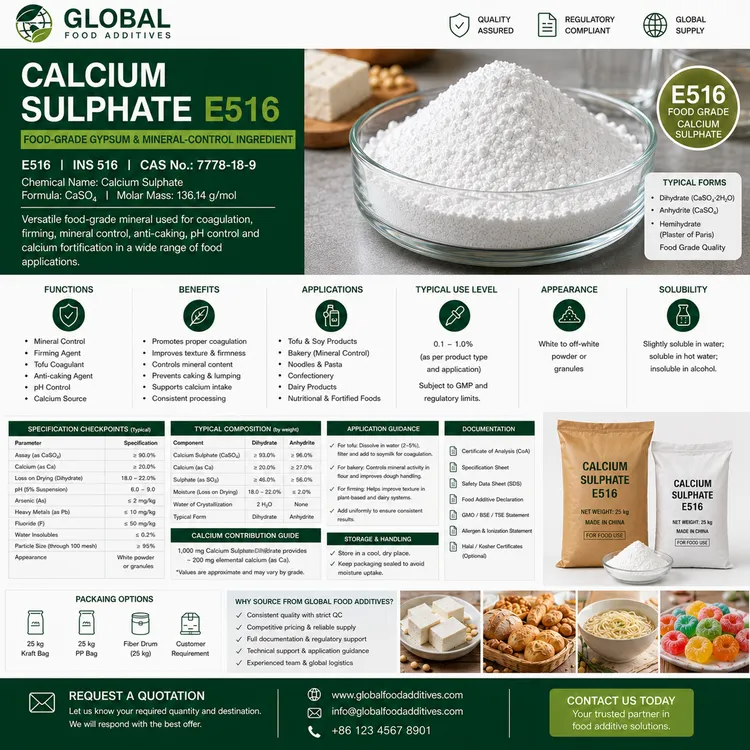
Calcium Sulphate performance depends on hydrate form, particle size, calcium release, solubility, pH, protein system, water chemistry, mixing, heat process and destination-market rules.
Product identity
| Product | Calcium Sulphate |
|---|---|
| Alternative names | Calcium Sulfate; Calcium Sulphate E516; Calcium Sulfate E516; INS 516; gypsum; food-grade gypsum; anhydrite; calcium sulfate dihydrate; plaster of Paris food-grade material |
| Category | Phosphates, Salts & Sequestrants |
| Function | Salt / phosphate / sequestrant / mineral-control ingredient |
| E / INS number | E516 / INS 516 |
| CAS / identity | 7778-18-9 for anhydrous calcium sulfate; calcium sulfate dihydrate may be referenced separately depending on supplier documentation |
| Chemical formula | CaSO4, with common hydrate forms such as CaSO4·2H2O and CaSO4·0.5H2O |
| Functional family | Calcium salt, firming agent, tofu coagulant, anticaking agent, flour treatment aid, pH-control aid, mineral source, processing aid and texturizer |
| Typical form | Fine powder, micronized powder, crystal, granule, dihydrate gypsum, hemihydrate, anhydrite or application-specific dry blend |
| Typical appearance | White to slightly off-white powder or granule, depending on source, purification, hydrate form and particle size |
| Main technical value | Provides controlled calcium contribution, firming, protein coagulation, anticaking, flour treatment, mineral adjustment and texture support |
| Key buying point | Compare by hydrate form, assay, calcium release, particle size, purity, application performance and cost-in-use, not only by price per kilogram |
Industrial buying value
Calcium Sulphate is normally evaluated when a manufacturer needs a relatively low-solubility calcium source, a clean-label mineral salt, a tofu or soy-protein coagulant, a flour-treatment aid, an anticaking component or a mineral-control ingredient. It can support texture, firmness, protein network formation, dough performance, pH control and calcium enrichment, but the correct grade depends on hydrate form, particle-size distribution, purity, whiteness and application route.
- Supports calcium-controlled coagulation in tofu and selected protein systems
- Can contribute firmness, texture and mineral balance in selected food matrices
- Can be used as a flour treatment, dough strengthener, anticaking or formulation aid where permitted
- Available in different hydrate forms that affect dosage, solubility and process behaviour
- Requires review of assay, particle size, heavy metals, acid-insoluble matter, hydrate form and destination-market approval
Technical overview
Calcium Sulphate is a calcium salt with limited water solubility compared with many other calcium salts. This lower solubility can be useful when a slower or more controlled calcium release is needed, such as in tofu coagulation or texture-forming systems. It can also be valuable in dry blends, bakery systems and mineral-fortification programs where neutral flavour, whiteness and low reactivity are important.
For procurement and R&D teams, Calcium Sulphate should be specified by hydrate form and application performance. Anhydrous calcium sulfate, calcium sulfate dihydrate and calcium sulfate hemihydrate differ in water content, calcium percentage, setting behaviour, flowability and processing response. Substitution between forms should be calculated and trialled in the actual product before commercial approval.
Hydrate form and calcium release
The hydrate form is one of the most important purchasing details. Water of crystallisation changes the assay basis and calcium contribution per kilogram. It can also influence dispersion, settling, setting, reaction rate and final texture.
- Dihydrate gypsum: often reviewed for tofu coagulation, mineral addition and food-grade calcium sulphate use
- Hemihydrate: may show setting behaviour and faster hydration characteristics in selected systems
- Anhydrite: anhydrous form with different water uptake and calcium-per-kilogram calculation
- Micronized grades: useful where fine dispersion, smooth texture or uniform dry blending is required
- Granular grades: may improve flow, reduce dusting and support controlled handling in industrial plants
Performance variables
The same Calcium Sulphate grade can behave differently across food matrices. Industrial trials should evaluate the grade under actual pH, temperature, mixing, protein level, water hardness, shear, holding time and packaging conditions.
- Particle size and surface area, which affect dispersion and reaction speed
- Hydrate form, which affects calcium concentration and water balance
- Product pH, salt level, phosphate level, protein composition and mineral balance
- Heat process, shear, holding time, hydration time and order of addition
- Target texture, sediment tolerance, calcium claim requirements and final label wording
Application fit
Potential use areas may include the applications below, subject to destination-market rules, food-category permission, use level, final label declaration and customer policy. These examples are technical formulation contexts, not a universal approval list.
| Application area | Technical reason to evaluate | Buyer / R&D checks |
|---|---|---|
| Tofu and soy-protein coagulation | Controlled calcium release, protein coagulation, gel texture and smooth curd structure | Soy milk solids, temperature, dosage, particle size, slurry method, setting time, gel strength, water retention and calcium content |
| Bakery and flour systems | Flour treatment, dough strengthening support, calcium addition, anticaking and processing-aid function | Flour type, dough absorption, yeast activity, pH, leavening system, crumb texture, particle size, taste and regulatory limits |
| Leavening and baking powder systems | Mineral carrier, anticaking support and formulation aid in selected dry leavening systems | Moisture, particle size, acid/base system, release rate, caking, CO2 generation and shelf-life stability |
| Processed cheese and dairy preparations | Calcium balance, mineral adjustment and texture support in selected dairy systems | Protein, fat, pH, emulsifying salts, calcium/phosphate balance, melting behaviour, sliceability and gritty texture risk |
| Frozen desserts and puddings | Mineral control, texture adjustment, stabilizer support and calcium contribution in selected formulas | Protein, stabilizer system, pH, freezing profile, sediment, mouthfeel, calcium claim and permitted use |
| Confectionery and frostings | Anticaking, mineral addition, drying support, texture and formulation aid in selected systems | Particle size, grittiness, colour, moisture, fat compatibility, sugar system and sensory impact |
| Processed vegetables and fruit systems | Firming support and calcium interaction with pectin structures in selected applications | pH, calcium release, texture, brine composition, heat process, colour, sediment and local category rules |
| Beverages and powdered drinks | Calcium addition or mineral balance where suspension and mouthfeel can be managed | Solubility, sediment, pH, turbidity, flavour, calcium claim, stabilizer system and packaging instructions |
| Meat, seafood and plant-protein systems | Mineral balance, water binding, protein functionality and texture support in selected systems | pH, salt, phosphate system, protein type, particle size, cook yield, texture, purge and permitted use |
| Dry mixes and premixes | Calcium source, anticaking aid, formulation aid and texture support after reconstitution | Bulk density, dusting, dry-blend uniformity, segregation, moisture barrier, reconstitution and label declaration |
Quality and specification parameters
For industrial purchasing, Calcium Sulphate should be compared by active assay, hydrate form, purity, particle size and application performance. A technically suitable grade should deliver the required calcium contribution and functional effect without unacceptable grit, colour change, sediment, heavy-metal concerns, caking, dosing inconsistency or compliance gaps.
| Specification area | What to request | Why it matters |
|---|---|---|
| Regulatory identity | E516 / INS 516 confirmation, CAS number, chemical identity and destination-market compliance note | Confirms correct additive identity and avoids industrial gypsum or non-food grade material |
| Hydrate form | Anhydrous, dihydrate, hemihydrate or supplier-declared hydrate form | Changes calcium content, water content, assay basis, solubility behaviour and dosage calculation |
| Assay | Calcium sulfate assay, analytical method and acceptance range | Primary basis for supplier comparison and dosage setting |
| Calcium content | Elemental calcium percentage and calculation basis | Important for fortification, nutrition labelling and mineral-balance calculations |
| Sulfate content | Sulfate content and analytical method where available | Supports identity confirmation and grade comparison |
| Particle size | Mesh size, D10/D50/D90, fines, sieve residue and micronization status | Affects dispersion, mouthfeel, reaction speed, sediment, dusting and dry-blend uniformity |
| Solubility and dispersibility | Solubility guidance, slurry behaviour, sediment rate and application advice | Important for tofu, beverages, dairy systems, dry mixes and mineral fortification |
| Whiteness and colour | Whiteness index, appearance range or colour standard where required | Important for tofu, dairy, bakery, confectionery and light-coloured products |
| Moisture / loss on drying | Moisture, loss on drying or water of crystallisation data | Affects assay, hydrate form, caking, shelf life and dosage calculation |
| pH | pH of suspension or solution and acceptance range | Influences formulation compatibility and process behaviour |
| Acid-insoluble matter | Acid-insoluble matter, sand, silica or insoluble impurity limits | Important for smooth texture, purity, equipment protection and food-grade approval |
| Contaminants | Heavy metals, lead, arsenic, cadmium, mercury, fluoride where required and other impurities | Supports food-grade approval, export compliance and customer audit requirements |
| Microbiology | Microbiological specification where required by customer or application | Relevant for high-care foods, dry blends, dairy applications and customer-specific quality programs |
| Compliance | Food-grade declaration, allergen statement, GMO statement, gluten statement, vegan/vegetarian statement, halal/kosher if required | Reduces regulatory, customer and label-approval delays |
| Traceability | Manufacturer, production site, country of origin, batch number, production date, retest date and shelf life | Enables supplier qualification, recall readiness and audit-trail control |
Formulation and plant-trial checklist
- Target function: define whether Calcium Sulphate is needed for tofu coagulation, firming, anticaking, flour treatment, pH control, calcium fortification, mineral balance or texture support.
- Hydrate-form confirmation: confirm anhydrous, dihydrate or hemihydrate form before calculating dosage.
- Calcium calculation: calculate elemental calcium contribution and check whether nutrition or mineral claims are intended.
- Particle-size selection: choose fine, micronized or granular grade based on dispersion, mouthfeel, dusting and dry-blend performance.
- Solubility validation: confirm calcium release, sediment and dispersion in the actual product matrix.
- Protein testing: validate gelation, coagulation or texture effect in soy, dairy, meat, seafood or plant-protein systems.
- Process testing: test heat treatment, shear, holding, filling, baking, freezing, drying and shelf-life conditions where applicable.
- Sensory review: check grittiness, chalkiness, bitterness, mineral taste, colour change and mouthfeel.
- Label review: confirm additive name, calcium declaration, nutrition claim, processing-aid status and destination-market wording.
- Cost-in-use: compare suppliers by active calcium contribution, functionality, yield, defects, documentation and landed cost.
Comparison with related calcium and mineral-control ingredients
Calcium Sulphate is part of a wider calcium-salt and mineral-control toolbox. The right choice depends on solubility, calcium release, taste, pH impact, texture target, label strategy, cost and destination-market approval.
| Ingredient option | Typical reason to compare | Industrial note |
|---|---|---|
| Calcium Sulphate / E516 | Controlled calcium release, tofu coagulation, firming, anticaking, flour treatment and calcium addition | Low solubility can be useful, but dispersion and sediment must be validated |
| Calcium Chloride / E509 | Highly soluble calcium source for firming, brines, cheese and rapid calcium release | Can taste bitter or salty; faster calcium release than calcium sulphate |
| Calcium Lactate / E327 | Moderate calcium source with milder taste in some applications | Often used for fortification, alginate systems and firming; compare solubility and flavour |
| Calcium Carbonate / E170 | High-calcium, low-cost mineral fortificant and anticaking or colour adjunct | Low solubility and possible chalky mouthfeel; reacts with acids to release CO2 |
| Calcium Citrate / E333 | Calcium source and acidity/buffer-related mineral salt | Different solubility, taste and pH behaviour from calcium sulphate |
| Calcium Phosphates / E341 | Mineral fortification, anticaking, leavening systems and phosphate functionality | Contributes phosphate; not interchangeable where phosphate declaration or formulation restrictions apply |
| Magnesium Chloride / E511 | Alternative tofu coagulant or mineral salt | More soluble and can create different tofu texture and taste profile |
| Glucono delta-lactone / E575 | Acidifying coagulant for smooth tofu and dairy-style gel systems | Works through gradual pH reduction rather than direct calcium release |
Process integration guidance
Calcium Sulphate should be added through a controlled dosing and dispersion process. The best addition point depends on whether the grade is used as a dry powder, pre-slurry, premix, coagulant, dough ingredient, anticaking aid or fortification mineral. Because it is relatively low in solubility, uniform dispersion and particle-size selection are central to industrial performance.
Powder and dry-blend handling
- Use accurate weighing and validated batch records to control calcium contribution
- Pre-blend with flour, starch, sugar, stabilizers or dry carriers to improve distribution where appropriate
- Select particle size to reduce segregation, dusting, grittiness and blend non-uniformity
- Control moisture pickup to prevent caking and flow problems
- Record lot number, dosage, hydrate form, mesh size and internal release status
Slurry, tofu and high-moisture systems
- Prepare a controlled slurry when direct powder addition causes uneven dispersion
- Control temperature, agitation, hydration time and addition rate
- Validate calcium release, gel setting, curd firmness, syneresis and texture
- Check sediment and filtration impact in beverage or liquid systems
- Measure finished-product calcium content where claims or specifications require
Tofu coagulation workflow
Calcium Sulphate is widely reviewed as a tofu coagulant because it can provide slower calcium release and a smooth gel structure in suitable soy milk systems. Commercial tofu trials should define the soy milk solids, temperature, coagulant slurry, addition method, setting time and pressing conditions before supplier approval.
| Control point | Recommended buyer action |
|---|---|
| Soy milk solids | Standardise protein and solids before comparing coagulant grades |
| Coagulant slurry | Disperse Calcium Sulphate uniformly to prevent local over-coagulation or sandy texture |
| Temperature | Control addition temperature and setting temperature for repeatable curd formation |
| Dosage | Screen dosage levels based on texture, yield, calcium content and flavour |
| Setting time | Define holding time before cutting, moulding or pressing |
| Texture validation | Measure firmness, smoothness, brittleness, water release and yield after cooling |
| Finished calcium | Verify calcium content where nutrition labelling or calcium claims are planned |
Calcium fortification and label planning
When Calcium Sulphate is used as a calcium source, the buyer should calculate calcium contribution from the exact hydrate form and assay. The technical team should confirm whether calcium remains suspended, dissolved, bound in a gel network or present as fine mineral particles. Nutrition claims, mineral declarations and finished-product calcium values should be supported by analytical data and destination-market rules.
Handling, storage and warehouse control
Calcium Sulphate should be handled according to the supplier safety data sheet, food-safety plan and local workplace rules. Food-grade calcium sulphate powders are generally stable, but fine grades can create dust, absorb moisture, cake or segregate in blends if handled poorly. Storage should protect flowability, whiteness, purity and traceability.
| Control point | Recommended buyer action |
|---|---|
| Storage environment | Store in a clean, cool, dry and well-ventilated area according to supplier recommendations |
| Moisture protection | Keep bags or containers sealed until use and protect opened packs from humidity and condensation |
| Dust control | Use appropriate ventilation, closed handling and PPE according to SDS and site risk assessment |
| Segregation control | Manage particle-size differences in dry blends to prevent mineral settling or non-uniform calcium distribution |
| Odour and colour control | Store away from strong-smelling ingredients, cleaning chemicals, colourants and materials that may stain or contaminate the product |
| Cross-contact | Manage allergen, GMO, halal, kosher and customer-specific segregation requirements according to site policy |
| Lot traceability | Record lot number, supplier COA, internal release status and expiry/retest date before use |
| Opened packaging | Define resealing, relabelling, retest and maximum-open-time procedures for each grade |
Packaging and logistics options
Packaging depends on supplier standard, particle size, hydrate form and order volume. Common industrial requests include laboratory samples, 1-5 kg trial packs, 10-25 kg PE-lined multiwall bags, moisture-barrier bags, fibre drums, big bags, palletised export packaging and full-container supply. For export projects, buyers should request pallet dimensions, net and gross weight, liner type, bag closure, batch coding system, shelf life, storage temperature, HS code guidance, document language and shipping marks before confirming the order.
Regulatory and label diligence
Calcium Sulphate should be managed as a regulated food additive, mineral source or processing aid according to the destination market and intended use. The buyer is responsible for verifying whether E516 / INS 516 is permitted in the destination market, whether the intended food category is covered, the maximum use level, purity criteria, calcium declaration, processing-aid interpretation, nutrition claim requirements, label wording and customer-specific restrictions.
Regulatory status can differ by country, food category and final positioning. A grade that is suitable for tofu, bakery or dry mixes may not be automatically suitable for infant foods, medical foods, organic programs, supplements, dairy standards or export-only products. Regulatory and customer approval should be completed before bulk purchase and before full-scale production.
Documents to request
- Product specification or technical data sheet with E516 / INS 516 confirmation and intended applications
- Certificate of analysis for available batch or representative lot
- Safety data sheet with dust-handling and storage guidance
- Food-grade declaration and market-specific additive-use statement
- CAS, E-number, chemical identity, hydrate form and manufacturing-process statement where required
- Assay method, calcium content, sulfate content and calculation basis
- Hydrate-form statement: anhydrous, dihydrate, hemihydrate or supplier-specific form
- Particle size, bulk density, whiteness, moisture, loss on drying, pH and solubility data
- Acid-insoluble matter, chloride, carbonate, iron, fluoride where required and other impurity statements
- Heavy metals, lead, arsenic, cadmium and mercury data aligned with buyer requirements
- Microbiological specification where required by customer or application
- Allergen statement, gluten statement, GMO statement and cross-contact information
- Vegan/vegetarian, BSE/TSE, irradiation and nanomaterial statements where required
- Halal and kosher certificates when required by customer or destination market
- Origin statement, manufacturer information and traceability declaration
- Shelf-life, retest date and recommended storage conditions
- Label draft, packaging details, pallet configuration and net/gross weight
- Market-specific declarations required by the importing country
How to request this product
Send the product name, target grade, hydrate form, required assay, particle size, intended application, quantity, destination country, packaging preference, expected shipment date, delivery term and required documents. If you already purchase Calcium Sulphate, attach or describe your current specification, label, certificate of analysis, calcium content, hydrate form, particle size, dosage and supplier grade so alternatives can be compared accurately.
For faster technical review, include the finished-product category, whether the use is tofu coagulation, bakery, mineral fortification, anticaking, firming, beverage, cheese, meat, seafood or dry mix. Also include pH, heat process, protein system, target texture, target calcium level, sediment tolerance, allergen/GMO requirements, destination-market rules, customer compliance requirements and whether trial samples are needed before bulk quotation.
Useful answers
What is Calcium Sulphate used for in food manufacturing?
Calcium Sulphate E516 is typically reviewed for calcium contribution, tofu coagulation, firming, flour treatment, anticaking, pH-control support, processing-aid use, texture support and mineral balance. Exact suitability depends on grade, hydrate form, application, process, regulations and supplier documents.
Is Calcium Sulphate the same as gypsum?
Food-grade gypsum commonly refers to calcium sulfate dihydrate. Calcium Sulphate may also be supplied as anhydrous or hemihydrate forms depending on production and supplier grade. Buyers should confirm the exact hydrate form before calculating dosage.
Why does hydrate form matter?
Hydrate form changes calcium content, water content, solubility behaviour, setting behaviour, flowability and cost-in-use. Dihydrate, hemihydrate and anhydrous grades should not be substituted without technical review.
Can Calcium Sulphate be used as a tofu coagulant?
Yes, Calcium Sulphate is commonly reviewed as a tofu coagulant because it can provide controlled calcium release and smooth soy-protein gel formation. Texture depends on soy milk solids, dosage, slurry preparation, temperature, setting time and particle size.
Which applications commonly evaluate this ingredient?
Potential applications include tofu, soy-protein systems, bakery, flour treatment, leavening blends, processed cheese, dairy preparations, frozen desserts, puddings, confectionery, processed vegetables, beverages, meat, seafood, plant-protein systems, dry mixes and premixes.
Which technical parameters should be compared between suppliers?
Buyers should compare E516 identity, assay, hydrate form, calcium content, sulfate content, particle size, solubility, whiteness, moisture, loss on drying, pH, acid-insoluble matter, heavy metals, lead, arsenic, fluoride where required, microbiology where relevant, shelf life, packaging and compliance documents.
Can Global Food Additives source Calcium Sulphate?
Global Food Additives can review sourcing options for Calcium Sulphate according to target specification, hydrate form, particle size, application, quantity, destination, packaging, shipment timing and required documentation.
Which documents should be requested?
Buyers commonly request a technical data sheet or specification, certificate of analysis, safety data sheet where applicable, food-grade declaration, E516 confirmation, hydrate-form statement, calcium-content data, heavy-metal information, allergen/GMO/gluten statements, shelf-life information, label details and packing details.
Is this product permitted in every country?
No. Food additive use depends on destination-market rules, food category, approved use, use level, purity criteria, calcium claim rules, label requirements and buyer responsibility. Always verify regulatory status before commercial use.
Tell us which food additive or ingredient you need.
Send product names, target specifications, quantity, destination country, packaging preference, delivery term, and document requirements. Our team will review your inquiry and respond from orders@foodgradeadditives.com.
Your message has been received. You will be redirected to the home page.