
Carbon Dioxide
Carbon Dioxide, commonly referenced as E290 / INS 290, is a food-grade gas used for beverage carbonation, modified-atmosphere packaging, oxygen displacement, headspace management, propellant functions, dry ice cooling and controlled-atmosphere applications. For industrial buyers, the purchasing value depends on food-grade or beverage-grade status, purity, impurity limits, taste and odour neutrality, cylinder or bulk supply format, pressure-system compatibility, gas-mix performance, supply continuity, safety controls, regulatory fit and documentation quality.
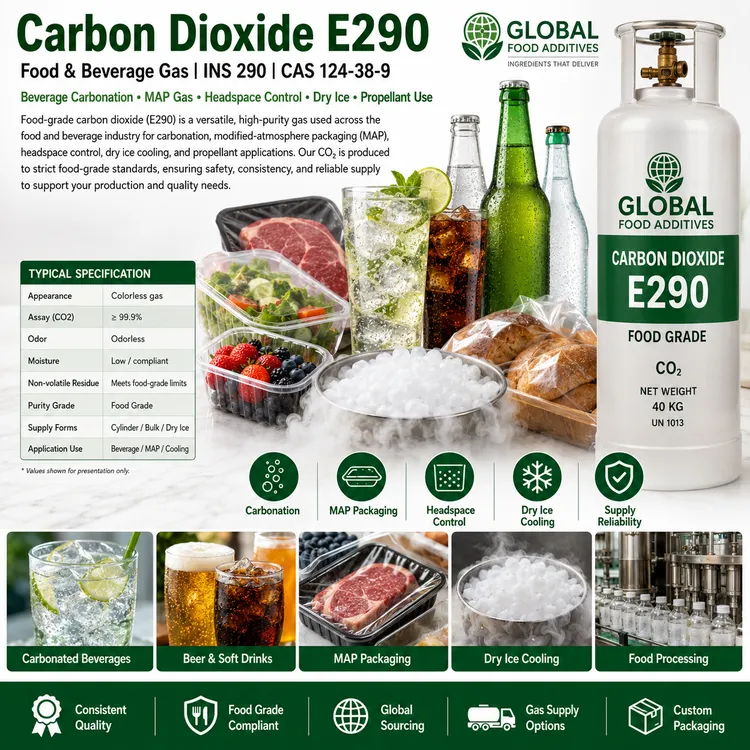
Gas performance depends on purity, moisture, pressure, temperature, flow rate, package barrier, product respiration, carbonation target, oxygen target and gas-handling safety controls.
Product identity
| Product | Carbon Dioxide |
|---|---|
| Alternative names | CO2; Carbon Dioxide E290; INS 290; food-grade CO2; beverage-grade CO2; packaging gas; carbonation gas; dry ice |
| Category | Packaging Gases & Beverage Gases |
| Function | Packaging gas / beverage gas / propellant or atmosphere-control ingredient |
| E / INS number | E290 / INS 290 |
| CAS / identity | 124-38-9 |
| Chemical formula | CO2 |
| Physical identity | Colourless, odourless, noncombustible gas at normal temperature and pressure; available as compressed gas, liquefied gas and dry ice |
| Dry ice note | Solid carbon dioxide sublimates directly to gas and is used for chilling, frozen logistics and selected process applications where suitable |
| Typical form | Compressed gas cylinders, liquefied gas cylinders, beverage cylinders, dry ice pellets, dry ice blocks, microbulk tanks or bulk liquid CO2 supply |
| Main technical value | Provides carbonation, oxygen displacement, microbial-growth control support in MAP, product chilling, headspace control and propellant/aeration functions |
| Key buying point | Compare by food-grade purity, impurity profile, taste/odour neutrality, delivery format, equipment compatibility and total cost of supply, not only by gas price |
Industrial buying value
Carbon Dioxide is normally evaluated when a food or beverage plant needs controlled gas contact with a product, package or process stream. In beverage plants it supports carbonation, foam behaviour and sensory profile. In modified-atmosphere packaging it can help reduce oxygen and inhibit selected aerobic spoilage organisms when combined with appropriate packaging, chilling and hygiene. In frozen logistics, dry ice can support low-temperature handling without liquid water residue.
- Supports carbonation and dissolved gas control in soft drinks, sparkling water, beer, cider and selected beverages
- Contributes to modified-atmosphere packaging systems for meat, bakery, coffee, produce and ready-to-eat foods where suitable
- Can displace oxygen in tanks, headspaces, pipelines and packs when process controls are validated
- Can be supplied as cylinders, beverage cylinders, bulk liquid CO2, microbulk or dry ice depending on plant demand
- Requires review of purity, impurity limits, pressure safety, ventilation, asphyxiation risk and destination-market rules
Technical overview
Carbon Dioxide is a functional food gas used in direct product contact and processing environments. It can dissolve in water to form carbonic acid, lower beverage pH slightly, create effervescence, support foam behaviour and provide the characteristic bite of carbonated beverages. In packaging systems, CO2 is commonly used with nitrogen or oxygen depending on product type, desired shelf life and package design.
Industrial sourcing of Carbon Dioxide is different from purchasing a dry additive. The buyer must confirm not only chemical identity but also gas purity, impurity profile, source, delivery format, cylinder or tank compatibility, pressure equipment, gas-flow control, safety systems and continuity of supply. Food-grade documentation, cylinder traceability and emergency handling procedures are central purchasing requirements.
Beverage carbonation logic
In beverages, Carbon Dioxide must be controlled as a dissolved gas, not only as a supplied commodity. Carbonation level depends on pressure, temperature, contact time, beverage composition and equipment design. The correct grade should deliver neutral taste and odour and must not introduce contaminants that affect flavour or shelf life.
- Temperature: colder liquid absorbs CO2 more readily and supports stable carbonation
- Pressure: carbonation level depends on controlled gas pressure and liquid residence time
- Composition: sugar, alcohol, minerals, acids, proteins and flavours can change foam and sensory effects
- Packaging: bottle or can pressure rating, closure integrity and gas transmission influence shelf life
- Quality: taste, odour, sulfur compounds, hydrocarbons and oil residues are critical in beverage applications
MAP and headspace control logic
In modified-atmosphere packaging, Carbon Dioxide is used to alter the package atmosphere and can support shelf-life goals when paired with temperature control, hygiene and appropriate package barrier. CO2 often works with nitrogen for oxygen displacement or with oxygen in selected red-meat applications where colour maintenance is required.
- Gas mix: select CO2, N2 and O2 ratios according to product and shelf-life target
- Product absorption: high CO2 absorption can cause pack collapse in some products
- Package barrier: film permeability determines how long the gas mix remains effective
- Residual oxygen: target oxygen must be measured after sealing and during shelf life
- Temperature: MAP does not replace cold-chain control or hygienic processing
Application fit
Potential use areas may include the applications below, subject to destination-market rules, food-category permission, gas purity, equipment design, safety controls, final label declaration and customer policy. These examples are technical production contexts, not a universal approval list.
| Application area | Technical reason to evaluate | Buyer / R&D checks |
|---|---|---|
| Carbonated soft drinks and sparkling water | Effervescence, mouthfeel, acidity perception and dissolved gas control | CO2 purity, taste/odour, carbonation volume, water temperature, pressure, filler performance, closure integrity and shelf-life carbonation loss |
| Beer, cider and alcoholic beverages | Carbonation control, foam behaviour, tank blanketing and keg or draught dispense systems | Gas purity, dissolved oxygen, foam stability, pressure control, keg compatibility, taste impact and local beverage rules |
| Coffee packaging | Oxygen displacement and package headspace control for roasted coffee or coffee capsules | Degassing rate, residual oxygen, valve design, package barrier, aroma retention, gas flush efficiency and pack swelling |
| Fresh meat MAP | Atmosphere control for shelf-life support, colour strategy and microbial-growth control in chilled packs | CO2/O2/N2 ratio, meat colour target, drip, pack collapse, residual oxygen, film barrier and cold chain |
| Cooked meat and ready-to-eat packs | Oxygen reduction and modified headspace for chilled shelf-life programs | Gas ratio, product pH, water activity, hygiene, pack barrier, seal integrity, residual oxygen and validation studies |
| Fresh produce packaging | Respiration management and atmosphere modification in selected produce systems | Produce respiration rate, film permeability, CO2 injury risk, oxygen level, temperature, moisture and condensation |
| Bakery packs | Mould-growth control support and oxygen displacement in selected packaged bakery products | Water activity, product pH, residual oxygen, CO2 absorption, pack volume, film barrier and shelf-life testing |
| Dairy and cheese packaging | Headspace control and shelf-life support in selected cheese or dairy packs | Product pH, culture activity, gas absorption, package collapse, film barrier, residual oxygen and sensory impact |
| Dry ice chilling and logistics | Low-temperature cooling, frozen transport, sample shipment and process chilling without liquid water residue | Dry ice format, sublimation rate, insulated packaging, ventilation, worker safety, temperature target and transport rules |
| Propellant and aeration systems | Dispensing, foaming or aerating effect in selected products where permitted | Pressure rating, package design, valve compatibility, gas solubility, foam target, label requirements and local rules |
Quality and specification parameters
For industrial purchasing, Carbon Dioxide should be compared by food-grade identity, impurity limits, sensory neutrality and delivery reliability. A technically suitable gas should deliver the required carbonation or atmosphere-control function without unacceptable taste, odour, oil residue, sulfur notes, moisture, oxygen contamination, equipment incompatibility or documentation gaps.
| Specification area | What to request | Why it matters |
|---|---|---|
| Regulatory identity | E290 / INS 290 confirmation, CAS number, food-grade or beverage-grade declaration and destination-market compliance note | Prevents use of unsuitable industrial gas in food-contact or direct food applications |
| Purity | CO2 purity percentage and acceptance range | Primary indicator of grade identity and gas consistency |
| Moisture | Water content, dew point or moisture limit | Important for beverage quality, freezing risk, corrosion control and cylinder/tank performance |
| Oxygen | O2 limit in the supplied gas | Critical for oxygen-sensitive beverages, coffee, MAP foods and shelf-life programs |
| Nitrogen and inert gases | N2 or inert gas impurity levels where specified | Affects carbonation consistency, gas-mixture accuracy and analytical release |
| Carbon monoxide | CO limit and test method | Important for food-grade safety, regulatory compliance and supplier qualification |
| Hydrocarbons | Total hydrocarbons, methane and non-methane hydrocarbon limits | Can affect odour, taste, fire-safety assessment and grade acceptance |
| Sulfur compounds | Hydrogen sulfide, sulfur dioxide, carbonyl sulfide or total sulfur limits where required | Sulfur compounds can create strong sensory defects, especially in beverages |
| Oil and particulates | Oil residue, aerosol, particulate or filtration specifications | Protects beverage quality, valves, regulators, filters and food-contact equipment |
| Taste and odour | Sensory neutrality statement or beverage-grade taste/odour release where available | Essential for sparkling water, soft drinks, beer and aroma-sensitive foods |
| Supply format | Cylinder size, bulk tank, microbulk, dry ice pellets, dry ice blocks, valve type, pressure and connection standard | Determines plant compatibility, delivery planning, storage footprint and safety requirements |
| Traceability | Source plant, batch or delivery lot, cylinder number, tanker load, fill date, COA and delivery note | Enables supplier qualification, audit trail and investigation of sensory or process deviations |
| Safety documentation | SDS, transport classification, pressure equipment guidance, ventilation guidance and emergency procedures | Required for worker safety, storage compliance and gas-system risk assessment |
| Compliance | Food-contact declaration, HACCP or food-safety statement, allergen/GMO relevance statement if required and local declarations | Reduces regulatory, customer and audit delays |
Formulation and plant-trial checklist
- Target function: define whether CO2 is needed for carbonation, MAP, headspace flushing, tank blanketing, dry ice cooling, propellant use or process pH/aeration effect.
- Grade selection: request food-grade or beverage-grade confirmation and do not assume industrial gas is suitable for food use.
- Purity review: compare moisture, oxygen, sulfur compounds, hydrocarbons, carbon monoxide, oil residue and taste/odour status.
- Equipment compatibility: confirm valve connection, regulator, pressure rating, tank design, vaporiser capacity, gas mixer and filler requirements.
- Dosage or gas ratio: define carbonation volumes, MAP gas percentage, residual oxygen target or dry ice mass per shipment.
- Process monitoring: measure dissolved CO2, residual oxygen, pack gas ratio, headspace pressure, dry ice temperature or gas flow as relevant.
- Sensory validation: check taste, odour, carbonation bite, foam behaviour, aroma retention and product-specific defects.
- Safety review: validate ventilation, CO2 detection, cylinder restraint, dry ice handling, confined-space procedures and emergency response.
- Shelf-life testing: monitor carbonation loss, pack collapse, residual oxygen, microbial results, texture, colour and sensory stability.
- Cost-in-use: compare total delivered cost including gas loss, delivery fees, tank rental, cylinder deposits, regulator equipment, dry ice sublimation and supply continuity.
Comparison with related food gases
Carbon Dioxide is often used with other food gases. The right choice depends on product sensitivity, desired atmosphere, pressure system, package barrier, safety requirements and destination-market approval.
| Gas option | Typical reason to compare | Industrial note |
|---|---|---|
| Carbon Dioxide / E290 | Carbonation, oxygen displacement, MAP microbial-growth control support, dry ice cooling and propellant use | Dissolves in water and can affect pH, pack pressure, product taste and package collapse |
| Nitrogen / E941 | Inert blanketing, oxygen displacement, snack packaging and coffee packaging | Low solubility; useful for pack volume and oxygen control but does not carbonate |
| Oxygen | Red-meat colour maintenance and selected produce respiration strategies | Can accelerate oxidation or microbial growth in some foods; gas mix must be validated |
| Argon / E938 | Inert headspace control in selected high-value oxygen-sensitive applications | Higher cost; used where inertness and density provide practical benefit |
| Nitrous oxide | Propellant and whipping gas in selected products where permitted | Different solubility, sensory and regulatory profile from CO2 |
| Gas blends | Custom MAP or beverage gas performance | Require gas-mix certificate, mixer calibration, residual oxygen testing and shelf-life validation |
Process integration guidance
Carbon Dioxide should be integrated through a controlled gas-handling system. The correct process depends on whether the plant uses cylinders, beverage cylinders, bulk liquid CO2, microbulk tanks, dry ice or on-site gas mixing. Pressure equipment, regulators, vaporizers, hoses, valves, alarms and gas detectors should be compatible with the grade and flow requirement.
Beverage carbonation systems
- Control water or beverage temperature before carbonation
- Set gas pressure and contact time according to target dissolved CO2
- Use beverage-grade gas filtration and validated food-contact components
- Monitor dissolved oxygen and carbonation level after filling
- Check package pressure, closure performance and carbonation loss through shelf life
MAP and gas-flushing systems
- Define the gas mixture based on product type, shelf-life target and package barrier
- Validate gas mixer accuracy and gas-flush efficiency at production speed
- Measure residual oxygen and headspace gas ratio after sealing
- Confirm film permeability and seal integrity under expected storage conditions
- Monitor pack collapse, swelling, drip, colour, aroma and microbial shelf-life results
Dry ice and low-temperature logistics
Dry ice is solid carbon dioxide used for low-temperature cooling, frozen logistics, sample shipment and selected process chilling. It sublimates directly to gas, which makes ventilation and package pressure control important. Dry ice procurement should specify pellet size, block size, quantity, insulation, sublimation allowance, handling PPE and transport classification.
| Dry ice control point | Recommended buyer action |
|---|---|
| Format | Specify pellets, nuggets, slices, blocks or custom cut forms according to cooling and packing need |
| Sublimation allowance | Account for CO2 loss during handling, transport, storage and customs delays |
| Packaging | Use insulated packages designed for gas venting and temperature retention |
| Worker safety | Require gloves, eye protection, ventilation and handling procedures for cryogenic-burn and asphyxiation hazards |
| Transport compliance | Confirm transport classification, markings, documentation and airline or carrier restrictions where applicable |
| Receiving checks | Verify remaining mass, packaging integrity, temperature performance and delivery time |
Gas storage, safety and site controls
Carbon Dioxide is nonflammable but can displace oxygen. Gas storage and use require ventilation, pressure-system control and worker-safety procedures. Bulk tanks, cylinders and dry ice rooms should be reviewed by qualified personnel according to local requirements and site risk assessments.
| Control point | Recommended buyer action |
|---|---|
| Ventilation | Ensure storage rooms, cylinder areas, dry ice handling spaces and low points have suitable ventilation |
| Gas detection | Install CO2 monitoring and alarms where risk assessment requires |
| Cylinder restraint | Secure cylinders upright and protect valves from impact |
| Pressure control | Use regulators, hoses, relief valves and fittings rated for CO2 service and operating pressure |
| Bulk tank management | Confirm tank sizing, vaporizer capacity, telemetry, delivery access, relief devices and inspection requirements |
| Confined spaces | Do not enter tanks, pits, cold rooms or enclosed spaces without approved confined-space procedures where applicable |
| Dry ice handling | Use insulated gloves, eye protection, ventilation and vented containers |
| Traceability | Record supplier, delivery lot, COA, cylinder or tanker number and receiving release status |
Packaging and logistics options
Supply format depends on consumption rate, site infrastructure and application. Common industrial options include small cylinders, beverage cylinders, cylinder bundles, liquid cylinders, microbulk tanks, bulk liquid CO2 tanks, tanker deliveries, dry ice pellets, dry ice blocks, insulated dry ice containers and gas blends. For export or cross-border projects, buyers should confirm gas transport rules, cylinder ownership, valve standard, pressure rating, tank access, delivery frequency, emergency supply plan, document language and local installation requirements before confirming the order.
Regulatory and label diligence
Carbon Dioxide should be managed as a regulated food gas, packaging gas, propellant, processing aid or direct food ingredient according to the destination market and intended use. The buyer is responsible for verifying whether E290 / INS 290 is permitted in the destination market, whether the intended food category is covered, the purity requirements, the use level, the processing-aid interpretation, the label declaration and customer-specific restrictions.
For international supply, regulatory review should also include cylinder and pressure-equipment rules, transport classification, dry ice shipment restrictions, worker-safety requirements, food-contact equipment requirements and local gas installation rules. A gas that is acceptable for one beverage plant, MAP line or dry ice logistics route may not be automatically suitable for another without equipment and documentation review.
Documents to request
- Product specification or technical data sheet with E290 / INS 290 and CAS 124-38-9 confirmation
- Certificate of analysis for available batch, cylinder fill, tanker delivery or representative supply lot
- Safety data sheet with pressure, ventilation, dry ice and asphyxiation hazard guidance
- Food-grade or beverage-grade declaration and intended-use statement
- Purity specification and impurity limits for moisture, oxygen, nitrogen, carbon monoxide, hydrocarbons, sulfur compounds and oil residues
- Taste and odour declaration or beverage-grade sensory release where required
- Origin, source plant or production method information where available
- Cylinder, valve, tank, pressure, connection and packaging details
- Transport classification, delivery note, cylinder traceability and emergency response information
- Gas-mixture certificate where CO2 is supplied as a blended MAP gas
- Dry ice format, size, weight, packaging and sublimation guidance where applicable
- Food-contact declaration for hoses, fittings or supplier-owned equipment where relevant
- Allergen, GMO, vegan/vegetarian, halal, kosher or customer-positioning statements where required by customer policy
- HACCP, food-safety, quality-system or audit documents where required
- Shelf-life, retest, cylinder-return or stock-rotation guidance where applicable
- Label draft, packaging details, pallet configuration and net/gross weight where relevant
- Market-specific regulatory declarations required by the importing country
How to request this product
Send the product name, target grade, intended application, required purity, gas format, quantity, delivery frequency, destination country, packaging or tank preference, expected shipment date, delivery term and required documents. If you already purchase Carbon Dioxide, attach or describe your existing specification, COA, supplier grade, impurity limits, cylinder size, valve type, tank format, gas mixture, dry ice format or delivery schedule so supplier options can be compared accurately.
For faster technical review, include whether the gas is for beverage carbonation, MAP, coffee packaging, meat packaging, dry ice logistics, tank blanketing, propellant use or another process. Also include gas-flow rate, pressure requirements, residual oxygen target, carbonation target, required safety documents, local pressure-equipment requirements, destination-market rules, customer compliance requirements and whether trial cylinders or trial dry ice shipments are needed before bulk supply.
Useful answers
What is Carbon Dioxide used for in food manufacturing?
Carbon Dioxide E290 is typically reviewed for beverage carbonation, modified-atmosphere packaging, oxygen control, headspace management, dry ice cooling, propellant functions and process-aid use. Exact suitability depends on grade, application, process, regulations and supplier documents.
Is food-grade Carbon Dioxide different from industrial CO2?
Yes. Food-grade or beverage-grade Carbon Dioxide should be supplied with impurity limits, traceability and documentation suitable for food applications. Industrial CO2 may not meet the same food-contact, taste, odour or documentation expectations.
Which applications commonly evaluate this gas?
Potential applications include sparkling water, soft drinks, beer, cider, coffee packaging, meat MAP, produce packaging, bakery packs, cheese packaging, tank blanketing, dry ice cooling and propellant or aeration systems.
Which technical parameters should be compared between suppliers?
Buyers should compare food-grade identity, purity, moisture, oxygen, nitrogen, carbon monoxide, hydrocarbons, sulfur compounds, oil residues, taste and odour, cylinder or bulk format, valve type, pressure rating, dry ice form, supply continuity, COA, SDS, traceability and compliance documents.
What should be checked for beverage carbonation?
Check gas purity, taste and odour, moisture, sulfur compounds, oil residues, carbonation target, pressure, beverage temperature, dissolved oxygen, filling conditions, closure integrity and shelf-life carbonation loss.
What should be checked for modified-atmosphere packaging?
Check gas mixture, residual oxygen, film permeability, seal integrity, product respiration, CO2 absorption, package collapse, cold chain, microbial shelf-life validation and gas mixer calibration.
Can Global Food Additives source Carbon Dioxide?
Global Food Additives can review sourcing options for Carbon Dioxide according to target specification, gas format, application, quantity, destination, packaging or tank requirements, shipment timing and required documentation.
Which documents should be requested?
Buyers commonly request a technical specification, certificate of analysis, safety data sheet, food-grade or beverage-grade declaration, impurity profile, origin statement, cylinder or tank details, transport information, traceability documents and market-specific declarations.
Is this product permitted in every country?
No. Food gas use depends on destination-market rules, food category, purity criteria, processing-aid interpretation, label requirements, pressure-equipment rules and buyer responsibility. Always verify regulatory status before commercial use.
Tell us which food additive or ingredient you need.
Send product names, target specifications, quantity, destination country, packaging preference, delivery term, and document requirements. Our team will review your inquiry and respond from orders@foodgradeadditives.com.
Your message has been received. You will be redirected to the home page.