
Cellulase
Cellulase is a food enzyme preparation used to modify cellulose and plant-cell-wall structures in selected food manufacturing processes. It is typically evaluated for process efficiency, fruit and vegetable extraction, juice yield, mash liquefaction, filtration improvement, bakery dough handling, brewing performance, plant-based texture modification and fibre-rich ingredient processing. For industrial buyers, the purchasing value depends on declared activity, activity unit method, source organism, side-activity profile, pH and temperature range, dosage efficiency, regulatory status, storage stability and documentation quality.
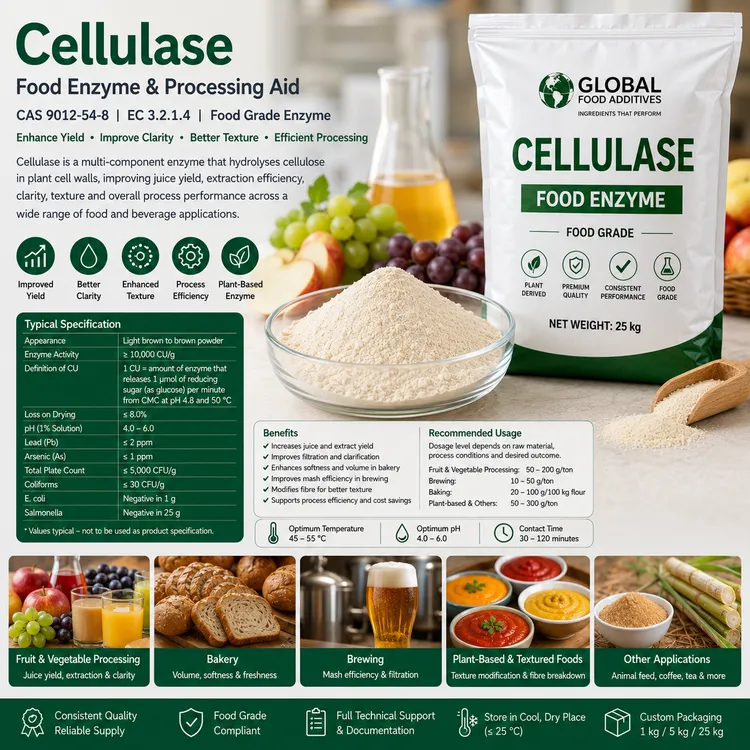
Enzyme performance depends on substrate, pH, temperature, contact time, dosage, side activities, thermal inactivation and destination-market food enzyme rules.
Product identity
| Product | Cellulase |
|---|---|
| Alternative names | Cellulase enzyme; food-grade cellulase; cellulose-hydrolysing enzyme; endoglucanase-containing enzyme preparation |
| Category | Enzymes & Processing Aids |
| Function | Food enzyme / processing aid for manufacturing performance |
| E / INS number | Confirm by destination market and supplier documentation; food enzymes are often regulated by source organism, function and intended use rather than an E number |
| CAS / identity | 9012-54-8 |
| EC reference | Commonly associated with EC 3.2.1.4 for cellulase activity; exact activity profile depends on supplier preparation |
| Substrate focus | Cellulose, carboxymethyl cellulose, beta-glucans and related plant-cell-wall polysaccharides depending on enzyme composition |
| Typical form | Enzyme powder, granulate, coated granule, tablet, liquid concentrate, stabilised liquid or custom enzyme blend |
| Typical source | Microbial fermentation using supplier-specific fungal or bacterial production strains; confirm source organism and GMO status on documentation |
| Main technical value | Improves plant-material breakdown, extraction, processing efficiency, viscosity reduction, filtration, texture control and manufacturing consistency |
| Key buying point | Compare by active performance under your process conditions, not only by kilogram price or nominal enzyme activity |
Industrial buying value
Cellulase is normally evaluated when a factory needs to modify plant fibre, reduce viscosity, improve extraction, release bound solids, support clarification or adjust texture without aggressive mechanical or chemical treatment. The best grade depends on raw material, process pH, temperature, contact time, whether side activities are useful or problematic, and whether the enzyme must be inactivated before the final product is packed.
- Supports fruit, vegetable, grain and plant-cell-wall processing efficiency
- Can improve juice or extract yield by breaking down cellulose-rich structures
- May reduce mash viscosity and improve filtration, pressing or separation
- Can support texture modification in plant-based, fibre-rich and bakery systems
- Requires careful control of enzyme activity, dosage, contact time, inactivation and legal classification
Technical overview
Cellulase is not a single universal enzyme performance profile. Commercial cellulase preparations may contain endoglucanase, exoglucanase, beta-glucosidase and related side activities depending on the producing microorganism and formulation. Some grades are designed for broad plant-cell-wall breakdown, while others are targeted for controlled viscosity reduction, fruit processing, bakery improvement, brewing support or textile-type uses that may not be suitable for food.
For procurement and R&D teams, the critical task is to match the enzyme to the process objective. A cellulase that performs well in apple mash may not be ideal for cereal brewing, vegetable puree, bakery dough or plant-based protein texture modification. Enzyme choice should be based on application trials, activity method, supplier technical guidance and validation under real production conditions.
How Cellulase works
Cellulase preparations hydrolyse beta-linked cellulose structures and related plant-cell-wall materials. In food manufacturing, this can weaken plant tissue, lower viscosity, release trapped juice or extract, improve separation and modify fibre texture. The result depends on enzyme composition, substrate accessibility and process conditions.
- Endoglucanase activity: attacks internal cellulose chain regions and reduces viscosity
- Exoglucanase activity: releases smaller cellulose fragments from chain ends
- Beta-glucosidase activity: can convert cellobiose or related oligosaccharides into glucose
- Side activities: hemicellulase, xylanase or pectinase activity may be beneficial or unwanted depending on the process
- Substrate access: particle size, heat treatment and mechanical breakdown influence enzyme efficiency
Performance variables
The same Cellulase dose can produce different results across raw materials and factories. Industrial trials should evaluate the enzyme under the actual process pH, temperature, solids content, shear, hold time, water quality and inactivation conditions.
- Raw material variety, maturity, fibre structure and pretreatment
- pH, temperature, calcium/mineral level and buffer capacity
- Particle size, mash solids, viscosity and mixing intensity
- Contact time, enzyme dosage and order of addition
- Thermal inactivation, filtration, pressing, separation and final product specification
Application fit
Potential use areas may include the applications below, subject to destination-market rules, enzyme approval, process design, final label interpretation and customer policy. These examples are technical production contexts, not a universal approval list.
| Application area | Technical reason to evaluate | Buyer / R&D checks |
|---|---|---|
| Fruit juice and puree processing | Improves tissue breakdown, pressing efficiency, juice yield, viscosity reduction and clarification support | Fruit type, pH, temperature, pulp solids, pectinase synergy, press cycle, turbidity, colour, aroma and enzyme inactivation |
| Vegetable processing and plant extracts | Supports cell-wall breakdown, extract release, fibre modification and process yield improvement | Raw material fibre level, particle size, heat pretreatment, extraction yield, flavour release, colour stability and filtration load |
| Wine, cider and fermented beverages | May support maceration, pressing, aroma release and clarification when used with suitable enzyme systems | Grape or fruit type, pH, alcohol, sulphite level, pectinase blend, colour extraction, aroma retention and legal use |
| Brewing and cereal processing | Can reduce beta-glucan-related viscosity, support lautering, improve filtration or assist adjunct processing in selected systems | Malt quality, cereal adjunct, mash pH, mash temperature, beta-glucan level, wort viscosity, haze risk and enzyme inactivation |
| Bakery and dough systems | Can modify fibre-rich doughs, improve dough handling, adjust crumb texture and support wholegrain processing where suitable | Flour type, wholegrain level, dough absorption, mixing tolerance, proofing, bake performance, crumb softness and enzyme dosage |
| Plant-based foods | May modify vegetable fibres, improve texture, reduce grittiness or support extraction of plant components | Protein source, fibre level, pH, heat process, texture target, water binding, off-flavour release and shelf-life stability |
| Starch and grain ingredient processing | Supports fibre modification, viscosity reduction and process separation in selected grain-based systems | Substrate composition, amylase compatibility, xylanase side activity, solids level, filtration and yield |
| Coffee, tea and botanical extraction | Can improve extraction efficiency or modify plant material where cellulose limits release | Extraction temperature, pH, flavour selectivity, bitterness, colour, filtration and residual enzyme control |
| Dietary fibre and ingredient modification | Can alter fibre particle structure, hydration behavior, viscosity and mouthfeel in controlled processing | Degree of hydrolysis, particle size, viscosity, water-holding capacity, label interpretation and regulatory classification |
Quality and specification parameters
For industrial purchasing, Cellulase should be compared by enzyme activity, performance under process conditions, formulation format and documentation package. A technically suitable enzyme should deliver the desired process benefit without uncontrolled hydrolysis, off-flavour formation, unacceptable side activity, contamination risk, poor stability or regulatory uncertainty.
| Specification area | What to request | Why it matters |
|---|---|---|
| Enzyme identity | Product name, enzyme class, CAS number, EC reference, source organism and production method | Confirms the food enzyme identity and supports regulatory/customer approval |
| Declared activity | Activity units, assay method, substrate, pH, temperature, reaction time and acceptance range | Cellulase units are method-dependent; values are not comparable unless assay conditions are understood |
| Activity profile | Endoglucanase, beta-glucanase, hemicellulase, xylanase, pectinase or beta-glucosidase side activities where available | Side activities can improve performance or create defects depending on application |
| pH profile | Optimum pH, working pH range and stability at process pH | Critical for fruit juice, brewing, bakery, plant-based and extraction processes |
| Temperature profile | Optimum temperature, working temperature range, thermal stability and inactivation conditions | Required for process design and residual enzyme control |
| Dosage guidance | Recommended dosage per kg raw material, tonne of mash, litre of juice, flour weight or application-specific basis | Supports cost-in-use calculation and trial design |
| Physical form | Powder, granulate, coated granule, liquid concentrate, tablet or stabilised blend | Determines handling, dosing accuracy, dusting, dissolution, storage and operator exposure |
| Carrier and stabilisers | Carrier declaration, preservatives, salts, glycerol, sugars, maltodextrin or other formulation components | Affects label review, allergen status, dosage, viscosity, shelf life and customer approval |
| Microbiological quality | Total plate count, yeast and mould, coliforms, E. coli, Salmonella and production-strain absence where required | Important for food enzyme safety, high-care processing and import compliance |
| Contaminants | Heavy metals, lead, arsenic, cadmium, mercury, mycotoxins and unwanted enzyme metabolites where relevant | Supports food-grade approval, export compliance and customer audit requirements |
| Allergen and GMO status | Allergen statement, GMO statement, fermentation substrate information and processing aid declarations | Important for customer approval, clean-label policies and destination-market documentation |
| Storage and shelf life | Recommended storage temperature, shelf life, opened-pack guidance and activity retention data | Enzyme activity can decline with heat, moisture, oxygen and time |
| Traceability | Manufacturer, production site, batch number, production date, expiry/retest date and lot-specific COA | Enables supplier qualification, recall readiness and audit-trail control |
Formulation and plant-trial checklist
- Target function: define whether Cellulase is needed for yield, viscosity reduction, filtration, clarification, dough handling, texture modification or extraction.
- Substrate mapping: identify cellulose, beta-glucan, hemicellulose and pectin contributions in the raw material.
- Assay basis: confirm supplier activity units and avoid comparing enzyme products by unit number alone.
- Dosage screening: test multiple dosage levels under real process pH, temperature, solids and contact time.
- Synergy review: evaluate whether pectinase, hemicellulase, xylanase, amylase, protease or beta-glucanase combinations are needed.
- Process endpoint: define when hydrolysis should stop and how the enzyme will be inactivated or removed if required.
- Sensory review: check aroma, flavour release, bitterness, mouthfeel, turbidity and colour after enzyme treatment.
- Filtration and separation: measure press yield, filtration time, centrifuge load, haze, sediment and fouling risk.
- Analytical validation: monitor viscosity, reducing sugars, soluble solids, turbidity, fibre change or yield depending on objective.
- Cost-in-use: compare suppliers by delivered performance, dosage, yield improvement, process time reduction, reject reduction and landed cost.
Comparison with related food enzyme systems
Cellulase is often used alone or as part of a broader enzyme toolbox. The correct choice depends on substrate, process objective, raw material, pH, temperature, legal status and desired final product quality.
| Enzyme option | Typical reason to compare | Industrial note |
|---|---|---|
| Cellulase | Cellulose and plant-cell-wall modification, yield improvement and viscosity reduction | Review side activities and substrate specificity before use |
| Pectinase | Fruit juice yield, clarification and pectin breakdown | Often more important than cellulase in pectin-rich fruits; blends may be useful |
| Hemicellulase / xylanase | Hemicellulose breakdown, dough handling and cereal processing | Useful in bakery and brewing; excessive activity can weaken structure |
| Beta-glucanase | Viscosity reduction in brewing and cereal processes | Often selected for wort filtration and beta-glucan management |
| Amylase | Starch breakdown, fermentable sugar release and baking performance | Targets starch rather than cellulose; may be combined with cellulase in grain systems |
| Protease | Protein modification, dough relaxation and flavour release | Can change texture strongly; dosage must be controlled |
| Multi-enzyme blends | Complex raw materials where cellulose, pectin, starch and hemicellulose all matter | Effective but harder to control; request full side-activity and regulatory information |
Process integration guidance
Cellulase should be introduced through a controlled process window. The optimal point of addition depends on the target substrate, physical form, water availability, pH, temperature and desired degree of hydrolysis. In many applications, the enzyme is added after mechanical size reduction and before pressing, filtration, fermentation or heat inactivation.
Liquid enzyme handling points
- Meter accurately into mash, juice, slurry or process water according to supplier guidance
- Mix evenly to avoid local over-treatment and uneven hydrolysis
- Protect from excessive heat before use and avoid prolonged storage at high temperature
- Confirm compatibility with preservatives, cleaning residues, acids, salts and other enzymes
- Record enzyme lot, dosage, addition time, temperature, pH and inactivation step
Powder and granulate handling points
- Use dust controls and PPE according to SDS because enzyme dust can be sensitising
- Pre-dilute or disperse where required to avoid clumping or uneven dosing
- Control humidity during weighing, dosing and storage
- Check dissolution rate in the actual process medium
- Keep opened packs sealed and minimise exposure to moisture and heat
Enzyme inactivation and residual activity control
Many Cellulase applications require a defined endpoint. If residual enzyme remains active, it may continue to modify texture, viscosity, clarity or fibre structure during storage. The inactivation strategy should be validated in the real product matrix, not only by supplier literature.
| Control point | Recommended buyer action |
|---|---|
| Target endpoint | Define the required viscosity, yield, soluble solids, texture, turbidity or filtration target before treatment |
| Thermal inactivation | Validate time and temperature needed to reduce activity under actual product pH and solids conditions |
| pH shift | Review whether pH adjustment reduces activity or changes the enzyme performance window |
| Removal step | Check whether filtration, centrifugation or clarification removes enzyme-containing solids where relevant |
| Storage monitoring | Track viscosity, texture, haze, sediment and flavour during shelf life to detect residual activity issues |
Handling, storage and warehouse control
Cellulase should be handled according to the supplier safety data sheet, food-safety plan and local workplace rules. Enzyme preparations can lose activity if exposed to heat, moisture or unsuitable storage conditions. Powder enzymes can also create inhalation-sensitisation concerns if dust is not controlled.
| Control point | Recommended buyer action |
|---|---|
| Storage environment | Store in a cool, dry, clean and well-ventilated area according to supplier recommendations |
| Temperature control | Confirm whether refrigerated storage is required and protect from heat during transport and warehousing |
| Moisture protection | Keep containers sealed until use and protect powder or granulate grades from humidity and condensation |
| Operator exposure | Use suitable dust extraction, closed handling and PPE according to SDS and site risk assessment |
| Cross-contact | Store away from allergens, strong chemicals, oxidants, cleaning agents and incompatible materials |
| Lot traceability | Record lot number, supplier COA, internal release status and expiry/retest date before use |
| Opened packaging | Define resealing, relabelling, activity-retention and maximum-open-time procedures for each grade |
Packaging and logistics options
Packaging depends on supplier standard, enzyme form, activity and order volume. Common industrial requests include sample packs, laboratory trial bottles, 1-5 kg pouches, 10-25 kg drums or bags for powder enzymes, HDPE drums or jerrycans for liquid enzymes, coated granule packs, insulated packaging, palletised export packaging and full-container supply. For export projects, buyers should request storage temperature, net and gross weight, pack count, liner type, batch coding system, shelf life, activity retention guidance, HS code guidance, document language and shipping marks before confirming the order.
Regulatory and label diligence
Cellulase should be managed as a food enzyme or processing aid according to the destination market. The buyer is responsible for verifying whether the exact enzyme preparation, production organism, manufacturing process and intended use are permitted in the target country and product category. Some markets require source-organism information, enzyme nomenclature, technological function, absence of viable production organism, toxicology support or processing-aid justification.
The final label route depends on local rules and how the enzyme functions in the finished food. In some cases, a food enzyme used as a processing aid may not be labelled in the same way as an ingredient; in other cases, declaration may be required. Buyers should confirm this before commercial use, especially for export, infant foods, organic products, clean-label programs and customer-specific standards.
Documents to request
- Product specification or technical data sheet with enzyme name, CAS number, EC reference and intended applications
- Certificate of analysis for available batch or representative lot
- Safety data sheet where applicable
- Food enzyme declaration and food-grade or processing-aid statement
- Source organism, production strain and fermentation-process declaration to the level available from supplier
- GMO statement, including production organism and final enzyme preparation status where required
- Activity unit method, substrate, assay pH, assay temperature and acceptance range
- pH profile, temperature profile, recommended dosage range and thermal inactivation guidance
- Carrier, stabiliser, preservative and formulation-component declaration
- Side-activity profile where relevant to the application
- Shelf-life, retest date and recommended storage conditions
- Microbiological specification and absence-of-pathogen statement
- Heavy metals, lead, arsenic, cadmium, mercury, mycotoxins and impurity statements aligned with buyer requirements
- Allergen statement, vegan/vegetarian status, BSE/TSE and irradiation statements where required
- Halal and kosher certificates when required by customer or destination market
- Label draft, packaging details, pack count, pallet configuration and net/gross weight
- Market-specific regulatory declarations required by the importing country
How to request this product
Send the product name, target application, enzyme activity requirement, activity unit method if known, physical form, quantity, destination country, packaging preference, expected shipment date, delivery term and required documents. If you already purchase Cellulase, attach or describe your current specification, label, certificate of analysis, enzyme activity, dosage, source organism, application and process conditions so supplier options can be compared accurately.
For faster technical review, include raw material, pH, temperature, contact time, process objective, desired yield or viscosity target, inactivation step, allergen/GMO requirements, destination-market rules, customer compliance requirements and whether trial samples are needed before bulk quotation.
Useful answers
What is Cellulase used for in food manufacturing?
Cellulase is typically reviewed for process efficiency, fruit and vegetable extraction, juice yield, mash liquefaction, viscosity reduction, filtration support, dough handling, brewing performance and plant-fibre texture modification. Exact suitability depends on enzyme grade, application, process, regulations and supplier documents.
Is Cellulase an additive or a processing aid?
In many applications Cellulase is evaluated as a food enzyme processing aid, but the final classification depends on destination-market rules, the intended function, residual activity, finished-product presence and customer policy.
Why are Cellulase activity units hard to compare?
Activity units may be based on different substrates, pH, temperature, reaction times and analytical methods. A higher number on one supplier specification does not always mean stronger performance in the buyer's process.
Which applications commonly evaluate this enzyme?
Potential applications include bakery, brewing, fruit juice processing, vegetable processing, plant extracts, wine and cider processing, plant-based foods, starch or grain processing, fibre modification and botanical extraction.
Which technical parameters should be compared between suppliers?
Buyers should compare declared activity, activity method, source organism, enzyme side activities, pH and temperature profile, dosage range, thermal inactivation data, carrier system, liquid or powder form, microbiology, heavy metals, allergen/GMO status, shelf life, packaging and compliance documents.
Can Global Food Additives source Cellulase?
Global Food Additives can review sourcing options for Cellulase according to target specification, enzyme activity, application, quantity, destination, packaging, shipment timing and required documentation.
Which documents should be requested?
Buyers commonly request a technical data sheet or specification, certificate of analysis, safety data sheet where applicable, food enzyme declaration, source-organism statement, activity method, allergen/GMO statements, microbiological safety information, heavy-metal data, storage instructions, shelf-life information, label details and market-specific declarations.
Is this product permitted in every country?
No. Food enzyme use depends on destination-market rules, enzyme source, production organism, food category, processing-aid interpretation, use level, label requirements and buyer responsibility. Always verify regulatory status before commercial use.
Tell us which food additive or ingredient you need.
Send product names, target specifications, quantity, destination country, packaging preference, delivery term, and document requirements. Our team will review your inquiry and respond from orders@foodgradeadditives.com.
Your message has been received. You will be redirected to the home page.