
Choline Chloride
Choline Chloride is a water-soluble choline source used in selected food, nutrition and premix applications for fortification, enrichment and nutrition-positioning programs. For industrial food manufacturers, the real purchasing value depends on verified food-grade status, active choline basis, assay, carrier system, hygroscopicity, solubility, process stability, label requirements, regulatory fit, documentation quality and batch-to-batch consistency.
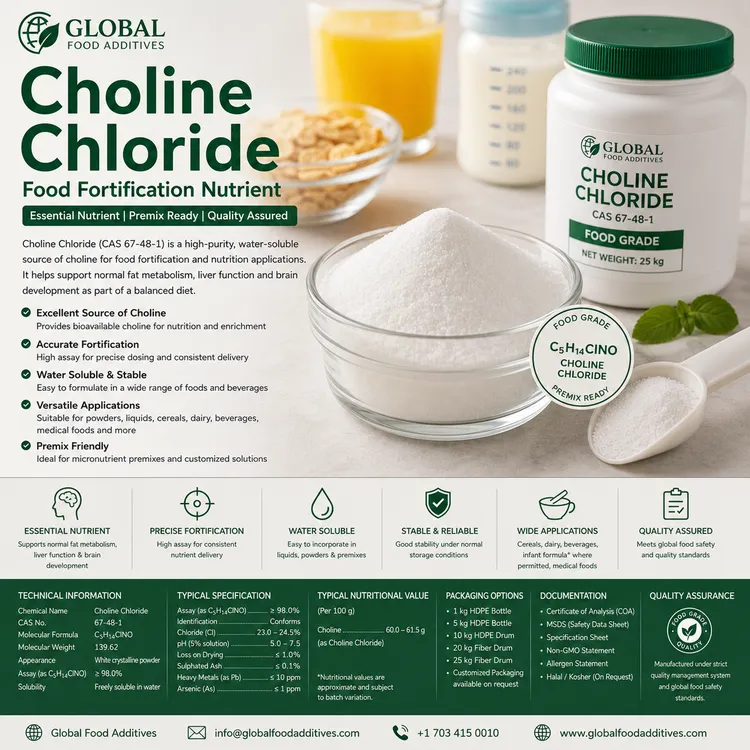
Fortification use must be verified against destination-market nutrient rules, food category, claim language, dosage basis and final label declaration.
Product identity
| Product | Choline Chloride |
|---|---|
| Alternative names | 2-Hydroxyethyltrimethylammonium chloride; 2-hydroxy-N,N,N-trimethylethanaminium chloride; choline chloride nutrient source |
| Category | Fortification Nutrients |
| Function | Vitamin, mineral or enrichment ingredient for food fortification |
| E / INS number | Confirm by destination market and supplier documentation |
| CAS / identity | 67-48-1 |
| Chemical family | Quaternary ammonium choline salt |
| Formula reference | C5H14ClNO / C5H14NO.Cl |
| Molecular weight reference | Approx. 139.62 g/mol for pure Choline Chloride |
| Typical appearance | White to off-white crystalline powder, granule, beadlet, premix-ready carrier grade or clear aqueous solution depending on supplier grade |
| Typical form | Fine powder, granule, beadlet, carrier-based premix grade, dry blend or solution grade |
| Main technical value | Supplies choline for nutrition fortification, enrichment, premix dosing and selected specialty nutrition applications |
| Key buying point | Compare active choline basis, food-grade status, carrier, hygroscopicity, moisture, assay method and compliance documents before comparing price |
Industrial buying value
Choline Chloride is usually evaluated when a manufacturer needs a concentrated and measurable choline source for fortified foods, nutrition powders, beverage systems, cereals, dairy-style products, infant and medical foods where permitted, or custom nutrient premixes. It is not purchased like a general commodity: grade, active content, carrier system, impurity profile and legal suitability can strongly affect both formula cost and product approval.
- Supports choline fortification and nutrition-positioning programs where permitted
- Can be used in premix systems for controlled micro-dosing and nutrient uniformity
- Available as high-assay powder, granule, solution or carrier-based grade depending on supplier
- Requires careful control of hygroscopicity, caking, odour and compatibility with vitamins and minerals
- Should be compared by cost per unit of active choline, not only price per kilogram
Technical overview
Choline Chloride is a choline salt used as a nutritional ingredient in selected food and specialty nutrition systems. Choline is involved in phospholipid structure, methyl-group metabolism and acetylcholine synthesis, but finished-product claims and permitted use depend on the destination market and food category. In manufacturing terms, Choline Chloride should be evaluated as both a nutrient source and a process-sensitive ingredient because it is water-soluble, moisture-sensitive and often highly hygroscopic.
For procurement and R&D teams, the most important technical question is not simply “Do you have Choline Chloride?” but “Which grade, which active basis, which carrier, which compliance package, and which performance data are available for the intended application?” A material suitable for feed, technical use or a general industrial process is not automatically suitable for food fortification or infant nutrition. Food-grade qualification must be confirmed by documentation and customer approval.
Fortification and dosage logic
Choline fortification requires precise dosage calculation. Buyers should confirm whether the formula target is expressed as Choline Chloride, choline base, total choline, nutrient claim level, serving-size contribution or premix addition rate. These bases are not interchangeable without conversion.
- Confirm the assay basis: as-is, dry basis, Choline Chloride basis or choline-base equivalent
- Calculate active choline delivered per serving and per 100 g or 100 mL where required
- Include processing loss, analytical tolerance and shelf-life overage strategy
- Check chloride contribution when formula electrolyte balance is important
- Verify final label declaration and nutrient claim eligibility with regulatory teams
Premix and process behaviour
Choline Chloride can be challenging in dry systems because hygroscopicity may cause caking, poor flow, vitamin degradation risk or uneven dispersion if the carrier and packaging are not well selected. In liquid systems, solubility is usually less of a challenge, but taste, odour, pH, heat exposure and interaction with other nutrients must still be tested.
- Evaluate powder flow, caking and storage stability under warehouse humidity
- Check compatibility with vitamins A, D, E, K, B vitamins, minerals, amino acids and flavours
- Review carrier selection for premix grades, including silica, starch, maltodextrin or mineral carriers
- Assess odour, bitterness, saltiness and other sensory effects at target dosage
- Validate nutrient recovery after blending, filling, heat treatment and shelf life
Application fit
Potential use areas may include the applications below, subject to destination-market rules, food-category permission, nutrient levels, final label declaration and customer policy. These examples are technical formulation contexts, not a universal approval list.
| Application area | Technical reason to evaluate | Buyer / R&D checks |
|---|---|---|
| Infant and follow-on nutrition where permitted | Choline source for regulated infant or young-child nutrition formulas where local rules require or allow use | Regulatory permission, minimum/maximum nutrient levels, infant-grade purity, chloride balance, microbiology, heavy metals and supplier qualification |
| Medical foods and clinical nutrition where permitted | Controlled choline contribution in specialized nutritional products under professional or regulatory frameworks | Target population, dosage basis, nutrient interaction, osmolarity, stability, label requirements and analytical verification |
| Powdered nutrition and meal replacements | Premix-ready choline source for vitamin-mineral blends, protein powders and complete nutrition formats | Hygroscopicity, carrier, blend uniformity, vitamin compatibility, flavour impact, serving-size claim and moisture barrier packaging |
| Fortified cereals and grain products | Dry nutrient addition in cereal, flour, bar, extruded and grain-based enrichment systems | Heat exposure, extrusion stability, dry-blend uniformity, caking, dosage recovery, sensory impact and local enrichment rules |
| Beverages and beverage concentrates | Water-soluble choline source for fortified drinks, concentrates and functional beverage systems | Solubility, clarity, pH, flavour masking, heat process, preservative system, chloride contribution and shelf-life recovery |
| Dairy and dairy alternatives | Nutrient fortification in milk drinks, yogurts, plant-based drinks and powdered dairy-style products | Protein stability, mineral balance, pH drift, heat treatment, sensory profile, culture compatibility and label requirements |
| Bars, gummies and confectionery supplements | Choline positioning in functional snacks, chewables, gummies and nutrition confectionery where permitted | Water activity, flavour masking, heat process, acid system, texture, dosage uniformity and serving-size claim |
| Custom vitamin-mineral premixes | Centralised microingredient dosing for food factories requiring validated nutrient uniformity | Carrier choice, particle size, segregation risk, moisture control, assay verification and premix shelf life |
Quality and specification parameters
For industrial purchasing, Choline Chloride should be compared by measurable specification, active content and final application performance. A technically suitable grade should deliver the required nutrient level without causing unacceptable caking, odour, taste, degradation, moisture pickup, poor blend uniformity or regulatory risk.
| Specification area | What to request | Why it matters |
|---|---|---|
| Identity and grade | Product name, CAS number, chemical name, food-grade statement, supplier grade code and intended use category | Confirms that the offered material matches food or nutrition use and avoids feed or technical-grade substitution |
| Assay | Choline Chloride assay, method, result basis and acceptance range | Prevents dosage errors and enables accurate comparison between powder, solution and carrier-based grades |
| Active choline basis | Choline base equivalent, total choline contribution or nutrient conversion factor where required | Important for serving-size calculation, nutrient declaration and claim compliance |
| Chloride contribution | Chloride content or calculated chloride contribution at intended dosage | Important for infant nutrition, medical nutrition, electrolyte-controlled formulas and sensory review |
| Physical form | Powder, granule, beadlet, liquid solution, carrier-based premix grade or encapsulated format | Determines handling, dissolution, flowability, blending behaviour and packaging requirements |
| Carrier system | Carrier declaration, carrier percentage and allergen/GMO status for premix-ready grades | Affects label, allergen review, active content, flow behaviour and customer approval |
| Moisture and hygroscopicity | Moisture, loss on drying, water activity, caking tendency and storage recommendations | Critical because moisture uptake can reduce flow, shorten shelf life and affect premix stability |
| Particle size and bulk density | Mesh size, D10/D50/D90 where available, loose/tapped density and flowability | Affects dry blending, dosing accuracy, segregation risk, sachet filling and premix uniformity |
| Solubility and clarity | Water solubility, clarity, insoluble matter and dissolution rate where relevant | Important for beverages, syrups, liquid nutrition, reconstituted powders and clear systems |
| Odour and sensory profile | Odour standard, trimethylamine-like odour limits where applicable, taste notes and sensory guidance | Important for lightly flavoured beverages, infant nutrition, dairy systems and powders |
| Impurities | Heavy metals, lead, arsenic, cadmium, mercury, residual solvents, trimethylamine-related impurities and related substances | Supports food-grade approval, infant-grade review, export compliance and customer audits |
| Microbiology | Total plate count, yeast and mould, coliforms, E. coli, Salmonella and other limits when required | Important for nutrition powders, infant-related applications, beverages, dairy systems and high-care factories |
| Compliance | Food-grade declaration, allergen statement, GMO statement, vegan/vegetarian statement, halal/kosher if required | Reduces regulatory, customer and label-approval delays |
| Traceability | Manufacturer, country of origin, batch number, production date, retest date and shelf life | Enables supplier qualification, recall readiness and audit-trail control |
Formulation and plant-trial checklist
- Target nutrient basis: define whether the product needs Choline Chloride, choline base, total choline, nutrient claim level or regulatory minimum contribution.
- Assay conversion: calculate delivered choline per serving and confirm conversion factors with the supplier specification.
- Overage strategy: set a controlled overage only after evaluating processing loss, analytical tolerance and shelf-life decline.
- Moisture control: test caking and flow after warehouse humidity exposure, especially in premixes and powder blends.
- Blend uniformity: validate homogeneity because Choline Chloride may be dosed at low levels in a large powder matrix.
- Vitamin compatibility: check interaction with sensitive vitamins, minerals, amino acids, flavours and colours during premix storage.
- Sensory review: assess bitterness, saltiness, amine-like odour, aftertaste and flavour masking at the intended use level.
- Heat stability: evaluate extrusion, baking, pasteurisation, UHT, spray drying or hot-fill exposure where applicable.
- Analytical verification: confirm nutrient recovery in the finished product using a validated method and defined sampling plan.
- Cost-in-use: compare suppliers by delivered active choline, dosage, handling losses, packaging, documentation and landed cost.
Comparison with related choline sources
Choline Chloride is one of several choline-source options. The right choice depends on regulatory status, application, taste, solubility, dosage, processing conditions, label strategy, active content and cost-in-use.
| Choline option | Typical reason to compare | Industrial note |
|---|---|---|
| Choline Chloride | Concentrated, water-soluble choline source for fortification and premixes | Check hygroscopicity, chloride contribution, odour, assay basis and food-grade documentation |
| Choline bitartrate | Alternative dry choline source for supplement-style and nutrition applications | Compare active choline percentage, taste, acidity contribution, tabletability and regulatory acceptance |
| Phosphatidylcholine / lecithin | Choline-containing phospholipid source with emulsification function | Lower active choline density; may be selected for emulsification or natural-source positioning |
| Alpha-GPC | Specialty choline ingredient for selected nutrition formats where permitted | Higher cost and market-specific regulatory review; usually used for targeted supplement-style positioning |
| Citicoline | Specialty cognitive-health ingredient in selected markets and categories | Regulatory status and claims vary strongly; not a direct replacement for commodity fortification |
| Custom vitamin-mineral premix | Pre-diluted and controlled choline delivery with other nutrients | Improves dosing control but requires premix stability, carrier and assay verification |
Process integration guidance
Choline Chloride should be introduced through a controlled batching procedure. The best method depends on whether the buyer is using powder, granule, beadlet, carrier grade or solution. In dry systems, the main risks are caking, segregation and compatibility with other nutrients. In liquid systems, the main risks are taste, odour, pH, clarity, thermal exposure and nutrient recovery.
Dry-system handling points
- Pre-blend with a suitable carrier when dosage is low or uniformity is critical
- Match particle size with the host powder to reduce segregation
- Control humidity during weighing, blending, transfer and packing
- Use moisture-barrier packaging for premixes and fortified powders
- Verify nutrient recovery after blending, storage and reconstitution
Liquid-system handling points
- Pre-dissolve or meter liquid grades according to supplier guidance
- Check clarity, pH, sediment and interaction with minerals or proteins
- Evaluate flavour masking when the base product is lightly flavoured
- Confirm heat-process stability during pasteurisation, UHT or hot-fill steps
- Record lot number, dosage and analytical recovery for traceability
Premix design and nutrient uniformity
Many food manufacturers prefer to dose Choline Chloride through a premix rather than as a stand-alone microingredient. Premixing can improve weighment accuracy and reduce operator error, but only when carrier selection, particle-size match, assay verification and moisture protection are controlled.
| Premix control point | Recommended action |
|---|---|
| Carrier selection | Choose a food-approved carrier that meets allergen, GMO, label, density and flow requirements |
| Blend ratio | Set dilution level to support accurate scaling and prevent microingredient hotspots |
| Particle-size match | Align carrier and Choline Chloride particle sizes to reduce segregation during transport and storage |
| Moisture barrier | Use suitable liners, drums, foil bags or barrier pouches where hygroscopicity affects stability |
| Assay verification | Test the premix for active choline and uniformity before commercial release |
| Compatibility | Check interaction with sensitive vitamins, minerals, flavours, colours and encapsulated nutrients |
Handling, storage and warehouse control
Choline Chloride should be handled according to the supplier safety data sheet, food-safety plan and local workplace rules. Because many grades are moisture-sensitive and may be hygroscopic, storage conditions should protect active content, flowability, odour quality and premix stability.
| Control point | Recommended buyer action |
|---|---|
| Storage environment | Store in a clean, cool, dry and well-ventilated area according to supplier recommendations |
| Moisture protection | Keep containers sealed until use and protect opened packs from humidity and condensation |
| Odour control | Store away from odorous or aroma-sensitive ingredients and verify packaging closure after opening |
| Dust management | Use suitable handling controls and PPE according to SDS and site policy for powder grades |
| Cross-contact | Store away from allergens, wet materials, cleaning chemicals and incompatible ingredients |
| Lot traceability | Record lot number, supplier COA, internal release status and expiry/retest date before use |
| Opened packaging | Define resealing, relabelling, retest and maximum-open-time procedures for each grade |
Packaging and logistics options
Packaging depends on supplier standard, assay, grade and order volume. Common industrial requests include sample packs, laboratory trial packs, 1-5 kg packs for premix trials, 10-25 kg bags, fibre drums, lined cartons, foil-lined bags, HDPE drums, IBCs for solution grades, palletised export packaging and full-container supply. For export projects, buyers should request pallet dimensions, net and gross weight, liner type, batch coding system, shelf life, storage temperature, HS code guidance, document language and shipping marks before confirming the order.
Regulatory and label diligence
Choline Chloride should be managed as a regulated nutrient source, not only as a commodity chemical. The buyer is responsible for verifying whether it is permitted in the destination market, whether the intended food category is allowed, the applicable minimum or maximum nutrient levels, the calculation basis, the permitted source form, label declaration, nutrient claim language and customer-specific requirements.
For infant, medical, sports, fortified beverage and supplement-style foods, regulatory review should be completed before commercial purchase. A grade that is acceptable in one country or one product category may not be acceptable in another. Buyers should also verify whether the ingredient must meet food-grade, FCC, USP, EP, infant-grade or customer-defined purity criteria.
Documents to request
- Product specification or technical data sheet with grade, CAS number, assay and active-basis information
- Certificate of analysis for available batch or representative lot
- Safety data sheet where applicable
- Food-grade declaration and intended-use statement
- Assay basis clarification: Choline Chloride, choline base equivalent, dry basis, as-is basis or carrier-adjusted basis
- Origin statement, manufacturer information and traceability declaration
- Carrier declaration, allergen statement and GMO statement for premix-ready or carrier-based grades
- Shelf-life, retest date and recommended storage conditions
- Particle size, bulk density, moisture, water activity, flowability and solubility data where process performance matters
- Heavy metals, lead, arsenic, cadmium, mercury and impurity statements aligned with buyer requirements
- Residual solvent and trimethylamine-related impurity information where required by buyer specification
- Microbiological specification for nutrition powders, beverages, dairy, infant-related or high-care applications
- Vegan/vegetarian, BSE/TSE, irradiation and nanomaterial statements where required
- Halal and kosher certificates when required by customer or destination market
- Label draft, packaging details, pallet configuration and net/gross weight
- Market-specific regulatory declarations required by the importing country
How to request this product
Send the product name, target grade or reference specification, assay basis, desired active choline content, quantity, destination country, packaging preference, expected shipment date, delivery term and required documents. If you already purchase Choline Chloride, attach or describe your current specification, label, certificate of analysis, active basis, carrier system and dosage so supplier options can be compared accurately.
For faster technical review, include the intended application, target consumer group, serving size, required nutrient contribution, process conditions, moisture sensitivity, flavour requirements, packaging type, destination-market rules, customer compliance requirements and whether trial samples are needed before bulk quotation.
Useful answers
What is Choline Chloride used for in food manufacturing?
Choline Chloride is typically reviewed for choline fortification, enrichment, nutrition positioning, premix-ready formulation and selected specialty nutrition applications. Exact suitability depends on grade, assay basis, application, process, regulations and supplier documents.
Is Choline Chloride the same as choline?
Choline Chloride is a salt form used to supply choline. In formulation work, buyers should confirm whether dosage and claims are calculated as Choline Chloride, choline base equivalent, total choline or another market-specific basis.
Why is Choline Chloride difficult in some dry premixes?
Many grades are hygroscopic and can absorb moisture, cake, reduce powder flow or interact with sensitive nutrients. Carrier choice, humidity control, moisture-barrier packaging and premix stability testing are important.
Which applications commonly evaluate this nutrient?
Potential applications include nutrition powders, fortified cereals, beverages, dairy systems, plant-based nutrition, medical foods, infant and young-child nutrition where permitted, bars, gummies and custom vitamin-mineral premixes.
Which technical parameters should be compared between suppliers?
Buyers should compare food-grade status, identity, assay, active choline basis, chloride content, moisture, carrier system, particle size, bulk density, solubility, odour, hygroscopicity, microbiology, heavy metals, residual solvents, origin, shelf life, packaging and compliance documents.
Can Global Food Additives source Choline Chloride?
Global Food Additives can review sourcing options for Choline Chloride according to target specification, assay basis, quantity, destination, packaging, shipment timing and required documentation.
Which documents should be requested?
Buyers commonly request a technical data sheet or specification, certificate of analysis, safety data sheet where applicable, food-grade declaration, assay-basis statement, origin statement, allergen/GMO statements, heavy-metal information, microbiology data, residual-solvent information, shelf-life information, label details and packing details.
Is this product permitted in every country?
No. Food nutrient use depends on destination-market rules, food category, source form, use level, label requirements, nutrient claim rules and buyer responsibility. Always verify regulatory status before commercial use.
Tell us which food additive or ingredient you need.
Send product names, target specifications, quantity, destination country, packaging preference, delivery term, and document requirements. Our team will review your inquiry and respond from [email protected].
Your message has been received. You will be redirected to the home page.