
Chromium Chloride
Chromium Chloride is a trivalent chromium mineral source considered for food fortification, nutritional enrichment, supplement manufacturing and premix-ready formulations where chromium use is permitted by local regulation. Industrial grade selection should focus on elemental chromium assay, chromium valence, hydrate form, solubility, particle size, premix dilution, homogeneity, contaminant control, Cr(VI) risk management, dosage accuracy, label declaration, certification and destination-market compliance.
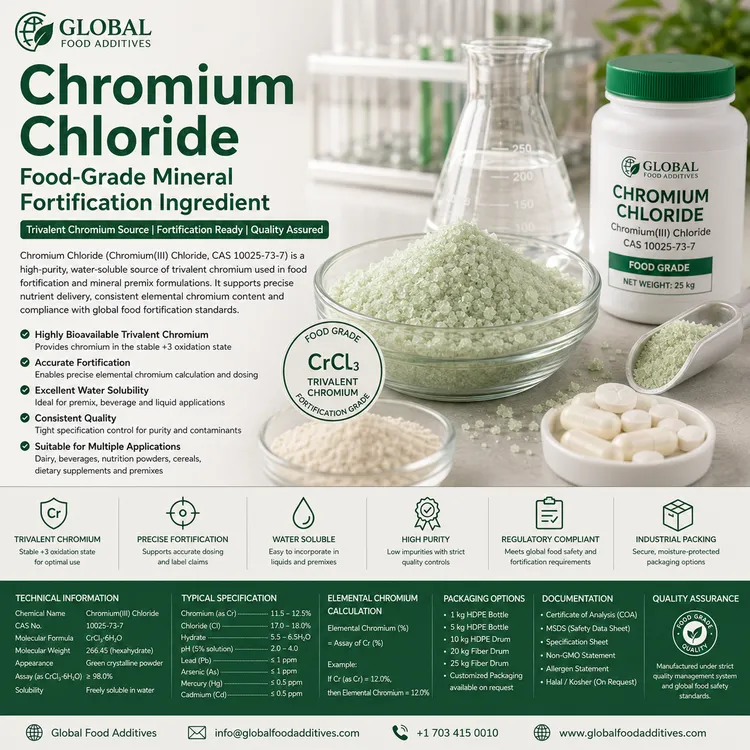
Product identity
| Product | Chromium Chloride |
|---|---|
| Common names | Chromium(III) chloride, chromic chloride, trivalent chromium chloride, chromium mineral source |
| Category | Fortification Nutrients |
| Function | Vitamin, mineral or enrichment ingredient for food fortification and nutrition premixes |
| E / INS number | Supplier and market specific; confirm by destination-market rules and supplier documentation |
| CAS / identity | 10025-73-7 for chromium(III) chloride anhydrous; hydrated forms may use different CAS references |
| Chromium valence | Trivalent chromium, Cr(III), for nutritional applications; Cr(VI) must be controlled as a contaminant risk |
| Typical form | Fine powder, granule, beadlet, diluted premix, triturated blend or solution grade |
| Typical use basis | Microgram-level elemental chromium contribution in finished products, premixes or supplements |
| Industrial purchasing basis | Elemental chromium assay, compound identity, hydrate state, solubility, particle size, dilution carrier, homogeneity, contaminant limits, documentation and certification |
Application fit
Chromium Chloride is evaluated where a manufacturer needs a controlled chromium source for nutrition, enrichment or supplement-style formulations, subject to the rules of the destination market.
- Vitamin and mineral premixes
- Dietary supplements and tablets where permitted
- Capsules, sachets, stick packs and powdered nutrition blends
- Fortified beverages and dry beverage mixes
- Breakfast cereals, cereal bars and fortified grain systems
- Dairy powders, meal replacements and protein nutrition products
- Medical foods and special nutrition applications where specifically permitted
- Sports nutrition and weight-management products, subject to claim review
- Infant and young-child nutrition only where the exact source and use level are permitted
Technical overview for industrial buyers
Chromium Chloride is a concentrated trace-mineral ingredient that is normally handled through controlled premix systems rather than direct addition to large food batches. Because finished-product chromium levels are typically measured in micrograms, industrial users must manage weighing accuracy, dilution strategy, blend homogeneity, segregation control, analytical verification and overage calculations carefully. The product should be specified as trivalent chromium and evaluated against food-grade or supplement-grade requirements, with particular attention to heavy metals, hexavalent chromium control, solubility, carrier compatibility and destination-market permission.
Functional value in fortified products
Trace mineral fortification
Provides a controlled chromium source for selected fortified foods, nutrition powders, supplements and premix systems where local regulations allow chromium addition.
Premix-ready formulation
Can be supplied or converted into diluted premixes to improve dosing accuracy and blend uniformity at microgram-level finished-product targets.
Elemental assay control
Supports label and formulation control when the supplier provides clear elemental chromium assay, compound identity, hydrate state and batch COA values.
Flexible nutrition positioning
Can be considered for fortified nutrition systems, but any claims about chromium, glucose metabolism or health effects must be reviewed under destination-market rules.
Chromium Chloride compared with other chromium sources
| Chromium source | Typical use logic | Points to verify |
|---|---|---|
| Chromium Chloride | Inorganic trivalent chromium source used in selected premixes, supplements and fortified formulations where permitted. | Elemental chromium assay, hydrate form, solubility, Cr(VI) control, chloride content, contaminants and regulatory permission. |
| Chromium Picolinate | Common supplement source in some markets and supplement categories. | Permitted use, purity, picolinic acid complex identity, claim rules, dosage limits and customer preference. |
| Chromium Nicotinate / Polynicotinate | Alternative supplement-style chromium source used in some nutrition products. | Exact composition, label name, regulatory status, assay, contaminants and market acceptance. |
| Chromium Yeast | Organic matrix or yeast-bound chromium source for selected supplement and nutrition positioning. | Yeast source, allergen/GMO status, chromium assay, microbial control, label wording and claim review. |
| Custom mineral premix | Pre-diluted blend designed for safe plant dosing and uniform distribution. | Carrier, dilution ratio, homogeneity data, stability, segregation risk, assay method and finished-product dosage calculation. |
Grade selection guidance
| Manufacturing need | Grade point to confirm | Why it matters |
|---|---|---|
| Vitamin and mineral premix | Elemental chromium assay, dilution carrier, particle size, flowability and blend homogeneity | Controls dosing accuracy and prevents hot spots in microgram-level fortification. |
| Tablet or capsule supplement | Assay, bulk density, compatibility with excipients, compressibility and regulatory status | Supports uniform tablet content, label compliance and stable manufacturing performance. |
| Powdered drink or sachet | Solubility, carrier compatibility, taste impact, colour, hygroscopicity and segregation risk | Prevents uneven dosing, visible specks, metallic taste or consumer reconstitution problems. |
| Fortified beverage | Solubility, clarity, pH compatibility, mineral interactions and chelation behaviour | Reduces risk of haze, sediment, colour shift, flavour change or mineral precipitation. |
| Cereal or grain fortification | Premix dilution, dry-blend uniformity, thermal process stability and analytical verification | Supports uniform distribution through flour, cereal base, coating slurry or seasoning system. |
| Special nutrition products | Permitted source, maximum level, claim restrictions, contaminant limits and documentation | Critical for infant, medical, clinical, sports and weight-management products. |
| Export production | Destination-market status, label wording, allowed chromium source and certificate package | Prevents customs delays, customer rejection, relabelling and compliance risk. |
Elemental chromium calculation and dosing control
Chromium Chloride should be purchased and formulated using the elemental chromium contribution declared on the specification or certificate of analysis. The same finished-product target may require different compound weights depending on whether the raw material is anhydrous, hydrated, diluted, premixed or standardised on a carrier. For this reason, purchasing teams should request the exact assay basis and quality teams should confirm the calculation before production release.
| Calculation item | Industrial control point |
|---|---|
| Elemental chromium target | Define the intended micrograms of chromium per serving, per 100 g, per tablet, per sachet or per batch according to the product label and regulation. |
| Compound assay | Use the COA assay value and not only theoretical molecular composition, especially for hydrated or diluted grades. |
| Premix dilution | Use a controlled carrier dilution when direct weighing of pure mineral salt would be too small or too variable for plant equipment. |
| Manufacturing overage | Set any overage only after stability, assay variability, regulatory maximums and label tolerances are reviewed. |
| Analytical verification | Validate chromium content in premix and finished product using a suitable method and statistically sound sampling plan. |
| Change control | Recalculate dosage if supplier, hydrate form, assay range, carrier, particle size or premix concentration changes. |
Processing and formulation considerations
- Valence control: specify trivalent chromium, Cr(III), and request supplier controls or test data related to hexavalent chromium, Cr(VI), where relevant.
- Micro-dosing: chromium is used at very low levels, so direct addition to a large mixer can create poor distribution unless a validated premix is used.
- Carrier selection: common carriers may include maltodextrin, dextrose, starch, mineral premix bases or other approved carriers depending on the product type.
- Homogeneity: validate blending time, mixer type, order of addition and sampling plan to ensure chromium is uniformly distributed.
- Segregation risk: differences in particle size, density and electrostatic behaviour can cause separation during transport, hopper discharge or dry blending.
- Solubility: beverage and liquid systems should be tested for complete dissolution, clarity, precipitation, haze and interaction with other minerals.
- pH and chelation: acidulants, citrate, phosphate, proteins and other minerals may affect chromium behaviour and finished-product stability.
- Colour and taste: high local concentrations can create visible specks, colour effects or metallic notes; premix dilution and process control reduce these risks.
- Interaction with vitamins: evaluate compatibility with sensitive vitamins, antioxidants, minerals and flavour systems during real-time and accelerated storage.
- Claims review: chromium-related nutrient claims, metabolism claims, blood glucose statements or weight-management positioning must be reviewed under local rules before label approval.
Application-specific technical notes
| Application | Technical value | Trial focus |
|---|---|---|
| Vitamin/mineral premixes | Controlled chromium addition with improved weighing accuracy and distribution | Validate carrier, dilution ratio, blend uniformity, assay method, particle size and segregation during handling. |
| Tablets and capsules | Microgram-level mineral delivery in controlled unit dosage | Check content uniformity, excipient compatibility, flow, compression, disintegration and label assay tolerance. |
| Powdered beverages | Chromium fortification in sachets, tubs or stick packs | Check dry-blend uniformity, reconstitution, colour, flavour, humidity stability and segregation after transport simulation. |
| Ready-to-drink beverages | Mineral fortification in liquid systems | Test solubility, pH, heat treatment, haze, sediment, metal interaction, flavour stability and shelf-life assay. |
| Cereals and bars | Trace mineral enrichment in dry or low-moisture food matrices | Validate premix distribution, coating slurry compatibility, thermal process, moisture migration and finished-product assay. |
| Meal replacements and protein powders | Nutrition positioning and multi-mineral blend compatibility | Evaluate interaction with proteins, fibres, sweeteners, flavours, vitamins, magnesium, zinc, iron and calcium salts. |
| Special nutrition products | Precise nutrient delivery where permitted | Confirm permitted source, dosage, finished-product category, contaminant limits, stability data and label declaration. |
Quality parameters to compare
Industrial purchasing should compare Chromium Chloride grades by elemental assay, purity, safety controls, premix compatibility and document strength rather than price per kilogram alone. Because use levels are low, quality failures usually arise from poor homogeneity, incorrect assay basis, insufficient regulatory documentation or contaminant issues rather than bulk ingredient cost.
| Parameter | What to request from supplier |
|---|---|
| Elemental chromium assay | Specification range, COA result, test method and whether the assay is reported as chromium, chromium chloride, anhydrous basis or hydrated basis. |
| Compound identity | Chromium(III) chloride, hydrate form, CAS reference, molecular form and any carrier or dilution information. |
| Chromium valence / speciation | Confirmation of trivalent chromium and Cr(VI) control statement or test data where required. |
| Solubility | Water solubility, recommended dissolution method, pH effect, clarity and compatibility with beverage or liquid premix systems. |
| Particle size | Sieve analysis, particle-size distribution, flowability, dusting behaviour and suitability for dry premix blending. |
| Bulk density and flow | Loose/tapped density, flow characteristics and dosing behaviour in micro-ingredient equipment. |
| Moisture and hydrate state | Loss on drying, water content, hydrate identity, caking tendency and shelf-life implications. |
| Heavy metals and contaminants | Lead, arsenic, cadmium, mercury, nickel and other destination-specific contaminant limits, plus Cr(VI) control where relevant. |
| Microbiology | Total plate count, yeast and mould, coliforms, E. coli, Salmonella and buyer-specific microbiological limits where applicable. |
| Certification | Halal, kosher, vegan, vegetarian, non-GMO, allergen, ISO, FSSC 22000, HACCP, GMP or other customer-required certificates. |
| Regulatory support | Food-grade or supplement-grade statement, permitted-source statement, nutrition-use statement and destination-market documentation where available. |
Regulatory and labelling review points
Chromium Chloride should be reviewed as a nutrient source, not as a general-purpose additive. The permitted chromium source, maximum level, label declaration, claim language and intended consumer group can vary significantly by country and product category. Infant foods, medical foods, food supplements, sports nutrition, meal replacements and fortified conventional foods may each have different requirements. Buyers should verify the exact legal status before purchasing production quantities or printing labels.
Permitted source
Confirm whether Chromium Chloride is an allowed chromium source for the exact food category and destination market.
Elemental declaration
Nutrition labels and supplement panels commonly declare elemental chromium, not the full chromium chloride compound weight.
Maximum level
Check local maximums, label tolerances, overage restrictions and special-population rules before setting dosage.
Claims control
Review all chromium-related nutrient, metabolism, glucose, insulin, weight-management or wellness claims with regulatory specialists.
Premix and manufacturing control checklist
- Define the finished-product chromium target on elemental chromium basis.
- Confirm whether Chromium Chloride is permitted for the destination country and product category.
- Request supplier data for chromium assay, hydrate form, compound identity, valence and contaminant controls.
- Decide whether to buy pure mineral salt, a diluted premix or an application-ready blend.
- Select a carrier that is compatible with the finished product, allergen policy, GMO policy and processing conditions.
- Validate weighing accuracy for the smallest production batch and micro-dosing equipment.
- Run blend-uniformity trials with samples taken from multiple mixer locations and discharge points.
- Test finished-product chromium assay after processing and during shelf life where required.
- Confirm label declaration, claims, contaminant limits and documentation before commercial release.
- Approve the supplier only after specification, COA, regulatory status, packaging, lead time and logistics are aligned.
Documents to request
- Product specification or technical data sheet with chromium identity, assay and intended-use guidance
- Certificate of analysis for available batch or representative lot
- Elemental chromium assay, assay method and calculation basis
- Chromium valence/speciation statement confirming trivalent chromium
- Cr(VI) control statement or test result where required by customer or market rules
- Food-grade, supplement-grade or nutrient-source suitability statement for the destination market
- Safety data sheet for handling, storage and transport review
- Origin statement, manufacturer information and change-control statement where available
- Allergen statement, GMO statement, gluten statement, vegan/vegetarian statement and irradiation statement
- Halal and kosher certificates when required by customer or destination market
- Heavy metal and contaminant results according to buyer and destination requirements
- Microbiological specification and recent microbiology results where applicable
- Particle size, bulk density, solubility and flowability data for premix applications
- Shelf-life, storage conditions and opened-pack handling guidance
- Packaging details, inner liner, net weight, gross weight, pallet configuration and batch traceability information
- Market-specific regulatory statements, label guidance and customs documents when available
Packaging, storage and logistics
Chromium Chloride may be supplied as concentrated powder, diluted powder, granule, premix-ready blend or liquid solution. Packaging should protect the material from moisture, contamination, accidental exposure, labelling errors and cross-contamination with non-food or incompatible materials. Because chromium is dosed at trace levels, clear batch identification and controlled handling are essential.
Concentrated grades
Require strict weighing control, PPE, dust management, secure storage and strong internal procedures to prevent dosing errors.
Premix grades
Improve handling and dose uniformity but require carrier approval, dilution verification, homogeneity data and stability review.
Storage control
Store tightly closed in a cool, dry, clean and clearly labelled area, away from moisture, incompatible chemicals and non-food materials.
Export readiness
Request packing list, batch list, COA, SDS, origin documents, nutrient-source statements and country-specific import documents before dispatch.
Commercial sourcing notes
Commercial evaluation should include regulatory suitability, analytical quality and supply reliability. Buyers should compare supplier capacity, food-grade or supplement-grade status, assay consistency, contaminant controls, minimum order quantity, lead time, price validity, packaging, certificate availability, country of origin and change-notification policy. For recurring production, request retained samples, batch-to-batch COA history and written notification of changes to assay, carrier, site, source or hydrate form.
| Purchasing question | Why it matters |
|---|---|
| Is the product a pure salt or a diluted premix? | Dose calculation, handling risk, blend uniformity and label assay all depend on concentration. |
| What is the elemental chromium percentage? | Finished-product labels and nutrition targets are based on elemental chromium, not compound weight. |
| Which chromium form and hydrate state is supplied? | Anhydrous, hydrated and blended grades can differ in assay, handling, solubility and dosage conversion. |
| Is Cr(VI) controlled? | Food and nutrition applications require trivalent chromium; Cr(VI) is a critical contaminant concern. |
| Which product category and destination market apply? | Chromium source permissions and maximum levels vary by product type and country. |
| What certificates are available before shipment? | Missing COA, SDS, contaminant data, origin, halal, kosher, non-GMO or regulatory statements can delay approval and customs clearance. |
How Global Food Additives supports sourcing
Global Food Additives, Inc. supports food and nutrition manufacturers with practical sourcing coordination for Chromium Chloride and other fortification nutrients. Our team can help compare supplier options by elemental assay, form, premix suitability, solubility, contaminant controls, documentation, packaging, lead time, certification and destination-market requirements. We can also coordinate supplier document review, sample discussions and quotation comparison against your current approved mineral source or target premix specification.
How to request this product
Send the product name, target chromium source, elemental chromium target, application, current specification if available, quantity, destination country, packaging preference, expected shipment date and required documents. If you already purchase Chromium Chloride or a chromium premix, attach your existing specification, certificate of analysis, label declaration, dosage calculation or benchmark sample details so supplier options can be compared more accurately.
| Best inquiry information | Example details to include |
|---|---|
| Application | Vitamin premix, supplement tablet, capsule, sachet, fortified beverage, cereal, protein powder, meal replacement or special nutrition product. |
| Technical target | Elemental chromium per serving, assay basis, premix concentration, solubility requirement, particle size, carrier and blend-uniformity target. |
| Compliance need | Destination country, product category, permitted source, maximum level, label declaration, claim wording and special-population restrictions. |
| Grade preference | Chromium(III) chloride, anhydrous, hydrated, diluted premix, solution grade, halal, kosher, vegan, non-GMO or supplier-recommended grade. |
| Commercial details | Sample quantity, first order quantity, annual usage, Incoterm, delivery date, destination port or country and payment preference. |
| Documentation | Specification, COA, elemental assay, SDS, Cr(VI) statement, heavy metals, origin, allergen, GMO, halal, kosher, microbiology, shelf-life and packaging documents. |
Useful answers
What is Chromium Chloride used for in food manufacturing?
Chromium Chloride is used as a chromium mineral source in selected food, supplement, nutrition and premix applications where chromium fortification is permitted by local regulation.
Is Chromium Chloride added by compound weight or elemental chromium?
Formulation and label calculations should be made on elemental chromium basis. Compound weight depends on assay, hydrate state, dilution and supplier specification.
Why is Cr(III) versus Cr(VI) important?
Food and nutrition applications use trivalent chromium, Cr(III). Hexavalent chromium, Cr(VI), is not an acceptable nutritional form and should be controlled through supplier qualification and contaminant testing.
Can Chromium Chloride be used directly in a large food batch?
Usually it is safer and more accurate to use a validated premix because chromium is dosed at very low microgram levels. Direct addition can create weighing and homogeneity risks.
Can chromium claims be used on the finished product?
Only if allowed by the destination market and supported by finished-product composition, label rules and approved claim wording. Glucose metabolism, wellness or weight-management claims require careful regulatory review.
Which documents should be requested?
Buyers commonly request a technical data sheet, certificate of analysis, elemental chromium assay, specification, SDS, food-grade or supplement-grade statement, heavy metal results, Cr(VI) control statement, origin, allergen and GMO declarations, shelf-life, storage and packaging details.
Can Global Food Additives source Chromium Chloride?
Global Food Additives can review sourcing options according to target specification, elemental chromium assay, grade, quantity, destination country, packaging preference and required documentation.
Is this product permitted in every country?
No. Chromium fortification, permitted source, maximum level, label declaration, claim wording and special-category use depend on destination-market rules, product category, supplier documentation and buyer responsibility.
Tell us which Chromium Chloride grade or mineral premix solution you need.
Send product name, elemental chromium target, application, quantity, destination country, packaging preference, delivery term and required documents. Our team will review your inquiry and respond from orders@foodgradeadditives.com.
Your message has been received. You will be redirected to the home page.