
Cyanocobalamin Vitamin B12
Cyanocobalamin is a food-grade Vitamin B12 source used for nutritional fortification, enrichment, premix production and nutrition-positioned food applications. It is commonly selected for industrial fortification because it offers a practical balance of potency, stability, process compatibility and availability compared with many alternative B12 vitamers.
For purchasing and formulation teams, Cyanocobalamin should be specified by assay strength, physical form, carrier system, solubility, particle size, stability requirement, documentation package and destination-market compliance. This page is designed as a technical sourcing guide for food manufacturers, premix blenders, beverage producers, cereal manufacturers, dairy-alternative producers, nutrition brands and import coordinators.
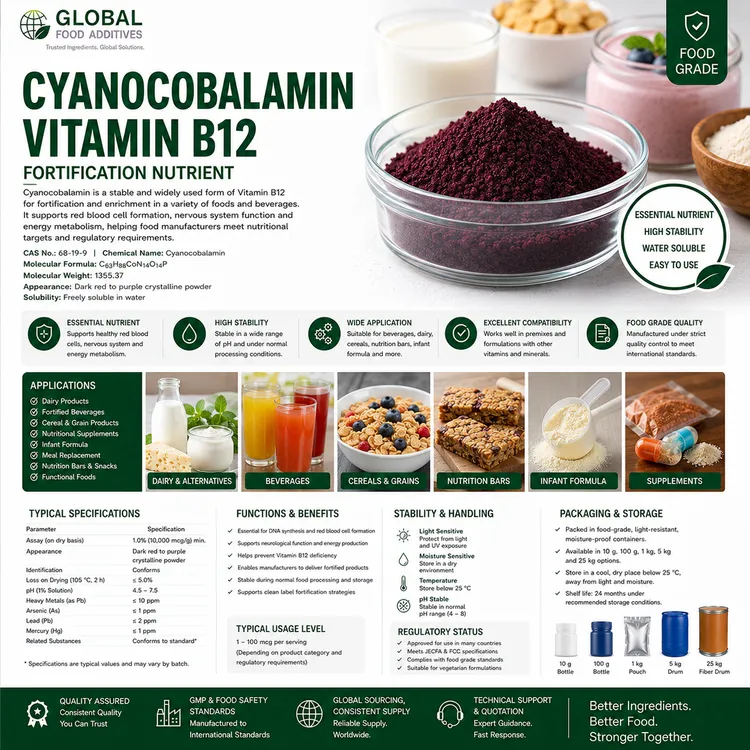
Product identity
| Product | Cyanocobalamin |
|---|---|
| Common nutrient name | Vitamin B12 / Vitamin B-12 / Cobalamin source |
| Category | Fortification Nutrients |
| Function | Vitamin B12 fortification nutrient, enrichment ingredient and premix-ready nutrition component |
| E / INS number | Usually treated as a nutrient source rather than a standard E-number additive; confirm by destination market and supplier documentation |
| CAS / identity | 68-19-9 |
| Typical form | Dark red crystalline powder, fine powder, triturated dilution, spray-dried powder, beadlet, premix-ready grade or solution grade |
| Typical assay basis | Pure Cyanocobalamin assay or diluted Vitamin B12 activity such as 0.1%, 1%, 5% or customer-specific premix potency |
| Main sourcing note | The requested grade should match final dosage, mixing equipment, carrier compatibility, heat exposure, light exposure, shelf-life target and label requirements. |
Application fit
Potential use areas may include the following, subject to destination-market rules, nutrient claim requirements, dosage validation and supplier documentation:
- Breakfast cereals, cereal bars and extruded grain products
- Flour enrichment, bakery premixes and fortified grain systems where permitted
- Dairy drinks, yogurt preparations and flavored milk systems
- Plant-based milk alternatives, vegan foods and fortified nutritional beverages
- Powdered drink mixes, meal replacements and instant nutrition powders
- Infant, medical and special-nutrition foods only where permitted and validated
- Confectionery, gummies, tablets and supplement-style food formats
- Vitamin-mineral premixes for food, beverage and nutrition manufacturers
Technical overview for industrial buyers
Cyanocobalamin is a highly potent micronutrient, so industrial handling is normally focused on accurate dilution, homogeneous distribution and stability protection. In most food factories, pure Vitamin B12 is not dosed directly into the final product because the required addition level may be extremely low. Instead, buyers often request standardized dilutions, premix-ready powders, beadlets or liquid preparations that improve weighing accuracy, dispersion and traceability.
The best Cyanocobalamin grade depends on the application matrix. A dry cereal premix may require low dust, defined particle size and excellent blend uniformity. A beverage application may need water dispersibility, clarity or controlled solution preparation. A gummy, tablet or confectionery system may need compatibility with acids, heat, moisture and colors. A plant-based milk or nutrition drink may need validated shelf-life retention after heat treatment and light exposure.
Commercial grade options
| Grade or format | Industrial relevance | Purchasing focus |
|---|---|---|
| Pure crystalline Cyanocobalamin | High-potency raw material used by experienced premix manufacturers or controlled dosing operations. | Assay, identity, impurity profile, residual solvents, heavy metals, microbiology, storage protection and weighing control. |
| 0.1% or 1% trituration | Common for easier weighing, safer handling and improved distribution in food premixes. | Carrier identity, uniformity, particle size, flow, assay tolerance, allergen/GMO status and label impact. |
| Spray-dried powder | Useful for dry blends, beverage powders, cereals and nutrition products requiring good dispersion. | Carrier system, solubility, moisture, bulk density, dust level, color impact and process stability. |
| Beadlet or protected grade | Reviewed for improved handling, controlled release, reduced dusting or better stability in demanding matrices. | Coating composition, allergen status, vegan status, particle size, heat tolerance and compatibility with the final process. |
| Liquid solution or dispersion | Used where metered liquid dosing or premade vitamin solution is preferred. | Concentration, solvent system, preservative system, microbiology, pH, light protection, packaging and shelf life. |
| Custom vitamin-mineral premix | Combines Cyanocobalamin with other vitamins, minerals and carriers for direct factory addition. | Blend uniformity, overage strategy, ingredient compatibility, assay guarantee, stability study and regulatory labeling support. |
Fortification and formulation value
Low-dose nutrient precision
Vitamin B12 is used at very low levels compared with macronutrients and many additives. Correct dilution, premix design and validated mixing are essential to avoid under-fortification, over-fortification or batch-to-batch variability.
Nutrition positioning
Cyanocobalamin can support nutrition-positioned products such as fortified cereals, plant-based beverages, vegan foods, meal replacements and functional nutrition products. Claim wording, nutrient reference values and label declarations must be reviewed for each destination market.
Premix compatibility
In vitamin-mineral blends, Cyanocobalamin may be exposed to minerals, acids, reducing agents, moisture and light-sensitive vitamins. Compatibility should be reviewed with the premix supplier and confirmed through stability testing.
Process retention
Retention depends on the food matrix, heat process, pH, oxygen exposure, light, storage temperature and packaging. Manufacturers should define an overage strategy based on validated process loss and shelf-life data.
Application matrix
| Food or process area | Typical technical objective | Key questions before sourcing |
|---|---|---|
| Breakfast cereals and cereal bars | Deliver Vitamin B12 fortification with good dry-blend uniformity and shelf-life retention. | Will the vitamin be added before extrusion, after extrusion, through coating, or as part of a premix? |
| Flour and bakery premixes | Support enrichment or nutrition positioning while maintaining powder flow and uniform distribution. | Is Cyanocobalamin permitted for the specific flour or bakery category in the destination market? |
| Plant-based beverages | Provide Vitamin B12 in vegan or dairy-alternative products where natural B12 may be absent. | What heat process, pH, light exposure, packaging and shelf-life target will the product face? |
| Dairy drinks and yogurt systems | Support nutrient enrichment in refrigerated or ambient dairy applications. | Will fermentation, low pH, heat treatment or cultures affect B12 retention and assay recovery? |
| Powdered beverages and meal replacements | Support accurate vitamin dosing, dry-mix uniformity and rapid dispersion after reconstitution. | What carrier, particle size, solubility and humidity protection are required? |
| Gummies, tablets and confectionery | Provide Vitamin B12 in controlled serving formats while maintaining sensory quality and stability. | Will heat, acid, sugar system, moisture, color or flavor components affect retention? |
| Infant, medical and special-nutrition foods | Meet strict nutrient specifications, regulatory limits and shelf-life assay guarantees. | Are the grade, manufacturing site, contaminant limits and documentation suitable for the intended regulated category? |
| Custom vitamin-mineral premixes | Ensure homogeneous micronutrient delivery in industrial food manufacturing. | Has the premix been validated for blend uniformity, assay recovery, segregation risk and long-term stability? |
Specification parameters to compare
Industrial approval should include a side-by-side comparison of supplier specifications and an application-specific stability review. Exact limits vary by pharmacopeial grade, food-grade standard, manufacturer, carrier system and destination market, but the following parameters are commonly relevant for Cyanocobalamin sourcing.
| Parameter | Why it matters |
|---|---|
| Identity confirmation | Confirms the material is Cyanocobalamin and not another B12 form or an unspecified cobalamin blend. |
| Assay / potency | Controls dosage, label declaration, premix strength and finished-product nutrient claim compliance. |
| Assay method | HPLC, UV or microbiological methods can produce different practical considerations; the method should match QA requirements. |
| Carrier identity | Important for diluted grades, allergen review, GMO review, vegan status, labeling and customer approval. |
| Particle size distribution | Affects blend uniformity, segregation risk, dust level, dosing accuracy and dissolution behavior. |
| Bulk density and flow | Important for automatic dosing, premix blending, sachet filling and container loading calculations. |
| Moisture / loss on drying | Influences caking, stability, microbiological risk and shelf life, especially in premix-ready grades. |
| Solubility or dispersibility | Critical for beverages, liquid premixes, gummies, dairy systems and powder reconstitution. |
| Light and heat stability | Supports process design, packaging selection, overage calculation and shelf-life planning. |
| Heavy metals and elemental impurities | Required for food-grade compliance, sensitive applications, infant nutrition and import clearance. |
| Residual solvents and process impurities | Important for supplier approval, regulatory compliance and customer quality systems. |
| Microbiological quality | Important for dry blends, nutrition powders, infant/medical foods and liquid preparations. |
| Shelf life and storage conditions | Supports purchasing, warehouse rotation, export planning and finished-product retention guarantees. |
Stability and compatibility notes
Cyanocobalamin is commonly selected because it is a practical and relatively stable Vitamin B12 source, but stability is still formulation-specific. Vitamin B12 can be affected by light, oxygen, high heat, alkaline conditions, moisture and incompatible ingredients. Finished-product retention should be validated under the real process and storage conditions, especially when the product is heat-treated, transparent-packaged, acidic, mineral-rich or stored for long periods.
In complex premixes, compatibility should be reviewed against minerals such as iron and copper, reducing agents such as ascorbic acid, aggressive acids, alkaline ingredients, peroxides, oxidized fats and high-moisture carriers. Sensitive formulations may require protected grades, separate addition points, lower-moisture carriers, opaque packaging or increased overage based on stability testing.
Light exposure
Cyanocobalamin-containing raw materials and premixes should be protected from direct sunlight and strong processing-room light. Opaque or light-protective packaging is recommended for storage, sampling and transport.
Heat exposure
Heat loss depends on time, temperature, matrix and pH. UHT, retort, extrusion, baking and hot-fill processes should be validated with finished-product assay testing rather than assumed retention.
Moisture control
Moisture can increase caking, reduce powder flow and accelerate degradation in some premix systems. Dry carriers, sealed bags and low-humidity handling are important for premix-ready grades.
Ingredient interactions
Some minerals, acids, reducing agents and oxidizing environments can reduce vitamin retention. Separate premixes or protective carriers may be useful for demanding formulations.
Premix design and dosage control
Because Vitamin B12 is dosed in microgram-level nutritional amounts, a robust premix strategy is often more important than the raw material price. The premix should be designed to prevent segregation, improve weighing accuracy and ensure uniform nutrient distribution in each serving. Poor premix design can create compliance risk even when the raw material is high quality.
Buyers should define the intended addition point, batch size, mixing time, carrier, particle size match, assay tolerance, overage policy and finished-product testing method. In high-volume production, the most practical grade may be a diluted powder or custom premix that balances potency with factory handling, traceability and QA release requirements.
Processing and formulation notes
- Confirm whether the target material is pure Cyanocobalamin, a diluted grade, a beadlet, a spray-dried grade or a custom premix.
- Specify assay strength clearly, especially when requesting 0.1%, 1%, 5% or other premix-ready dilutions.
- Define whether the final claim is based on Vitamin B12, Cyanocobalamin, daily value, nutrient reference value or local label terminology.
- Use suitable overage only after reviewing process loss, shelf-life retention and legal maximum limits.
- Protect raw material and premixes from light, heat, moisture, oxygen and incompatible ingredients.
- For beverage applications, check solution clarity, color impact, pH stability, heat-process retention and packaging light transmission.
- For dry premixes, evaluate blend uniformity, segregation, dusting, caking, humidity exposure and assay recovery.
- For gummies and confectionery, validate retention after cooking, acid addition, cooling, depositing and shelf-life storage.
- For infant, medical and special-nutrition products, request enhanced contaminant, microbiology and regulatory documentation.
Trial and validation recommendations
Laboratory screening
- Confirm appearance, identity, assay, carrier, solubility and moisture against the supplier specification.
- Check whether the assay method is suitable for the raw material and the finished-product matrix.
- Prepare bench premixes to evaluate blend uniformity, dust level, flow and segregation risk.
Pilot formulation
- Test Cyanocobalamin in the real food matrix, including heat, pH, light and storage conditions.
- Measure retention immediately after processing and after accelerated or real-time shelf-life storage.
- Evaluate sensory impact, color effect and compatibility with flavors, minerals and other vitamins.
Factory trial
- Run the material through actual weighing, premixing, dosing, processing, filling and packaging conditions.
- Track assay recovery, dosage accuracy, blend uniformity and finished-product variation.
- Confirm that the packaging protects against light, humidity and transport-related quality loss.
Commercial approval
- Approve exact manufacturer, grade name, assay strength, carrier, origin, packaging and shelf life.
- Keep retained samples, approved COA, supplier specification and regulatory confirmation for audit records.
- Define change-notification requirements for raw material source, fermentation origin, carrier, assay method or packaging.
Documents to request
- Product specification or technical data sheet clearly identifying Cyanocobalamin and assay strength
- Certificate of analysis for available batch or representative lot
- Safety data sheet where applicable
- Food-grade declaration and compliance statement for the intended destination market
- Assay method information, including whether testing is HPLC, UV or another validated method
- Carrier declaration for diluted, spray-dried, beadlet or premix-ready grades
- Origin statement, manufacturing process overview and fermentation or synthetic-origin information where required
- Shelf-life statement and recommended storage conditions
- Residual solvent, heavy-metal and elemental impurity declarations
- Microbiological specification and contaminant declarations where required by buyer or regulation
- Allergen, GMO, vegan/vegetarian, irradiation and residual solvent statements when applicable
- Halal, kosher, ISO, HACCP, FSSC, BRCGS or other certification copies when required
- Packaging specification, bag or bottle size, pallet configuration and container loading information
- Market-specific nutrient, fortification, label or import declarations required by the destination country
Packaging, storage and logistics
Cyanocobalamin and Vitamin B12 premixes should be stored in original, tightly closed packaging in a clean, dry, cool and light-protected warehouse. For high-potency material, sampling should be controlled to avoid contamination, moisture pickup, mix-up and prolonged light exposure. Opaque bottles, foil bags, fiber drums with liners or sealed cartons may be used depending on grade and supplier packaging.
During export shipments, buyers should consider temperature exposure, humidity, container transit time, customs delays and warehouse conditions at destination. For sensitive grades, request packaging that protects against light, oxygen and moisture. FIFO or FEFO stock rotation is recommended, and opened containers should be resealed immediately and used according to the supplier's instructions.
Regulatory and labeling review
Cyanocobalamin is typically reviewed as a nutrient source for Vitamin B12 fortification rather than as a general-purpose processing additive. The permitted use, minimum and maximum fortification levels, nutrient claims, health claims, label terminology, daily value or nutrient reference value calculations and population-specific restrictions vary by destination market.
For fortified foods, the buyer should confirm whether Vitamin B12 addition is permitted or mandatory for the target product category, how much Vitamin B12 must remain at end of shelf life, whether overage is allowed, and which analytical method is acceptable for compliance. Special attention is needed for infant formula, medical foods, dietary supplements, meal replacements, vegan-positioned foods and products shipped to multiple countries.
Technical purchasing notes
When reviewing Cyanocobalamin, compare the supplier specification against the intended food application, process conditions, assay requirement, target function, label expectations and local rules. For industrial purchasing, the most useful inquiry normally includes target grade, assay or active content, physical form, carrier, packaging size, quantity, destination and document requirements.
If the target is a fortified beverage, include pH, heat process, packaging type, light exposure and shelf-life target. If the target is a dry premix, include carrier system, particle size, desired dilution strength, batch size and mixing conditions. If the target is infant, medical or special nutrition, include all contaminant limits, microbiological requirements, regulatory standards and certification expectations.
How to request this product
Send the product name, target assay, physical form, reference specification, quantity, destination country, packaging preference, expected shipment date and required documents. If you already purchase Cyanocobalamin, attach or describe your existing specification, product code, label, certificate of analysis or premix formula so supplier options can be compared more accurately.
Useful answers
What is Cyanocobalamin used for in food manufacturing?
Cyanocobalamin is used as a Vitamin B12 source for food fortification, enrichment, premix-ready formulation and nutrition-positioned products. It is commonly reviewed for cereals, beverages, plant-based dairy alternatives, nutrition powders, flour systems, confectionery and supplement-style food formats.
Is Cyanocobalamin the same as Vitamin B12?
Cyanocobalamin is one form of Vitamin B12 and is widely used as a practical fortification ingredient. Other B12 forms may exist, but Cyanocobalamin is often selected for industrial applications because of availability, stability and established use in premixes and fortified foods.
Which Cyanocobalamin grade should be requested?
The required grade depends on the application and dosing system. Buyers may request pure crystalline material, 0.1% or 1% dilution, spray-dried powder, beadlet, premix-ready grade or liquid solution. The inquiry should include assay, carrier, solubility, particle size, packaging and required documents.
Is Cyanocobalamin stable during processing?
Cyanocobalamin is generally selected for good practical stability, but retention can be reduced by light, heat, moisture, alkaline pH, oxygen and incompatible ingredients. Finished-product stability should be confirmed by process and shelf-life testing.
Can Cyanocobalamin be used in vegan products?
Cyanocobalamin is commonly used in vegan-positioned fortified foods, but vegan suitability depends on the manufacturing process, carrier, encapsulation material and supplier declaration. Buyers should request a vegan or vegetarian statement when needed.
Can Cyanocobalamin be added directly to final food?
It can be added directly only when the factory has suitable weighing, dilution and mixing controls. Because Vitamin B12 is highly potent and used at very low levels, many manufacturers prefer diluted grades or custom premixes to improve uniformity and reduce dosing risk.
Can Global Food Additives source Cyanocobalamin?
Global Food Additives can review sourcing options for Cyanocobalamin according to target assay, grade, carrier system, quantity, destination, packaging and required documentation.
Which documents should be requested?
Buyers commonly request a technical data sheet, specification, certificate of analysis, safety data sheet, food-grade statement, assay method, origin statement, shelf-life information, carrier declaration, label and packing details, plus halal, kosher, allergen, GMO, vegan or other certificates when required.
Is Cyanocobalamin permitted in every country?
No. Vitamin fortification rules depend on destination-market regulations, food category, dosage, nutrient claim, label requirements and buyer responsibility. Always verify current local rules and final product suitability before commercial use.
Tell us which Cyanocobalamin grade or fortification premix you need.
Send product names, target assay, grade, physical form, carrier preference, quantity, destination country, packaging preference, delivery term and document requirements. Our team will review your inquiry and respond from orders@foodgradeadditives.com.
Your message has been received. You will be redirected to the home page.