
Cyclamate E952
Cyclamate is a high-intensity sweetener used in permitted markets for sugar reduction, low-calorie formulation, sweetness balancing and cost-efficient sweetener systems. Commercial purchasing usually refers to cyclamic acid and its food-grade salts, especially sodium cyclamate and calcium cyclamate, which are identified under E952 / INS 952 where permitted by local regulation.
This page is prepared for purchasing teams, beverage formulators, confectionery producers, R&D departments, QA managers, regulatory teams and import coordinators who need a more technical basis for Cyclamate sourcing. It covers identity selection, application fit, sweetness design, blend strategy, specification review, documentation, storage, compliance checks and quotation requirements.
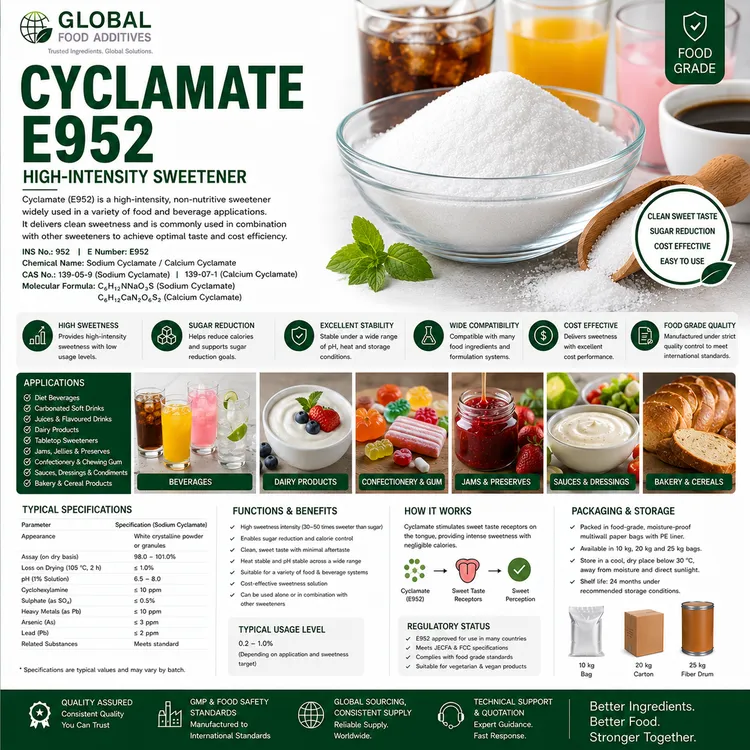
Product identity
| Product | Cyclamate |
|---|---|
| E / INS number | E952 / INS 952 |
| Category | Sweeteners & Polyols |
| Correct function | High-intensity sweetener and sugar-reduction ingredient; not a polyol and not a bulking sweetener |
| Common identity options | Cyclamic acid, sodium cyclamate, calcium cyclamate and market-specific permitted salt forms |
| CAS / identity | Cyclamic acid CAS 100-88-9; sodium cyclamate, calcium cyclamate and other salt identities should be confirmed on the supplier specification |
| Typical form | White crystalline powder, fine powder, granular grade, tablet-blend grade or prepared liquid sweetener formulation |
| Typical industrial focus | Sweetness design, calorie reduction, sugar replacement, beverage sweetening, tabletop sweetener systems and sweetener cost optimization where legally permitted |
Application fit
Potential use areas may include the following, subject to destination-market approval, food category limits, label rules and application trials:
- Carbonated and still low-calorie beverages
- Powdered drink mixes and instant beverage bases
- Tabletop sweetener tablets, sachets and liquid drops
- Confectionery, hard candy, chewing gum and sugar-reduced sweets
- Dairy desserts, flavored dairy drinks and non-dairy dessert systems
- Jams, fruit preparations, syrups and water-based sweetened systems
- Pharmaceutical-style taste masking and permitted nutraceutical formats
- Multi-sweetener blends where cost, stability and sweetness curve are optimized
Technical overview for industrial buyers
Cyclamate is valued because it can provide sweetness at a much lower dosage than sucrose while contributing negligible bulk to the formula. This makes it useful in low-calorie and sugar-reduced products, but it also means the formulation usually needs other ingredients to replace sugar's body, viscosity, solids, freezing-point behavior, browning contribution or mouthfeel. For this reason, Cyclamate is often part of a complete sweetener and texture system rather than a one-for-one sugar replacement.
In industrial sourcing, the key purchasing question is not only “Can you offer Cyclamate?” but “Which salt form, specification, regulatory package and application performance are required for the destination market?” Sodium cyclamate and calcium cyclamate can differ in mineral contribution, solubility behavior, labeling implications and customer acceptance. Buyers should define the exact identity, assay basis, target application and permitted use level before comparing quotations.
Commercial forms and identity selection
| Identity or form | Industrial relevance | Purchasing focus |
|---|---|---|
| Cyclamic acid | Reference acid form for identity, regulatory calculations and conversion basis in some specifications. | Confirm CAS, assay, acid-equivalent basis, impurity profile and whether the material is intended for food use. |
| Sodium cyclamate | Common commercial sweetener salt for beverages, tabletop products, confectionery and dry blends where permitted. | Confirm sodium contribution, solubility, assay, pH, particle size, moisture, residual impurities and destination compliance. |
| Calcium cyclamate | Alternative salt form where sodium contribution or customer preference is relevant. | Confirm calcium contribution, solubility behavior, salt identity, assay basis, regulatory status and labeling impact. |
| Granular or tablet-blend grade | Used in tabletop sweetener tablets, sachets or direct-blend systems where flow and compressibility matter. | Confirm particle size distribution, bulk density, flow, compaction behavior, anti-caking system and carrier ingredients. |
| Liquid sweetener formulation | Used where rapid dissolution, dosing convenience or premade sweetener solution is preferred. | Confirm concentration, preservative system, microbiology, pH, water quality, packaging, stability and local label rules. |
Sweetness design and formulation value
Sweetness profile
Cyclamate is generally used for a relatively smooth sweetness profile compared with some intense sweeteners. Its lower sweetness intensity can be useful in blends because formulators may fine-tune sweetness without using extremely small addition levels. Sensory performance should be checked in the actual product matrix because acidity, flavor type, carbonation, minerals and processing can affect perception.
Blend synergy
In permitted markets, Cyclamate is often evaluated with saccharin, acesulfame-K, aspartame, sucralose, steviol glycosides or nutritive sweeteners. Blending may reduce bitterness, metallic notes, delayed sweetness, lingering aftertaste or cost-in-use. The final blend should be tested by trained sensory panels and consumer-preference trials.
Heat and acid tolerance
Cyclamate is often selected for beverage and processed-food systems where heat treatment, low pH or storage stability may be important. Buyers should still validate stability under the actual pasteurization, hot-fill, UHT, retort, baking, pH, preservative and shelf-life conditions used in the factory.
Bulk replacement requirement
Because Cyclamate is not a bulking agent, sugar-reduced products may require polyols, fibers, maltodextrin, hydrocolloids, fruit solids or other body-building ingredients. This is especially important in confectionery, bakery, sauces, syrups and desserts where sugar contributes texture as well as sweetness.
Application matrix
| Food or process area | Typical technical objective | Key questions before sourcing |
|---|---|---|
| Low-calorie soft drinks | Provide sweetness with low caloric contribution and good acid beverage stability. | Is Cyclamate permitted in the destination market, and what is the maximum use level for the beverage category? |
| Powdered beverages | Support sweetness in dry drink bases with good solubility and consistent sachet dosing. | What particle size, flow, carrier system, dissolution speed and humidity protection are required? |
| Tabletop sweeteners | Create tablets, sachets or liquid drops with a pleasant sweetness profile and accurate serving strength. | Will the formula use tablets, granules, liquid concentrate or sachets, and what bulking system is needed? |
| Confectionery and chewing gum | Provide sweetness while supporting cost control and sugar-reduction targets. | Which texture system will replace sugar bulk, and how will sweetness release behave during chewing or consumption? |
| Dairy desserts and flavored drinks | Reduce sugar while maintaining flavor balance, mouthfeel and sweetness intensity. | Does the grade remain stable through heat treatment, protein systems, pH conditions and refrigerated storage? |
| Fruit preparations, syrups and jams | Support sweetness in acidic fruit systems and sugar-reduced products. | How will viscosity, soluble solids, water activity, preservative system and label claims be managed? |
| Bakery and heat-processed foods | Provide sweetness where permitted, but not sugar's browning, bulk or fermentation behavior. | What replaces sugar's structure, moisture control, browning and yeast-fermentation contribution? |
Specification parameters to compare
Before approving a Cyclamate supplier, compare specifications side by side and confirm the analytical basis. The same E number does not guarantee the same salt form, particle size, packaging quality, impurity profile or regulatory package.
| Parameter | Why it matters |
|---|---|
| Exact identity and salt form | Confirms whether the offered material is cyclamic acid, sodium cyclamate, calcium cyclamate or another permitted salt form. |
| Assay / active content | Controls sweetness strength, dosing accuracy, regulatory calculation and lot-to-lot consistency. |
| Acid-equivalent calculation | Some rules and specifications express use levels as cyclamic acid equivalent, so conversion must be clear. |
| Moisture or loss on drying | Influences powder stability, caking risk, tablet performance and shelf life. |
| pH of solution | Useful for beverage, dairy, syrup and liquid sweetener compatibility. |
| Solubility and clarity | Important for clear beverages, liquid concentrates and fast-dissolving dry mixes. |
| Particle size distribution | Affects dry blending, segregation, dusting, dissolution speed, sachet filling and tablet compression. |
| Bulk density and flow | Important for automated dosing, premix production, filling lines and container loading. |
| Residual cyclohexylamine and related impurities | Key food-grade quality and compliance parameters that may be required by customer or regulation. |
| Sulfate, chloride and inorganic impurities | Support purity review, process consistency and suitability for sensitive applications. |
| Heavy metals and contaminants | Required for food-grade compliance, import clearance and customer approval. |
| Microbiological quality, where applicable | Relevant for liquid formulations, dry blends, tabletop products and customers with strict QA systems. |
Sweetener blending and cost-in-use review
Cyclamate is often assessed as part of a sweetener blend rather than as a single sweetener. In beverages, a blend may be designed to improve sweetness onset, reduce aftertaste, optimize cost, improve flavor release or maintain sweetness during shelf life. In tabletop sweeteners, the blend also has to match serving size, tablet strength, dissolution speed and consumer expectation.
For cost-in-use calculations, evaluate the finished product cost per 1,000 liters, per ton of dry mix or per 1 million servings rather than only the raw material price per kilogram. Include sweetness potency, legal maximum level, blend ratio, losses during processing, packaging cost, carrier cost, sensory acceptance and any additional ingredients required to replace sugar bulk.
With saccharin
Cyclamate and saccharin are often discussed together in markets where both are permitted because the combination can balance cost and sweetness profile. The exact ratio should be based on sensory testing, legal limits and desired aftertaste control.
With acesulfame-K or sucralose
Blends with acesulfame-K or sucralose may be reviewed for faster sweetness impact, improved sweetness intensity or better flavor balance. Compatibility depends on pH, flavor type, processing and market rules.
With steviol glycosides
Cyclamate may be evaluated with stevia-derived sweeteners where formulators want to manage licorice-like or lingering notes. Label strategy and local approval status must be reviewed carefully.
With nutritive sweeteners
Partial sugar reduction can combine Cyclamate with sucrose, glucose syrup, fructose or fruit solids. This approach may preserve mouthfeel and solids while reducing total sugar or cost.
Processing and formulation notes
- Confirm whether the formulation needs sodium cyclamate, calcium cyclamate or another permitted salt form.
- Check local rules before developing a product for export, because Cyclamate status differs significantly between markets.
- Do not assume Cyclamate replaces sugar's bulk, browning, humectancy, freezing-point depression or fermentation role.
- For clear beverages, test dissolution, clarity, sediment, pH stability, preservative compatibility and storage performance.
- For dry blends, evaluate particle-size match, segregation risk, dusting, humidity sensitivity and sachet filling accuracy.
- For tabletop tablets, check compression force, friability, disintegration time, serving sweetness and carrier compatibility.
- For confectionery, confirm sweetness release, texture replacement, thermal exposure and finished-product water activity.
- For multi-sweetener blends, run sensory panels across the full shelf-life period, not only immediately after production.
Trial and validation recommendations
Laboratory screening
- Confirm identity, appearance, odor, taste, solubility and pH against the supplier specification.
- Compare assay, moisture, impurity profile and heavy-metal limits against internal QA requirements.
- Prepare bench blends with other sweeteners to evaluate sweetness onset, peak intensity and aftertaste.
Pilot formulation
- Test the grade in the real product matrix, including acidity, flavor, heat treatment and storage conditions.
- Measure sweetness stability, clarity, color, sediment, mouthfeel and sensory acceptability over time.
- Compare dosage efficiency and legal maximum use levels in the target country before scale-up.
Factory trial
- Run the material through actual dosing, mixing, dissolution, filling, pasteurization or packaging conditions.
- Track powder flow, weighing accuracy, solution preparation time, blend uniformity and product consistency.
- Check whether the packaging protects against humidity, caking and transport-related compaction.
Commercial approval
- Approve the exact manufacturer, salt form, product code, specification, packaging and origin.
- Keep retained samples, approved COA, regulatory confirmation and dosage calculations for audit records.
- Define change-notification requirements for raw material origin, process, impurity profile or packaging changes.
Documents to request
- Product specification or technical data sheet clearly identifying E952 / INS 952 and exact salt form
- Certificate of analysis for available batch or representative lot
- Safety data sheet where applicable
- Food-grade declaration and compliance statement for the intended destination market
- Statement confirming whether the material is cyclamic acid, sodium cyclamate, calcium cyclamate or another salt
- Assay basis and conversion information where use limits are expressed as cyclamic acid equivalent
- Origin statement, manufacturer information, shelf-life and recommended storage conditions
- Residual impurity declarations, including cyclohexylamine where required
- Heavy metals, contaminants and microbiological declarations where required by buyer or regulation
- Allergen, GMO, vegan/vegetarian, irradiation and residual solvent statements when applicable
- Halal, kosher, ISO, HACCP, FSSC, BRCGS or other certification copies when required
- Label draft, packaging specification, bag size, pallet configuration and container loading information
- Market-specific import, customs or regulatory declarations required by the destination country
Packaging, storage and logistics
Cyclamate should normally be stored in original, tightly closed packaging in a clean, dry, cool and odor-free warehouse. Powder grades should be protected from moisture, condensation, damaged pallets, open bags and strong-smelling materials. For humid destinations, request moisture-resistant inner liners, sealed bags and export-ready pallet wrapping.
During handling, avoid unnecessary dust generation and keep the material away from incompatible substances according to the supplier SDS. For high-volume beverage or dry-blend plants, evaluate whether the package size, bag strength, pallet dimensions and discharge behavior are compatible with the dosing room and mixing operation. FIFO or FEFO stock rotation is recommended.
Regulatory and labeling review
Cyclamate requires careful regulatory review because approval status, maximum use levels and permitted food categories vary by country. It may be acceptable for certain food categories in one market and prohibited in another. For export business, the destination-market rule should be checked before quotation, formulation, label approval or shipment.
Buyers should confirm the food category, maximum permitted dosage, whether limits are expressed as cyclamic acid equivalent, required label declaration, warning statements if any, and whether use is permitted in products intended for children, diabetic-positioned foods, supplements, tabletop sweeteners or multi-country distribution. Do not assume E952 recognition means universal approval.
Technical purchasing notes
When reviewing Cyclamate, compare the supplier specification against the intended food application, process conditions, target sweetness profile, label expectations and local rules. For industrial purchasing, the most useful inquiry normally includes exact salt form, assay, physical form, packaging size, quantity, destination, delivery term and document requirements.
If the target is beverage use, include pH, heat process, flavor type, carbonation, preservative system, target sweetness level and required shelf life. If the target is tabletop sweeteners or dry mixes, include carrier system, tablet or sachet format, serving size, particle size, flow requirements and blending process. If the product will be exported, list every destination country.
How to request this product
Send the product name, required identity such as sodium cyclamate or calcium cyclamate, target grade or reference specification, quantity, destination country, packaging preference, expected shipment date and required documents. If you already purchase Cyclamate, attach or describe your current specification, label, certificate of analysis or supplier product code so sourcing options can be compared more accurately.
Useful answers
What is Cyclamate used for in food manufacturing?
Cyclamate is used as a high-intensity sweetener in permitted markets. It is typically evaluated for low-calorie beverages, tabletop sweeteners, confectionery, chewing gum, dairy desserts, powdered drink mixes and multi-sweetener systems.
Is Cyclamate a polyol?
No. Cyclamate is not a polyol and does not provide the same bulk, texture or humectancy as sorbitol, xylitol, maltitol or erythritol. It mainly provides sweetness at low dosage, so sugar-reduced products may require separate bulking or texture ingredients.
What does E952 mean?
E952 / INS 952 refers to cyclamic acid and cyclamate salts such as sodium cyclamate and calcium cyclamate where permitted by local food additive regulations. The exact salt form should always be confirmed on the supplier specification and COA.
Is Cyclamate permitted in every country?
No. Cyclamate is a destination-sensitive sweetener. It is permitted in some markets and prohibited or restricted in others. Buyers must verify current local regulations, food category permissions, use limits and label requirements before purchasing or formulating.
Can Cyclamate be used in beverages?
Cyclamate may be used in beverage applications only where it is legally permitted. Beverage formulators should confirm acid stability, sweetness profile, preservative compatibility, clarity, shelf-life stability and maximum permitted use level for the destination market.
Can Cyclamate replace sugar directly?
No. Cyclamate can replace sweetness, but it does not replace sugar's bulk, viscosity, browning, water activity, freezing-point effect or fermentation role. A complete reformulation may require bulking agents, fibers, polyols, hydrocolloids, acids, flavors or other sweeteners.
Can Cyclamate be blended with other sweeteners?
Yes, in permitted markets. Cyclamate may be blended with saccharin, acesulfame-K, sucralose, aspartame, steviol glycosides or nutritive sweeteners to balance sweetness, aftertaste and cost-in-use. Blend design should be confirmed by sensory and regulatory review.
Can Global Food Additives source Cyclamate?
Global Food Additives can review sourcing options for Cyclamate according to salt form, target specification, quantity, destination, packaging and required documentation.
Which documents should be requested?
Buyers commonly request a technical data sheet, specification, certificate of analysis, safety data sheet, food-grade statement, origin statement, regulatory declaration, impurity declaration, shelf-life information, label and packing details, plus halal, kosher or other certificates when required.
Tell us which Cyclamate grade or sweetener system you need.
Send product names, salt form, target specifications, application, quantity, destination country, packaging preference, delivery term and document requirements. Our team will review your inquiry and respond from orders@foodgradeadditives.com.
Your message has been received. You will be redirected to the home page.