
Delta-Tocopherol E309
Delta-Tocopherol, also written as δ-Tocopherol, is a food-grade tocopherol antioxidant used to support oxidation control in fat-containing foods and ingredient systems. It is considered for edible oils, frying oils, snack oils, bakery fats, margarines, shortenings, meat systems, seafood systems, flavour oils, colour preparations, vitamin blends, emulsions, beverages and sensitive finished products where lipid oxidation can reduce flavour, colour, nutritional value and shelf-life performance.
For industrial buyers, Delta-Tocopherol should be evaluated as a performance antioxidant rather than only as a commodity vitamin-E-related ingredient. The correct supplier grade can affect peroxide development, rancidity delay, flavour retention, colour stability, oil compatibility, dosage efficiency, label declaration, regulatory approval, carrier suitability, source claims, allergen/GMO status and batch-to-batch oxidative stability.
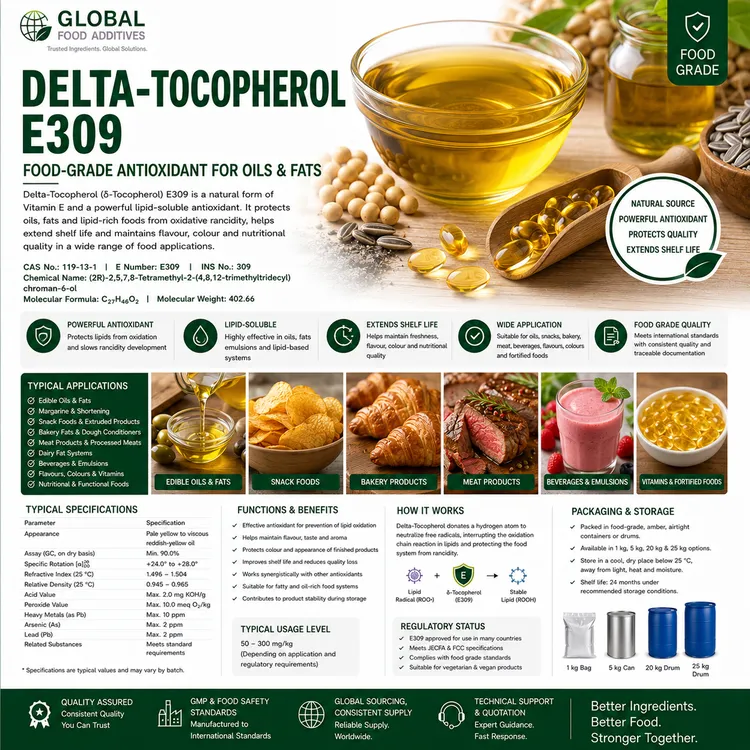
Product identity
| Product name | Delta-Tocopherol |
|---|---|
| Common technical name | δ-Tocopherol |
| Other names | D-Delta-Tocopherol; Vitamin E Delta-Tocopherol; Tocopherol Antioxidant; Delta-Rich Tocopherol Concentrate |
| Category | Antioxidants & Oxidation Control |
| Functional class | Antioxidant / lipid-oxidation-control ingredient / oil-stability support |
| E / INS number | E309 / INS 309, subject to destination-market rules |
| CAS / identity | 119-13-1 |
| Chemical formula | C27H46O2 |
| Chemical family | Tocopherol; fat-soluble phenolic antioxidant related to vitamin E compounds |
| Typical commercial form | Oil-dispersible liquid, concentrate, powder on carrier, emulsion or formulated antioxidant blend |
| Primary technical purpose | Delay lipid oxidation, rancidity, off-flavour development, colour loss and quality deterioration in oxygen-sensitive systems |
Application fit
Delta-Tocopherol is normally considered where unsaturated oils, fat-containing ingredients, oxygen exposure, heat, metal traces or long distribution chains increase the risk of oxidative quality loss. Potential industrial use areas may include:
- Edible vegetable oils, speciality oils, frying oils and oil blends
- Snacks, chips, crackers, extruded snacks, roasted nuts and seasoned oil systems
- Bakery fats, margarines, shortenings, fillings, icings and laminated dough fats
- Processed meat, poultry, seafood, pet-food-style savoury systems and fat-rich prepared foods
- Oil-based flavours, spice oleoresins, natural colours, carotenoids and vitamin preparations
- Emulsions, beverages, powdered fats, encapsulated oils and fat-containing dry premixes
Industrial function and formulation value
Delta-Tocopherol functions as a chain-breaking antioxidant in lipid systems. It can help slow oxidative reactions that generate hydroperoxides, aldehydes, ketones and other compounds associated with rancid odours, stale flavours, colour fading and quality loss. In food manufacturing, this makes it valuable for oils and fat-containing formulations that are exposed to oxygen, heat, light, metal ions, grinding, spray drying, frying, baking or long storage.
The ingredient is often evaluated where formulators want an antioxidant system that can be positioned differently from some synthetic phenolic antioxidants. However, antioxidant performance is highly matrix dependent. A grade that works well in one oil may not perform the same way in another oil, emulsion, snack coating, meat system or encapsulated flavour. Product trials should compare Delta-Tocopherol against the buyer's current antioxidant system and against the untreated control.
Technical performance considerations
Lipid oxidation pathway
Oxidation usually begins with free-radical formation and develops through peroxide formation, breakdown products and sensory defects. Delta-Tocopherol is used to interrupt radical propagation and delay quality deterioration, but it cannot reverse already rancid oil.
Tocopherol profile
Suppliers may offer purified delta-tocopherol, delta-rich concentrates or mixed-tocopherol systems. The isomer profile matters because alpha, gamma and delta tocopherols can differ in antioxidant performance, nutritional positioning, label wording and regulatory treatment.
Oil solubility and dispersion
Liquid grades are usually selected for oil systems, while powders, emulsions or carrier-based grades may be required for dry blends, beverage emulsions or water-containing products. Uniform dispersion is essential because antioxidants perform where they are distributed in the oxidation-prone phase.
Synergy with other controls
Delta-Tocopherol may be combined with oxygen control, light protection, chelating agents, ascorbyl palmitate, rosemary extract, citric acid, nitrogen flushing, improved packaging or low-peroxide raw oils. A complete oxidation-control plan usually works better than a single additive change.
Typical manufacturing applications
| Application area | Technical role | Purchasing and formulation notes |
|---|---|---|
| Edible oils and speciality oils | Supports peroxide control, rancidity delay and retention of fresh oil flavour during storage. | Check initial peroxide value, fatty-acid profile, refining history, metal traces, packaging oxygen barrier, headspace and expected distribution temperature. |
| Frying oils and snack oils | May help manage oxidative quality during oil handling, snack coating or moderate heat exposure. | Evaluate under real frying or seasoning conditions, because high heat, moisture, crumbs, salt and air entrainment can change antioxidant performance. |
| Bakery fats, margarines and shortenings | Helps protect fat phases from rancidity and supports shelf-life stability in fat-rich bakery systems. | Test with emulsifiers, dairy solids, cocoa, nuts, fillings, inclusions, packaging film and expected storage temperature. |
| Meat, poultry and seafood systems | Can support control of oxidative off-flavours and colour or flavour deterioration in fat-containing savoury products. | Review local food category rules, fat level, salt, metal ions, curing system, oxygen exposure, modified atmosphere packaging and sensory shelf life. |
| Flavour oils and oleoresins | Protects sensitive aroma compounds, spice extracts and oil-based flavours from oxidative loss. | Check solubility, flavour neutrality, colour, carrier oil, storage temperature, light exposure and compatibility with natural-flavour labelling requirements. |
| Natural colours and vitamin systems | May help protect carotenoids, oil-soluble colours, vitamin preparations and sensitive active ingredients. | Evaluate active retention, colour fade, oxygen exposure, carrier oil, emulsifier system and packaging barrier through shelf life. |
| Emulsions and beverage systems | Supports oxidation control in oil droplets, flavour emulsions and fat-containing beverage bases. | Select emulsion-compatible grade and test with pH, emulsifier, droplet size, pasteurisation, light exposure, oxygen and bottle material. |
| Dry premixes and encapsulated fats | Helps protect powdered fats, encapsulated oils, seasoning carriers and sensitive dry blends. | Check carrier system, powder flow, oxidative stability, water activity, caking, packaging barrier and storage humidity. |
Specification points to review before approval
Industrial buyers should compare supplier specifications against internal quality standards, application requirements, customer expectations and destination-market legislation. A robust technical review normally covers:
- Delta-tocopherol content: Confirms the target active isomer and supports dosage calculation.
- Total tocopherols: Important when comparing purified delta-tocopherol, delta-rich concentrate and mixed-tocopherol antioxidant systems.
- Isomer profile: Review alpha, beta, gamma and delta tocopherol distribution where applicable.
- Assay method: HPLC or supplier-defined methods should be reviewed for identity, isomer profile and batch-to-batch comparability.
- Source and production route: Confirm natural, nature-identical, synthetic, mixed-tocopherol or source-oil origin according to label strategy and customer rules.
- Carrier system: For blends, powders or emulsions, request carrier oil, carrier powder, emulsifier, antioxidant co-system and processing-aid declarations.
- Appearance, colour and odour: Important for light-coloured oils, delicate flavours and clean-label products.
- Acid value and peroxide value: Relevant for oil-based grades and antioxidant blends supplied in carrier oils.
- Solubility or dispersibility: Confirm suitability for oil systems, emulsions, dry blends or beverage applications.
- Residual solvents and impurities: Review supplier-declared limits where extraction, concentration or purification routes require confirmation.
- Heavy metals: Check lead, arsenic, cadmium, mercury and supplier-specific impurity limits where required.
- Microbiology: Confirm microbiological limits for powder, emulsion or carrier-based grades where relevant.
- Allergen and dietary status: Request allergen, GMO, halal, kosher, vegetarian or vegan documents where required by the finished product or customer.
- Packaging and shelf life: Check bottle, drum, pail, bag-in-box, IBC or container format, nitrogen blanket, light protection, storage condition and expiry or retest date format.
Regulatory and labelling review
Delta-Tocopherol is identified as E309 / INS 309 in additive-number systems, but permission is not automatic for every country, food category or use level. Before commercial use, the buyer should verify additive status in the destination market, the relevant food category, maximum permitted level, carry-over rules, import requirements and finished-product label declaration.
Depending on local rules, finished product labels may need to declare the additive class and name or number, such as "antioxidant: Delta-Tocopherol", "antioxidant: E309", "tocopherol antioxidant", "mixed tocopherols" or a market-specific equivalent. Where products are positioned as natural, non-GMO, organic, clean-label, vitamin-fortified, child-oriented, export-market specific or synthetic-antioxidant-free, additional regulatory and customer approval is recommended before launch.
Quality, storage and handling expectations
Storage
Store in tightly closed original packaging according to supplier instructions. Protect from oxygen, heat, direct sunlight, moisture and odour contamination. Oil-based grades may benefit from nitrogen blanketing, amber containers or low-oxygen storage depending on supplier recommendation.
Handling
Use clean, dry dosing equipment and avoid contamination with water, metals, old oil residues or strongly odorous materials. Low-dosage antioxidant systems require accurate weighing, proper dilution where needed and complete dispersion in the fat phase.
Incoming inspection
At goods receipt, verify product name, grade, batch number, net weight, packaging condition, shelf life, certificate of analysis and label information. Inspect for leakage, oxidation odour, abnormal colour, damaged seals, phase separation in emulsions or caking in powder grades before release.
Traceability
Batch-level traceability should connect purchase order, supplier lot, certificate of analysis, warehouse receipt, internal material code, antioxidant premix, production batch and finished-product lots. This supports customer audits, export compliance and recall-readiness programs.
Plant-trial and oxidation-validation guidance
Before full commercial approval, Delta-Tocopherol should be evaluated in pilot or plant-scale trials using the same oil source, fat blend, mixing sequence, temperature profile, oxygen exposure, packaging, headspace, light exposure and shelf-life conditions planned for commercial production. Bench trials are useful, but they may not reveal all process, packaging and distribution effects.
- Benchmark the current system: Compare against the current antioxidant, untreated control and target shelf-life requirement.
- Measure oil quality: Track peroxide value, p-anisidine value, Totox value, free fatty acids and sensory rancidity where relevant.
- Validate dosage: Test multiple use levels to identify the lowest effective dose within the permitted regulatory range.
- Check dispersion: Confirm the antioxidant is evenly distributed in the oil or fat phase before further processing.
- Evaluate process stress: Test after frying, baking, spray drying, emulsification, pasteurisation, grinding or other relevant production steps.
- Review packaging effects: Compare oxygen barrier, headspace, light exposure, nitrogen flushing and closure integrity.
- Run sensory shelf life: Evaluate rancid odour, stale flavour, colour fade, flavour loss and customer-acceptable shelf life.
- Confirm label strategy: Verify E-number declaration, tocopherol wording, source claims and clean-label requirements before launch.
Documents to request
For a professional food-manufacturing approval process, buyers should request documentation that supports identity, safety, compliance, traceability and customer claims. Typical document requirements include:
- Product specification or technical data sheet
- Certificate of analysis for the offered batch or representative lot
- Safety data sheet where applicable
- Food-grade statement and intended-use statement
- Origin statement, manufacturer statement and production-route declaration
- Delta-tocopherol content, total tocopherols and isomer-profile information
- Source-oil declaration or synthetic/natural-origin statement where required
- Carrier system, carrier oil, carrier powder, emulsifier or auxiliary-ingredient declaration where applicable
- Residual solvent, peroxide value, acid value or purity limits where relevant
- Allergen statement and cross-contact information
- GMO status statement, if required by the destination market or customer
- Halal, kosher, vegetarian or vegan certificate or declaration, if applicable
- Heavy metals, microbiological and purity limits from the supplier specification
- Shelf-life, storage, packaging and pallet-configuration details
- Label draft, container label and batch-coding format
- Market-specific declarations required by the importing country, retailer or end customer
Commercial sourcing and logistics notes
Delta-Tocopherol is typically purchased by industrial users according to grade, assay, tocopherol profile, source, carrier system, documentation package, batch availability, shipment destination, packaging format and cost-in-use performance. When comparing offers, buyers should not evaluate only the unit price. Antioxidant performance, dispersion, source declaration, concentration, carrier compatibility, packaging protection, documentation quality, lead time, regulatory suitability and plant performance can all affect the real commercial value of the material.
For export projects, buyers should confirm HS code guidance with their customs broker, required import permits, original document requirements, shelf-life remaining at dispatch, pallet and container requirements, temperature exposure during transport and whether the product requires protection from light, oxygen or heat.
How to request this product
To receive a more accurate quotation, send the product name, target specification, intended food application, annual or spot quantity, destination country, packaging preference, required delivery term, expected shipment date and requested documents. If you already purchase Delta-Tocopherol or a mixed-tocopherol antioxidant, attach your current specification, supplier label, certificate of analysis, tocopherol-profile requirement, carrier-system requirement or benchmark sample details so alternatives can be compared more accurately.
Minimum inquiry details
- Product name: Delta-Tocopherol / δ-Tocopherol / E309 / CAS 119-13-1
- Required grade and target specification
- Required delta-tocopherol content, total tocopherols or isomer profile, if known
- Liquid, oil-dispersible, powder, emulsion or formulated blend preference
- Quantity per shipment and annual forecast
- Destination country and delivery term
- Preferred packaging size and pallet requirements
- Required certificates and declarations
Helpful technical details
- Application type: edible oil, frying oil, snack, bakery fat, meat, seafood, flavour, colour, vitamin blend, emulsion or beverage
- Target issue: rancidity, peroxide increase, flavour loss, colour fade, vitamin loss or shelf-life extension
- Current antioxidant system and dosage level
- Oil type, fat level, packaging type, oxygen exposure and expected shelf life
- Need for natural-source, synthetic, halal, kosher, vegetarian, vegan, allergen or GMO documentation
- Any regulatory market, customer standard or retailer requirement to be matched
Useful answers
What is Delta-Tocopherol used for in food manufacturing?
Delta-Tocopherol E309 is used as an antioxidant and oxidation-control ingredient in selected fat-containing food systems. It may help protect oils, fats, flavours, colours, vitamins and sensitive finished products from oxidative quality loss. Exact suitability depends on grade, source, tocopherol profile, dosage, process, packaging, label requirements, regulations and supplier documents.
Is Delta-Tocopherol the same as mixed tocopherols?
No. Delta-Tocopherol is one specific tocopherol isomer. Mixed tocopherols may contain alpha, beta, gamma and delta tocopherols in supplier-dependent ratios. Buyers should confirm whether the offered material is purified delta-tocopherol, delta-rich concentrate or a mixed-tocopherol antioxidant blend.
Which applications are most relevant?
Relevant applications may include edible oils, frying oils, snack oils, bakery fats, margarines, shortenings, meat and seafood systems, oil-based flavours, colour preparations, vitamin blends, emulsions, beverage systems and fat-containing dry premixes.
Can Delta-Tocopherol replace synthetic antioxidants directly?
Not automatically. Tocopherol performance depends on oil type, unsaturation level, metal ions, oxygen exposure, process temperature, packaging, water activity, emulsifier system and dosage. Replacement of BHA, BHT, TBHQ, ascorbyl palmitate or rosemary extract should be validated by oxidation testing and sensory shelf-life trials.
Which specification points are important?
Important specification points include delta-tocopherol content, total tocopherols, isomer profile, assay method, source oil, carrier system, appearance, odour, colour, acid value, peroxide value, residual solvents where applicable, heavy metals, microbiology for powder or emulsion grades, solubility or dispersibility, packaging type, shelf life and storage conditions.
Which documents should be requested?
Buyers commonly request a technical data sheet or specification, certificate of analysis, safety data sheet where applicable, food-grade statement, origin statement, source-oil declaration, tocopherol-isomer profile, allergen statement, GMO statement, halal or kosher documents if required, shelf-life information, storage guidance, label details and packaging configuration.
Is this product permitted in every country?
No. Food additive use depends on destination-market rules, food category, use level, additive class, labelling requirements and buyer responsibility. Regulatory approval should be checked before commercial production.
Tell us which food additive or ingredient you need.
Send product names, target specifications, quantity, destination country, packaging preference, delivery term, and document requirements. Our team will review your inquiry and respond from orders@foodgradeadditives.com.
Your message has been received. You will be redirected to the home page.