
Dextrin E1400
Dextrin is a food-grade starch-derived carbohydrate ingredient used for texture, bulking, viscosity adjustment, binding, carrier performance, encapsulation support, moisture management, crispness, coating behaviour and process stability. It is considered in soups, sauces, dressings, bakery products, meat products, snacks, seasonings, confectionery, beverage powders, dry premixes, glazes, coatings and industrial carrier systems.
For industrial buyers, Dextrin should be evaluated as a functional starch-conversion ingredient rather than only as a generic carbohydrate powder. The correct supplier grade can affect colour, solubility, viscosity, film formation, binding strength, flavour release, carrier capacity, browning, caking tendency, powder flow, source declaration, allergen status, label wording and batch-to-batch production consistency.
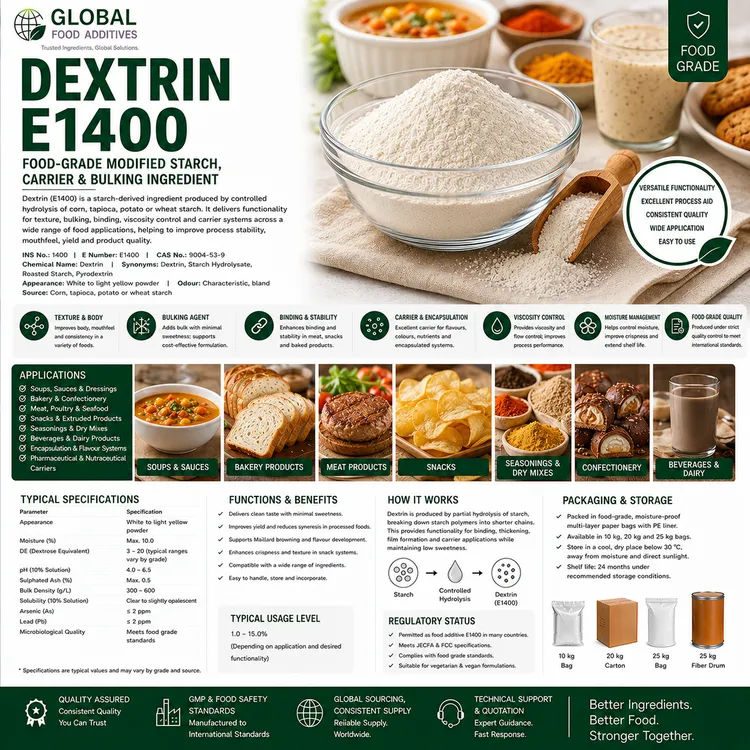
Product identity
| Product name | Dextrin |
|---|---|
| Common technical names | Dextrins; Roasted Starch; Pyrodextrin; White Dextrin; Yellow Dextrin; British Gum |
| Category | Modified Starches, Fibres & Bulking Agents |
| Functional class | Texture ingredient / bulking agent / viscosity modifier / binder / carrier / encapsulation support / dry-blend process aid |
| E / INS number | E1400 / INS 1400, subject to destination-market rules |
| CAS / identity | 9004-53-9 |
| Chemical nature | Starch-derived carbohydrate polymer mixture; exact chain length, branching, solubility and reducing-sugar profile depend on supplier process |
| Typical formula reference | Variable carbohydrate polymer commonly represented by starch-fragment units; composition is grade dependent |
| Typical source starch | Corn, wheat, potato, tapioca, rice or other botanical source, supplier dependent |
| Typical commercial form | White, cream, yellow or light brown powder; fine powder, granule or agglomerated grade |
| Primary technical purpose | Texture, bulk solids, binding, carrier performance, viscosity adjustment, film formation and process-stability support |
Application fit
Dextrin is normally considered where formulators need a starch-derived ingredient with controlled solubility, mild flavour, binding ability, dry solids contribution, carrier performance or process-stability benefits. Potential industrial use areas may include:
- Soups, sauces, dressings, gravies, marinades and savoury wet systems
- Bakery products, batters, coatings, glazes, crackers, wafers and crisp snack systems
- Meat products, formed foods, coatings, binders and processed-food structure systems
- Seasonings, flavour powders, dry premixes, beverage powders and instant products
- Confectionery, tablets, chewing gum systems, sugar coatings and edible film applications
- Encapsulated flavours, colours, oils, vitamins, enzymes, cultures and sensitive micro-ingredients
Industrial function and formulation value
Dextrin is produced by controlled conversion of starch, typically by heat, acid, enzyme or combined processing routes. This conversion changes the original starch structure and can produce powders with different levels of solubility, viscosity, colour, film formation, binding power and reducing-sugar content. In food manufacturing, these properties make dextrin useful for carrying flavours, building solids, modifying texture, improving coating adhesion, supporting crispness, managing moisture and improving dry-blend handling.
Different dextrin grades can behave very differently. White dextrins may be selected for lower colour and milder sensory impact, while yellow dextrins or pyrodextrins may offer stronger solubility, adhesive behaviour, colour contribution or film-forming functionality depending on process and specification. Food manufacturers should not assume that dextrin, maltodextrin, native starch and modified starch can be substituted without application trials.
Technical performance considerations
Solubility and viscosity
Dextrin grades may range from partially soluble to highly soluble and may produce different solution viscosities. This is important for soups, sauces, coatings, beverage powders, syrups, glazes, binders and encapsulation systems where mouthfeel and process flow must be controlled.
Binding and film formation
Dextrin can support adhesion, binding and thin-film formation in coatings, glazes, snack seasonings, tablets and processed-food systems. Binding performance depends on solids level, water addition, drying temperature, particle size and interaction with proteins, sugars, gums, fats and salts.
Carrier and encapsulation function
Carrier grades may help convert liquid flavours, colours, oils or sensitive actives into dry powders. Important checks include flavour release, oil retention, hygroscopicity, powder flow, oxidative stability, spray-drying compatibility and sensory neutrality.
Dry-blend behaviour
Particle size, bulk density and moisture control influence flow, dusting, dosing accuracy, segregation and caking. For automatic dosing, buyers should confirm hopper behaviour, filling accuracy, blend uniformity and storage stability under plant humidity.
Typical manufacturing applications
| Application area | Technical role | Purchasing and formulation notes |
|---|---|---|
| Soups, sauces and dressings | Contributes body, solids, mild viscosity, texture support and process consistency. | Check hydration, pH tolerance, heat stability, shear stability, flavour release, starch interaction, gum compatibility and finished-product mouthfeel. |
| Bakery, batters and coatings | Supports crispness, browning balance, coating adhesion, glaze formation, batter solids and dry-mix handling. | Evaluate with flour, leavening systems, proteins, sugars, fats, frying or baking profile, water pickup, surface colour and shelf-life texture. |
| Meat products and formed foods | May support binding, texture, coating adhesion, seasoning distribution and process yield in selected systems. | Confirm local food category permission, water addition, salt level, protein extraction, thermal process, purge control and label declaration. |
| Seasonings and dry flavour systems | Acts as a carrier, bulking ingredient and flow-support material for spices, flavours, oils and powdered actives. | Check oil absorption, flavour release, dusting, blend uniformity, caking, colour, bulk density and packaging moisture barrier. |
| Confectionery and coatings | Can support binding, film formation, coating strength, sweetness balance and moisture management. | Review solubility, clarity, chew texture, crystallisation, stickiness, gloss, drying time and compatibility with sugars, polyols, acids and colours. |
| Powdered beverages and instant mixes | Provides carbohydrate solids, carrier function, dispersion support and mouthfeel control. | Evaluate dissolution speed, lumping, sediment, clarity or haze, flavour release, particle size and instantisation needs. |
| Encapsulated ingredients | Can be used as part of a carrier matrix for flavours, oils, colours, vitamins, enzymes, cultures or sensitive ingredients. | Check spray-drying performance, emulsion stability, oxidative protection, active retention, water activity and storage stability. |
| Tablets and compressed products | May function as a binder, filler, carrier or compression-support material in some food or supplement-style systems. | Check compressibility, tablet hardness, friability, disintegration, mouthfeel, dusting, lubricant compatibility and regulatory category. |
Specification points to review before approval
Industrial buyers should compare supplier specifications against internal quality standards, application requirements, customer expectations and destination-market legislation. A robust technical review normally covers:
- Source starch: Confirm botanical source such as corn, wheat, potato, tapioca or rice because allergen, GMO, claim and functional expectations may differ.
- Colour and appearance: White, cream, yellow or brown tones may affect light-coloured foods, coatings, powders and label expectations.
- Moisture: Important for shelf life, caking tendency, powder flow, microbial stability and storage performance.
- Solubility: Critical for beverages, coatings, sauces, glazes, encapsulation systems and dry mixes that require rapid dispersion.
- Viscosity: Required for texture control, coating behaviour, binder strength, spray-drying performance and process pumpability.
- Reducing sugars: Relevant for browning, flavour development, fermentation behaviour and storage stability in heated or protein-containing systems.
- Dextrose equivalent where applicable: Useful when comparing dextrin with maltodextrin or other starch hydrolysates.
- pH and acidity: Relevant for sauces, dressings, beverages, proteins, colours and heat-processed foods.
- Ash or sulphated ash: Indicates mineral residue and helps compare supplier purity and process consistency.
- Particle size distribution: Affects dissolution, dusting, blend uniformity, mouthfeel, tableting and dosing behaviour.
- Bulk density: Important for packaging volume, hopper discharge, filling accuracy and dry-premix logistics.
- Flowability and caking tendency: Critical for premixes, silos, hoppers, automatic dosing and humid climates.
- Microbiology: Confirm total plate count, yeast and mould, pathogens and any category-specific microbiological expectations.
- Heavy metals and impurities: Review lead, arsenic, cadmium, mercury and supplier-specific impurity limits where required.
- Sulphur dioxide or sulphite status: Relevant when production route, refining aids, customer standards or local labelling rules require confirmation.
- Dietary and customer documents: Confirm allergen, GMO, halal, kosher, vegetarian or vegan status where required by the finished product.
- Packaging and shelf life: Check bag type, liner, net weight, pallet configuration, storage condition and expiry or retest date format.
Regulatory and labelling review
Dextrin is associated with E1400 / INS 1400 in modified-starch classifications, but the regulatory and label treatment depends on destination market, ingredient function, source starch, food category and final label strategy. Before commercial use, the buyer should verify additive or ingredient status, maximum permitted level where applicable, carry-over rules, processing-aid interpretation, source declaration, allergen status, GMO policy and finished-product label wording.
Depending on local rules, finished product labels may need to declare the ingredient as "dextrin", "modified starch", "roasted starch", "E1400", "INS 1400", a botanical-source-specific term or another market-specific equivalent. Where products are positioned as gluten-free, non-GMO, organic, natural, clean-label, high-fibre, reduced-sugar, child-oriented, halal, kosher or export-market specific, additional regulatory and customer approval is recommended before launch.
Quality, storage and handling expectations
Storage
Store in tightly closed original packaging in a clean, dry, cool and well-ventilated area. Protect from moisture, damaged bags, direct sunlight, pests and odour contamination. Humidity control is important because dextrin powders can cake, bridge or lose flowability if exposed to moisture.
Handling
Powder handling should follow site procedures for hygiene, dust control and cross-contamination prevention. Use clean dosing equipment, controlled transfer systems and dedicated or properly cleaned tools where allergen, halal, kosher, vegetarian or vegan controls apply.
Incoming inspection
At goods receipt, verify product name, grade, batch number, net weight, packaging condition, shelf life, certificate of analysis and label information. Inspect for caking, moisture ingress, torn liners, pests, foreign odour, abnormal colour or damaged pallets before release.
Traceability
Batch-level traceability should connect purchase order, supplier lot, certificate of analysis, warehouse receipt, internal material code, premix batch, production batch and finished-product lots. This supports customer audits, export compliance and recall-readiness programs.
Plant-trial and formulation guidance
Before full commercial approval, Dextrin should be evaluated in pilot or plant-scale trials using the same ingredient sequence, mixing equipment, water temperature, heat process, drying step, humidity exposure, packaging format and shelf-life conditions planned for commercial production. Laboratory screening can be useful, but it may not reveal all caking, viscosity, coating, binding, flavour-release or dry-blend effects.
- Define the function: Confirm whether the target is texture, bulking, viscosity, binding, film formation, encapsulation, carrier use, moisture control or cost optimisation.
- Match source and grade: Select corn, wheat, potato, tapioca, rice or other starch-source grades according to function, label and customer requirements.
- Validate solubility: For beverages, sauces and coatings, test at real water temperature, solids level, pH, shear and ingredient order.
- Check viscosity and mouthfeel: Measure texture after mixing, after heat treatment and through shelf life.
- Test carrier performance: Evaluate flavour release, oil retention, oxidative stability, caking and powder flow in carrier or encapsulation systems.
- Evaluate coating and binding: Review adhesion, drying time, film strength, crispness, surface appearance and storage stability.
- Review caking behaviour: Store trial blends under realistic humidity, compression and warehouse conditions before approval.
- Confirm label strategy: Verify source starch, gluten status, GMO status, additive declaration and any customer claim requirements before launch.
Documents to request
For a professional food-manufacturing approval process, buyers should request documentation that supports identity, safety, compliance, traceability and customer claims. Typical document requirements include:
- Product specification or technical data sheet
- Certificate of analysis for the offered batch or representative lot
- Safety data sheet where applicable
- Food-grade statement and intended-use statement
- Origin statement, manufacturer statement and production-route declaration
- Source-starch declaration, such as corn, wheat, potato, tapioca, rice or other botanical origin
- Colour, moisture, pH, solubility, viscosity, reducing-sugar and particle-size information
- Dextrose equivalent or carbohydrate profile where applicable
- Allergen statement and cross-contact information
- GMO status statement, if required by the destination market or customer
- Halal, kosher, vegetarian or vegan certificate or declaration, if applicable
- Gluten-free statement where required and supported by supplier testing or source control
- Heavy metals, microbiological and purity limits from the supplier specification
- Sulphur dioxide or sulphite declaration where relevant
- Nutrition information and carbohydrate declaration support where required
- Shelf-life, storage, packaging and pallet-configuration details
- Label draft, bag marking and batch-coding format
- Market-specific declarations required by the importing country, retailer or end customer
Commercial sourcing and logistics notes
Dextrin is typically purchased by industrial users according to grade, source starch, solubility, viscosity, colour, documentation package, batch availability, shipment destination, packaging format and cost-in-use performance. When comparing offers, buyers should not evaluate only the unit price. Source declaration, viscosity, colour, solubility, particle size, flowability, caking behaviour, carrier performance, documentation quality, lead time, regulatory suitability and plant performance can all affect the real commercial value of the material.
For export projects, buyers should confirm HS code guidance with their customs broker, required import permits, original document requirements, shelf-life remaining at dispatch, pallet treatment, container loading plan and whether the product requires special protection from humidity during transport.
How to request this product
To receive a more accurate quotation, send the product name, target specification, intended food application, annual or spot quantity, destination country, packaging preference, required delivery term, expected shipment date and requested documents. If you already purchase Dextrin, attach your current specification, supplier label, certificate of analysis, source-starch requirement, solubility requirement, viscosity target or benchmark sample details so alternatives can be compared more accurately.
Minimum inquiry details
- Product name: Dextrin / E1400 / CAS 9004-53-9
- Required grade and target specification
- White dextrin, yellow dextrin, pyrodextrin or specific functional grade, if known
- Required source starch, colour, solubility, viscosity or particle size, if known
- Quantity per shipment and annual forecast
- Destination country and delivery term
- Preferred packaging size and pallet requirements
- Required certificates and declarations
Helpful technical details
- Application type: soup, sauce, dressing, bakery, meat, snack, seasoning, confectionery, beverage powder, coating or encapsulation system
- Target function: texture, bulking, viscosity, binding, carrier use, film formation, moisture control or dry-blend flow
- Current grade, source starch, viscosity or supplier being used
- Process conditions: dry blending, hot process, cold dispersion, spray drying, coating, baking, frying, extrusion or tableting
- Need for halal, kosher, vegetarian, vegan, gluten-free, allergen, GMO or source-starch documentation
- Any regulatory market, customer standard or retailer requirement to be matched
Useful answers
What is Dextrin used for in food manufacturing?
Dextrin E1400 is used in selected food systems as a starch-derived texture ingredient, bulking agent, viscosity modifier, binder, carrier, encapsulation support, crispness aid and dry-blend process aid. It may be evaluated in soups, sauces, dressings, bakery, meat products, snacks, seasonings, confectionery, beverage powders and premixes. Exact suitability depends on grade, source starch, solubility, viscosity, particle size, use level, process, label requirements, regulations and supplier documents.
Is Dextrin the same as maltodextrin?
No. Dextrin and maltodextrin are related starch-derived carbohydrate ingredients, but they are not automatically interchangeable. Dextrin E1400 often refers to roasted or converted starch products with supplier-specific colour, solubility and viscosity properties, while maltodextrin is usually specified by dextrose equivalent and spray-dried carbohydrate profile.
Which grade should be selected?
Grade selection depends on the function. Carrier and encapsulation grades may require controlled solubility, low flavour impact and defined particle size. Binding or coating grades may require film-forming strength and viscosity. Bakery or snack grades may require crispness, colour control or dry-blend handling performance.
Which applications are most relevant?
Relevant applications may include soups, sauces, dressings, bakery products, meat products, snacks, seasonings, dry mixes, beverage powders, confectionery, coatings, glazes, flavour carriers, encapsulated ingredients, tablet systems and processed-food binding systems.
Which specification points are important?
Important specification points include source starch, colour, odour, moisture, pH, solubility, viscosity, reducing sugars, dextrose equivalent where applicable, ash, particle size, bulk density, flowability, caking tendency, microbiology, heavy metals, sulphur dioxide or sulphite status where relevant, allergen status, GMO status, packaging type, shelf life and storage conditions.
Which documents should be requested?
Buyers commonly request a technical data sheet or specification, certificate of analysis, safety data sheet where applicable, food-grade statement, origin statement, source-starch declaration, allergen statement, GMO statement, halal or kosher documents if required, shelf-life information, storage guidance, nutrition information, label details and packaging configuration.
Is this product permitted in every country?
No. Food additive and ingredient use depends on destination-market rules, food category, use level, labelling requirements and buyer responsibility. Regulatory approval should be checked before commercial production.
Tell us which food additive or ingredient you need.
Send product names, target specifications, quantity, destination country, packaging preference, delivery term, and document requirements. Our team will review your inquiry and respond from orders@foodgradeadditives.com.
Your message has been received. You will be redirected to the home page.