
Dimethylpolysiloxane E900
Dimethylpolysiloxane, also known as Polydimethylsiloxane or PDMS, is a food-grade silicone-based ingredient used in selected food-manufacturing systems for foam control, defoaming, release performance, surface management and processing efficiency. It is considered in frying oils, edible-oil systems, sugar processing, fermentation, beverages, sauces, confectionery, bakery release systems, chewing gum, coatings and other industrial operations where foam, sticking or surface behaviour must be controlled.
For industrial buyers, Dimethylpolysiloxane should be evaluated as a performance-controlled ingredient rather than only as a generic additive name. The correct supplier grade can affect defoaming speed, foam knockdown, foam-suppression persistence, oil compatibility, emulsion stability, viscosity, dosing accuracy, carry-over control, process efficiency, label declaration, regulatory approval and batch-to-batch reliability.
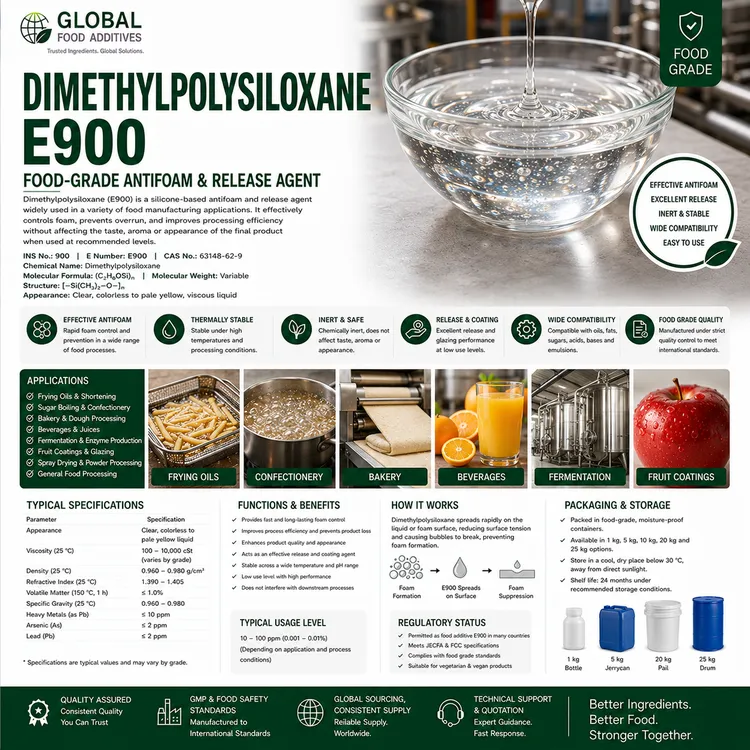
Product identity
| Product name | Dimethylpolysiloxane |
|---|---|
| Common technical name | Polydimethylsiloxane / PDMS |
| Other names | Dimethicone; Dimethyl Silicone Fluid; Silicone Antifoam; Silicone Defoamer |
| Category | Glazing, Coating & Release Agents |
| Functional class | Antifoam / defoamer / release aid / coating component / processing aid |
| E / INS number | E900 / INS 900 |
| CAS / identity | 63148-62-9 |
| Chemical family | Silicone polymer based on repeating dimethylsiloxane units |
| Typical formula reference | Polymeric material commonly represented as —[Si(CH3)2O]—n; molecular weight and viscosity are supplier dependent |
| Typical commercial form | Clear silicone fluid, emulsion, dispersion, compound or formulated antifoam grade |
| Primary technical purpose | Foam knockdown, foam suppression, anti-sticking, release performance and surface-process control |
Application fit
Dimethylpolysiloxane is normally considered where foam, sticking, surface wetting or release behaviour affects process stability or product quality. Potential industrial use areas may include:
- Frying oils and high-temperature oil systems where foaming must be controlled
- Edible-oil processing, vegetable washing, syrup handling and sugar-processing operations
- Fermentation, yeast processing, sauces, beverages and liquid food systems with foam risk
- Confectionery, chewing gum, tablet coating and selected surface-treatment applications
- Bakery pan-release systems, mould-release operations and anti-sticking process aids
- Fruit coatings, glazing systems and carrier applications where permitted by local rules
Industrial function and formulation value
Dimethylpolysiloxane is valued because very small quantities of silicone-based antifoam can reduce the stability of foam films in processing systems. Foam can reduce equipment capacity, interfere with filling accuracy, create boil-over risk, slow evaporation, affect heat transfer, increase cleaning frequency and cause quality variation. A suitable E900 grade can improve throughput, process consistency and operational control when used in the correct system and within local legal limits.
The ingredient may be supplied as neat silicone fluid or as a formulated antifoam containing carriers, emulsifiers, silica or other permitted components. The best form depends on the food matrix, temperature, aqueous or oil phase, shear conditions, process pH, salinity, dosing method, foam source and whether the material is used as a direct food additive, incidental processing aid or component of a release/coating system.
Technical performance considerations
Foam knockdown
Foam knockdown describes how quickly an antifoam collapses existing foam. It is important in frying, boiling, fermentation, evaporation, sugar processing, beverage handling and filling lines where foam can reduce process capacity or create overflow risk.
Foam suppression
Foam suppression describes how long the ingredient prevents new foam from forming after dosing. Long-process systems may require persistence, while short-contact operations may need fast knockdown with minimal carry-over.
Oil and water compatibility
Neat silicone fluids may be more relevant to oil-based systems, while emulsions or dispersions may be selected for water-based processes. The buyer should match the grade to the phase, mixing energy, temperature, pH and dosing equipment.
Viscosity and dosing control
Viscosity affects pumpability, droplet formation, dispersion and accuracy at low dosage. For food manufacturing, viscosity, active silicone content and the carrier system should be specified clearly to avoid overuse, underuse or inconsistent process performance.
Typical manufacturing applications
| Application area | Technical role | Purchasing and formulation notes |
|---|---|---|
| Frying oils and edible-oil systems | Helps control foam formation, oil splatter, boil-over risk and oil-handling instability during high-temperature processing. | Check local legal limits, oil compatibility, thermal stability, dosing point, filtration effect, final food carry-over and customer label expectations. |
| Sugar processing, syrups and sweet systems | Reduces foam during boiling, evaporation, concentration, transfer and filling operations. | Evaluate with sugar concentration, temperature, pH, process shear, colour impact, filtration, residue control and cleaning procedures. |
| Fermentation and yeast processing | Controls foam caused by aeration, proteins, metabolites and biological activity, helping protect tank capacity and process control. | Check compatibility with microorganisms, oxygen transfer, downstream filtration, residue rules, processing-aid status and customer requirements. |
| Beverages, sauces and liquid foods | May reduce foam during mixing, pumping, pasteurisation, filling or concentrate preparation. | Confirm emulsion grade, clarity impact, droplet size, flavour neutrality, pH tolerance, heat stability and permitted-use status. |
| Confectionery and chewing gum | Can support surface handling, anti-sticking, release performance or coating-system process control. | Review carrier composition, sensory neutrality, coating compatibility, polishing behaviour, label declaration and country-specific permission. |
| Bakery release systems | May support mould release, pan release, anti-sticking and equipment cleanliness when used in formulated release aids. | Evaluate with oil base, emulsifier system, spray pattern, baking temperature, residue, surface appearance and cleaning frequency. |
| Fruit coatings and surface systems | May contribute to processability, surface management or coating behaviour in permitted applications. | Verify permitted use, coating composition, wax compatibility, gloss, tackiness, residue, label rules and export-market restrictions. |
Specification points to review before approval
Industrial buyers should compare supplier specifications against internal quality standards, customer requirements, process conditions and destination-market legislation. A robust technical review normally covers:
- Active silicone content: Confirm whether the product is neat PDMS, an emulsion, a dispersion or a compounded antifoam with carriers and auxiliary ingredients.
- Viscosity: Critical for dosing, spreading, foam-control performance and regulatory matching in certain markets.
- Appearance and odour: Check colour, clarity, phase separation, foreign odour and suitability for sensitive food systems.
- Density and refractive index: Useful for identity control, batch comparison and quality verification for silicone-fluid grades.
- Volatility or loss on heating: Relevant for high-temperature frying, evaporation, cooking and heat-process applications.
- Emulsion stability: For water-dispersible grades, review droplet size, creaming, separation, freeze-thaw stability and shelf-life performance.
- Carrier and auxiliary ingredients: Request declaration of emulsifiers, silica, oils, preservatives or other components where required for food approval.
- Residual impurities: Review residual cyclic siloxanes, hydrolysable groups, heavy metals and supplier-specific purity limits where applicable.
- Microbiology: Confirm total plate count, yeast and mould, pathogens and preservative system for aqueous emulsion grades.
- Food-grade status: Confirm compliance with the buyer's target regulation, customer standard and intended application.
- Allergen and dietary status: Request allergen, GMO, halal, kosher, vegetarian or vegan documents where required by the finished product or customer.
- Packaging and shelf life: Check bottle, drum, IBC or container format, net weight, pallet configuration, storage condition and expiry or retest date format.
Regulatory and labelling review
Dimethylpolysiloxane is identified as E900 / INS 900, but permission is not automatic for every country, food category, use level or processing-aid situation. Before commercial use, the buyer should verify additive status in the destination market, the relevant food category, maximum permitted level, carry-over rules, processing-aid interpretation, import requirements and finished-product label declaration.
Depending on local rules, finished product labels may need to declare the additive class and name or number, such as "antifoaming agent: Dimethylpolysiloxane", "defoaming agent: E900", "release agent: Dimethylpolysiloxane" or a market-specific equivalent. Where the material is used as a processing aid, label treatment must still be verified according to the destination market and customer policy.
Quality, storage and handling expectations
Storage
Store in tightly closed original packaging in a clean, dry, cool and well-ventilated area. Protect from direct sunlight, freezing where not permitted, excessive heat, dust and damaged containers. Emulsions and dispersions should be stored according to supplier temperature guidance to avoid separation or microbial risk.
Handling
Handling procedures should prevent over-dosing, cross-contamination and accidental use of non-food-grade silicone materials. Use clean dosing pumps, calibrated metering systems and clearly identified storage containers. Avoid introducing water into silicone-fluid containers unless the supplier specifically allows it.
Incoming inspection
At goods receipt, verify product name, grade, batch number, net weight, packaging condition, shelf life, certificate of analysis and label information. Inspect for leakage, phase separation, abnormal colour, foreign odour, sediment, damaged drums or broken seals before release.
Traceability
Batch-level traceability should connect purchase order, supplier lot, certificate of analysis, warehouse receipt, internal material code, dosing record, process batch and finished-product lots. This is especially important where the material is used at very low dosage.
Plant-trial and process-validation guidance
Before full commercial approval, Dimethylpolysiloxane should be evaluated in pilot or plant-scale trials using the same foam source, process temperature, mixing energy, pH, solids content, fat level, aeration rate, line speed, filtration step and packaging format planned for production. Foam-control performance is highly process dependent, so laboratory screening should be confirmed under real manufacturing conditions.
- Define the foam problem: Identify whether the target is foam knockdown, long-term suppression, boil-over prevention, filling accuracy or equipment capacity.
- Select the correct grade: Match neat silicone fluid, emulsion, dispersion or compound to the food matrix and dosing point.
- Validate dose response: Test the lowest effective dosage and confirm compliance with local maximum-use or carry-over limits.
- Check dispersion: Confirm mixing energy, droplet distribution and whether the antifoam reaches the foam interface effectively.
- Evaluate downstream effects: Review filtration, centrifugation, coating, printing, filling, packaging seals, cleaning and wastewater handling.
- Confirm sensory neutrality: Check flavour, odour, mouthfeel, surface appearance and any oily or silicone-like perception in the finished product.
- Document process controls: Record dosing location, dosing equipment, pump calibration, batch quantity, corrective actions and operator instructions.
Documents to request
For a professional food-manufacturing approval process, buyers should request documentation that supports identity, safety, compliance, traceability and customer claims. Typical document requirements include:
- Product specification or technical data sheet
- Certificate of analysis for the offered batch or representative lot
- Safety data sheet where applicable
- Food-grade statement and intended-use statement
- Active silicone content, viscosity and formulation-type declaration
- Carrier, emulsifier, silica, preservative or auxiliary-ingredient declaration where required
- Origin statement, manufacturer statement and production-route declaration
- Allergen statement and cross-contact information
- GMO status statement, if required by the destination market or customer
- Halal, kosher, vegetarian or vegan certificate or declaration, if applicable
- Residual cyclic siloxane, heavy metals, microbiological and purity limits where required
- Shelf-life, storage, packaging and pallet-configuration details
- Label draft, drum label, container label or batch-coding format
- Market-specific declarations required by the importing country, retailer or end customer
Commercial sourcing and logistics notes
Dimethylpolysiloxane is typically purchased by industrial users according to grade, viscosity, active content, formulation type, documentation package, origin, batch availability, shipment destination, packaging format and cost-in-use performance. When comparing offers, buyers should not evaluate only the unit price. Defoaming efficiency, dosing rate, regulatory suitability, carrier system, emulsion stability, thermal performance, documentation quality and plant performance can all affect the real commercial value of the material.
For export projects, buyers should confirm HS code guidance with their customs broker, required import permits, country-specific additive rules, original document requirements, shelf-life remaining at dispatch, pallet treatment, container loading plan and whether the product requires special protection from freezing, heat or leakage during transport.
How to request this product
To receive a more accurate quotation, send the product name, target specification, intended food application, annual or spot quantity, destination country, packaging preference, required delivery term, expected shipment date and requested documents. If you already purchase Dimethylpolysiloxane or a silicone antifoam, attach your current specification, supplier label, certificate of analysis, viscosity requirement, active-content requirement or benchmark sample details so alternatives can be compared more accurately.
Minimum inquiry details
- Product name: Dimethylpolysiloxane / PDMS / E900 / INS 900
- Required grade and target specification
- Neat fluid, emulsion, dispersion or formulated antifoam preference
- Required viscosity, active content or carrier system, if known
- Quantity per shipment and annual forecast
- Destination country and delivery term
- Preferred packaging size and pallet requirements
- Required certificates and declarations
Helpful technical details
- Application type: frying oil, beverage, fermentation, sugar, sauce, coating, release system or other process
- Foam problem: initial foam, persistent foam, boil-over, filling foam or cleaning issue
- Process temperature, pH, solids content, fat level and aeration conditions
- Current antifoam grade, dosing level and dosing point
- Need for direct additive, processing-aid, halal, kosher, vegetarian, vegan, allergen or GMO documentation
- Any regulatory market, customer standard or retailer requirement to be matched
Useful answers
What is Dimethylpolysiloxane used for in food manufacturing?
Dimethylpolysiloxane E900 is used in selected food-processing systems as an antifoam, defoaming agent, release aid, coating component or processing aid. It can help reduce foam formation, improve process stability, support oil handling, reduce boil-over risk, improve equipment efficiency and support anti-sticking or surface-management performance. Exact suitability depends on grade, use level, process, label requirements, regulations and supplier documents.
Is Dimethylpolysiloxane the same as PDMS?
Dimethylpolysiloxane is commonly known as polydimethylsiloxane or PDMS. In food applications, buyers should confirm food-grade status, viscosity range, purity limits, formulation type, carrier system and regulatory suitability from supplier documents.
Which applications are most relevant?
Relevant application areas may include frying oils, edible-oil processing, sugar processing, fermentation, beverages, sauces, confectionery, bakery release systems, chewing gum, fruit or surface coatings, tablets and selected processing-aid uses, subject to local additive rules.
Which specification points are important?
Important specification points include active silicone content, viscosity, appearance, density, refractive index where applicable, volatility or loss on heating, residual cyclic siloxanes where required, heavy metals, microbiology for emulsions, carrier composition, emulsion stability, shelf life, storage conditions and packaging type.
Which documents should be requested?
Buyers commonly request a technical data sheet or specification, certificate of analysis, safety data sheet where applicable, food-grade statement, origin statement, formulation or carrier declaration where required, allergen statement, GMO statement, halal or kosher documents if required, shelf-life information, storage guidance, label details and packaging configuration.
Is Dimethylpolysiloxane suitable for halal, kosher, vegetarian or vegan products?
Suitability depends on the exact supplier, formulation type, carrier system, auxiliary ingredients, processing aids and certification status. Request supplier declarations before using the product in halal, kosher, vegetarian, vegan or claim-sensitive finished foods.
Is this product permitted in every country?
No. Food additive and processing-aid use depends on destination-market rules, food category, use level, carry-over, labelling requirements and buyer responsibility. Regulatory approval should be checked before commercial production.
Tell us which food additive or ingredient you need.
Send product names, target specifications, quantity, destination country, packaging preference, delivery term, and document requirements. Our team will review your inquiry and respond from [email protected].
Your message has been received. You will be redirected to the home page.