
DL-Malic Acid
DL-Malic Acid, also identified as E296 / INS 296, is a food-grade acidulant and acidity regulator used for pH control, fruit-like sourness, flavour enhancement, acid blending, confectionery acid sanding, beverage acidity, buffering support and process stability. Industrial grade selection should consider assay, particle size, dissolution speed, sourness profile, pH target, buffering capacity, acid blend compatibility, moisture sensitivity, impurity limits, packaging protection, label declaration and destination-market compliance.
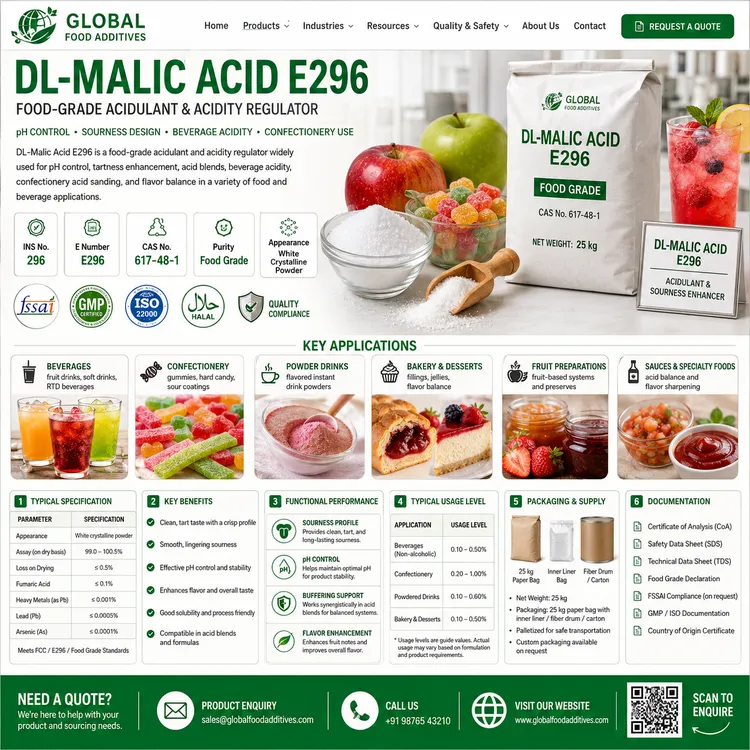
Product identity
| Product | DL-Malic Acid |
|---|---|
| Common names | DL-malic acid, malic acid E296, INS 296, racemic malic acid, hydroxybutanedioic acid, 2-hydroxybutanedioic acid |
| Category | Acidulants & Acidity Regulators |
| Function | Acidity regulator, acidulant, sourness enhancer, flavour-balancing acid and buffering ingredient |
| E / INS number | E296 / INS 296 |
| CAS / identity | 617-48-1 for DL-Malic Acid |
| Chemical description | Racemic hydroxy dicarboxylic acid with two carboxyl groups and one hydroxyl group |
| Typical taste profile | Clean, persistent, fruit-like tartness commonly associated with apple, berry, grape and sour confectionery profiles |
| Typical form | White crystalline powder, fine powder, granule, coarse crystal, acid blend or liquid preparation |
| Industrial purchasing basis | Assay, particle size, moisture, solution clarity, colour, dissolution rate, impurity profile, heavy metals, certification, packaging and documents |
Application fit
DL-Malic Acid is evaluated where manufacturers need fruit-like acidity, controlled pH, longer-lasting sourness or an acid profile that is less sharply citrus-like than citric acid alone.
- Carbonated beverages, still drinks, fruit drinks, syrups and concentrates
- Powdered beverages, instant drink mixes and electrolyte-style drink powders
- Sour confectionery, gummies, jellies, hard candy, chews and acid-sanded products
- Fruit preparations, jams, fillings, toppings, glazes and dessert systems
- Sauces, dressings, marinades, condiments and culinary acid blends
- Bakery fillings, fruit-flavoured bakery products and sweet bakery systems
- Dairy desserts, fermented-style flavours and fruit dairy preparations
- Snack seasonings, salt-and-vinegar profiles and fruit-acid seasoning systems
- Acid blends with citric, fumaric, tartaric, lactic, phosphoric or adipic acids where permitted
Technical overview for manufacturers
DL-Malic Acid is a dicarboxylic food acid valued for its smooth, persistent and fruit-like acidity. It is used to adjust pH, enhance fruit flavours, increase perceived sourness, improve acid balance and support flavour release in beverages, confectionery, fruit systems and dry mixes. Because the acid profile is different from citric, fumaric, tartaric and lactic acids, DL-Malic Acid is often used as part of an acid blend rather than as a stand-alone acidulant. The correct grade and particle size can strongly affect dissolution speed, mouthfeel, acid release, dusting, blending and surface sourness.
Functional value in food systems
Fruit-like sourness
Provides a lingering tartness that works well in apple, berry, grape, cherry, tropical fruit, cola, sour candy and beverage flavour systems.
pH control
Supports finished-product pH targets for flavour balance, preservative effectiveness, protein behaviour, colour stability and process consistency.
Confectionery performance
Useful in sour coatings and sugar-acid sanding where controlled acid release, particle size and moisture stability influence consumer perception.
Acid blend design
Can be blended with other food acids to create a more rounded acid curve, improved flavour lift and application-specific sourness timing.
DL-Malic Acid compared with common food acids
| Acidulant | Typical sensory role | How DL-Malic Acid differs |
|---|---|---|
| Citric Acid | Sharp, immediate citrus-style acidity and broad pH control | DL-Malic Acid usually gives a smoother, more persistent fruit sourness and can soften or extend the citric acid profile. |
| Fumaric Acid | Strong sourness, low solubility and slow release in selected confectionery and bakery systems | DL-Malic Acid is generally easier to dissolve and provides a different fruit-acid profile with less delayed release than fumaric acid. |
| Tartaric Acid | Sharp grape-like acidity, wine-style profiles and selected confectionery uses | DL-Malic Acid can deliver a rounder fruit acidity and may be blended with tartaric acid to shape sourness timing. |
| Lactic Acid | Mild dairy-style acidity and fermentation-associated flavour | DL-Malic Acid is more fruit-forward and crystalline, making it more practical for dry blends and sour coatings. |
| Phosphoric Acid | Cola-style sharpness and strong pH adjustment in beverages | DL-Malic Acid can provide fruit depth and persistent tartness where a softer acid profile is desired. |
| Adipic Acid | Slow acid release and buffering in dry dessert and confectionery systems | DL-Malic Acid usually provides stronger fruit-acid identity and broader beverage/confectionery use flexibility. |
Grade selection guidance
| Manufacturing need | Grade point to confirm | Why it matters |
|---|---|---|
| Clear beverages and syrups | Solution clarity, colour, insoluble matter, particle size and dissolution speed | Prevents haze, sediment, slow tank preparation and filtration issues. |
| Powdered drinks | Particle size, dry-blend uniformity, dissolution rate, caking tendency and flavour compatibility | Supports consumer reconstitution, sachet stability, sourness balance and dosing accuracy. |
| Sour confectionery coatings | Crystal size, acid release, dusting, surface adhesion and humidity resistance | Controls sour burst, coating stability, mouthfeel, stickiness and shelf-life appearance. |
| Gummies and jellies | pH impact, gel system compatibility, acid addition point and particle dissolution | Prevents gel weakening, sugar inversion problems, flavour imbalance and inconsistent sourness. |
| Fruit preparations and fillings | pH target, buffering capacity, fruit-acid profile, heat process and colour stability | Improves flavour definition while protecting texture and colour during storage. |
| Sauces, dressings and condiments | pH, preservative system, salt compatibility, sweetness balance and acid blend design | Supports stable acidity without excessive sharpness or flavour imbalance. |
| Export products | Destination-market additive status, infant-food restrictions, maximum levels and label declaration | Prevents regulatory delays, relabelling, customer rejection and reformulation. |
Processing and formulation considerations
- pH target: establish both target pH and sensory acidity because pH alone does not predict perceived sourness.
- Acid blend design: combine DL-Malic Acid with other acids to tune onset, peak sourness, lingering tartness and flavour authenticity.
- Particle size: fine powder dissolves faster but may dust more; coarser crystals may be preferred for sour coatings or controlled surface impact.
- Moisture sensitivity: protect powder from humidity to avoid caking, stickiness, acid-sugar reaction and loss of free-flowing behaviour.
- Gel systems: gelatin, pectin, starch and hydrocolloid systems can be sensitive to acid addition point, pH and thermal history.
- Sugar systems: acid level, temperature and holding time can influence sugar inversion, texture, stickiness and browning in confectionery and fillings.
- Preservative performance: pH affects sorbate, benzoate and other preservation strategies; finished-product safety must be validated.
- Colour stability: anthocyanins, carmine, caramel colour and other pigments may shift shade with pH and acid blend changes.
- Protein systems: dairy, plant protein and gelatin systems may destabilise if acid is added too early, too quickly or at too high a level.
- Equipment compatibility: acidic solutions can increase corrosion risk in unsuitable materials; confirm plant material compatibility and cleaning procedures.
Application-specific technical notes
| Application | Technical value | Trial focus |
|---|---|---|
| Carbonated and still beverages | Fruit-like acidity, pH adjustment and flavour lift | Check pH, titratable acidity, sweetness balance, preservative system, clarity, flavour release and shelf-life stability. |
| Powdered drinks | Dry acid source with rounded fruit sourness | Evaluate particle-size match, dissolution, caking, sachet stability, hygroscopicity and consumer mixing. |
| Sour gummies and jellies | Persistent sourness and fruit flavour enhancement | Control acid addition point, gel strength, pH, sugar inversion, surface sanding and storage stickiness. |
| Hard candy and chews | Acid balance, sour impact and flavour authenticity | Test cooking process, acid stability, final moisture, crystallisation, sticking and wrapper interaction. |
| Fruit preparations and fillings | pH control, fruit-acid profile and colour support | Track pectin behaviour, soluble solids, heat process, fruit buffering, colour retention and storage pH drift. |
| Sauces and dressings | Acid balance, preservative support and flavour smoothing | Validate pH, salt level, oil phase, hydrocolloid interaction, heat process and packaged storage. |
| Snack seasonings | Fruit-acid or vinegar-style sourness in dry coating systems | Check dusting, carrier selection, oil adhesion, acid bite, caking, humidity exposure and flavour stability. |
Acid blend development strategy
DL-Malic Acid is often most effective when used as part of a designed acid system. Different acids reach the palate differently and affect pH, flavour release, buffering, solubility and processing in different ways. A balanced acid blend can help a product taste more natural, reduce harshness, improve fruit realism and create a more complete sourness curve.
| Blend partner | Why it is used | Development watchpoint |
|---|---|---|
| Citric Acid | Adds fast, sharp acidity and efficient pH adjustment. | Too much citric acid can make fruit flavours taste harsh or overly citrus-like. |
| Fumaric Acid | Adds strong, slower-release sourness in low-moisture or confectionery systems. | Low solubility can create graininess or uneven acid release if not controlled. |
| Tartaric Acid | Supports grape, berry and wine-style acid profiles. | Can become sharp or astringent if not balanced with sweetness and flavour. |
| Lactic Acid | Gives softer fermented or dairy-style acidity. | Liquid form and flavour impact must be considered in dry products. |
| Phosphoric Acid | Useful in cola-style beverage profiles and strong pH adjustment. | Usually liquid and sharp; label and market rules must be checked. |
| Sodium or potassium malates | Can support buffering and malate-based acid balance. | Mineral contribution, taste and label declaration must be reviewed. |
Quality parameters to compare
Industrial purchasing should compare DL-Malic Acid by performance, specification consistency and cost-in-use rather than price per kilogram alone. Differences in particle size, dissolution, moisture control, impurity profile and packaging can affect plant handling, consumer sourness, finished-product stability and label compliance.
| Parameter | What to request from supplier |
|---|---|
| Assay | Specification range, COA result and test method for DL-Malic Acid content. |
| Identity | Confirmation of DL form, CAS reference, E296 / INS 296 identity and food-grade status. |
| Particle size | Fine, standard, coarse or customised crystal size; sieve analysis, dusting tendency and dissolution behaviour. |
| Moisture | Water content, loss on drying, caking tendency and opened-pack handling guidance. |
| Solution quality | Solution clarity, colour, insoluble matter and suitability for clear beverages, syrups and concentrates. |
| Impurities | Fumaric acid, maleic acid, residue on ignition, related organic acids and customer-specific impurity limits. |
| Heavy metals | Lead, arsenic, cadmium, mercury and destination-specific contaminant limits. |
| Microbiology | Total plate count, yeast and mould, coliforms, E. coli, Salmonella and buyer-specific microbiological limits where required. |
| Source and process | Manufacturer, production route, country of origin, raw material basis and change-control statement where available. |
| Certifications | Halal, kosher, vegan, vegetarian, non-GMO, allergen, ISO, FSSC 22000, BRCGS, HACCP, GMP or other customer-required certificates. |
| Packaging | Bag size, inner liner, moisture barrier, pallet configuration, batch coding, shelf life and storage conditions. |
Regulatory and labelling review points
DL-Malic Acid is identified as E296 / INS 296 in many additive systems, but the final regulatory position depends on destination country, food category, use level, infant or young-child food restrictions, label wording and customer policy. Buyers should confirm whether the finished product should declare “malic acid,” “DL-malic acid,” “acidity regulator,” “acidulant,” “E296,” “INS 296” or another locally accepted ingredient name.
Food-category permission
Confirm whether DL-Malic Acid is allowed in the exact food category, especially for infant, medical or special nutrition foods.
Use-level control
Review whether the market applies GMP, quantum satis, category-specific maximums or finished-product standards.
Label declaration
Confirm local requirements for additive class name, E-number use, acidulant declaration and clean-label positioning.
Claims and positioning
Natural, fruit-derived, synthetic, vegan, non-GMO, halal, kosher or clean-label claims must be supported by supplier documents and market rules.
Formulation development checklist
- Define the target function: pH control, fruit sourness, sour coating, acid blend, preservative support, flavour balance or buffering.
- Set both target pH and target sensory acidity because they are not the same measurement.
- Select the particle size according to dissolution, dusting, dry blending, acid sanding or controlled sour release needs.
- Prepare acid blend trials with citric, fumaric, tartaric, lactic or other acids where permitted and technically relevant.
- Test the acid in the full formula with sweeteners, flavours, colours, preservatives, proteins, hydrocolloids and minerals.
- Validate pH, titratable acidity, sweetness balance, flavour release, colour, texture and shelf-life pH drift.
- For confectionery, test moisture migration, surface stickiness, sugar inversion, coating adhesion and acid release during storage.
- For beverages, test clarity, sediment, preservative effectiveness, packaging compatibility and sensory stability.
- Confirm label declaration, permitted use, infant-food restrictions and customer policy before commercial approval.
- Approve the supplier only after specification, COA, documents, packaging, price, lead time and logistics meet the project requirement.
Documents to request
- Product specification or technical data sheet with identity, assay and recommended application guidance
- Certificate of analysis for available batch or representative lot
- Food-grade declaration and E296 / INS 296 additive-status statement for the destination market
- Safety data sheet for handling, storage and transport review
- Origin statement, manufacturer information and production-process statement where available
- Allergen statement, GMO statement, gluten statement, vegan/vegetarian statement and irradiation statement
- Halal and kosher certificates when required by customer or destination market
- Assay, moisture, solution clarity, colour, residue on ignition and impurity data
- Fumaric acid, maleic acid and related organic acid data where required by customer specification
- Heavy metal results and destination-specific contaminant data where required
- Microbiological specification and recent microbiological results where applicable
- Particle-size distribution, bulk density, flowability and dusting information for dry applications
- Solubility, acid blend or application data where available
- Shelf-life, storage conditions and opened-pack handling guidance
- Packaging details, inner liner, net weight, gross weight, pallet configuration and batch traceability information
- Market-specific regulatory statements, label guidance and customs documents when available
Packaging, storage and logistics
DL-Malic Acid is normally supplied in food-grade bags, lined paper sacks, polyethylene-lined cartons, fibre drums, big bags or other industrial formats. Packaging should protect the acid from moisture, contamination, odour pickup, caking and physical crystal damage during storage and transport. Moisture protection is especially important for fine powders, sour sanding blends, powdered beverages and dry premix systems.
Moisture protection
Confirm inner liner, bag material, humidity resistance, pallet wrapping and storage guidance to prevent caking or loss of free-flowing behaviour.
Plant handling
Review bag weight, dusting, crystal size, flowability, bulk density, manual dosing, pneumatic transfer and sieve compatibility before plant approval.
Storage control
Store tightly closed in a cool, dry, clean and odour-free area, away from moisture, direct sunlight, strong bases and incompatible materials.
Export readiness
Request packing list, batch list, certificate package, shelf-life remaining at shipment, origin documents and country-specific import documents before dispatch.
Commercial sourcing notes
Commercial evaluation should include both technical performance and supply reliability. Buyers should compare supplier capacity, lead time, minimum order quantity, particle-size availability, packaging options, price validity, Incoterms, payment terms, certification availability, origin restrictions and consistency of batch quality. For recurring production, request retained samples, batch-to-batch COA history and a change-notification commitment.
| Purchasing question | Why it matters |
|---|---|
| Is the required identity DL-Malic Acid or L-Malic Acid? | Regulatory status, label positioning, customer claims and specification may differ by stereochemical form. |
| Which particle size is required? | Fine, standard and coarse grades behave differently in dissolution, dusting, sour coating and dry blending. |
| Will the acid be used alone or in a blend? | Acid blends affect pH, sourness timing, flavour profile, preservative systems and label declaration. |
| Is the product moisture-sensitive? | Powdered drinks, sour coatings and dry mixes require strong moisture-control packaging and storage. |
| Which quality standard applies? | FCC, EU, JECFA, national standards and customer specifications may require different impurity limits and documents. |
| What certificates are needed before shipment? | Missing halal, kosher, vegan, non-GMO, allergen, origin, COA or regulatory documents can delay customer approval and customs clearance. |
How Global Food Additives supports sourcing
Global Food Additives, Inc. supports food manufacturers with practical sourcing coordination for DL-Malic Acid and other acidulants, acidity regulators and sourness-design ingredients. Our team can help compare grade options by assay, particle size, sourness profile, application fit, specification, documentation, packaging, lead time, certification and destination-market requirements. We can also coordinate sample discussions, supplier document review and quotation comparison against your current approved acidulant or target formulation.
How to request this product
Send the product name, required form, particle size, intended application, target pH or sourness profile, current specification if available, quantity, destination country, packaging preference, expected shipment date and documentation requirements. If you already purchase DL-Malic Acid, attach your existing specification, certificate of analysis, label declaration or benchmark acid blend details so supplier options can be compared more accurately.
| Best inquiry information | Example details to include |
|---|---|
| Application | Beverage, powdered drink, sour candy, gummy, hard candy, sauce, dressing, fruit preparation, bakery filling, dairy dessert or seasoning blend. |
| Technical target | Target pH, titratable acidity, sourness profile, acid release, particle size, dissolution speed, coating adhesion or acid blend ratio. |
| Grade preference | DL-Malic Acid E296, fine powder, standard crystal, coarse crystal, FCC grade, EU grade, halal, kosher, vegan or non-GMO grade. |
| Compliance need | Destination country, food category, label declaration, infant-food status, maximum level, additive class name or customer-specific policy. |
| Commercial details | Sample quantity, first order quantity, annual volume, Incoterm, delivery date, destination port or country and payment preference. |
| Documentation | Specification, COA, SDS, origin, allergen, GMO, halal, kosher, heavy metals, microbiology, shelf-life and packaging documents. |
Useful answers
What is DL-Malic Acid used for in food manufacturing?
DL-Malic Acid is used as an acidulant and acidity regulator for pH control, fruit-like sourness, flavour balance, confectionery acid sanding, beverage acidity, powder drink formulation, buffering support and process stability.
How is DL-Malic Acid different from Citric Acid?
DL-Malic Acid usually gives a smoother, more persistent fruit-like tartness, while Citric Acid gives a sharper and more immediate citrus-style acidity. They are often blended to build a balanced acid profile.
Is DL-Malic Acid the same as L-Malic Acid?
No. DL-Malic Acid is the racemic form, while L-Malic Acid is the naturally occurring enantiomer associated with many fruits. Buyers should confirm which identity is required for the application and market.
Which particle size should be selected?
Fine grades dissolve quickly and work well in many beverages and dry mixes. Coarser grades may be useful for sour coatings, acid sanding and controlled acid release.
Can DL-Malic Acid be used in infant foods?
Infant and young-child foods require strict destination-market review. Buyers should not assume DL-Malic Acid is allowed in special nutrition categories without specific regulatory confirmation.
Which documents should be requested?
Buyers commonly request a technical data sheet, certificate of analysis, safety data sheet, food-grade statement, origin statement, allergen and GMO declarations, heavy metal data, shelf-life, storage and packaging details.
Can Global Food Additives source DL-Malic Acid?
Global Food Additives can review sourcing options according to target specification, particle size, application, quantity, destination country, packaging preference and required documentation.
Is this product permitted in every country?
No. DL-Malic Acid use, maximum levels where applicable, label declaration, infant-food restrictions, claims and food-category permissions depend on destination-market regulations, supplier documentation and buyer responsibility.
Tell us which DL-Malic Acid grade or acidulant solution you need.
Send product name, particle size, application, target pH or sourness profile, quantity, destination country, packaging preference, delivery term and required documents. Our team will review your inquiry and respond from orders@foodgradeadditives.com.
Your message has been received. You will be redirected to the home page.