
Electrolytic Iron
Electrolytic Iron is a food-grade elemental iron powder used as a mineral fortification ingredient in selected flour, cereal, grain, nutrition, premix and enrichment applications where local regulations permit iron addition. Industrial grade selection should focus on elemental iron assay, particle-size distribution, bioavailability, blend uniformity, dusting, segregation, oxidation behaviour, magnetic response, sensory neutrality, contaminant limits, label declaration, nutrient claims and destination-market compliance.
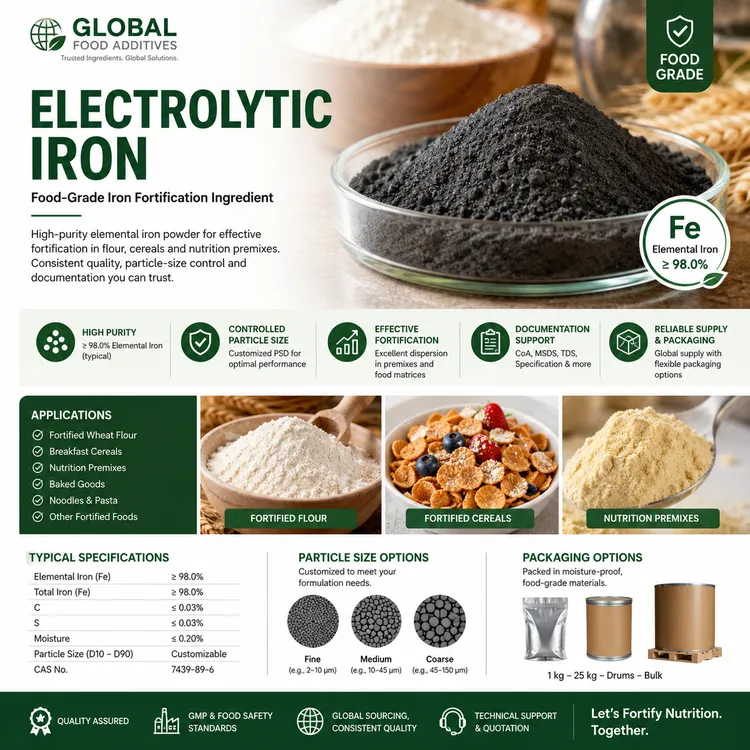
Product identity
| Product | Electrolytic Iron |
|---|---|
| Common names | Elemental iron, food-grade iron powder, electrolytic iron powder, iron fortification ingredient, premix-ready iron |
| Category | Fortification Nutrients |
| Function | Vitamin, mineral or enrichment ingredient for food fortification |
| E / INS number | Confirm by destination market and supplier documentation |
| CAS / identity | 7439-89-6 |
| Nutrient form | Elemental iron / nonheme iron source |
| Typical appearance | Grey to dark grey metallic powder, depending on particle size, surface area and manufacturing process |
| Typical form | Fine powder, micronised powder, granule, beadlet, diluted premix or premix-ready grade |
| Industrial purchasing basis | Elemental iron assay, particle-size distribution, bioavailability, bulk density, flowability, heavy metals, contaminants, microbiology, carrier, certification and documentation |
Application fit
Electrolytic Iron is evaluated where a manufacturer needs an iron source with relatively low sensory reactivity, high elemental iron content and suitability for dry staple-food fortification.
- Wheat flour, corn flour, cereal flour and grain enrichment programs
- Breakfast cereals, cereal flakes, extruded cereals and fortified grain products
- Bakery premixes, flour improver systems and dry ingredient blends
- Nutrition powders, meal replacements and protein blends
- Vitamin and mineral premixes for industrial food production
- Fortified pasta, noodles, snack bases and dry mix systems where permitted
- Infant, medical and special nutrition only where the exact iron source is permitted
- Export fortification projects requiring exact destination-market review
- Applications needing lower taste and colour impact compared with some soluble iron salts
Technical overview for food manufacturers
Electrolytic Iron is produced as an elemental iron powder with high iron content and is commonly evaluated for dry fortification systems. Because it is less soluble than many ferrous salts, its performance depends heavily on particle size, surface area, food matrix, processing conditions and bioavailability expectations. In flour and cereal applications, it may be preferred where low colour impact, low metallic taste and dry-blend stability are important, but its nutritional effectiveness must be reviewed against local fortification standards and product objectives.
Functional value in fortified foods
High elemental iron content
Because Electrolytic Iron is an elemental iron powder, it provides a high percentage of iron by weight compared with many iron salts or iron complexes.
Dry premix compatibility
Suitable grades can be blended into dry premixes for flour, cereal, bakery and nutrition systems when particle size and carrier compatibility are controlled.
Lower sensory reactivity
Compared with some soluble iron salts, elemental iron may have lower immediate taste, colour and oxidation impact in selected dry food systems.
Fortification flexibility
Can support enrichment and fortification projects where the source is permitted and where bioavailability, finished-product assay and label requirements are validated.
Electrolytic Iron compared with other iron sources
| Iron source | Typical use logic | Key points to verify |
|---|---|---|
| Electrolytic Iron | Elemental iron powder used in selected dry fortification systems such as flour, cereals and premixes. | Particle size, bioavailability, elemental assay, magnetic behaviour, contaminant profile, blend uniformity and permitted source status. |
| Reduced Iron | Elemental iron powder produced by reduction methods and used in some dry staple-food fortification programs. | Manufacturing method, particle size, surface area, bioavailability and equivalence to the approved specification. |
| Ferrous Sulfate | Highly soluble iron salt used where good bioavailability is required and sensory reactivity can be managed. | Metallic taste, colour change, fat oxidation, moisture sensitivity, reaction with ingredients and label declaration. |
| Ferrous Fumarate | Iron salt used in foods and supplements where higher iron content and lower solubility than ferrous sulfate are desired. | Bioavailability, particle size, colour, taste, permitted categories and analytical recovery. |
| Ferric Pyrophosphate | Less reactive iron source often selected for beverages, dairy-style systems or sensitive matrices where permitted. | Lower solubility, bioavailability, suspension behaviour, colour, sediment and market permission. |
| Iron Chelates | Complexed iron forms used where specific absorption or sensory goals are required. | Exact chelate identity, elemental iron content, cost-in-use, label wording and destination-market status. |
Grade selection guidance
| Manufacturing need | Grade point to confirm | Why it matters |
|---|---|---|
| Flour fortification | Particle size, bulk density, premix dilution, milling compatibility and finished-flour iron assay | Supports uniform distribution, stable label value and low visible specking in flour and bakery products. |
| Breakfast cereal | Thermal stability, extrusion impact, colour effect, particle size and analytical recovery | Ensures iron remains measurable and visually acceptable after cooking, extrusion, drying and coating. |
| Dry vitamin/mineral premix | Carrier compatibility, flowability, particle-size match, segregation risk and homogeneity data | Prevents mineral hot spots, dosing variation and poor finished-product assay results. |
| Nutrition powders | Taste impact, colour, magnetic separation risk, interaction with vitamins and dispersibility | Protects consumer acceptance, label compliance and multi-nutrient stability. |
| Infant or medical nutrition | Permitted source, bioavailability, contaminant limits, dosage and category-specific regulations | Special-category foods have stricter source, safety, analytical and documentation requirements. |
| Export production | Destination-market source permission, fortification standard, label declaration and customs documents | Prevents rejected shipments, label errors and reformulation after customer review. |
Elemental iron calculation and premix control
Electrolytic Iron should be formulated on elemental iron basis. Finished-product targets are normally expressed as iron per serving, per 100 g, per kilogram or per pound depending on the market and product standard. Because Electrolytic Iron is a concentrated mineral powder, it is usually safer and more consistent to dose it through a validated premix rather than adding small quantities directly to a large production batch.
| Control point | Industrial guidance |
|---|---|
| Elemental iron target | Define the legal and label target for the finished product before choosing the raw material dosage. |
| Assay basis | Use the supplier’s COA assay result and specification range, not only the theoretical iron content. |
| Premix dilution | Use a suitable carrier to improve weighing accuracy and distribution when iron is added at low levels. |
| Overage policy | Set overage only after reviewing label tolerances, expected losses, assay variability, regulatory maximums and shelf-life requirements. |
| Blend validation | Run homogeneity tests at multiple sampling points after mixing, transfer, storage and discharge. |
| Finished-product assay | Verify iron in the finished product with an approved analytical method and representative sampling plan. |
Particle size, bioavailability and handling
Particle size is one of the most important performance variables for Electrolytic Iron. Smaller particles generally offer higher surface area and may improve relative bioavailability, but they can also increase dusting, oxidation, handling difficulty, colour specking and segregation risk. Coarser particles may handle more easily but can reduce nutritional effectiveness or create poor distribution in some matrices. The correct grade depends on the product category, fortification target, process and regulatory requirement.
Fine grades
Useful where improved distribution and nutritional performance are priorities, but dusting, flowability, worker exposure and oxidation should be controlled.
Coarser grades
May improve handling and reduce dust, but must be tested for bioavailability, distribution, mouthfeel and assay recovery.
Premix grades
Diluted or carrier-based forms can improve dosing accuracy and reduce hot spots in flour, cereal and nutrition blends.
Magnetic response
Elemental iron can be affected by magnetic separation equipment, so the production line and metal-detection strategy should be reviewed.
Processing and formulation considerations
- Bioavailability: confirm that the iron source and particle size meet the nutritional objective and destination-market fortification requirement.
- Dry-blend uniformity: validate carrier selection, particle-size match, mixing time, mixer fill level and discharge behaviour.
- Segregation risk: density differences between iron and flour, sugar, starch or vitamin carriers can cause separation during transport or storage.
- Colour impact: elemental iron can create dark specks if particle size, dispersion or premix dilution is unsuitable.
- Flavour impact: test for metallic notes and oxidation-related off-flavours, especially in high-fat cereals, bars, powders and snacks.
- Oxidation interaction: iron can catalyse oxidation in sensitive fat, flavour or vitamin systems; antioxidants, packaging and matrix design may be needed.
- Phytate effects: cereal and legume matrices may contain iron-absorption inhibitors, so bioavailability strategy should be reviewed for public-health fortification programs.
- Vitamin compatibility: check interaction with vitamin A, vitamin C, folates, flavours, fats and colour systems during accelerated and real-time stability.
- Metal detection: elemental iron may interact with magnets, sieves and metal detectors; validate plant controls before commercial use.
- Special categories: infant, medical, clinical and special nutrition products require strict source permission, dosage and contaminant review.
Application-specific technical notes
| Application | Technical value | Trial focus |
|---|---|---|
| Fortified flour | Dry staple-food enrichment with high elemental iron content | Check premix distribution, finished-flour assay, colour specks, baking performance and label compliance. |
| Breakfast cereals | Iron enrichment in extruded, toasted, flaked or coated cereals | Evaluate extrusion stability, colour impact, oxidation, sensory profile, coating uniformity and iron recovery. |
| Bakery premixes | Mineral enrichment in dry flour-based systems | Validate flour blending, dough performance, crumb colour, metallic notes and finished-product assay. |
| Nutrition powders | Iron fortification in protein, meal-replacement or sports nutrition blends | Test taste, colour, dispersibility, vitamin stability, segregation, serving-size iron value and label declaration. |
| Dry beverage mixes | Iron addition in powder systems where permitted | Check reconstitution, sediment, visible particles, metallic notes, pH interaction and consumer acceptance. |
| Bars and snacks | Iron fortification in low-moisture or cereal-based products | Evaluate fat oxidation, flavour stability, particle visibility, texture and shelf-life assay. |
| Special nutrition | Controlled iron addition for specific nutritional targets where permitted | Confirm source permission, bioavailability, maximum level, contaminant limits, claims and stability. |
Fortification program checklist
- Define the finished-product iron target, serving size, legal category and destination market.
- Confirm whether Electrolytic Iron is a permitted iron source for the exact product category.
- Request elemental iron assay, particle-size distribution, purity data and contaminant limits from the supplier.
- Select pure powder, micronised powder, granule or premix-ready grade according to dosing and blending needs.
- Choose a carrier system that matches particle size, density, allergen policy, GMO policy and processing conditions.
- Run blend-uniformity testing at laboratory, pilot and plant scale.
- Measure finished-product iron content after processing and during shelf life where required.
- Evaluate sensory effects including metallic taste, colour specks, oxidation notes and consumer appearance.
- Confirm label declaration, nutrition claims, permitted overage and regulatory documents before launch.
- Approve supplier only after performance, documentation, packaging, price, lead time and logistics are aligned.
Quality parameters to compare
Industrial purchasing should compare Electrolytic Iron by nutrient performance, particle-size consistency, purity, contaminant control and document strength rather than price per kilogram alone. Because iron is usually added at low levels, quality failures often arise from poor dispersion, wrong particle size, inaccurate assay basis, oxidation impact or incomplete regulatory documentation.
| Parameter | What to request from supplier |
|---|---|
| Elemental iron assay | Specification range, COA result, test method and basis of calculation. |
| Particle-size distribution | Sieve analysis, laser particle-size data, D10/D50/D90 values or customer-specific particle-size limits. |
| Bioavailability information | Supplier application data, fortification-program suitability or regulatory support for the intended source and particle size. |
| Bulk density and flow | Loose/tapped density, flowability, dusting tendency and compatibility with micro-ingredient dosing systems. |
| Magnetic properties | Information on magnetic response and compatibility with magnets, metal detectors and plant separation equipment. |
| Moisture and oxidation | Moisture, surface oxidation, storage stability and opened-pack handling guidance. |
| Purity profile | Acid-insoluble matter, non-iron metals, carbon, sulphur or supplier-specific impurity data where relevant. |
| Heavy metals | Lead, arsenic, cadmium, mercury and destination-specific contaminant limits. |
| Microbiology | Total plate count, yeast and mould, coliforms, E. coli, Salmonella and buyer-specific microbiological limits where required. |
| Certification | Halal, kosher, vegan, vegetarian, non-GMO, allergen, ISO, FSSC 22000, HACCP, GMP or other customer-required certificates. |
| Packaging | Bag size, inner liner, moisture protection, pallet configuration, batch coding, shelf life and storage conditions. |
Regulatory and labelling review points
Electrolytic Iron should be reviewed as a nutrient source rather than as a general-purpose processing additive. The allowed source, required level, label declaration, nutrition claim, overage allowance, analytical method and contaminant limits depend on destination market and food category. Fortified flour, enriched rice, infant foods, medical foods, food supplements and general nutrition products may each follow different rules.
Permitted source
Confirm whether Electrolytic Iron is allowed for the exact product category and target market before purchasing production quantities.
Elemental declaration
Finished-product nutrition panels normally declare iron as elemental iron, not as the weight of Electrolytic Iron powder.
Nutrition claims
Iron source, high iron, fortified, enriched and anemia-related claims require careful review under local label and claims rules.
Special populations
Infant, child, pregnant-women, medical and clinical products require strict maximum-level, bioavailability and contaminant review.
Documents to request
- Product specification or technical data sheet with identity, elemental iron assay and intended-use guidance
- Certificate of analysis for available batch or representative lot
- Particle-size distribution, bulk density, flowability and dusting information
- Food-grade, supplement-grade or nutrient-source suitability statement for the destination market
- Bioavailability, fortification-program or application support data where available
- Safety data sheet for handling, dust control, storage and transport review
- Origin statement, manufacturer information and change-control statement where available
- Allergen statement, GMO statement, gluten statement, vegan/vegetarian statement and irradiation statement
- Halal and kosher certificates when required by customer or destination market
- Heavy metal and contaminant results according to buyer and destination requirements
- Microbiological specification and recent microbiology results where applicable
- Magnetic response or metal-detection compatibility guidance where available
- Shelf-life, storage conditions and opened-pack handling guidance
- Packaging details, inner liner, net weight, gross weight, pallet configuration and batch traceability information
- Market-specific regulatory statements, label guidance and customs documents when available
Packaging, storage and logistics
Electrolytic Iron is typically supplied in food-grade bags, lined sacks, fibre drums, cartons, big bags or premix packaging. Packaging should protect the material from moisture, contamination, oxidation, dust release and accidental cross-contact with incompatible ingredients. Because iron powders are dense and can segregate from lighter carriers, transport and warehouse handling should be reviewed as part of the quality plan.
Moisture protection
Confirm inner liner, moisture barrier, closure integrity, pallet wrapping and storage guidance to reduce caking, oxidation or flow problems.
Dust and worker handling
Review SDS guidance, PPE, dust-control measures, bag emptying, local exhaust, housekeeping and spill procedures for fine powder grades.
Segregation control
Premixes should be handled to minimise vibration, long drop heights and repeated transfer that can separate dense iron particles from carriers.
Export readiness
Request COA, SDS, origin documents, packing list, batch list, nutrient-source statement and country-specific import documents before dispatch.
Commercial sourcing notes
Commercial evaluation should include regulatory suitability, nutritional performance and supply reliability. Buyers should compare supplier capacity, particle-size availability, assay consistency, contaminant controls, minimum order quantity, lead time, price validity, packaging, certificate availability, country of origin and change-notification policy. For recurring production, request retained samples, batch-to-batch COA history and written notification of changes to particle size, production site, assay range, carrier or specification.
| Purchasing question | Why it matters |
|---|---|
| Is the product pure Electrolytic Iron or a diluted premix? | Dosage, homogeneity, label calculation and handling controls depend on concentration and carrier. |
| What particle size is supplied? | Particle size affects bioavailability, specking, flowability, dusting, segregation and analytical recovery. |
| Is the source permitted for the product category? | Fortification rules can differ for flour, rice, infant foods, supplements and general foods. |
| What is the finished-product iron target? | Correct dosage depends on legal requirements, label target, serving size and expected processing or storage variation. |
| Will the product pass magnetic separation or metal detection? | Elemental iron may be affected by plant detection or separation systems; this must be validated before scale-up. |
| What documents are available before shipment? | Missing COA, SDS, origin, contaminant data, allergen, GMO, halal, kosher or regulatory statements can delay customer approval and customs clearance. |
How Global Food Additives supports sourcing
Global Food Additives, Inc. supports food and nutrition manufacturers with practical sourcing coordination for Electrolytic Iron and other fortification nutrients. Our team can help compare supplier options by elemental assay, particle size, premix suitability, application fit, contaminant controls, documentation, packaging, lead time, certification and destination-market requirements. We can also coordinate sample discussions, supplier document review and quotation comparison against your current approved iron source or target premix specification.
How to request this product
Send the product name, target iron source, elemental iron target, particle size if known, application, current specification if available, quantity, destination country, packaging preference, expected shipment date and required documents. If you already purchase Electrolytic Iron or an iron premix, attach your existing specification, certificate of analysis, label declaration, dosage calculation or benchmark sample details so supplier options can be compared more accurately.
| Best inquiry information | Example details to include |
|---|---|
| Application | Wheat flour, corn flour, breakfast cereal, bakery premix, nutrition powder, bar, fortified pasta, infant food, medical food or export fortification project. |
| Technical target | Elemental iron per serving, per 100 g, per kilogram or per pound; particle size, bioavailability target, blend uniformity and sensory requirement. |
| Grade preference | Electrolytic Iron, fine powder, micronised powder, granule, premix-ready grade, halal, kosher, vegan, non-GMO or supplier-recommended grade. |
| Compliance need | Destination country, product category, permitted iron source, maximum level, label declaration, nutrition claim and special-population restrictions. |
| Commercial details | Sample quantity, first order quantity, annual usage, Incoterm, delivery date, destination port or country and payment preference. |
| Documentation | Specification, COA, elemental assay, particle size, SDS, heavy metals, origin, allergen, GMO, halal, kosher, microbiology, shelf-life and packaging documents. |
Useful answers
What is Electrolytic Iron used for in food manufacturing?
Electrolytic Iron is used as an elemental iron source in selected flour, cereal, grain, nutrition, premix and enrichment applications where iron fortification is permitted.
Is Electrolytic Iron the same as ferrous sulfate?
No. Electrolytic Iron is an elemental iron powder, while ferrous sulfate is a soluble iron salt. They differ in elemental iron content, solubility, sensory effect, reactivity, bioavailability and label treatment.
Why is particle size important?
Particle size affects bioavailability, blend uniformity, dusting, segregation, visible specks, magnetic response and finished-product assay. Buyers should request particle-size distribution before approval.
Can Electrolytic Iron be added directly to a large food batch?
In many cases, a validated premix is safer and more accurate because iron is dense and can segregate. Direct addition should be supported by mixing and homogeneity trials.
Can Electrolytic Iron be used in beverages?
It is generally more suitable for dry applications than clear beverages because it is elemental and insoluble. Beverage use requires careful review of suspension, sediment, taste, colour and permitted source status.
Which documents should be requested?
Buyers commonly request a technical data sheet, certificate of analysis, elemental iron assay, particle-size distribution, food-grade statement, safety data sheet, heavy metal results, microbiology where applicable, allergen and GMO statements, origin, shelf-life, storage and packaging details.
Can Global Food Additives source Electrolytic Iron?
Global Food Additives can review sourcing options according to target specification, particle size, elemental iron assay, application, quantity, destination country, packaging preference and required documentation.
Is this product permitted in every country?
No. Iron source permission, fortification levels, label declaration, nutrition claims and contaminant requirements depend on destination-market regulations, supplier documentation and buyer responsibility.
Tell us which Electrolytic Iron grade or mineral premix solution you need.
Send product name, elemental iron target, particle size if known, application, quantity, destination country, packaging preference, delivery term and required documents. Our team will review your inquiry and respond from [email protected].
Your message has been received. You will be redirected to the home page.