Moisture-barrier design
Ethyl Cellulose can help form films or coatings that reduce moisture migration between components, such as crunchy inclusions, hygroscopic powders, fillings, tablets or coated flavour particles.
 Global Food AdditivesFood-grade additive sourcing
Ethyl Cellulose, identified as E462 in many food-additive systems, is a cellulose ether used for film formation, moisture-barrier design, coating, encapsulation, carrier systems, oil structuring and controlled-release concepts. Unlike water-soluble cellulose ethers, Ethyl Cellulose is generally water-insoluble, so industrial performance depends heavily on viscosity grade, ethoxy substitution, particle size, solvent or dispersion method, processing temperature and compatibility with the finished food matrix.
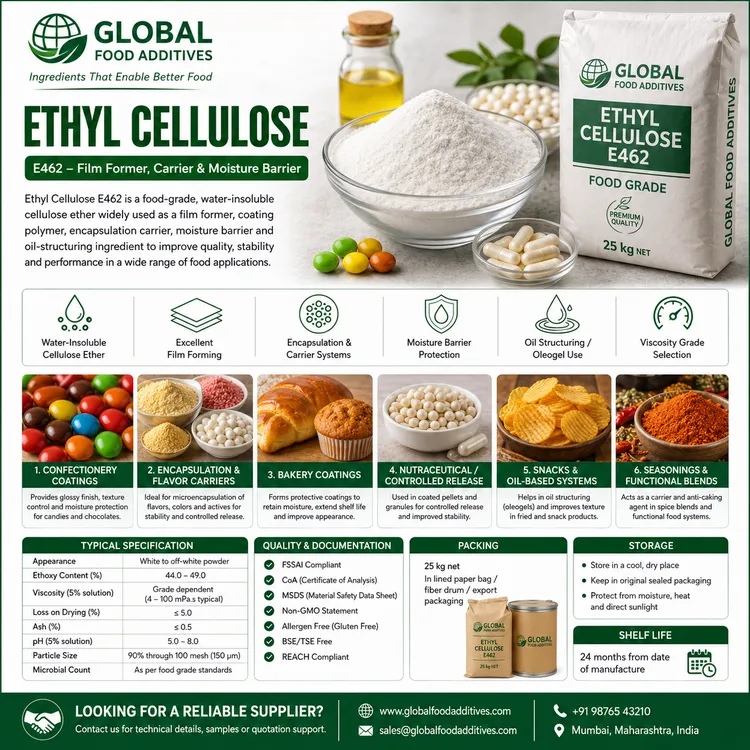
| Product | Ethyl Cellulose |
|---|---|
| Alternative names | Ethylcellulose, cellulose ethyl ether, ethylated cellulose |
| Category | Modified Starches, Fibres & Bulking Agents |
| Function | Film former / moisture barrier / carrier / encapsulation aid / viscosity and texture-support ingredient |
| E / INS number | E462 |
| CAS / identity | 9004-57-3 |
| Chemical family | Cellulose ether derived from cellulose by ethyl substitution |
| Typical form | Fine powder, granule, agglomerated powder, aqueous dispersion, organic-solvent grade or formulated coating preparation |
Potential use areas may include:
Ethyl Cellulose is selected when manufacturers need a hydrophobic, film-forming cellulose derivative rather than a conventional water-soluble thickener. Its value is strongest in systems where moisture protection, controlled release, oil-phase structure, coating integrity, encapsulation efficiency or carrier stability are required. Because Ethyl Cellulose does not simply dissolve into water like many gums or hydrocolloids, grade selection and process design are critical for successful scale-up.
Ethyl Cellulose can help form films or coatings that reduce moisture migration between components, such as crunchy inclusions, hygroscopic powders, fillings, tablets or coated flavour particles.
It is evaluated as a carrier or coating polymer for flavours, acids, vitamins, minerals, sweeteners and sensitive actives where delayed release, protection or reduced interaction is required.
Suitable grades may be evaluated in oleogel or fat-structuring systems, helping create oil viscosity, suspension stability or solid-fat-like texture without relying only on saturated fats.
Ethyl Cellulose can support coating durability, ingredient protection, dust reduction, tableting, granulation and handling stability when the correct viscosity and particle-size grade is selected.
Ethyl Cellulose should be purchased by viscosity grade, ethoxy content, particle size and intended process, not by name alone. Two materials labelled “Ethyl Cellulose” may behave very differently in coating, encapsulation, oleogel, granulation or film applications.
| Grade type | Typical purchasing interest | Technical points to verify |
|---|---|---|
| Low-viscosity powder | Coating solutions, encapsulation, spray applications and processes requiring lower solution viscosity at practical solids content. | Viscosity method, ethoxy content, particle size, solution clarity, residual solvent declaration and film performance. |
| Medium-viscosity grade | Balanced film strength, coating durability, carrier performance and processability in many industrial systems. | Film flexibility, drying behaviour, dissolution conditions, viscosity tolerance, ash, chloride and lot consistency. |
| High-viscosity grade | Stronger film formation, thicker coatings, oil structuring and systems requiring higher polymer chain contribution. | Processing temperature, mixing power, gel strength, solids loading, organogel formation and scale-up feasibility. |
| Agglomerated or granular grade | Reduced dusting, improved powder flow, easier handling and better wetting in selected processes. | Granule size, dissolution rate, bulk density, flowability, dust level and packaging integrity. |
| Aqueous dispersion | Coating applications where a pre-dispersed system is preferred over solvent preparation. | Polymer solids, plasticizer system, emulsifier declaration, microbial control, pH, viscosity, freeze-thaw stability and label impact. |
| Formulated coating blend | Ready-to-use or custom coating systems for flavours, nutrients, tablets, confectionery pieces or ingredient protection. | Complete composition, plasticizer, solvent or carrier, food-grade status, release profile, film strength and regulatory declaration. |
For industrial purchasing, Ethyl Cellulose must be reviewed as a functional polymer. Viscosity grade, substitution level and particle characteristics are often more important than simple appearance or product name.
Ethyl Cellulose should be validated in the finished system because its performance changes with solvent or dispersion method, polymer concentration, plasticizer, oil type, water activity, temperature, drying profile and storage conditions. Application testing should include processability, film quality, sensory impact, migration behaviour, release profile and shelf-life performance.
Ethyl Cellulose can be evaluated as a coating or matrix polymer for flavours, acids, sweeteners, vitamins, colours and functional actives. Key checks include encapsulation efficiency, release profile, carrier compatibility, solvent removal and sensory impact.
In products with crunchy inclusions, hygroscopic powders, fillings or layered formats, Ethyl Cellulose may reduce moisture migration. Validate barrier performance at target humidity and shelf-life conditions.
It may be evaluated for coatings, inclusions, fillings, barrier layers or particulate protection. Check film brittleness, gloss, mouthfeel, drying rate, adhesion and compatibility with sugars and fats.
In fat-phase systems, suitable grades can be tested for structuring edible oils, suspension of particles and texture design. Process temperature, cooling rate and oil polarity influence performance.
Ethyl Cellulose can be evaluated as a carrier or protective matrix for sensitive components in dry premixes. Check particle size, flowability, dusting, segregation, release and compatibility with other powders.
For compressed food formats, supplements or beadlets, Ethyl Cellulose may support binding, coating and release control. Check compressibility, friability, disintegration, coating weight gain and label status.
Ethyl Cellulose is not normally a simple water-phase thickener. In sauces or dressings, it should be evaluated through a formulated dispersion, fat-phase structuring system or carrier approach rather than direct hydration in water.
Where permitted, Ethyl Cellulose may be reviewed for oil binding, coating, encapsulated flavour release or moisture-barrier functions. Finished-product trials should check texture, heat stability and sensory quality.
| Technical factor | Why it matters | Practical buyer / R&D action |
|---|---|---|
| Solvent or dispersion system | Ethyl Cellulose is water-insoluble, so application success depends on the correct solvent, dispersion or heat-processing route. | Confirm food-grade solvent or dispersion compatibility, solvent-removal requirements and local regulatory limits. |
| Viscosity selection | Low, medium and high viscosity grades differ in processability, coating solids, film strength and oil-structuring behaviour. | Screen multiple viscosity grades at pilot scale before approving commercial grade. |
| Plasticizer compatibility | Ethyl Cellulose films may require plasticizers to reduce brittleness or improve flexibility. | Test permitted plasticizers, migration, taste, flexibility, drying rate and label impact. |
| Drying and solvent removal | Coating and encapsulation processes may require controlled drying to meet residual solvent, sensory and film-performance targets. | Validate inlet air, bed temperature, residence time, residual solvent and coating uniformity. |
| Thermal processing | Hot processes may change viscosity, film formation, oil-gel structure and release behaviour. | Test the ingredient under actual time-temperature, shear and cooling conditions. |
| Water activity and humidity | Moisture-barrier performance should be tested at the real storage humidity and product water activity. | Run shelf-life studies with controlled humidity, packaging formats and moisture-migration measurements. |
| Sensory impact | Coatings and films can affect mouthfeel, waxiness, flavour release or texture perception. | Include sensory review at initial production and through shelf life. |
| Release profile | For encapsulated flavours or actives, release timing determines performance in processing, storage and consumption. | Measure release in the target food matrix, not only in laboratory solvent systems. |
Ethyl Cellulose should be compared with other cellulose derivatives by solubility, viscosity, film performance, label status and process compatibility. It should not be substituted one-for-one with water-soluble cellulose gums or thermal-gelling cellulose ethers without R&D trials.
| Ingredient | Typical industrial reason to evaluate | Key difference to check |
|---|---|---|
| Ethyl Cellulose E462 | Water-insoluble film formation, moisture barrier, coating, encapsulation, carrier systems and oil structuring. | Requires grade-specific solvent, dispersion or thermal process; not a simple water-phase thickener. |
| Methyl Cellulose E461 | Water-based thickening, binding, plant-based meat texture and thermal gelation. | Water-soluble and thermally gelling; very different behaviour from Ethyl Cellulose. |
| Hydroxypropyl Methylcellulose E464 | Film forming, water-based viscosity, bakery, coatings and vegetarian capsules. | Generally water-dispersible or water-soluble depending grade; different hydration and film properties. |
| Carboxymethyl Cellulose E466 | Water-phase thickening, suspension, stabilisation and mouthfeel in beverages, sauces and dairy systems. | Anionic, water-soluble gum; not used for hydrophobic moisture-barrier films in the same way. |
| Microcrystalline Cellulose E460 | Bulking, anti-caking, suspension, tableting and texture support. | Particulate cellulose rather than soluble or film-forming cellulose ether. |
| Shellac or wax coatings | Gloss, surface coating and moisture protection in confectionery or fruit applications. | Different source, label perception, film behaviour, solubility and regulatory status. |
For repeat purchasing, Ethyl Cellulose should be approved through a formal supplier qualification process. The buyer should maintain an approved specification, COA history, supplier questionnaire, SDS, food-grade declaration, regulatory statements, allergen review, residual solvent information, change-control expectations and application validation records.
Check lot number, manufacturing date, expiry or retest date, viscosity, ethoxy content, loss on drying, ash, chloride, particle size, heavy metals, microbiology where required and packaging condition before release.
Request traceability from manufacturer to shipment. For export orders, align invoice, packing list, certificate of origin, batch documents and container or pallet references.
Ask whether the production site operates under recognised food safety or quality systems such as HACCP, ISO 22000, FSSC 22000, BRCGS, IFS, GMP or another customer-accepted programme.
For long-term projects, confirm notification expectations for changes in manufacturing site, cellulose source, process route, viscosity target, ethoxy range, particle-size grade, packaging or certifications.
Ethyl Cellulose is identified as E462 in many additive systems, but permissions, food categories, maximum levels, label names and solvent-related requirements vary by jurisdiction. Buyers should verify whether the intended use is permitted as a food additive, carrier, glazing agent, encapsulation aid, processing aid or component of a formulated system in the destination market.
Food-grade Ethyl Cellulose should be packed to protect the product from moisture, contamination, dust loss and package damage. Storage requirements depend on whether the material is supplied as a dry powder, agglomerate, dispersion or formulated coating preparation. Buyers should confirm remaining shelf life, recommended storage temperature, humidity control and packaging integrity before shipment.
Common options may include 20 kg or 25 kg bags, cartons, drums or foil-lined packs depending on grade, particle size and order quantity. Confirm net weight, liner and tamper evidence.
Aqueous or formulated dispersions may be supplied in drums, jerrycans or IBCs. Confirm polymer solids, preservatives, pH, microbial limits, freeze-thaw stability and shelf life after opening.
Store tightly closed in a cool, dry, clean area away from direct sunlight, humidity, strong odours and incompatible materials. Use first-in-first-out stock rotation.
For international shipments, align product description, HS code guidance, certificate of origin, SDS, food-grade statement, shelf-life remaining and destination-specific import documents.
Send the product name, target viscosity grade, ethoxy content if specified, physical form, application, solvent or dispersion preference, particle size, quantity, destination country, packaging preference, expected shipment date, Incoterms and required documents. If you already purchase Ethyl Cellulose, attach or describe your current specification, COA, viscosity method, coating formula, process conditions or finished-product standard so supplier options can be compared accurately.
Example: “We need food-grade Ethyl Cellulose E462, CAS 9004-57-3, target viscosity grade required, application: encapsulation / flavour coating / moisture barrier / oil structuring / tablet coating, physical form: powder or dispersion, quantity: 100 kg trial or annual contract, destination: EU / GCC / USA / Africa, required documents: TDS, COA, viscosity method, ethoxy content, SDS, food-grade statement, regulatory declaration, residual solvent statement, allergen statement, GMO statement, halal certificate, origin certificate and shelf-life declaration. Please quote FOB / CIF / CFR with lead time.”
Ethyl Cellulose is used for film formation, coating, encapsulation, moisture-barrier design, carrier systems, controlled release, oil structuring and process-stability support. Exact suitability depends on viscosity grade, ethoxy content, application, process, regulations and supplier documents.
In markets using E-number terminology, Ethyl Cellulose is identified as E462. Buyers should still confirm the legal name, permitted food categories and use conditions for the destination country.
No. Ethyl Cellulose is generally water-insoluble. This makes it useful for moisture-barrier and controlled-release applications, but it also means formulators need the right grade, solvent, dispersion or thermal process.
Not in the same way as water-soluble gums. Ethyl Cellulose does not simply hydrate in water, so use in soups, sauces or dressings normally requires a formulated dispersion, fat-phase system or carrier technology rather than direct water thickening.
The correct viscosity grade depends on the application. Low-viscosity grades may suit coating and encapsulation processes, while higher-viscosity grades may be evaluated for stronger films, thicker coatings or oil structuring. Pilot trials are recommended.
Not automatically. Ethyl Cellulose is water-insoluble, while methyl cellulose and HPMC are typically used for water-based thickening, binding and thermal-gelation functions. Substitution requires application trials and regulatory review.
Buyers commonly request a technical data sheet, approved specification, certificate of analysis, viscosity method, ethoxy content, safety data sheet, food-grade statement, regulatory declaration, residual solvent statement, contaminant declaration, shelf-life information and packaging details.
Global Food Additives can review sourcing options for Ethyl Cellulose according to viscosity grade, ethoxy content, physical form, application, quantity, destination, packaging, lead time and required documentation.
No. Permissions, maximum use levels, food categories, additive declaration, carrier use and processing-aid treatment depend on destination-market legislation, final formulation, use level and customer responsibility.
Send product name, target viscosity grade, ethoxy content if specified, physical form, application, quantity, destination country, packaging preference, delivery term and document requirements. Our team will review your inquiry and respond from orders@foodgradeadditives.com.