Proteins, Texturizers & Functional Ingredients
Faba Bean Protein
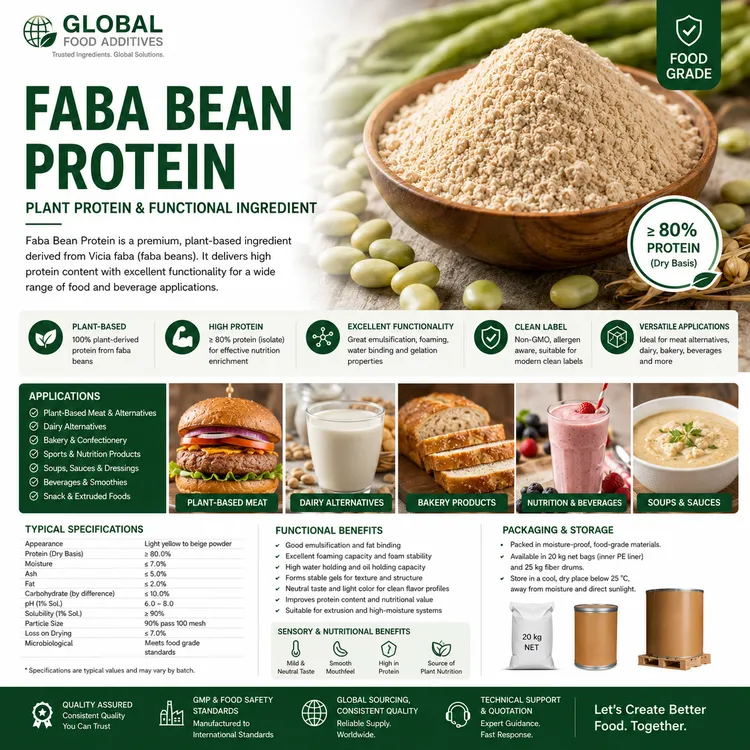
Faba Bean Protein is a plant-based functional protein ingredient produced from faba bean, also known as fava bean or broad bean. It is evaluated by food manufacturers for protein enrichment, water binding, emulsification, foaming, gelation, viscosity control, texture design and clean-label plant-based formulation support. For industrial sourcing, the most important purchasing points are protein content, functionality, flavour, colour, particle size, microbiology, antinutritional-factor control, allergen status, application performance and supplier documentation.
Vicia faba source
Plant protein
Isolate / concentrate options
Texturizing ingredient
Clean-label formulation support
Product identity
| Product | Faba Bean Protein |
|---|
| Alternative names | Fava Bean Protein, Broad Bean Protein, Vicia faba Protein |
|---|
| Category | Proteins, Texturizers & Functional Ingredients |
|---|
| Function | Plant protein / functional protein / texture-building ingredient / emulsifying and water-binding ingredient |
|---|
| E / INS number | Confirm by destination market and supplier documentation |
|---|
| CAS / identity | Plant protein; no single CAS identity for commercial protein ingredients |
|---|
| Botanical source | Vicia faba seed, depending on supplier origin and processing route |
|---|
| Typical form | Protein isolate, protein concentrate, flour, powder, flake, textured granule, crisp or hydrated ingredient |
|---|
Application fit
Potential use areas may include:
- Plant-based meat, burgers, sausages, nuggets and meat analogues
- Dairy alternatives, yogurts, drinks, desserts and cheese-style systems
- Bakery, gluten-free products, high-protein breads and snacks
- Nutrition powders, meal replacements, protein bars and sports products
- Sauces, dressings, emulsions, fillings and savoury prepared foods
- Egg-replacement, foaming and aerated food concepts where suitable
Industrial value for food manufacturers
Faba Bean Protein is selected when manufacturers need a pulse-based protein alternative to soy, pea, wheat or dairy proteins. It can support protein claims, plant-based positioning, water management, emulsion stability, texture building and nutritional diversification. Because faba protein performance depends heavily on extraction method, heat history, pH, protein concentration and particle size, buyers should approve a specific grade through application trials rather than relying on a generic product name.
Protein enrichment
Faba Bean Protein can raise protein content in plant-based foods, bakery, beverages, nutrition blends and snacks. Nutrition-panel calculation should use the supplier's declared protein basis and local regulatory rules for protein claims.
Texture and structure
Suitable grades may contribute body, bite, gel structure, viscosity or extrusion texture. Final texture depends on hydration, shear, temperature, salt level, pH, fat phase and interaction with starches or hydrocolloids.
Emulsification and water binding
Faba protein can be evaluated for oil-water stabilization, fat binding, water retention and yield improvement in plant-based meats, sauces, dressings and processed foods.
Alternative protein strategy
Faba bean can help diversify protein sourcing and reduce dependence on single protein systems. It is often evaluated in blends with pea, rice, soy, wheat, potato, oat, chickpea or mycoprotein.
Commercial grade options
Faba Bean Protein grades differ in protein level, flavour, colour, solubility, heat history and functional behaviour. The right grade depends on whether the target product needs high solubility, strong water binding, foaming, extrusion texture, neutral taste or low sediment.
| Grade type |
Typical purchasing interest |
Technical points to verify |
| Faba protein isolate |
High-protein applications, nutrition powders, dairy alternatives, beverages, egg-replacement concepts and premium plant-based foods. |
Protein content, dry-basis calculation, solubility, flavour, colour, viscosity, foaming, emulsification, microbiology and allergen status. |
| Faba protein concentrate |
Cost-effective protein enrichment, bakery, snacks, plant-based meat blends and dry premixes. |
Protein percentage, residual starch or fibre, water absorption, particle size, flavour intensity, bulk density and process compatibility. |
| Faba bean flour |
Bakery, snacks, pasta, gluten-free systems and whole-pulse positioning where fibre and starch contribution are useful. |
Protein level, starch content, enzyme activity, particle size, colour, beany notes, microbial load and heat treatment. |
| Texturized faba protein |
Plant-based meat, mince, chunks, strips, burger systems and hybrid meat products. |
Hydration ratio, fibre structure, bite, chew, water retention, particle size, colour, flavour absorption and cooking stability. |
| Hydrolysed or modified grade |
Applications requiring improved solubility, lower viscosity, flavour development or functional modification. |
Degree of hydrolysis, bitterness, peptide profile, salt content, solubility, regulatory status and label declaration. |
| Custom protein blend |
Products requiring balanced amino acid profile, improved texture or reduced sensory impact. |
Blend composition, protein quality, allergen status, particle-size matching, nutritional calculation and process validation. |
Technical specification checkpoints
Industrial Faba Bean Protein purchasing should be based on an approved specification and application testing. The checklist below helps procurement, R&D and quality teams compare supplier offers accurately.
- Protein content
- Confirm protein percentage, test method, nitrogen conversion factor and whether the value is reported as-is or on dry basis. This directly affects nutrition claims and dosage calculation.
- Solubility / dispersibility
- Request protein dispersibility, nitrogen solubility index or application-specific dispersion data. Solubility is especially important in beverages, dairy alternatives and nutrition powders.
- Particle size
- Particle size affects mouthfeel, hydration rate, sedimentation, blend uniformity, extrusion performance and visible specking. Request sieve or laser particle-size data where available.
- Water-holding capacity
- Water absorption and water retention influence yield, juiciness, dough handling, viscosity, cooking loss and texture in meat alternatives, bakery and prepared foods.
- Oil binding and emulsification
- For sauces, dressings, plant-based meat and dairy alternatives, verify emulsifying capacity, emulsion stability and compatibility with the selected fat or oil system.
- Gelation and texture
- Check gel strength, heat-set behaviour, viscosity development and interaction with salts, acids, starches, gums, fibres and other proteins.
- Foaming performance
- For egg-replacement, aerated desserts, whipped systems and bakery, compare foam capacity, foam stability, pH tolerance and sugar or fat compatibility.
- Flavour and odour
- Pulse proteins can show beany, earthy, bitter or astringent notes depending on raw material and process. Sensory testing and flavour masking may be required.
- Colour
- Check colour value and appearance because beige, yellow or greenish tones can influence dairy alternatives, white sauces, bakery crumb and light-coloured powders.
- Microbiology
- Request total plate count, yeast and mould, coliforms, E. coli, Salmonella, Bacillus cereus and other parameters required by the buyer's HACCP or customer standard.
- Contaminants
- Review heavy metals, pesticide residues, mycotoxins, foreign matter, residual solvents where applicable and any market-specific contaminant declarations.
- Antinutritional factors
- Depending on source and process, buyers may request declarations or data for trypsin inhibitors, lectins, tannins, phytic acid, vicine, convicine or other pulse-specific factors.
- Allergen and cross-contact
- Faba bean is a legume. Confirm allergen status, cross-contact controls, dedicated line information and destination-market labelling obligations.
- Shelf life and packaging
- Confirm moisture, water activity, packaging barrier, recommended storage, shelf life, pallet configuration and remaining shelf life at shipment.
Application guidance by food sector
Faba Bean Protein should be validated in the final formulation because plant protein performance changes with pH, salt, heat, shear, hydration time, fat level, starch, gums, fibres, acids and flavour systems. Trials should include sensory review, process tolerance, texture measurement, shelf-life stability and nutrition-panel calculation.
Plant-based meat
Faba protein can be evaluated for water binding, emulsification, bite, chew and protein contribution in burgers, sausages, mince, nuggets and hybrid products. Texturized grades should be tested for hydration ratio, fibre integrity, cooking loss, juiciness and flavour absorption.
Dairy alternatives
In plant-based milk, yogurt, cheese-style products and desserts, faba protein may support protein content, viscosity, emulsion stability and creamy mouthfeel. Check sediment, pH stability, heat treatment, fermentation compatibility and off-notes.
Bakery and gluten-free systems
Faba protein can increase protein content and modify dough water absorption, crumb texture, browning and structure. Gluten-free applications should test interaction with starches, fibres, hydrocolloids and leavening systems.
Nutrition powders and bars
For sports nutrition, meal replacement and high-protein bars, evaluate dispersibility, grittiness, flavour masking, sweetness balance, protein claim calculation, bar hardening and shelf-life texture.
Beverages and drink mixes
Beverage applications require careful solubility, sediment, pH and heat-stability testing. Acidic drinks may require a grade with improved dispersibility or a stabilizer system.
Sauces, dressings and emulsions
Faba protein may support emulsification, viscosity and water management. Test oil type, shear, pH, salt level, thermal treatment, freeze-thaw stability and flavour release.
Egg-replacement and foaming systems
Some grades may be evaluated for foaming and binding in bakery, aerated desserts or egg-free applications. Performance should be tested against the target egg function: foaming, binding, colour, emulsification or structure.
Prepared foods and savoury systems
In soups, fillings, sauces, ready meals and savoury bases, faba protein can contribute viscosity, protein enrichment and texture. Check heat stability, flavour interaction and hydration sequence.
Processing and formulation considerations
| Technical factor |
Why it matters |
Practical buyer / R&D action |
| Hydration sequence |
Plant proteins can hydrate slowly or form lumps if added incorrectly. |
Test pre-hydration, dry preblending, high-shear mixing and addition order under actual factory conditions. |
| pH sensitivity |
Protein solubility and charge change with pH, affecting beverages, dairy alternatives and sauces. |
Measure solubility, viscosity and sediment at the final product pH and after thermal processing. |
| Heat treatment |
Heat can improve gelation or reduce antinutritional factors, but it may also reduce solubility or increase cooked notes. |
Validate pasteurisation, UHT, baking, retort or extrusion conditions with the selected grade. |
| Salt and mineral level |
Ionic strength can change hydration, gelation, viscosity and emulsion behaviour. |
Test the protein in the complete formula, including salts, calcium, phosphates, buffers and flavour systems. |
| Extrusion performance |
Texturization depends on protein concentration, moisture, screw profile, temperature, shear and cooling die design. |
Run pilot extrusion trials and evaluate fibre structure, water retention, bite, colour and rehydration performance. |
| Sensory profile |
Pulse proteins can introduce beany, bitter, earthy or astringent notes. |
Compare flavour profiles across suppliers and test masking systems, fermentation, heat treatment or blending strategies. |
| Protein blend design |
Single plant proteins rarely solve every texture, flavour and nutrition target. |
Evaluate blends with pea, rice, soy, wheat, potato, oat, chickpea, fibres, starches and hydrocolloids. |
| Protein claim calculation |
Protein claims may require specific analytical values, amino acid scoring or digestibility considerations. |
Confirm local label rules, serving size, amino acid profile, protein quality method and finished-product analysis. |
Comparison with related plant proteins
Faba Bean Protein should be compared with other plant proteins by functionality, flavour, cost-in-use, allergen status, nutritional profile, supply chain and process performance. Do not substitute protein sources without R&D, QA and regulatory approval.
| Protein source |
Typical industrial reason to evaluate |
Key difference to check |
| Faba Bean Protein |
Plant protein enrichment, emulsification, foaming, texture building and pulse-protein diversification. |
Check flavour, colour, antinutritional factors, solubility, legume allergen handling and vicine / convicine declarations where required. |
| Pea Protein |
Widely used in plant-based meat, dairy alternatives, protein powders and bars. |
Different flavour profile, solubility, texture behaviour, amino acid profile and allergen considerations. |
| Soy Protein |
Strong functional performance in emulsification, gelation and texturized meat analogues. |
Major allergen status in many markets, GMO concerns, label perception and supply-chain requirements. |
| Wheat Gluten |
Elastic structure, chew and strong texturization in bakery and meat alternatives. |
Contains gluten and is not suitable for gluten-free products; texture is very different from pulse proteins. |
| Rice Protein |
Protein blending, allergen-sensitive positioning and nutrition powders. |
Lower solubility, grittiness and different amino acid balance may require blending. |
| Chickpea Protein |
Pulse-protein positioning, foaming, emulsification and plant-based dairy or bakery concepts. |
Different flavour, colour, cost, availability and functionality by grade. |
Quality assurance and supplier approval
For repeat purchasing, Faba Bean Protein should be approved through a formal supplier qualification process. The buyer should maintain an approved specification, COA history, supplier questionnaire, traceability records, food safety certificates, allergen review, sensory approval and change-control expectations.
COA review
Check lot number, manufacturing date, expiry or retest date, protein content, moisture, ash, fat, fibre, particle size, microbiology, heavy metals and packaging condition before releasing material to production.
Traceability
Request traceability from crop source or processor to finished lot. For export orders, align invoice, packing list, certificate of origin, batch documents and pallet or container references.
Food safety system
Ask whether the production site operates under recognised food safety or quality systems such as HACCP, ISO 22000, FSSC 22000, BRCGS, IFS, GMP or another customer-accepted programme.
Change control
For long-term projects, confirm notification expectations for changes in raw material origin, cultivar, process route, heat treatment, specification limits, packaging, allergen status or certifications.
Regulatory and labelling notes
Faba Bean Protein may be treated as a food ingredient, plant protein, protein isolate, concentrate, flour or texturized ingredient depending on the market and processing method. Some regions may require review of novel-food status, allergen labelling, protein claims, vegan claims, GMO status, origin declaration or processing-aid use. Buyers should also consider pulse-specific safety expectations such as vicine and convicine declarations where customer standards or target populations require them.
Buyer responsibility: Global Food Additives can support sourcing coordination and document collection, but the buyer remains responsible for confirming legal use, final label wording, allergen declaration, protein claims, serving-size calculations, finished-product suitability and destination-market compliance.
Packaging, storage and logistics
Food-grade Faba Bean Protein is normally packed in food-contact bags, cartons, big bags or palletized industrial packaging. Plant protein powders should be protected from moisture, odours, pests, heat exposure and cross-contamination. For texturized grades, packaging must protect structure, flowability and rehydration performance.
Typical packing
Common options may include 15 kg, 20 kg or 25 kg bags, cartons, fibre drums or big bags depending on grade, particle size, density and order quantity.
Storage guidance
Store tightly closed in a cool, dry, clean area away from moisture, direct sunlight, strong odours, pests and incompatible materials. Use first-in-first-out stock rotation.
Handling controls
Use clean tools, dust-minimising handling and allergen-aware production controls. Keep opened packaging sealed and protect powders from humidity pickup.
Export preparation
For international shipments, align product description, HS code guidance, certificate of origin, phytosanitary or health documents if required, shelf-life remaining and destination import rules.
Documents to request
- Product specification or technical data sheet
- Lot-specific certificate of analysis
- Protein assay and calculation basis
- Moisture, ash, fat, fibre and carbohydrate information
- Particle-size or sieve analysis
- Solubility, dispersibility or functionality data where available
- Water-holding, oil-binding, emulsification, foaming or gelation data where relevant
- Microbiological specification
- Heavy metals and contaminant declaration
- Pesticide residue or mycotoxin declaration where required
- Allergen, gluten, soy-free, dairy-free and cross-contact statement
- GMO, vegan, halal or kosher statement if required
- Origin, crop source and manufacturer information
- Vicine, convicine or antinutritional-factor declaration where required
- Safety data sheet where applicable
- Shelf-life, expiry or retest-date statement
- Storage and handling instructions
- Packaging specification and pallet configuration
- Change-control or notification policy for repeat supply
- Market-specific declarations requested by the destination country
Important: product availability, permitted use, protein claims, allergen treatment, application suitability and documentation depend on supplier, processing method, raw material origin, destination market, food category and customer responsibility. Buyers should verify regulatory status and final suitability before commercial use.
How to request this product
Send the product name, target protein level, grade type, functional requirement, particle size, colour target, flavour requirement, application, quantity, destination country, preferred packaging, expected shipment date, Incoterms and required documents. If you already purchase Faba Bean Protein, attach or describe your current specification, COA, reference sample, application process, target protein claim or finished-product standard so supplier options can be compared accurately.
Recommended inquiry format
Example: “We need food-grade Faba Bean Protein, isolate or concentrate grade, target protein percentage required, application: plant-based meat / dairy alternative / bakery / nutrition powder, particle-size and flavour requirements, quantity: 1 MT trial or annual contract, destination: EU / GCC / USA / Africa, required documents: TDS, COA, microbiology, allergen statement, GMO statement, vegan statement, halal certificate, origin certificate, heavy metals declaration and shelf-life declaration. Please quote FOB / CIF / CFR with lead time.”