
Glucose Oxidase
Glucose Oxidase is a food-grade enzyme preparation used as a processing aid in selected food-manufacturing systems. It catalyses the oxidation of glucose in the presence of oxygen and is considered for bakery dough strengthening, oxygen scavenging, glucose reduction, browning control, egg-product stability, beverage processing, juice systems, dairy-related processing, brewing, fermentation control and oxygen-sensitive packaged foods.
For industrial buyers, Glucose Oxidase should be evaluated as an activity-based enzyme system rather than a generic powder. The correct supplier grade can affect enzyme dosage, dough rheology, oxygen removal rate, glucose reduction, hydrogen peroxide formation, pH shift, process tolerance, enzyme inactivation, side activity, dust exposure, allergen/GMO status, label treatment, regulatory approval and batch-to-batch performance.
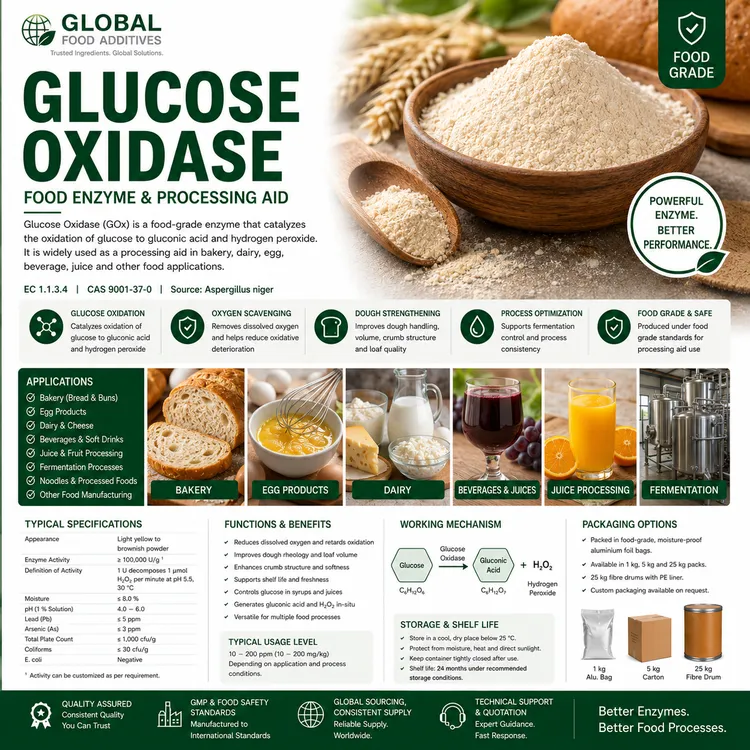
Product identity
| Product name | Glucose Oxidase |
|---|---|
| Common abbreviations | GOx / GOD |
| Other names | Glucose Oxidase Enzyme; Beta-D-Glucose:oxygen 1-oxidoreductase; Notatin |
| Category | Enzymes & Processing Aids |
| Functional class | Food enzyme / processing aid / glucose oxidation / oxygen removal / dough strengthening support |
| E / INS number | Confirm by destination market and supplier documentation; food enzymes are commonly regulated by food-enzyme rules rather than additive-number systems |
| CAS / identity | 9001-37-0 |
| EC number | EC 1.1.3.4 |
| Enzyme class | Oxidoreductase; flavoprotein enzyme requiring FAD as cofactor |
| Catalysed reaction | Beta-D-glucose + oxygen → D-glucono-delta-lactone + hydrogen peroxide; lactone may hydrolyse to gluconic acid |
| Typical commercial form | Enzyme powder, granulate, tablet, liquid preparation or formulated enzyme blend |
| Primary technical purpose | Controlled glucose oxidation, oxygen reduction, oxidative dough strengthening and process-performance improvement |
Application fit
Glucose Oxidase is normally considered where glucose, oxygen and process conditions can be used to create controlled oxidation effects. Potential industrial use areas may include:
- Bakery, flour treatment, bread improvers, dough systems and frozen dough applications
- Dry egg, egg powder and egg-containing products where glucose removal or browning control is required
- Oxygen-sensitive packaged foods where enzymatic oxygen removal may improve stability
- Beverage processing, juice systems and liquid products where oxygen management or glucose conversion is reviewed
- Dairy-related processing, fermentation systems, brewing and process-monitoring applications
- Starch-derived systems, carbohydrate streams and enzyme blends requiring glucose-specific oxidation
Industrial function and formulation value
Glucose Oxidase is used because it links two common formulation variables: glucose and oxygen. When both are available, the enzyme converts glucose while consuming oxygen and producing hydrogen peroxide. In bakery, this can support oxidative strengthening of dough systems. In oxygen-sensitive foods, it may help reduce oxygen availability. In egg products, glucose removal can help limit unwanted Maillard browning during drying or storage. In process systems, it may support controlled glucose conversion or oxygen-scavenging strategies.
The enzyme is not a universal preservative or dough improver. Performance depends strongly on substrate availability, water activity, pH, temperature, contact time, oxygen transfer, enzyme activity, process sequence and whether catalase, peroxidase or other enzymes are also present. For commercial approval, Glucose Oxidase should be tested under the same plant conditions planned for production.
Technical performance considerations
Glucose oxidation reaction
The enzyme oxidises beta-D-glucose while using molecular oxygen as the electron acceptor. The practical result may include glucose reduction, oxygen consumption, gluconic acid formation and hydrogen peroxide generation, depending on the application and process conditions.
Bakery dough strengthening
In dough systems, hydrogen peroxide produced during the reaction can contribute to oxidative strengthening of the gluten network. This may improve dough tolerance, gas retention, volume, shape stability, crumb structure and machinability when correctly dosed.
Oxygen scavenging
In oxygen-sensitive systems, Glucose Oxidase may help reduce dissolved or headspace oxygen when glucose and moisture are available. Packaging format, oxygen barrier, headspace, temperature and contact time must be validated.
Enzyme inactivation
Many food processes rely on enzyme inactivation by heat, pH shift, low water activity or downstream processing. Buyers should confirm whether residual activity is desirable, neutral or unacceptable in the finished product.
Typical manufacturing applications
| Application area | Technical role | Purchasing and formulation notes |
|---|---|---|
| Bakery and bread improvers | Supports oxidative dough strengthening, gas retention, dough tolerance and processing consistency. | Evaluate flour quality, gluten strength, water absorption, mixing time, yeast activity, proofing, ascorbic acid, emulsifiers, xylanase, amylase and final loaf volume. |
| Frozen dough and refrigerated dough | May improve dough handling and reduce weakening during storage or thawing when correctly balanced with other improvers. | Test freeze-thaw stability, fermentation tolerance, proof time, dough elasticity, final volume, crumb texture and sensory quality. |
| Dry egg and egg powder | Can support glucose removal before drying, helping reduce unwanted browning and off-flavour development during storage. | Check glucose level, pH, pasteurisation, enzyme contact time, catalase use, drying conditions, colour, foaming performance and residual activity. |
| Oxygen-sensitive packaged foods | May function as part of an oxygen-scavenging system to help reduce oxidative deterioration. | Validate with actual packaging, headspace, oxygen barrier, water activity, glucose availability, temperature and shelf-life conditions. |
| Juice and beverage processing | Can be reviewed for glucose conversion, oxygen reduction or process-specific stability strategies. | Evaluate pH, dissolved oxygen, sugar profile, colour, flavour, turbidity, pasteurisation, preservatives, packaging and regulatory treatment. |
| Dairy-related systems | May be used in selected process designs where glucose control, oxygen reduction or enzyme-supported stability is required. | Check milk solids, pH, heat treatment, peroxide sensitivity, culture compatibility, residual enzyme activity and finished-product label requirements. |
| Brewing and fermentation | May support oxygen management, glucose monitoring, carbohydrate conversion or process-control strategies. | Review substrate availability, yeast or culture compatibility, oxygen transfer, pH, temperature, fermentation profile and downstream inactivation. |
| Starch and carbohydrate processing | Can support glucose-specific oxidation or analytical/process-control applications in carbohydrate streams. | Confirm substrate composition, pH, temperature, residence time, enzyme stability, side activities and downstream purification needs. |
Specification points to review before approval
Industrial buyers should compare supplier specifications against internal quality standards, application requirements, customer expectations and destination-market legislation. A robust technical review normally covers:
- Declared enzyme activity: Confirm activity in units per gram or units per millilitre and understand the supplier's activity-unit definition.
- Activity method: Review the analytical method, substrate concentration, pH, temperature and calculation basis used to define enzyme potency.
- Source organism: Request the microbial source, such as fungal production organism, and confirm acceptability for the target market.
- Production strain: Confirm strain identity, genetic modification status, toxigenic potential review and strain-safety documentation where required.
- Enzyme preparation composition: Review carriers, stabilisers, diluents, salts, preservatives or processing aids in the commercial preparation.
- Side activities: Check catalase, peroxidase, amylase, protease or other enzyme side activities that may influence the finished product.
- pH activity range: Match the enzyme to the pH of dough, liquid products, egg systems, beverages or process streams.
- Temperature activity and stability: Confirm activity at processing temperature and expected inactivation during baking, drying, pasteurisation or heating.
- Moisture and water activity: Important for powder stability, shelf life and enzyme performance in low-moisture systems.
- Particle size and dusting: Relevant for worker safety, dosing accuracy, blending uniformity and enzyme sensitisation control.
- Microbiological limits: Confirm total plate count, yeast and mould, coliforms, E. coli, Salmonella and other market-specific criteria.
- Mycotoxin and toxin controls: Request supplier confirmation for relevant fungal-enzyme safety controls where applicable.
- Heavy metals and impurities: Review lead, arsenic, cadmium, mercury and other impurity limits required by the target market.
- Allergen and dietary status: Confirm allergen, GMO, halal, kosher, vegetarian or vegan status where required by the finished product.
- Packaging and shelf life: Check bag, drum, bottle, pouch or container format, net weight, storage temperature, humidity control and expiry or retest date format.
Regulatory and labelling review
Glucose Oxidase is usually evaluated as a food enzyme or processing aid, but the exact regulatory treatment depends on destination market, source organism, production strain, food category, use level, technological function, carry-over and residual activity in the finished product. Before commercial use, the buyer should verify whether the enzyme is permitted for the intended application and whether it must be declared on the finished product label.
Depending on local rules, finished product labels may need to declare "enzyme", "glucose oxidase", "processing aid", the enzyme source, a class name or a market-specific equivalent. In some cases, enzymes that are inactivated and no longer perform a function in the final food may be treated differently from enzymes that remain technologically active. This should be reviewed with the buyer's regulatory and quality teams before launch.
Quality, storage and safe handling expectations
Storage
Store in tightly closed original packaging according to supplier temperature guidance. Protect enzyme preparations from heat, moisture, direct sunlight, damaged packaging and odour contamination. Many enzyme powders require dry, cool storage to maintain activity through shelf life.
Dust and sensitisation control
Enzyme powders can cause respiratory sensitisation if dust is inhaled. Use dust-minimising handling, local exhaust ventilation, closed transfer where possible and appropriate PPE according to the safety data sheet and site procedures.
Incoming inspection
At goods receipt, verify product name, activity, batch number, net weight, packaging condition, shelf life, certificate of analysis and label information. Inspect for moisture exposure, caking, leakage, damaged seals, abnormal odour or damaged pallets before release.
Traceability
Batch-level traceability should connect purchase order, supplier lot, certificate of analysis, warehouse receipt, internal material code, enzyme premix, production batch and finished-product lots. This supports customer audits, export compliance and recall-readiness programs.
Plant-trial and process-validation guidance
Before full commercial approval, Glucose Oxidase should be evaluated in pilot or plant-scale trials using the same raw materials, water level, pH, processing temperature, mixing time, residence time, oxygen exposure, packaging and heat-treatment conditions planned for commercial production. Bench tests may confirm basic activity, but they may not predict actual performance in dough, liquid products, dry powders or packaged systems.
- Define the target function: Confirm whether the goal is dough strengthening, oxygen removal, glucose reduction, browning control, antimicrobial support or process monitoring.
- Validate dosage: Test several use levels to identify the lowest effective dosage without over-oxidation or quality defects.
- Measure substrates: Track glucose and oxygen availability before and after enzyme treatment.
- Monitor reaction effects: Review pH, gluconic acid formation, hydrogen peroxide generation and any need for catalase or downstream inactivation.
- Check product quality: In bakery, measure dough rheology, volume, crumb, crust, texture and handling. In liquids, evaluate colour, flavour, clarity and stability.
- Confirm inactivation: Verify whether heating, baking, drying, pasteurisation or pH shift inactivates the enzyme as expected.
- Run shelf-life testing: Evaluate browning, rancidity, oxygen-related deterioration, sensory quality and microbial stability under real storage conditions.
- Document process controls: Record activity units, dosing point, dilution method, contact time, temperature, pH, operator instructions and corrective actions.
Documents to request
For a professional food-manufacturing approval process, buyers should request documentation that supports identity, safety, compliance, traceability and customer claims. Typical document requirements include:
- Product specification or technical data sheet
- Certificate of analysis for the offered batch or representative lot
- Safety data sheet and enzyme-handling guidance
- Food-grade statement and intended-use statement
- Enzyme activity declaration and activity-method definition
- Source-organism statement and production-strain declaration
- GMO status statement for the production organism and final preparation where required
- Carrier, stabiliser, preservative or diluent declaration
- Side-activity information where relevant to the application
- Allergen statement and cross-contact information
- Halal, kosher, vegetarian or vegan certificate or declaration, if applicable
- Heavy metals, microbiological and purity limits from the supplier specification
- Mycotoxin, antibiotic activity or toxin-control statement where required for microbial enzyme preparations
- Shelf-life, storage, packaging and pallet-configuration details
- Label draft, bag marking, bottle label or batch-coding format
- Market-specific enzyme-compliance declarations required by the importing country, retailer or end customer
Commercial sourcing and logistics notes
Glucose Oxidase is typically purchased by industrial users according to enzyme activity, source organism, formulation type, carrier system, documentation package, batch availability, shipment destination, storage requirement, packaging format and cost-in-use performance. When comparing offers, buyers should not evaluate only the unit price. Activity retention, dosage efficiency, application performance, side activities, enzyme source, documentation quality, lead time, regulatory suitability and plant performance can all affect the real commercial value of the enzyme.
For export projects, buyers should confirm HS code guidance with their customs broker, required import permits, original document requirements, cold-chain or temperature-control needs, shelf-life remaining at dispatch, pallet and container requirements and whether the product requires special protection from heat or humidity during transport.
How to request this product
To receive a more accurate quotation, send the product name, target specification, intended food application, annual or spot quantity, destination country, packaging preference, required delivery term, expected shipment date and requested documents. If you already purchase Glucose Oxidase or an enzyme blend, attach your current specification, supplier label, certificate of analysis, activity requirement, source-organism requirement or benchmark sample details so supplier options can be compared more accurately.
Minimum inquiry details
- Product name: Glucose Oxidase / GOx / CAS 9001-37-0
- Required grade and target specification
- Required enzyme activity and activity-unit definition, if known
- Powder, granulate, tablet, liquid or formulated blend preference
- Quantity per shipment and annual forecast
- Destination country and delivery term
- Preferred packaging size and storage conditions
- Required certificates and declarations
Helpful technical details
- Application type: bakery, dough improver, egg powder, beverage, juice, dairy, brewing, fermentation or packaged food
- Target function: dough strengthening, oxygen removal, glucose reduction, browning control or process stability
- Current enzyme system, dosage and supplier being used
- Process pH, temperature, contact time, water activity, heat treatment and packaging conditions
- Need for halal, kosher, vegetarian, vegan, allergen, GMO, source-organism or processing-aid documentation
- Any regulatory market, customer standard or retailer requirement to be matched
Useful answers
What is Glucose Oxidase used for in food manufacturing?
Glucose Oxidase is used as a food enzyme and processing aid in selected manufacturing systems. It may support bakery dough strengthening, oxygen removal, glucose reduction, browning control, packaged-food stability, egg-product stability, beverage processing and fermentation control. Exact suitability depends on enzyme activity, source organism, formulation, use level, process, label requirements, regulations and supplier documents.
How does Glucose Oxidase work?
Glucose Oxidase catalyses the oxidation of beta-D-glucose in the presence of oxygen. The reaction forms D-glucono-delta-lactone, which can hydrolyse to gluconic acid, and hydrogen peroxide. In food systems, the practical effect may include oxygen scavenging, glucose reduction, oxidative dough strengthening or controlled antimicrobial contribution when all required substrates and process conditions are present.
Why is Glucose Oxidase used in bakery?
In bakery systems, Glucose Oxidase is evaluated for dough strengthening and handling improvement. The hydrogen peroxide generated during the enzymatic reaction can contribute to oxidative strengthening of the gluten network, helping improve dough tolerance, gas retention, volume, texture and processing consistency when correctly dosed.
Which applications are most relevant?
Relevant applications may include bakery, flour treatment, dough systems, dry egg and egg products, beverage processing, juice systems, oxygen-sensitive packaged foods, dairy-related processing, brewing, fermentation systems and starch-derived products, subject to local enzyme regulations and supplier documentation.
Which specification points are important?
Important specification points include declared enzyme activity, activity unit definition, source organism, production strain, enzyme concentration, carrier composition, side activities, pH activity range, temperature activity range, thermal stability, moisture, particle size, dusting behaviour, microbial limits, heavy metals, mycotoxin controls, allergen status, GMO status, packaging type, shelf life and storage conditions.
Which documents should be requested?
Buyers commonly request a technical data sheet or specification, certificate of analysis, safety data sheet, food-grade statement, enzyme activity declaration, source-organism statement, production-strain declaration, allergen statement, GMO statement, halal or kosher documents if required, shelf-life information, storage guidance, label details and packaging configuration.
Is this product permitted in every country?
No. Food enzyme and processing-aid use depends on destination-market rules, food category, source organism, use level, residual activity, labelling requirements and buyer responsibility. Regulatory approval should be checked before commercial production.
Tell us which food additive or ingredient you need.
Send product names, target specifications, quantity, destination country, packaging preference, delivery term, and document requirements. Our team will review your inquiry and respond from orders@foodgradeadditives.com.
Your message has been received. You will be redirected to the home page.