
Gold
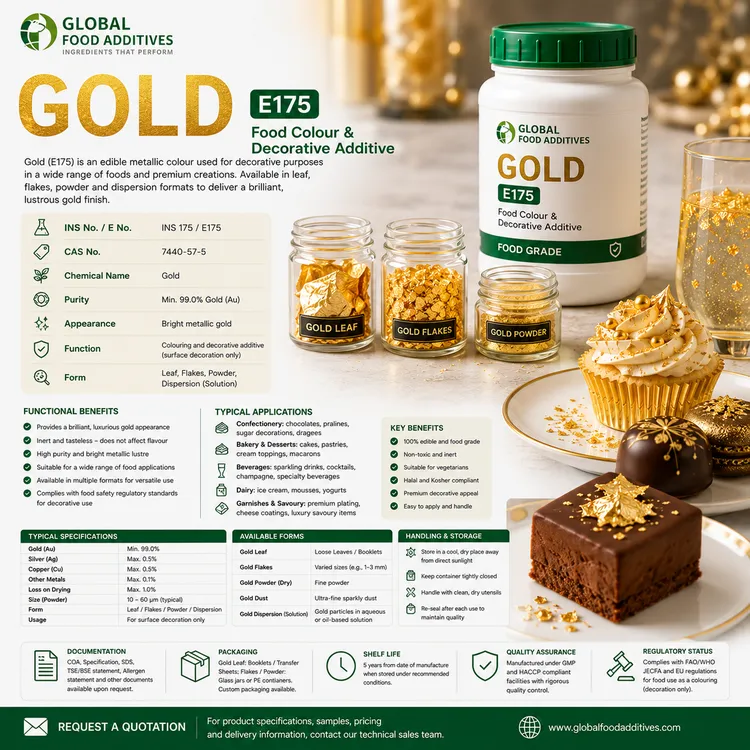
Gold, identified in many food additive systems as E175, is a premium decorative metallic colour used to create luxury visual effects on finished foods and beverages. In food manufacturing it is normally evaluated as edible gold leaf, transfer leaf, flakes, dust, powder, sprinkles or a dispersion in an approved carrier. Its value is visual and decorative: it is not selected for flavour, nutrition, preservation or bulk colour development. This page supports industrial buyers with grade selection, purity review, handling guidance, document collection, compliance screening and quotation preparation.
Product identity
| Product | Gold |
|---|---|
| Common commercial names | Edible Gold, Food Grade Gold, Gold Leaf, Transfer Gold Leaf, Gold Flakes, Gold Powder, Gold Dust |
| Category | Colours & Colouring Foods |
| Function | Decorative food colour, metallic visual effect, premium surface finish and luxury product differentiation where permitted |
| E / INS number | E175 where permitted and applicable |
| CAS / identity | 7440-57-5 |
| Typical form | Loose leaf, transfer leaf, flakes, powder, dust, sprinkles or dispersion in approved carrier |
| Industrial buying focus | Food-grade status, gold purity, assay, karat declaration, impurity profile, particle size, leaf dimensions, carrier composition, packaging hygiene, traceability and destination-market compliance |
Application fit
Gold E175 is selected when the finished product needs a visible premium metallic decoration. It is normally applied at the surface or suspended as visible flakes in clear or translucent products.
- Chocolate, pralines, truffles and premium confectionery
- Bakery decorations, cakes, pastries and desserts
- Ice cream, plated desserts and luxury dessert toppings
- Clear beverages, liqueurs, cocktails and celebration drinks where permitted
- Gourmet sauces, snacks and limited-edition products
- Tablet, capsule or nutraceutical decoration where food or supplement rules allow
- Hospitality, catering and high-end retail food presentations
Technical purchasing notes
When reviewing Gold E175, compare the supplier specification against the intended food application, visual target, application method, packaging line, destination market and customer quality requirements. Gold leaf for manual decoration, transfer sheets for controlled placement, flakes for beverages, and fine powder for dusting do not behave the same in production. Each form requires different handling, dosing, packaging and quality-control criteria.
Edible gold is valued because metallic gold is visually distinctive, chemically stable and tasteless at normal decorative use levels. However, industrial approval depends on much more than appearance. Food manufacturers should verify that the material is declared food grade, that the impurity profile is suitable, that the production site follows appropriate hygiene controls, and that the supplier provides lot-specific documentation.
Specification parameters to compare
| Parameter | Why it matters industrially | What to request from supplier |
|---|---|---|
| Food-grade declaration | Separates edible decorative gold from craft, cosmetic, jewellery or industrial metallic products that are not suitable for food use. | Food-grade statement, E175 declaration where applicable, intended-use statement and destination-market regulatory support. |
| Gold purity / assay | Purity determines suitability, value, price, impurity risk and customer acceptance. Non-food metallic additives or low-purity alloys may introduce unsuitable metals. | Assay value, karat declaration where used, certificate of analysis and impurity profile. |
| Heavy metals and metallic impurities | Critical for food safety, regulatory review and premium customer approval. Particular attention is usually given to lead, cadmium, mercury, arsenic, nickel, copper and other metals. | Lot-specific heavy metals results, impurity limits, analytical method and compliance statement. |
| Physical form | Leaf, flakes, powder and dispersion formats require different production handling and create different visual effects. | Exact form, grade name, intended application and sample photos or videos if available. |
| Leaf size and transfer format | Important for manual decoration, automated placement, chocolate finishing, pastry decoration and portion control. | Sheet dimensions, loose-leaf or transfer-leaf format, sheets per booklet, net gold weight and handling instructions. |
| Particle size and morphology | Controls sparkle, suspension, coverage, dusting behaviour, sedimentation and visible distribution in beverages or toppings. | Particle-size range, flake shape, powder fineness, distribution data and recommended dosing method. |
| Carrier composition | Dispersions, sprays or pre-mixes may include ethanol, water, glycerol, oils, propellants, stabilizers or other carriers that must be permitted in the final application. | Full composition, carrier declaration, allergen status, solvent statement, label impact and SDS where applicable. |
| Microbiological and hygiene status | Gold metal itself is not a nutrient source, but packaging, handling and carrier systems can introduce hygiene risks. | Packaging hygiene statement, microbiological limits for carrier-based grades and production-site quality certification. |
| Packaging format | Very thin gold leaf and light flakes are fragile, electrostatic and sensitive to airflow. Packaging affects waste, dosing accuracy and operator efficiency. | Booklet type, jar size, vial size, sachet size, tamper seal, inner liner, net weight and pallet configuration. |
| Traceability | Required for supplier approval, audits, export documentation, complaint investigation and recall systems. | Lot number, production date, expiry or retest date, origin, manufacturer details and batch traceability statement. |
Application guidance by industry
| Industry / application | Technical role | Key validation points |
|---|---|---|
| Chocolate and premium confectionery | Provides high-value metallic decoration on pralines, truffles, bars, panned products and gift assortments. | Surface adhesion, bloom risk, handling humidity, visual uniformity, decoration waste, packaging rub-off and label declaration. |
| Bakery, cakes and pastries | Creates luxury finishing on fondant, icing, cream, glaze, chocolate coating, macarons and plated dessert elements. | Moisture sensitivity, transfer method, surface tack, storage temperature, condensation and manual handling procedure. |
| Beverages and liqueurs | Gold flakes can create visible suspended luxury particles in clear or translucent products where permitted. | Flake size, settling rate, bottle visibility, agitation instructions, filtration compatibility, alcohol level, pH and market-specific approval. |
| Ice cream and frozen desserts | Used as a decorative surface finish or inclusion for premium limited-edition products. | Freeze-thaw handling, condensation, surface adhesion, packaging abrasion, cold-chain display and consumer visibility. |
| Snacks and savoury products | Applied as a premium visual highlight on luxury chips, nuts, canapés or gourmet items. | Oil surface compatibility, powder adhesion, rub-off, salt interaction, packaging loss and serving conditions. |
| Foodservice and hospitality | Used for final plate decoration, cocktail garnish, pastry finishing and event-specific luxury presentation. | Portion control, operator training, storage, cross-contact prevention, humidity, airflow and verified food-grade supply. |
| Supplements and tablets | May be considered for luxury coating or surface decoration when the applicable food, supplement or pharmaceutical rules allow it. | Regulatory category, coating compatibility, abrasion resistance, colour uniformity, GMP requirements and documentation package. |
Processing and handling considerations
- Select the correct format. Use loose leaf for manual artistic placement, transfer leaf for controlled contact application, flakes for visible particles, powder or dust for soft metallic coverage, and dispersions only when every carrier is acceptable in the final product.
- Control airflow and static. Gold leaf and light flakes are extremely delicate. Fans, open doors, air jets, static-charged gloves and dry environments can increase waste and make placement inconsistent.
- Prepare the food surface. Slightly tacky chocolate, glaze, icing or coating surfaces usually hold leaf better than dry or dusty surfaces. Excess moisture may wrinkle leaf or create uneven appearance.
- Prevent cross-contamination. Use dedicated food-contact tweezers, brushes, gloves and work surfaces. Do not use craft tools, jewellery tools or non-food metallic materials in the production area.
- Validate visual stability. Check the final product after packing, transport simulation, vibration, freezing, condensation, shelf-life storage and retail display conditions.
- Control dosage and waste. Gold is a high-value ingredient. Define target decoration weight per unit, operator method, loss factor, rework policy and acceptance criteria for visual variation.
- Confirm regulatory approval before launch. Permitted use, food category, label name and maximum level can vary by market. Confirm the rule for every destination country before commercial production.
For R&D teams
Request small samples of each required format and test them on the real product surface. Compare adhesion, sparkle, rub-off, visual intensity, handling loss, stability after packaging and compatibility with humidity, fat, sugar and alcohol.
For QA teams
Build an approval file covering food-grade status, E175 declaration where applicable, CAS identity, assay, impurity profile, heavy metals, carrier composition, allergen status, GMO status, COA format and traceability.
For procurement teams
Compare offers by gold purity, form, particle size, sheet dimensions, net weight, minimum order quantity, packaging format, lead time, documentation quality, origin and total cost per decorated unit.
For production teams
Confirm operator tools, humidity control, decoration station layout, airflow control, waste collection, work-in-process protection, packaging compatibility and training instructions before scale-up.
Quality-control and incoming inspection
A practical incoming inspection plan for Gold E175 should verify documents, packaging integrity, lot coding, physical form, visual appearance, quantity, supplier seal and storage condition. Because edible gold is high value and visually sensitive, inspection should include both quality and authenticity controls.
- Document check: confirm COA, food-grade declaration, E175 statement where applicable, assay, impurity data and traceability.
- Packaging check: inspect seals, booklet integrity, vial closure, tamper evidence, humidity protection and damage during transit.
- Visual check: review colour, brightness, flake size, leaf continuity, powder uniformity and visible foreign matter.
- Application check: test adhesion, transfer behaviour, dusting, coverage, rub-off and final visual effect on the intended product.
- Carrier check: for dispersions or sprays, verify full composition, carrier legality, allergen status, solvent statement and label impact.
- Authenticity check: maintain supplier traceability and consider periodic third-party assay or heavy-metal screening for high-value programs.
Recommended documentation package
A complete industrial sourcing file for edible Gold should support supplier approval, destination-market review, customer documentation, import clearance and batch release.
- Product specification or technical data sheet
- Certificate of analysis for offered batch or representative lot
- Food-grade declaration
- E175 regulatory statement where applicable
- CAS 7440-57-5 identity confirmation
- Gold assay or purity declaration
- Karat declaration where used commercially
- Heavy metals and metallic impurity results
- Carrier composition for liquid or dispersion grades
- Allergen declaration
- GMO statement
- Halal certificate where required
- Kosher certificate where required
- Vegan or vegetarian statement when needed
- Safety data sheet where applicable
- Packaging hygiene statement
- Sheet size, particle size or net weight declaration
- Shelf-life or retest recommendation
- Storage and handling instructions
- Label draft and packaging details
- Pallet configuration and net/gross weight
- Country-of-origin and export documentation
Storage, handling and packaging
Food-grade Gold should be stored in original sealed packaging in a clean, dry and odour-free area. Protect it from moisture, condensation, dust, strong airflow, crushing, vibration and unnecessary handling. Leaf and flake grades should be opened only at the decoration station because they can wrinkle, fold, cling to gloves, disperse into the air or stick to unintended surfaces.
Typical packaging may include booklets of loose leaf, transfer sheets, sealed vials, jars, sachets, tins, tubes or small cartons. For industrial supply, buyers should confirm sheets per booklet, dimensions, net gold weight, flake size range, powder quantity, inner packaging, tamper seal, master carton quantity, shelf-life statement and any transport precautions.
How to request this product
Send the product name, desired form, purity requirement, application, reference specification, quantity, destination country, packaging preference, delivery term, expected shipment date and required documents. If you already purchase edible gold, attach your current specification, certificate of analysis, label or sample photos so supplier options can be compared more accurately.
Recommended inquiry details
- Product identity: Gold, Edible Gold, Food Grade Gold, E175, Gold Leaf, Gold Flakes, Gold Dust or the exact name used in your formula.
- Application: chocolate, confectionery, bakery, dessert, beverage, liqueur, snack, foodservice decoration or supplement coating.
- Required form: loose leaf, transfer leaf, flakes, powder, dust, sprinkles, vial, booklet, sachet or approved-carrier dispersion.
- Specification target: purity, assay, karat if required, sheet size, particle size, carrier composition, heavy metals, packaging and label requirements.
- Quantity: sample, trial order, monthly demand, seasonal campaign quantity or annual contract.
- Destination: country, port, Incoterms, required import documents and delivery schedule.
- Compliance needs: E175 declaration, halal, kosher, allergen, GMO, vegan, heavy metals, origin or customer-specific declarations.
Useful answers
What is Gold E175 used for in food manufacturing?
Gold E175 is used as a premium decorative metallic colour and visual finishing ingredient. It is normally applied as edible gold leaf, transfer leaf, flakes, powder, dust, sprinkles or a dispersion in an approved carrier. Its main purpose is luxury appearance, not taste, nutrition or preservation.
Is edible gold the same as jewellery gold?
No. Food manufacturers should use only documented food-grade gold. Jewellery gold, craft leaf and imitation metallic leaf may contain unsuitable metals, coatings, adhesives, soldering residues or contaminants and should not be used in food production.
Which edible gold format should I choose?
Loose leaf is useful for manual artistic decoration, transfer leaf supports more controlled placement, flakes are common for visible particles in beverages or toppings, and powder or dust is useful for soft surface coverage. Dispersions should be checked carefully because the carrier must also be suitable for the final application.
Does Gold E175 add flavour or nutrition?
Gold is normally used for decorative visual effect only. It should not be positioned as a nutritional ingredient or functional health ingredient unless the buyer has specific legal approval for such claims in the destination market.
Which specification parameters are most important?
Key parameters include food-grade declaration, E175 status where applicable, CAS identity, gold purity, assay, karat declaration if used, heavy metals, metallic impurities, physical form, sheet size, particle size, carrier composition, packaging hygiene and batch traceability.
Can Global Food Additives source Gold E175?
Global Food Additives can review sourcing options for Gold E175 according to desired form, purity, application, quantity, destination country, packaging preference, shipment schedule and documentation requirements.
Which documents should be requested?
Buyers commonly request a technical data sheet, certificate of analysis, food-grade declaration, E175 statement where applicable, assay or purity declaration, heavy metals results, carrier composition for dispersions, allergen statement, GMO statement, halal or kosher certificates when required, shelf-life information, label details and packing list.
Is this product permitted in every country?
No. Food additive use depends on destination-market rules, exact grade, food category, maximum use level, label requirements and buyer responsibility. The final manufacturer should confirm compliance before commercial production.
What information should I send for a quotation?
Send the product name, required form, purity requirement, application, target specification, quantity, destination country, packaging preference, Incoterms, expected shipment date and required documents. Sharing an existing COA or supplier specification helps compare alternatives faster.
Tell us which food additive or ingredient you need.
Send product names, target specifications, quantity, destination country, packaging preference, delivery term, and document requirements. Our team will review your inquiry and respond from orders@foodgradeadditives.com.
Your message has been received. You will be redirected to the home page.