
Gum Rosin Ester
Gum Rosin Ester, also requested commercially as glycerol ester of rosin or ester gum, is a resin-based food additive option evaluated by manufacturers for beverage cloud systems, citrus-oil density adjustment, protective surface coatings, gloss development, moisture-barrier contribution, tack control and release performance. This page supports industrial buyers with a more technical sourcing framework: identity review, grade selection, regulatory screening, quality-control parameters, documentation requirements and quotation preparation.
*Regulatory names and permitted use can vary by market and rosin source. Always verify the exact supplier grade, declaration and destination-country requirements.
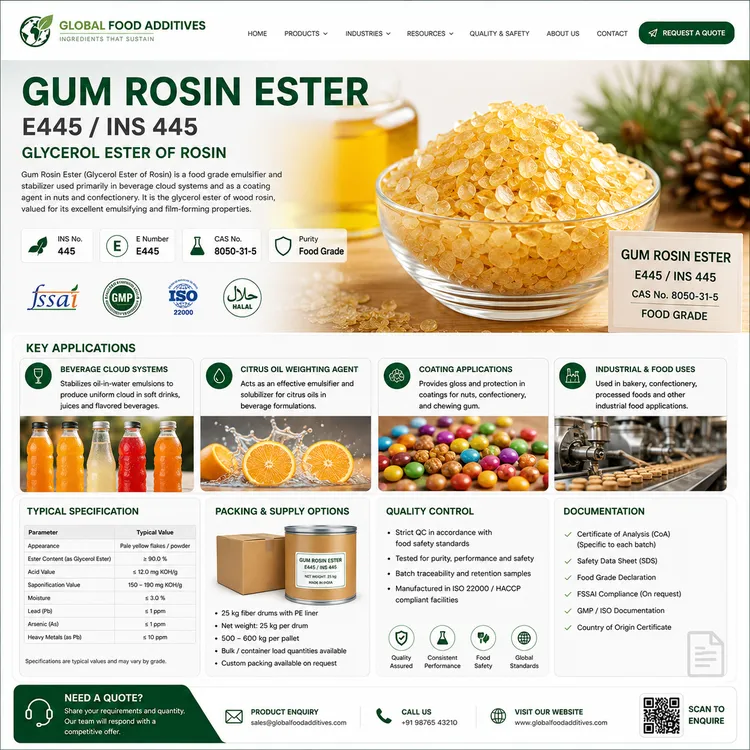
Product identity
| Product | Gum Rosin Ester |
|---|---|
| Common commercial names | Glycerol Ester of Rosin, Glycerol Ester of Wood Rosin, Ester Gum, Rosin Glycerol Ester |
| Category | Glazing, Coating & Release Agents; beverage cloud and resin-based additive systems where permitted |
| Primary function | Density adjustment, beverage cloud support, surface coating, gloss, anti-sticking, release and carrier support depending on grade and application |
| E / INS number | E445 / INS 445 where the identity and application are permitted by local regulation |
| CAS / identity | 8050-31-5; supplier documentation should confirm exact rosin source and additive identity |
| Typical form | Solid resin, flake, bead, granule, liquid solution, emulsion or dispersion grade |
| Industrial review focus | Acid number, softening point, colour, odour, purity, solubility, thermal behaviour, batch consistency, residual volatiles and regulatory declarations |
Application fit
Gum Rosin Ester is normally selected after a technical review of the final food matrix, process temperature, oil phase, emulsifier system, label target and destination-market additive rules.
- Beverage emulsions and citrus-oil cloud systems
- Flavour oil density adjustment where permitted
- Confectionery coating and anti-tack systems subject to grade suitability
- Chewing gum base and resin systems where allowed by local rules
- Fruit coating, glazing or protective surface applications where specifically permitted
- Release, carrier or processing-support systems after regulatory verification
Technical purchasing notes
When reviewing Gum Rosin Ester, compare the supplier specification against the intended food application, target function, production process, oil phase composition, storage conditions, label expectations and local food additive rules. Industrial buyers should define whether the product is required as a solid resin for in-house dissolution, a ready-to-use solution, a beverage-cloud weighting grade, a coating ingredient or a dispersion designed for a specific manufacturing process.
In beverage applications, rosin ester grades are commonly evaluated for their ability to increase the density of flavour oils, especially citrus oils, so the oil phase remains more uniformly dispersed in the finished drink. In coating and release applications, the review normally focuses on film formation, gloss, anti-tack effect, compatibility with waxes or oils, sensory neutrality and compliance with the food-contact or food-additive status required for the final market.
Specification parameters to compare
| Parameter | Why it matters industrially | What to request from supplier |
|---|---|---|
| Identity and rosin source | Food additive permissions may differ depending on whether the grade is declared as wood rosin, gum rosin, tall oil rosin or a broader glycerol ester of rosin. | Exact chemical identity, CAS reference, E/INS declaration, manufacturing source statement and regulatory compliance letter. |
| Acid number | Indicates remaining free resin acids and can affect flavour stability, compatibility, odour, emulsification behaviour and consistency between lots. | COA value, test method and specification range for each supplied lot. |
| Drop-softening point | Important for melting, handling, dosing, coating behaviour, dissolution into oil phase and thermal process design. | Typical and guaranteed range with test method. |
| Colour and odour | Colour and odour can influence clear or lightly flavoured products, coatings, beverage concentrates and sensory-sensitive applications. | Colour grade, odour description, organoleptic statement and batch-retain policy. |
| Solubility and compatibility | Determines whether the product can be dissolved into the target oil phase, flavour concentrate, coating blend or processing carrier. | Recommended solvents or carriers, oil compatibility notes, suggested processing temperature and pilot-trial guidance. |
| Residual volatiles and purification | Residual low-boiling components can affect odour, flavour quality and regulatory acceptance. | Purification description, residual solvent or volatile statement where applicable and food-grade compliance documentation. |
| Heavy metals and contaminants | Food manufacturers need contaminant control for ingredient approval, export documentation and customer audits. | Heavy metals limits, contaminant declaration and COA results where available. |
| Batch traceability | Essential for quality systems, recall control, supplier approval and export shipments. | Lot number, production date, expiry or retest date, origin, manufacturer name and packing list. |
Application guidance by industry
| Industry / application | Technical role | Key validation points |
|---|---|---|
| Beverage cloud and citrus-oil systems | Supports density adjustment of citrus oils and helps reduce oil separation, ringing, creaming and cloud instability when used in an appropriate emulsion system. | Oil phase composition, emulsifier choice, homogenization pressure, droplet size, pH, heat treatment, shelf-life, permitted level and sensory neutrality. |
| Flavour concentrates | Can be evaluated as a resinous weighting component for flavour oils, depending on local regulations and customer specification. | Solubility in flavour oil, haze, odour, oxidation stability, concentrate viscosity and storage temperature. |
| Confectionery and coating systems | May contribute to gloss, film formation, anti-tack performance or moisture-barrier effect in selected coating systems where the grade is approved. | Surface appearance, bite, drying time, migration, compatibility with waxes or oils and label declaration. |
| Chewing gum and gum-base systems | Resin ester grades may be evaluated for binding, plasticity, tack control and gum-base performance where allowed. | Softening point, elasticity, flavour release, odour, compatibility with elastomers and final regulatory status. |
| Fruit coating and glazing | Can be considered for shine and protective-film systems only where the identity and application are specifically permitted. | Coating uniformity, drying, breathability, sensory impact, market-specific wax/coating regulation and residue considerations. |
| Processing support and release | May support anti-sticking or release performance in selected systems, subject to the additive or processing-aid classification in the destination market. | Contact level, carry-over, cleaning validation, label impact and customer approval. |
Processing and formulation considerations
- Confirm the grade before laboratory trials. Do not assume that every Gum Rosin Ester grade is interchangeable. Confirm rosin source, E/INS status, intended application, food-grade declaration, physical form and recommended processing conditions.
- Define the oil phase or coating system. For beverage emulsions, start with the exact citrus oil or flavour oil system. For coatings, define waxes, oils, solvents or carriers, drying conditions and target surface performance.
- Use controlled heat and mixing. Solid resin grades may require melting or dissolution before incorporation. Avoid unnecessary overheating, long residence times and poor agitation because these can affect colour, odour and consistency.
- Validate emulsion stability under real conditions. Beverage systems should be checked for droplet size, turbidity, ring formation, creaming, sediment, pH stability, thermal treatment and shelf-life at the intended storage temperature.
- Check sensory and label impact. Resin-based ingredients can influence odour, flavour release, mouthfeel and label declarations. Run sensory comparison against the current formula before commercial approval.
- Approve the final use level with regulatory support. Maximum levels, permitted food categories and naming rules must be checked against the destination market before scale-up.
For R&D teams
Request a small sample together with the technical data sheet and recent COA. Run bench trials against the target formula, not only in a model system. Evaluate solubility, turbidity, odour, droplet stability, film formation and sensory impact.
For QA teams
Build an approval checklist covering identity, food-grade status, allergen statement, GMO statement, halal or kosher status if required, contaminant limits, COA format, traceability and supplier change-control policy.
For procurement teams
Compare offers by grade, origin, packaging, lead time, documentation quality, minimum order quantity, pallet configuration, shelf life, Incoterms and destination-country import requirements.
For production teams
Confirm handling temperature, melting or dissolution method, dosing point, filtration needs, tank-cleaning compatibility, dust or flake handling requirements and operator safety procedures before plant trial.
Recommended documentation package
A complete industrial sourcing file for Gum Rosin Ester should support quality approval, import clearance, customer review and batch release. The exact package depends on destination country and end use.
- Product specification or technical data sheet
- Certificate of analysis for the offered batch or representative lot
- Food-grade declaration
- Regulatory statement for E445 / INS 445 where applicable
- CAS and identity declaration
- Rosin source and manufacturing origin statement
- Safety data sheet where applicable
- Allergen declaration
- GMO statement
- Halal and kosher certificates when required
- Heavy metals or contaminant statement
- Residual solvent or residual volatile declaration where applicable
- Shelf-life and storage recommendation
- Label draft and packaging details
- Pallet configuration and net/gross weight
- Country-of-origin and export documentation
Storage, handling and packaging
Gum Rosin Ester should normally be stored in original sealed packaging, protected from excessive heat, direct sunlight, moisture, dust contamination and strong odour sources. Solid resin forms should be handled to avoid foreign-matter contamination and unnecessary thermal cycling. Liquid, emulsion or dispersion grades may require additional temperature-control and mixing instructions from the supplier.
Common commercial packaging may include bags, cartons, drums, fibre drums, pails, IBCs or palletized export units depending on grade and physical form. For international shipments, buyers should confirm HS code guidance, pallet dimensions, container loading, batch numbering, shelf-life at dispatch and whether temperature-sensitive transport is required.
How to request this product
Send the product name, target grade, reference specification, application, quantity, destination country, packaging preference, delivery term, expected shipment date and required documents. If you already purchase Gum Rosin Ester, attach your current specification, label, COA or sample photos so potential supplier options can be compared more accurately.
Recommended inquiry details
- Product identity: Gum Rosin Ester, Glycerol Ester of Rosin, E445 / INS 445 or another exact name used in your formula.
- Application: beverage cloud, flavour emulsion, coating, chewing gum, confectionery, glazing, release or another defined use.
- Required grade: solid resin, flake, bead, solution, emulsion, dispersion or supplier-equivalent grade.
- Specification target: acid number, softening point, colour, odour, solubility, permitted market and any customer limits.
- Quantity: sample, trial order, monthly demand, annual contract or container volume.
- Destination: country, port, Incoterms, required import documents and delivery schedule.
- Compliance needs: halal, kosher, allergen, GMO, heavy metals, vegan, origin or customer-specific declarations.
Useful answers
What is Gum Rosin Ester used for in food manufacturing?
Gum Rosin Ester is typically evaluated for resin-based technical functions such as beverage cloud stabilization, citrus-oil density adjustment, gloss, film formation, moisture-barrier support, anti-sticking, release performance and coating systems. Exact suitability depends on grade, final application, use level, processing conditions, regulations and supplier documents.
Is Gum Rosin Ester the same as E445?
E445 / INS 445 is commonly associated with glycerol esters of rosin in food additive systems, but regulatory wording may refer to specific rosin sources such as wood rosin, gum rosin or tall oil rosin. Buyers should confirm the exact identity, CAS reference, E/INS declaration and permitted use for the destination country.
What are the most important technical parameters?
Important parameters include identity, rosin source, acid number, drop-softening point, colour, odour, solubility, purity, residual volatiles, heavy metals, physical form, packaging, shelf life and lot-to-lot consistency. For beverage systems, emulsion stability and sensory neutrality are also critical.
Can it be used in beverages?
Certain rosin ester grades are used or evaluated in beverage cloud and citrus-oil systems where permitted. The buyer must confirm the exact additive identity, maximum level, food category, local rules and finished-product label requirements before commercial use.
Can Global Food Additives source Gum Rosin Ester?
Global Food Additives can review sourcing options for Gum Rosin Ester according to target specification, application, quantity, destination, packaging preference, shipment schedule and required documentation.
Which documents should be requested?
Buyers commonly request a technical data sheet, certificate of analysis, food-grade declaration, safety data sheet where applicable, origin statement, regulatory declaration, allergen statement, GMO statement, halal or kosher certificates when required, shelf-life information, label details and packing list.
Is this product permitted in every country?
No. Food additive use depends on destination-market rules, exact identity, food category, maximum use level, label requirements and buyer responsibility. The final manufacturer should confirm compliance before scale-up or commercial launch.
What information should I send for a quotation?
Send the product name, grade, application, target specification, quantity, destination country, packaging preference, Incoterms, expected shipment date and required documents. Sharing an existing COA or supplier specification helps compare alternatives faster.
Tell us which food additive or ingredient you need.
Send product names, target specifications, quantity, destination country, packaging preference, delivery term, and document requirements. Our team will review your inquiry and respond from orders@foodgradeadditives.com.
Your message has been received. You will be redirected to the home page.