
Helium E939
Helium is a food-grade inert gas identified as E939 / INS 939 and CAS 7440-59-7. In food-related applications, it is mainly considered for controlled headspace systems, modified-atmosphere concepts, oxygen displacement, specialist package leak testing, tracer-gas inspection and laboratory or pilot-plant gas applications where high purity and traceability are required.
Helium should not be described as a normal carbonation gas. Carbonated beverages use carbon dioxide, while helium is chemically inert and does not create carbonic acid, fizz or the sensory bite associated with carbonation. Industrial purchasing should focus on gas purity, impurity limits, cylinder or bulk supply mode, valve standard, regulator compatibility, oxygen-displacement safety, delivery feasibility and destination-market compliance.
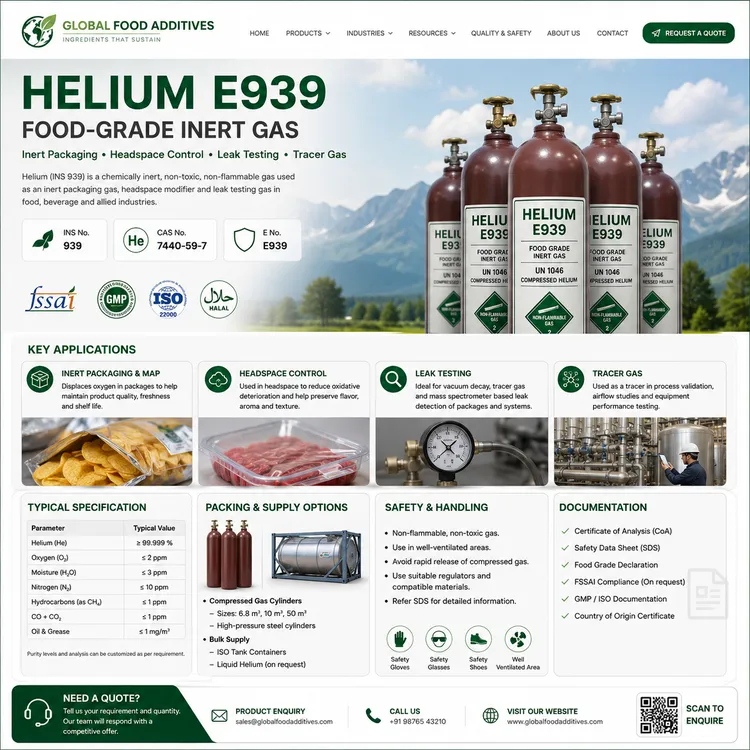
Product identity
| Product | Helium |
|---|---|
| Common names | Helium gas, He, food-grade helium, inert helium, compressed helium |
| Category | Packaging Gases & Beverage Gases |
| Function | Inert packaging gas / headspace gas / tracer gas / leak testing gas / atmosphere-control gas |
| E / INS number | E939 / INS 939 |
| CAS / identity | 7440-59-7 |
| Chemical symbol | He |
| Gas type | Noble gas, chemically inert, colourless, odourless, non-flammable and lighter than air |
| Typical form | Compressed gas cylinder, cylinder bundle, tube trailer or bulk supply depending on volume and local infrastructure |
| Key purchasing controls | Purity, oxygen, moisture, nitrogen, hydrogen, neon, argon, hydrocarbons, cylinder pressure, valve type, COA, SDS and transport documents |
Application fit
Helium is a specialized food and packaging gas. It is usually selected where inertness, high diffusivity or leak-detection sensitivity is more important than cost.
- Specialist modified-atmosphere packaging and inert headspace concepts
- Food package leak testing using helium tracer-gas methods
- Seal integrity testing for high-value, sensitive or export packaging
- Food-contact equipment, piping, valve and vessel leak testing
- Laboratory, QA and pilot-plant gas applications requiring high-purity inert gas
- Controlled oxygen-displacement studies in closed systems
- Specialized food-process validation where nitrogen, argon or carbon dioxide are unsuitable
Technical overview for industrial buyers
Helium is a noble gas with extremely low chemical reactivity. In food applications, this makes it useful as an inert gas where the goal is to reduce oxygen exposure, protect sensitive materials, create a non-reactive headspace or support specialist testing. It is not normally the first choice for routine MAP because nitrogen and carbon dioxide are more widely used and usually more economical. Helium is generally considered where its unique physical properties justify the cost.
The most important practical property of helium is its small atomic size and high diffusivity. These properties make helium useful for leak testing because it can pass through very small leak paths and be detected with sensitive instruments. The same properties can make helium difficult to retain in some packages or closed systems, so packaging films, seals, valves and closures should be tested under real storage conditions.
Functional performance
- Provides an inert atmosphere where chemical reactivity must be minimized
- Can displace oxygen in controlled headspace and process environments
- Supports high-sensitivity package, seal, valve and equipment leak testing
- Can be used as a tracer gas because of low background level and strong detector response
- Does not add flavour, odour, acidity or carbonation effect to foods or beverages
- Can be used in selected laboratory and pilot-plant systems requiring high-purity inert gas
- Requires packaging retention testing due to high diffusivity
- Requires careful cost and supply planning because helium availability and pricing can fluctuate
Supply mode selection
| Single cylinder | Suitable for laboratory, QA, pilot plant, low-volume leak testing and trial applications. |
|---|---|
| Cylinder bundle | Useful when consumption is higher but full bulk infrastructure is not justified. |
| Tube trailer | Considered for large users where local gas supply infrastructure and site access allow delivery. |
| Blended gas | Helium may be supplied in defined mixtures for leak testing, calibration or process-validation systems. |
| High-purity grade | Used where impurity control is critical, such as laboratory, analytical or sensitive food-contact validation. |
| Food-grade supply | Selected when the gas may contact food, beverage, packaging headspace or food-contact equipment. |
Helium compared with common food gases
Helium is different from the gases most often used in food plants. Nitrogen is widely used for inerting and oxygen displacement. Carbon dioxide is used for carbonation, microbial inhibition and MAP systems. Oxygen may be used for red meat colour or fresh produce respiration control. Argon can be used as an inert gas in selected applications. Helium is more specialized and is often justified by leak testing, analytical detection or a specific engineering need rather than routine packaging cost.
Gas comparison
| Helium E939 | Inert, very light and highly diffusive; useful for leak testing and specialist inert-gas applications. |
|---|---|
| Nitrogen E941 | Common economical inerting and packaging gas for oxygen displacement and headspace filling. |
| Carbon dioxide E290 | Used for carbonation and MAP systems where acidity, solubility or microbial inhibition are desired. |
| Oxygen E948 | Used in controlled cases such as fresh meat colour or produce respiration management. |
| Argon E938 | Inert noble gas sometimes considered for premium oxygen-displacement applications. |
When helium may be justified
- Very small package leaks need to be detected
- Seal integrity is critical for export or high-value products
- Analytical or QA methods require helium tracer gas
- A non-reactive high-purity gas is required for food-contact testing
- Packaging or process validation requires a gas with high diffusivity
- The project accepts higher cost and supply-chain planning requirements
Application-specific guidance
In package leak testing, helium can be introduced into a package headspace, chamber, seal area or test fixture and detected with a helium leak detector. This method can be useful for high-value food products, export packaging, aseptic packs, barrier packaging, flexible packs, closures, valves and food-contact equipment. The test procedure should define leak-rate limits, dwell time, background control, sampling method and pass/fail criteria.
In inert headspace projects, helium should be compared against nitrogen and argon before approval. Helium may be technically effective for oxygen displacement, but because it diffuses rapidly and can be expensive, it may not be the best commercial choice for routine packs. Packaging validation should include gas retention, oxygen ingress, seal integrity, shelf-life stability and sensory performance.
In beverage or food demonstrations, helium should not be marketed as a carbonation replacement. It has very different solubility and sensory behaviour compared with carbon dioxide. Any use involving finished beverages, label claims, novelty effects or consumer exposure should be reviewed carefully for safety, regulatory acceptance, claims and packaging performance.
Packaging and QA systems
- Leak testing: requires calibrated detector, defined helium concentration and validated acceptance criteria.
- Seal validation: useful for checking closures, valves, seams, welds, trays, pouches and barrier packs.
- Headspace studies: requires gas analyser validation, oxygen monitoring and retention testing.
- Food-contact equipment: may support leak detection in pipes, tanks, valves and closed process systems.
Process and laboratory systems
- QA laboratories: high-purity helium may be required for certain analytical or validation methods.
- Pilot plants: supports inert-gas trials where food-grade documentation is required.
- Gas mixtures: helium may be supplied in blends for calibration, detection or validation work.
- Special projects: requires review of supply continuity, cost, gas recovery and safety procedures.
Safety and handling considerations
Helium is non-flammable, non-toxic and chemically inert, but it can create oxygen-deficient atmospheres in poorly ventilated areas. Cylinders should be stored upright, secured against falling and protected from heat, impact and unauthorized handling. Gas release in small rooms, pits, confined spaces or low-ventilation areas should be avoided unless oxygen monitoring and ventilation controls are in place.
Compressed helium systems require compatible regulators, hoses, valves and pressure-rated fittings. Buyers should confirm cylinder pressure, valve connection, regulator standard, flow requirement, pressure control and local cylinder handling rules before ordering. Helium can leak through very small openings, so leak-tight connections and regular inspection are important for both safety and cost control.
For food facilities, helium use should be integrated with HACCP, food-contact controls, preventive maintenance and EHS procedures. The gas-contact path should be clean and suitable for food use when helium contacts food, beverage, packaging headspace or food-contact surfaces. Operators should be trained not to inhale helium intentionally and to treat compressed-gas cylinders as industrial pressure equipment.
Typical quality parameters
- Helium purity, usually stated as percentage or gas-grade code
- Oxygen impurity limit
- Moisture or dew point
- Nitrogen, hydrogen, neon, argon and total hydrocarbon impurities where specified
- Carbon monoxide and carbon dioxide limits where relevant to food-contact use
- Odour, oil, particulate and non-volatile residue where required by specification
- Cylinder pressure, fill pressure, water capacity and net gas volume
- Valve connection type and regulator compatibility
- Batch, lot, cylinder or delivery traceability
- Food-grade, beverage-grade or food-contact suitability statement
- Certificate of analysis and impurity profile for the delivered lot or cylinder batch
Common purchasing risks
- Assuming industrial helium automatically meets food-grade or food-contact requirements
- Using helium for routine MAP when nitrogen or carbon dioxide would be more economical
- Describing helium as a carbonation gas even though carbonation uses carbon dioxide
- Ordering cylinders without checking valve type, pressure rating and regulator compatibility
- Ignoring oxygen-deficiency risk in small or poorly ventilated areas
- Failing to test package retention because helium diffuses rapidly
- Using helium leak testing without validated leak-rate criteria and background controls
- Not planning for supply constraints, cylinder return rules and price fluctuations
Regulatory and compliance notes
Helium is commonly identified as E939 / INS 939 in food gas and packaging gas systems. Regulatory treatment depends on destination country, food category, technical function, whether the gas remains in the final package, whether it is used as a processing aid, and whether it contacts food, beverage, packaging headspace or food-contact equipment.
A gas used only for package leak testing may be treated differently from a gas intentionally retained in a food package. A gas used in the headspace of a packaged food may require label review as a packaging gas or modified atmosphere component, depending on local rules. Buyers should confirm the intended function and declaration with local food law, the gas supplier and customer standards.
Compliance is not limited to food law. Helium cylinders are compressed-gas pressure vessels and may be subject to transport, storage, workplace safety and pressure-equipment regulations. Procurement should verify dangerous-goods documentation where applicable, cylinder ownership, return terms, storage limits, ventilation expectations and local occupational-safety requirements.
Documents to request
- Gas specification or technical data sheet with purity and impurity limits
- Certificate of analysis for the delivered cylinder, bundle, trailer or production batch
- Food-grade, beverage-grade or food-contact suitability statement where applicable
- Safety data sheet for compressed helium
- Origin, production method and supply-chain traceability statement where required
- Oxygen, moisture, nitrogen, hydrogen, neon, argon and hydrocarbon impurity data where relevant
- Cylinder, bundle or bulk supply details including pressure, capacity and valve connection
- Transport classification, UN number where applicable and local delivery requirements
- Gas mixture certificate if helium is supplied blended with another gas
- Regulatory compliance statement for E939 / INS 939 or local food-gas status where required
- HACCP, ISO, food-safety or quality-system certificates from the gas supplier where available
- Regulator compatibility, safe-handling guidance and storage recommendations
- Shelf-life or cylinder retest policy, storage conditions and returnable-cylinder terms
- Market-specific declarations required by the destination country or customer standard
Packaging, storage and logistics
Helium is usually supplied in high-pressure cylinders, cylinder bundles, tube trailers or other gas supply formats depending on volume, location and local gas infrastructure. Supply mode depends on daily consumption, required pressure, delivery frequency, site access, cylinder-handling capability and distance from the gas supplier. Because helium can be supply-sensitive and expensive, buyers should plan lead time and backup supply options for continuous operations.
Cylinders should be stored upright, secured, capped when not in use, protected from heat and handled according to supplier instructions. Storage areas should be ventilated and controlled to prevent damage, unauthorized use and oxygen-displacement risk. Empty cylinders should be closed, labelled, segregated and returned according to supplier rules.
For larger users, a gas supplier may need to review pressure requirements, pipework, regulators, flow demand, storage location, cylinder manifold design, leak testing and emergency procedures. Buyers should confirm whether the delivery site can receive cylinders, bundles or bulk supply before placing an order.
Who usually buys Helium?
- Food packaging R&D teams evaluating specialist atmosphere-control systems
- QA laboratories and package validation teams using leak-testing methods
- Aseptic packaging, high-barrier packaging and export-pack validation teams
- Packaging-equipment manufacturers and inspection-system suppliers
- Food-contact equipment manufacturers requiring leak testing or validation gas
- Industrial food processors with high-value oxygen-sensitive products
- Gas distributors, technical procurement teams and food-sector service providers
Information needed for quotation
- Target product name: Helium, He, E939 or INS 939
- Required gas purity and impurity limits
- Application: packaging gas, leak testing, headspace control, process gas, laboratory use or gas mixture
- Required supply mode: cylinder, bundle, tube trailer, gas mixture or bulk supply
- Required pressure, flow rate and estimated daily or monthly consumption
- Destination country, delivery address and site access conditions
- Preferred cylinder size, valve type and regulator standard if known
- Required food-grade, beverage-grade, SDS, COA and transport documentation
- Whether the gas contacts food, packaging headspace or only test equipment
- Trial quantity, commercial quantity and delivery frequency
- Expected delivery date and any site-survey requirement
- Customer-specific declarations, compliance standards or audit documents
How Global Food Additives supports sourcing
Global Food Additives can help compare Helium supply options by gas grade, purity, impurity profile, food-gas documentation, cylinder or bulk supply format, delivery feasibility, safety documentation and commercial availability. For industrial customers, the fastest sourcing route is to provide the application, required purity, expected gas volume, destination country, preferred supply mode and whether the gas will contact food or packaging headspace.
For new product development or packaging validation, our team can coordinate sample-cylinder options and supplier questions around food-grade documentation, gas mixtures, helium leak testing, cylinder compatibility, pressure control, delivery logistics and market-specific declarations. Final process design, gas installation, EHS approval, use level, regulatory review, label declaration and finished-product suitability remain the responsibility of the manufacturer.
How to request this product
Send the product name, target purity, application, required supply mode, quantity, pressure or flow requirement, destination country, delivery location, valve or regulator requirement, expected delivery date and required documents. If you already purchase Helium, attach or describe your existing gas specification, certificate of analysis, cylinder format, valve standard, supplier reference or test method so options can be compared accurately.
Useful answers
What is Helium used for in food manufacturing?
Helium E939 is used in specialized food and packaging applications such as inert headspace control, modified- atmosphere concepts, package leak testing, seal validation, tracer-gas inspection, laboratory work and process validation where high-purity inert gas is required.
Is Helium used for carbonation?
No. Carbonation is normally performed with carbon dioxide. Helium is inert and does not create carbonic acid, fizz or the sharp sensory bite associated with carbonated beverages.
Why is Helium used for leak testing?
Helium has a very small atomic size and high diffusivity, making it useful for finding small leaks in packages, seals, valves, tanks, pipes and food-contact systems when paired with calibrated detection equipment and a validated test method.
Is Helium safe to handle?
Helium is non-flammable and chemically inert, but compressed cylinders are pressure hazards and helium can displace oxygen in confined or poorly ventilated areas. Safe use requires proper storage, regulators, ventilation, training and cylinder-handling procedures.
Can Helium replace nitrogen in MAP?
Not normally. Nitrogen is usually more economical for routine inerting and oxygen displacement. Helium may be justified for specialist applications such as leak testing, high-sensitivity validation or specific engineering requirements.
Can Global Food Additives source Helium?
Global Food Additives can review sourcing options for Helium according to gas purity, food-grade requirement, application, supply mode, quantity, destination, delivery feasibility and required documentation.
Which documents should be requested?
Buyers commonly request a gas specification, certificate of analysis, food-grade or food-contact statement, safety data sheet, impurity profile, cylinder or bulk supply details, valve information, transport documentation and market-specific compliance statements.
Is this product permitted in every country?
No. Use depends on destination-market rules, food category, technical function, label requirements, whether the gas contacts food or only test equipment, facility gas-handling capability and buyer responsibility.
Tell us which food additive or ingredient you need.
Send product names, target specifications, quantity, destination country, packaging preference, delivery term, and document requirements. Our team will review your inquiry and respond from orders@foodgradeadditives.com.
Your message has been received. You will be redirected to the home page.