
Hydrochloric Acid Food Grade E507
Hydrochloric Acid Food Grade is a strong mineral acid used for controlled pH adjustment, acidification and selected food-processing operations where a high-strength acid is required. It is identified as E507 / INS 507 and is normally supplied as an aqueous HCl solution, not as a powder, crystal or granule.
In industrial food purchasing, hydrochloric acid should be evaluated by assay concentration, impurity profile, food-grade status, packaging compatibility, corrosive-goods transport classification, dosing system design, storage infrastructure and destination-market compliance. Global Food Additives supports supplier comparison, document review, packaging selection and export-ready quotation communication for food-grade hydrochloric acid requirements.
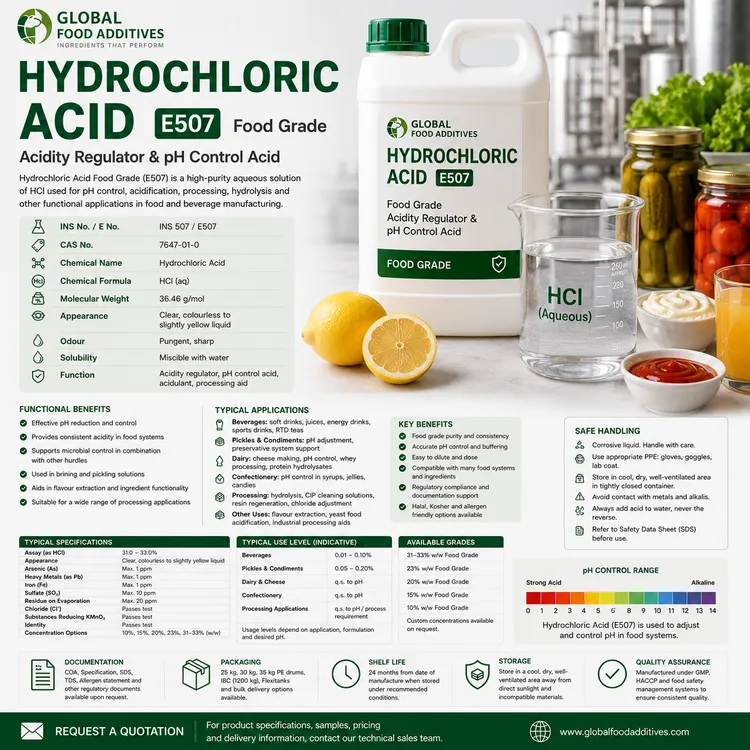
Product identity
| Product | Hydrochloric Acid Food Grade |
|---|---|
| Common names | Hydrochloric acid, food-grade HCl, aqueous hydrogen chloride, muriatic acid food grade |
| Category | Acidulants & Acidity Regulators |
| Function | Acidity regulator / pH control acid / acidulant / food processing aid |
| E / INS number | E507 / INS 507 |
| CAS / identity | 7647-01-0 |
| Chemical formula | HCl in aqueous solution |
| Typical form | Clear, colourless to slightly yellow aqueous solution, depending on concentration and impurity profile |
| Typical concentrations | Diluted grades, 30-33%, 34-36% or supplier-specific food-grade strengths |
| Key purchasing controls | Assay, density, colour, clarity, iron, sulfate, heavy metals, arsenic, residual chlorine, non-volatile residue, packaging, SDS and transport documents |
Application fit
Hydrochloric acid is selected when a strong, inorganic acid is needed for precise pH correction, process acidification or manufacturing operations where chloride contribution is acceptable.
- pH adjustment in selected food and beverage manufacturing processes
- Acidification of process streams where a strong mineral acid is technically justified
- Starch, protein, gelatin, pectin or ingredient-processing operations where permitted
- Ion-exchange resin regeneration in water treatment or ingredient-processing systems
- Acid washing, mineral removal and process-water correction where food-grade acid is required
- Preparation of chloride salts or neutralized process streams in controlled industrial operations
- Laboratory, QA and pilot-plant pH control where food-grade documentation is needed
Technical overview for industrial buyers
Hydrochloric Acid Food Grade is an aqueous solution of hydrogen chloride. It dissociates strongly in water and rapidly lowers pH, which makes it useful for pH control and process acidification. Because it is a strong acid, it is normally dosed through controlled metering systems rather than added manually. Its final effect depends on concentration, alkalinity of the food or process stream, buffering capacity, temperature, mixing efficiency and target pH.
Unlike citric, lactic, malic or acetic acid, hydrochloric acid does not provide fruity, dairy, wine-like or vinegar flavour notes. It contributes chloride ions after neutralization and may create sharp mineral acidity if present in the final product. For this reason, it is usually chosen for technical pH control or processing needs rather than flavour acidulation. Finished-product use should be validated for pH, chloride level, sensory effect, corrosion impact, label status and local regulatory acceptance.
Functional performance
- Provides rapid and predictable pH reduction in well-mixed aqueous systems
- Supports acidification where a strong mineral acid is required
- Can help control process pH in hydrolysis, extraction, precipitation and neutralization steps
- Supports regeneration of ion-exchange resins in selected water or ingredient-processing systems
- Can be used to prepare chloride salt systems after controlled neutralization
- Offers high acid strength and low dosage compared with weaker organic acids
- Requires compatible dosing equipment, corrosion-resistant materials and trained operators
- Requires strict impurity and heavy-metal control for food-grade applications
Grade and concentration selection
| Diluted solution | Lower handling concentration; useful for sites that want reduced fuming and easier dosing control. |
|---|---|
| 30-33% grade | Common industrial aqueous strength; often selected for bulk or drum supply when site controls are suitable. |
| 34-36% grade | Higher concentration; reduces transport water but increases fuming, corrosion and handling requirements. |
| Low-iron grade | Considered when colour, clarity, sensitive ingredients or equipment staining are important. |
| Low-heavy-metal grade | Required where strict food, pharma-style, infant-food or customer contaminant limits apply. |
| Bulk tanker supply | Suitable for large users with approved storage tanks, bunding, unloading points and emergency systems. |
Application-specific guidance
In pH adjustment, hydrochloric acid should be dosed gradually into a well-agitated system and monitored with a calibrated pH meter. The acid demand of a formulation can change with raw-material alkalinity, mineral content, protein level, starch level, salt level, temperature and buffering ingredients. Bench titration should be followed by plant-scale validation before commercial dosing parameters are approved.
In ingredient processing, hydrochloric acid may be evaluated for hydrolysis, extraction, mineral removal, resin regeneration or neutralization steps. These applications are normally process-specific and may be treated as processing-aid uses depending on local regulation and whether the acid or chloride residue remains in the finished product. Documentation should clearly state the intended technical function.
In water-treatment or ion-exchange systems, hydrochloric acid can be used for resin regeneration where the equipment and process are designed for acid service. The buyer should verify food-contact suitability of the water treatment system, rinse validation, chloride management, effluent handling and compatibility with the facility's HACCP or food safety program.
pH control and acidification systems
- Process pH adjustment: requires calibrated dosing, strong mixing and validated pH endpoints.
- Acidified foods: requires finished-product pH validation, regulatory review and microbial safety design.
- Ingredient streams: requires checking chloride contribution, taste effect and downstream neutralization.
- QA laboratories: require safe dilution, labelled reagents and controlled storage.
Processing and utility applications
- Ion-exchange regeneration: requires approved resin system, rinse validation and effluent controls.
- Hydrolysis processes: requires temperature, acid concentration, time and neutralization validation.
- Mineral removal: requires corrosion control and contaminant review in the treated stream.
- Salt preparation: requires controlled neutralization, heat management and impurity review.
Processing, dilution and handling considerations
Hydrochloric acid should be added only through approved procedures and compatible equipment. Manual handling should be minimized, especially for concentrated grades. Dosing systems should include compatible pumps, corrosion-resistant lines, secondary containment, backflow prevention, emergency shutoff and clear labelling. pH probes should be calibrated regularly and protected from acid shock or coating.
When dilution is required, facilities should use a validated procedure and appropriate heat-control measures. Acid dilution is exothermic and can release heat and fumes. Operators should follow the site safety procedure, supplier SDS and EHS requirements. Food plants should use controlled dosing and trained personnel rather than informal mixing or open-vessel handling.
Hydrochloric acid must not be mixed with incompatible chemicals. Contact with hypochlorite, bleach or strong oxidizing materials can release hazardous chlorine-containing fumes. Contact with alkaline materials can generate heat during neutralization. Contact with many metals can accelerate corrosion and may generate hydrogen gas. These risks must be addressed in storage, cleaning, waste handling and emergency-response procedures.
Typical quality parameters
- Assay as HCl percentage by weight
- Specific gravity or density at defined temperature
- Appearance, colour, clarity and odour
- Iron content and other metallic impurities
- Heavy metals such as lead, arsenic, mercury and cadmium where specified
- Sulfate, free chlorine, bromide or other ionic impurities where relevant
- Non-volatile residue or residue on evaporation
- Organic impurities, hydrocarbons or production-related contaminants where required
- Food-grade statement and compliance with applicable food-chemical purity criteria
- Packaging material compatibility and batch traceability
Common purchasing risks
- Buying industrial hydrochloric acid without confirming food-grade status and impurity limits
- Assuming all E507 grades have the same concentration, colour, iron level and impurity profile
- Requesting concentrated acid without approved storage, bunding, ventilation and dosing systems
- Using hydrochloric acid where a weaker organic acid would be more appropriate for flavour
- Not checking chloride contribution, sensory effect and corrosion impact in the final process
- Ordering drums, IBCs or tanker loads without confirming site unloading capability
- Ignoring corrosive-goods transport rules, emergency equipment and operator training
- Failing to review incompatibility with bleach, oxidizers, alkalis and sensitive metals
Regulatory, safety and compliance notes
Hydrochloric Acid is commonly identified as E507 / INS 507 in food additive systems and is generally positioned as an acidity regulator or processing acid. Regulatory treatment depends on the destination market, food category, technical function, use level, whether residues remain in the finished product, and whether the use is declared as an additive, processing aid or process chemical.
In finished foods, the use of hydrochloric acid must be evaluated carefully because it is a strong acid and may influence pH, chloride content, corrosion, taste and microbial stability. In processing-aid applications, buyers should verify whether local rules require declaration, residual limits, rinse validation, process records or customer approval. Acidified and low-acid foods may have additional safety rules and scheduled-process requirements depending on the country and product type.
Compliance is not limited to food law. Hydrochloric acid is corrosive and subject to chemical safety, worker protection, storage, transport and environmental rules. Buyers should confirm dangerous-goods classification, UN transport requirements, storage permits, PPE, eyewash and shower access, spill containment, neutralization procedures, effluent limits and emergency-response obligations before purchasing.
Documents to request
- Product specification or technical data sheet with concentration, impurity limits and test methods
- Certificate of analysis for the available batch, lot, drum, IBC or tanker shipment
- Food-grade statement and E507 / INS 507 declaration where applicable
- Safety data sheet for hydrochloric acid solution at the supplied concentration
- Origin, production method, manufacturer and traceability statement
- Heavy-metal declaration including lead, arsenic, mercury and cadmium where required
- Iron, sulfate, residual chlorine, non-volatile residue and other impurity data where relevant
- Packaging compatibility statement for HDPE, lined drums, IBCs, tankers or bulk tanks
- Dangerous-goods transport classification, UN number and transport documentation
- Halal, kosher, vegan, allergen and GMO statements where required by the customer
- Food-safety, HACCP, ISO, FSSC or supplier quality certificates where available
- Shelf-life, retest policy, storage conditions and container handling instructions
- Change-control, non-irradiation, BSE/TSE, residual solvent and contaminant statements when required
- Market-specific compliance declarations required by the destination country
Packaging, storage and logistics
Food-grade hydrochloric acid may be supplied in HDPE drums, jerrycans, IBCs, ISO tanks, road tankers or other corrosion-resistant containers depending on concentration, order size and destination. Packaging must be compatible with the acid concentration and suitable for corrosive-goods transport. For export shipments, buyers should confirm net weight, gross weight, UN marking, label language, batch coding, pallet type, container compatibility, venting rules and local import restrictions.
Storage areas should be cool, dry, ventilated, corrosion-resistant and equipped with secondary containment. Containers should be kept tightly closed and separated from incompatible materials such as oxidizers, bleach, hypochlorites, alkalis, cyanides, sulfides, reactive metals and food-contact packaging. Floors, drains, bunds and nearby equipment should be evaluated for acid resistance.
Bulk users should confirm tank material, vent scrubber needs, level measurement, overfill protection, unloading connections, spill containment, emergency neutralization and delivery access before ordering. Drum and IBC users should confirm forklift handling, container return rules, local storage limits and safe transfer procedures.
Who usually buys Hydrochloric Acid Food Grade?
- Food and beverage manufacturers requiring controlled pH adjustment
- Ingredient processors using acidification, extraction or hydrolysis steps
- Gelatin, starch, pectin, protein or mineral-processing operations where permitted
- Water-treatment and ion-exchange system operators in food plants
- Sauce, condiment, canned food and acidified-food manufacturers requiring pH control
- QA laboratories, pilot plants and process-development teams
- Chemical distributors and food-ingredient suppliers serving industrial food accounts
Information needed for quotation
- Target product name: Hydrochloric Acid Food Grade, HCl, E507 or INS 507
- Required concentration, such as diluted grade, 30-33% or 34-36%
- Application: pH adjustment, process acidification, resin regeneration, hydrolysis or laboratory use
- Required impurity limits, including iron, heavy metals, sulfate, residual chlorine or residue
- Required packaging: jerrycan, drum, IBC, ISO tank, road tanker or bulk supply
- Trial quantity, commercial quantity, monthly volume and delivery frequency
- Destination country, delivery address and unloading capability
- Site requirements for valve, hose, pump, bulk connection or container type
- Required documents: COA, SDS, food-grade statement, E507 declaration and transport documents
- Customer-specific requirements: halal, kosher, allergen, GMO, vegan, ISO or food-safety certificates
- Expected shipment date, delivery term and any import permit or dangerous-goods restriction
How Global Food Additives supports sourcing
Global Food Additives can help compare Hydrochloric Acid Food Grade options by concentration, assay, impurity profile, packaging format, supplier documentation, transport feasibility and commercial availability. For industrial customers, the fastest sourcing route is to provide the target concentration, required purity, intended application, quantity, destination country and preferred packaging format. This allows supplier options to be compared by delivered cost, compliance fit and handling practicality, not only by price per kilogram.
For new processing projects, our team can coordinate supplier questions around food-grade status, impurity limits, packaging compatibility, corrosive-goods logistics, documents, sample availability and export declarations. Final formulation, process validation, facility safety approval, hazardous-chemical handling, use level, regulatory review and finished-product label remain the responsibility of the manufacturer.
How to request this product
Send the product name, target concentration, application, required impurity limits, quantity, destination country, packaging preference, delivery location, expected shipment date and required documents. If you already purchase Hydrochloric Acid Food Grade, attach or describe your current specification, certificate of analysis, packaging format, concentration, supplier reference or site delivery requirement so options can be compared accurately.
Useful answers
What is Hydrochloric Acid Food Grade used for in food manufacturing?
Hydrochloric Acid Food Grade is used for controlled pH adjustment, acidification, process correction, hydrolysis, resin regeneration and selected food-processing operations where a strong mineral acid is technically justified and legally permitted.
Is Hydrochloric Acid Food Grade supplied as a powder?
No. Hydrochloric acid food grade is normally supplied as an aqueous solution. Common commercial options include diluted grades and concentrated aqueous grades such as approximately 30-33% or 34-36%, depending on supplier, logistics and customer requirement.
How is Hydrochloric Acid different from citric or lactic acid?
Hydrochloric acid is a strong mineral acid used mainly for technical pH correction and processing. Citric acid and lactic acid are weaker organic acids often used for flavour and acidulation. Direct replacement should be validated for pH, taste, chloride level and process performance.
What should be checked before buying Hydrochloric Acid?
Buyers should confirm concentration, food-grade status, impurity limits, packaging compatibility, SDS, transport classification, site storage capability, dosing system compatibility, PPE, spill response and local regulatory requirements.
Can Global Food Additives source Hydrochloric Acid Food Grade?
Global Food Additives can review sourcing options for Hydrochloric Acid Food Grade according to concentration, specification, quantity, destination, packaging, delivery feasibility and required documentation.
Which documents should be requested?
Buyers commonly request a technical data sheet, certificate of analysis, safety data sheet, food-grade statement, E507 / INS 507 declaration, impurity profile, heavy-metal declaration, transport documents, shelf-life or retest information and packing details.
Is this product permitted in every country?
No. Food additive use depends on destination-market rules, food category, technical function, use level, label requirements, processing-aid position, facility safety controls and buyer responsibility.
Tell us which food additive or ingredient you need.
Send product names, target specifications, quantity, destination country, packaging preference, delivery term, and document requirements. Our team will review your inquiry and respond from orders@foodgradeadditives.com.
Your message has been received. You will be redirected to the home page.