
Hydrolyzed Vegetable Protein
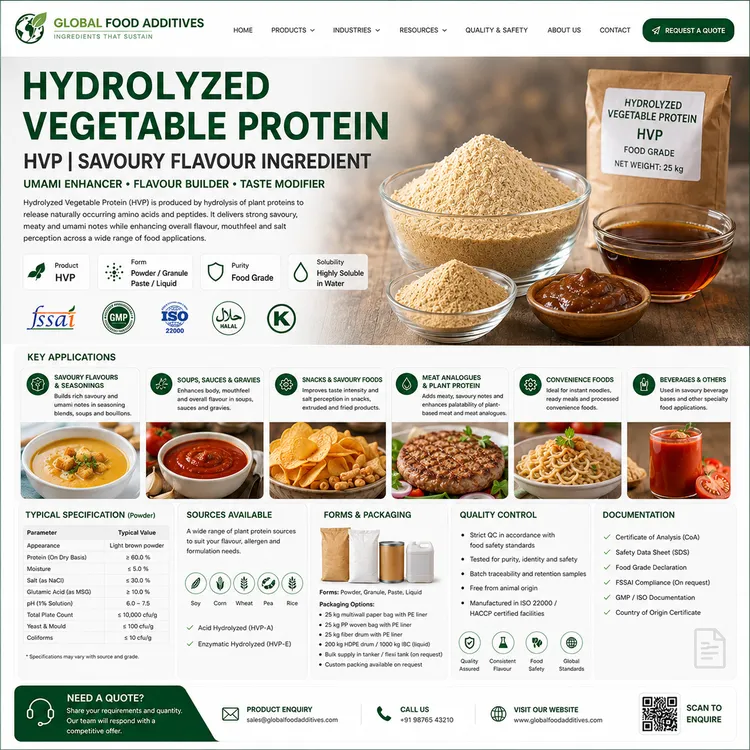
Hydrolyzed Vegetable Protein, commonly called HVP, is a plant-derived savoury flavour ingredient used to create umami, bouillon depth, roasted notes, meaty character, salt perception and overall taste balance. It is widely evaluated in seasoning systems, soups, sauces, snacks, ready meals, marinades, meat analogues and culinary formulations where consistent savoury impact is required.
Industrial buyers should select HVP by source protein, hydrolysis method, flavour profile, total nitrogen, amino nitrogen, salt level, solubility, colour, powder behaviour, allergen position, contaminant controls and destination-market labelling requirements. Global Food Additives supports supplier comparison, document review, sample coordination and export-ready quotation communication for food-grade HVP requirements.
Product identity
| Product | Hydrolyzed Vegetable Protein |
|---|---|
| Common names | HVP, hydrolysed vegetable protein, plant protein hydrolysate, savoury protein hydrolysate |
| Category | Flavour Enhancers & Taste Modifiers |
| Function | Flavour enhancer / taste modifier / savoury system ingredient / umami and bouillon note builder |
| E / INS number | No single universal E-number; confirm ingredient status, flavour status and label declaration by destination market |
| CAS / identity | Protein hydrolysate blend; identity depends on source protein and hydrolysis process |
| Typical source proteins | Soy, corn, wheat, pea, rice, rapeseed or other edible vegetable protein sources depending on grade |
| Hydrolysis methods | Acid hydrolysis, enzymatic hydrolysis, fermentation-assisted processes or blended savoury systems |
| Typical form | Powder, granule, paste, liquid concentrate, spray-dried grade or customized seasoning base |
| Key purchasing controls | Source protein, flavour profile, total nitrogen, amino nitrogen, salt, moisture, pH, colour, solubility, allergen status, 3-MCPD control, microbiology and heavy metals |
Application fit
HVP is selected when formulators need savoury impact, taste rounding, broth character, roasted depth or stronger overall flavour perception without relying only on salt or single-note flavour enhancers.
- Seasoning blends, snack seasonings, chips, crackers, extruded snacks and savoury dustings
- Instant soups, bouillons, stock cubes, broth powders and culinary bases
- Sauces, gravies, marinades, dressings, condiments and ready-meal sauces
- Meat analogues, plant-based meat, vegan burgers, sausages and restructured products
- Processed meat, poultry and seafood seasonings where permitted by local rules
- Noodles, ramen seasonings, dry mixes, meal kits and instant savoury foods
- Frozen meals, canned foods, retorted foods and shelf-stable prepared meals
- Flavour houses, savoury premix manufacturers and private-label seasoning producers
Technical overview for industrial buyers
Hydrolyzed Vegetable Protein is produced by breaking plant proteins into smaller peptides and amino acids. This hydrolysis creates a savoury ingredient rich in taste-active compounds such as free amino acids, peptides, salts and process-derived flavour molecules. The result can deliver bouillon, roasted, soy sauce-like, meaty, cooked vegetable, cereal, nutty, brothy or fermented notes depending on the source material and manufacturing method.
Acid-HVP and enzymatic HVP can perform very differently. Acid-HVP is often stronger, darker, saltier and more bouillon-like because acid hydrolysis and neutralization can create a concentrated savoury profile. Enzymatic HVP is often selected where the manufacturer needs a milder, cleaner, lighter-coloured or lower-salt profile. Many commercial products are not pure hydrolysates; they may be blended with salt, yeast extract, maltodextrin, sugar, amino acids, spices, flavourings or carriers to meet a target taste profile.
Functional performance
- Builds umami, broth, roasted, cooked and meaty flavour character
- Improves savoury depth in soups, sauces, snacks and ready meals
- Supports salt perception and flavour impact in sodium-reduction projects
- Rounds harsh, bitter, acidic, metallic or thin flavour profiles in selected systems
- Can enhance meat analogue taste and mask plant-protein off-notes
- Contributes amino acid and peptide complexity beyond single flavour enhancers
- Can be blended into dry seasonings, liquid bases, pastes and culinary concentrates
- Supports consistent taste standardisation across industrial production batches
Grade and source selection
| Soy HVP | Common savoury base with strong umami and brothy notes; requires soy allergen review where applicable. |
|---|---|
| Corn HVP | Often used where soy or wheat avoidance is needed; flavour profile may be lighter or more cereal-like depending on grade. |
| Wheat HVP | Can provide strong savoury depth but requires wheat and gluten-related label review for many markets and customers. |
| Pea HVP | Useful in plant-based and allergen-conscious systems, subject to flavour, off-note and regional allergen review. |
| Rice HVP | Often evaluated where a milder profile or specific allergen positioning is required; taste strength must be validated. |
| Enzymatic HVP | Often selected for cleaner label positioning, milder hydrolysis conditions, lower salt possibilities and softer savoury notes. |
| Acid-HVP | Often selected for strong bouillon, roasted and dark savoury character; requires strict contaminant and salt review. |
Application-specific guidance
In seasoning blends and snack systems, HVP provides savoury backbone and improves impact at low dosage. It can be combined with yeast extract, MSG, disodium inosinate, disodium guanylate, onion powder, garlic powder, spices, maltodextrin, salt, sugar, acids and natural or artificial flavours to build a complete savoury profile. The correct grade depends on the target flavour direction: chicken, beef, vegetable, mushroom, cheese, barbecue, soy sauce, ramen, roasted onion or general umami.
In soups, sauces and ready meals, HVP can replace part of meat extract, strengthen broth perception, improve cooked flavour and compensate for flavour loss during canning, freezing, drying or retorting. In plant-based meat systems, HVP can help cover pea, soy, wheat or cereal off-notes while adding roasted, meaty, brothy or grilled character. Heat stability, colour contribution and salt balance should be checked in the finished matrix.
Seasonings, snacks and dry mixes
- Snack seasonings: adds strong savoury impact and improves flavour release on chips, crackers and extruded snacks.
- Instant soup powders: provides bouillon depth, salt perception and cooked background notes.
- Noodle seasonings: supports ramen-style broth, soy sauce, meat, mushroom or vegetable flavour systems.
- Dry premixes: requires control of particle size, flowability, caking, hygroscopicity and blend uniformity.
Sauces, meats and plant-based foods
- Ready-meal sauces: strengthens savoury body after heating, chilling, freezing or retorting.
- Marinades and gravies: builds meaty depth and improves taste continuity across batches.
- Plant-based meats: masks plant-protein bitterness and adds roasted, brothy or umami notes.
- Processed meats: supports flavour standardisation where local rules and customer standards permit use.
Processing and formulation considerations
HVP should be added according to the processing format. Powder grades may be dry-blended with salt, spices, maltodextrin, starch, flour, sugar or yeast extract before use. Liquid or paste grades are usually easier to dose into wet systems but require viscosity, pumpability, microbiology and preservation review. Hygroscopic powder grades require moisture control during handling and storage to prevent caking.
Flavour performance should be evaluated after the complete manufacturing process, not only in a water solution. Heat treatment, retorting, frying, baking, drying, pH, salt, sugar, fat, proteins, acids, spices and packaging can change flavour perception. In dry snack systems, the finished seasoning should be tested for dusting, adhesion, oil compatibility, colour, caking, flavour release and shelf-life stability.
For sodium-reduction projects, HVP can improve salt perception but it may also contribute sodium depending on the hydrolysis process and formulation. Buyers should compare sodium content, chloride content, salt level, taste impact and cost-in-use instead of evaluating only the dosage rate.
Typical quality parameters
- Appearance, colour, odour and sensory profile
- Source protein and hydrolysis method
- Total nitrogen, amino nitrogen and degree of hydrolysis where specified
- Salt, sodium, chloride and ash content
- Moisture, water activity and dry matter
- pH, solubility and insoluble matter
- Particle size, bulk density, flowability and caking tendency for powder grades
- Viscosity, Brix or solids for liquid and paste grades
- Glutamic acid or free glutamate content where required by the buyer
- 3-MCPD, 2-MCPD or chloropropanol data for acid-hydrolyzed grades where required
- Microbiological limits including total plate count, yeast, mold, coliforms and pathogens where applicable
- Heavy metals, contaminants and pesticide or mycotoxin checks where required by market or customer standards
Common purchasing risks
- Buying by “HVP” name only without confirming source protein and hydrolysis method
- Replacing one supplier with another without sensory matching in the final application
- Ignoring allergen declaration for soy, wheat, gluten or other source materials
- Assuming HVP and MSG have the same label, taste or regulatory position
- Using acid-HVP without checking 3-MCPD or chloropropanol compliance documents
- Not controlling salt and sodium contribution in reduced-sodium formulations
- Approving a dry powder without testing caking, dusting, flowability and shelf-life stability
- Requesting a “natural” or “clean label” claim without checking local flavour and ingredient rules
Regulatory, allergen and labelling notes
Hydrolyzed Vegetable Protein does not have one universal E-number or one universal label name. The final declaration depends on the destination market, source protein, hydrolysis route, flavour status, carrier system, added ingredients and finished food category. Some markets may require the source to be named, such as hydrolyzed soy protein, hydrolyzed corn protein or hydrolyzed wheat protein. Buyers should verify whether the material is declared as a flavouring, seasoning ingredient, protein hydrolysate, hydrolyzed vegetable protein or a more specific source-based ingredient.
Allergen review is critical. HVP may be produced from soy, wheat, pea, corn, rice, rapeseed or other sources, and allergen obligations depend on the source material and destination-market rules. In the United States, the major food allergens include milk, eggs, fish, crustacean shellfish, tree nuts, peanuts, wheat, soybeans and sesame. The food source of a major allergen must be declared on labels where applicable. Other markets may have additional allergens or different declaration formats.
Acid-hydrolyzed vegetable protein may require additional contaminant review, especially for 3-MCPD and related chloropropanols. Buyers should request supplier statements and analytical data where relevant, particularly for export shipments, infant-food applications, premium seasonings, customer-controlled specifications and markets with defined contaminant limits.
Documents to request
- Product specification or technical data sheet with flavour description and recommended applications
- Certificate of analysis for the available batch or lot
- Source-protein declaration, such as soy, corn, wheat, pea, rice or other botanical source
- Hydrolysis method statement: acid-hydrolyzed, enzymatic, fermented, blended or supplier-specific process
- Food-grade statement and destination-market compliance statement
- Ingredient declaration, flavour declaration and label-name recommendation for the target market
- Allergen statement, including soy, wheat, gluten and cross-contact position where relevant
- GMO, non-GMO, vegan, halal and kosher statements where required by the customer
- 3-MCPD, 2-MCPD, chloropropanol or process-contaminant statement for acid-HVP where required
- Salt, sodium, total nitrogen, amino nitrogen and moisture data
- Microbiological specification and recent test results
- Heavy-metal and contaminant declaration
- Safety data sheet where applicable for industrial handling
- Shelf-life, storage conditions and retest policy
- Packaging specification, net weight, pallet configuration and container loading details
- Change-control, non-irradiation, BSE/TSE, pesticide, residual solvent and food-contact packaging statements when required
Packaging, storage and logistics
HVP powders are commonly supplied in multiwall paper bags with food-grade inner liners, cartons, drums, fibre drums or big bags depending on grade and volume. Liquid and paste grades may be supplied in pails, drums, jerrycans, IBCs or other sealed food-grade containers. Packaging should protect the material from moisture, odour pickup, oxidation, microbial contamination, caking, leakage and warehouse damage.
Store in a cool, dry, clean and well-ventilated warehouse away from moisture, strong odours and direct sunlight. Hygroscopic powder grades should be resealed immediately after opening. Liquid and paste grades should be stored according to supplier temperature instructions and used within the recommended period after opening. For export shipments, buyers should confirm net weight, gross weight, pallet type, label language, batch coding, country-of-origin marking and whether heat-treated pallets or other documents are required.
Who usually buys Hydrolyzed Vegetable Protein?
- Seasoning blend, snack seasoning and savoury powder manufacturers
- Soup, bouillon, stock cube and culinary base producers
- Sauce, gravy, marinade, dressing and condiment manufacturers
- Ready-meal, frozen meal, canned food and retorted food producers
- Plant-based meat, vegan burger and meat-alternative manufacturers
- Processed meat, poultry and seafood seasoning producers
- Flavour houses, premix companies, distributors and private-label suppliers
Information needed for quotation
- Target product name: Hydrolyzed Vegetable Protein, HVP or source-specific hydrolyzed protein
- Preferred source: soy, corn, wheat, pea, rice, rapeseed or allergen-conscious alternative
- Hydrolysis type: acid-HVP, enzymatic HVP, low-salt HVP or custom savoury blend
- Target flavour profile: chicken, beef, vegetable, mushroom, soy sauce, roasted, brothy or general umami
- Required form: powder, granule, paste, liquid concentrate or spray-dried grade
- Target salt, sodium, total nitrogen, amino nitrogen or free glutamate values if specified
- Current specification, COA or approved supplier reference if available
- Destination country and label or allergen documentation needs
- Trial quantity, commercial quantity and annual volume
- Preferred packaging size and pallet requirements
- Required certificates: halal, kosher, vegan, allergen, GMO, origin or other declarations
- Delivery term, destination port or warehouse address
- Expected shipment date and sample approval timeline
How Global Food Additives supports sourcing
Global Food Additives can help compare HVP options by source protein, hydrolysis route, taste profile, salt level, nitrogen values, powder handling, allergen status, contaminant controls, documentation package, packaging format and commercial availability. For industrial customers, the fastest sourcing route is to provide an existing specification, certificate of analysis, target flavour direction, approved supplier reference and destination market. This allows supplier options to be compared by sensory performance and regulatory fit, not only by price per kilogram.
For new product development, our team can coordinate sample options and supplier questions around source selection, low-salt options, enzymatic versus acid-HVP, allergen positioning, vegan requirements, halal/kosher status, seasoning compatibility, export documentation and packaging. Final formulation, sensory approval, use level, regulatory review and finished-product label remain the responsibility of the manufacturer.
How to request this product
Send the product name, target source protein, hydrolysis method, flavour profile, application, salt or sodium target, quantity, destination country, packaging preference, expected shipment date and required documents. If you already purchase Hydrolyzed Vegetable Protein, attach or describe your current specification, certificate of analysis, label, sensory standard or approved supplier reference so supplier options can be compared accurately.
Useful answers
What is Hydrolyzed Vegetable Protein used for in food manufacturing?
Hydrolyzed Vegetable Protein is used for umami, savoury depth, bouillon notes, roasted flavour, salt perception, taste rounding and overall flavour balance. It is commonly evaluated in seasonings, soups, sauces, snacks, ready meals, marinades, processed foods and plant-based meat systems.
Is HVP the same as MSG?
No. HVP is a complex savoury ingredient made from hydrolyzed plant protein. It may contain free glutamate and may sometimes be blended with MSG, but it is not automatically the same ingredient. Buyers should check the supplier specification and label declaration.
What is the difference between acid-HVP and enzymatic HVP?
Acid-HVP is generally stronger, darker, saltier and more bouillon-like. Enzymatic HVP is often milder, lighter and more suitable where lower salt or cleaner sensory profile is preferred. Exact performance depends on source protein, process and supplier grade.
Does HVP contain allergens?
It can. HVP may be made from soy, wheat or other allergenic sources, so allergen declaration depends on source material and destination-market rules. Buyers should request a source-protein declaration and allergen statement before approval.
What should be checked for acid-HVP?
Acid-HVP should be reviewed for salt, sodium, total nitrogen, amino nitrogen, flavour strength, colour, pH, solubility and process contaminants such as 3-MCPD or related chloropropanols where required by market or customer standards.
Can Global Food Additives source Hydrolyzed Vegetable Protein?
Global Food Additives can review sourcing options for Hydrolyzed Vegetable Protein according to source protein, hydrolysis method, flavour profile, form, quantity, destination, packaging and required documentation.
Which documents should be requested?
Buyers commonly request a technical specification, certificate of analysis, source-protein declaration, allergen statement, GMO statement, food-grade statement, safety data sheet where applicable, 3-MCPD statement for acid-HVP, microbiological data, heavy-metal statement, shelf-life information and packing details.
Is this product permitted in every country?
No. Ingredient status, label name, allergen declaration, use level, contaminant limits and flavour declaration depend on destination-market rules, source material, hydrolysis method, food category and buyer responsibility.
Tell us which food additive or ingredient you need.
Send product names, target specifications, quantity, destination country, packaging preference, delivery term, and document requirements. Our team will review your inquiry and respond from [email protected].
Your message has been received. You will be redirected to the home page.