
Hydroxypropyl Cellulose E463
Hydroxypropyl Cellulose, commonly called HPC, is a food-grade cellulose ether hydrocolloid used for viscosity control, suspension, stabilization, film formation, protective colloid behavior, water binding and binding performance. It is selected when a manufacturer needs a cellulose-based functional ingredient with clean taste, controlled hydration and reliable processing performance.
Industrial purchasing should focus on viscosity grade, substitution level, hydroxypropoxy content, particle size, hydration profile, film strength, binder performance, process compatibility and destination-market compliance. Global Food Additives supports specification review, supplier comparison, sample coordination, document collection and export-ready quotation communication for E463 Hydroxypropyl Cellulose requirements.
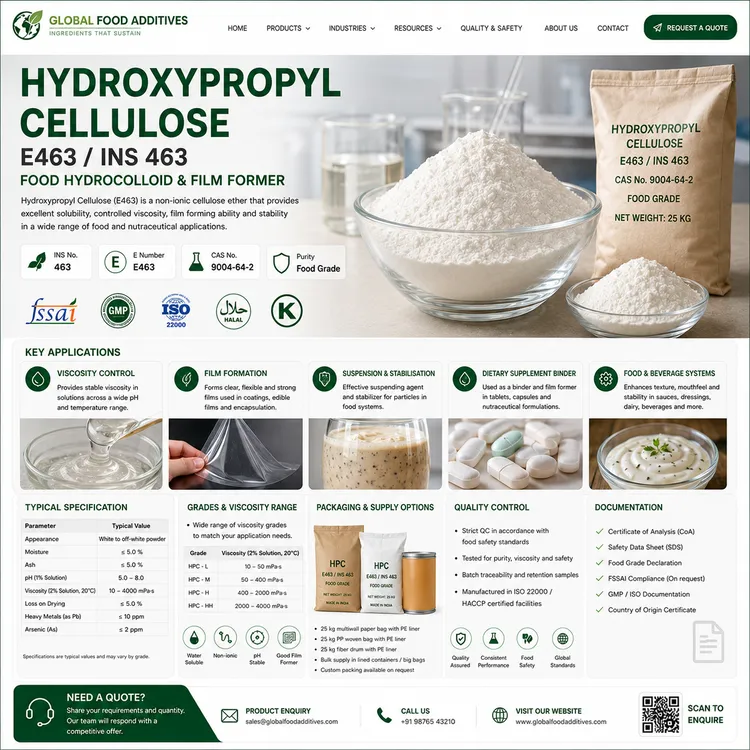
Product identity
| Product | Hydroxypropyl Cellulose |
|---|---|
| Common names | HPC, Hydroxypropyl Cellulose E463, Low-Substituted Hydroxypropyl Cellulose where applicable |
| Category | Hydrocolloids, Gums & Gelling Agents |
| Function | Thickener / stabilizer / film former / protective colloid / suspending agent / binder |
| E / INS number | E463 / INS 463 |
| CAS / identity | 9004-64-2 |
| Chemical family | Non-ionic cellulose ether produced by hydroxypropyl substitution of cellulose |
| Typical form | Fine powder, granule, surface-treated powder, low-substituted grade or application-specific preparation |
| Key functionality | Viscosity development, suspension, film formation, binding, water retention and protective colloid performance |
| Key purchasing controls | Viscosity, hydroxypropoxy content, substitution level, particle size, moisture, ash, pH, hydration behavior, microbiology, heavy metals, residual reagents and regulatory documents |
Application fit
Hydroxypropyl Cellulose is selected where formulators need controlled viscosity, stable dispersion, film-forming capability or binding performance in dry, aqueous or coating-related systems.
- Food coatings, glazes, surface films and protective coating systems
- Dietary supplement tablets, vitamin/mineral tablets and solid-dose binder systems where permitted
- Sauces, dressings, dips, condiments and water-phase stabilizer systems
- Dry mixes, instant powders, powdered beverages and seasoning systems
- Confectionery coatings, compressed sweets and texture-standardized fillings
- Bakery preparations, fillings, toppings, creams and controlled-viscosity systems
- Suspensions containing minerals, fibers, cocoa, spices, proteins or other insoluble particles
- Encapsulation, carrier and protective colloid systems where supplier grade is suitable
Technical overview for industrial buyers
Hydroxypropyl Cellulose is made by modifying cellulose with hydroxypropyl groups. This substitution changes the hydration, solubility, viscosity and film-forming behavior of the cellulose backbone. In food and supplement manufacturing, it is valued because it can provide controlled viscosity, improve suspension stability, form films, act as a protective colloid and support binding in selected compressed or coated systems.
Commercial grades vary widely. Some grades are designed for higher solution viscosity and thickening performance. Others are selected for film formation, binder performance, rapid hydration, controlled dispersion or low-substituted tablet functionality. Buyers should not treat all HPC grades as interchangeable. A supplier replacement can change hydration speed, viscosity curve, powder handling, coating performance, tablet hardness, disintegration behavior, mouthfeel, stability and finished-product appearance.
Functional performance
- Builds viscosity and body in selected aqueous systems
- Improves suspension of insoluble particles, powders or active ingredients
- Forms flexible films for coating, glazing and surface-protection applications
- Supports binder performance in selected dietary supplement tablet systems
- Can act as a protective colloid to support dispersion stability
- Provides water binding and texture control in selected formulations
- May improve powder cohesion, granulation and solid-dose handling performance
- Offers cellulose-derived functionality with generally neutral flavor contribution
Grade selection variables
| Viscosity grade | Controls solution thickness, suspension power, coating viscosity, processing flow and finished-product mouthfeel. |
|---|---|
| Substitution level | Influences solubility, hydration, film behavior, binder performance and compatibility with the application matrix. |
| Low-substituted grade | Often evaluated for tablet binding and disintegration performance in dietary supplement or solid-dose systems. |
| Particle size | Affects wetting, dusting, lumping, blend uniformity, granulation performance and hydration speed. |
| Surface treatment | Can help control dispersion and reduce lumping before full hydration in liquid processing. |
| Film-forming grade | Selected for coating strength, flexibility, adhesion, clarity and compatibility with plasticizers or pigments. |
Application-specific guidance
In coating and film systems, Hydroxypropyl Cellulose can help create a thin, cohesive film around food pieces, confectionery products, supplement tablets or other permitted products. The grade should be tested for coating viscosity, sprayability, adhesion, film clarity, cracking resistance, drying time, surface gloss and compatibility with colors, flavors, plasticizers, minerals or active ingredients.
In supplement tablet systems, low-substituted Hydroxypropyl Cellulose may be evaluated for binding and disintegration. Formulators should test tablet hardness, friability, compression force, disintegration time, moisture sensitivity, active compatibility and shelf-life behavior. Where products are sold as foods, supplements or regulated nutrition products, the permitted use and label declaration must be checked for the destination market.
Coating, glazing and film systems
- Food coatings: supports film formation, surface coverage and protective barrier performance where permitted.
- Confectionery: can support surface gloss, coating uniformity or film integrity in selected systems.
- Tablet coatings: helps form uniform films around dietary supplement tablets when the grade is suitable.
- Color and flavor coatings: requires compatibility testing with pigments, dyes, flavors, acids and plasticizers.
Viscosity, suspension and binder systems
- Suspensions: supports uniform distribution of minerals, fibers, cocoa, spices or insoluble particles.
- Dry mixes: can help control hydration, particle distribution and reconstitution behavior.
- Solid-dose supplements: supports binder or disintegration performance where the selected grade is appropriate.
- Sauces and dressings: may provide viscosity and stabilization in selected water-phase systems after validation.
Processing and hydration recommendations
Hydroxypropyl Cellulose powders should be dispersed carefully to prevent lumping and incomplete hydration. Depending on grade, the material may be dry-blended with sugar, salt, starch, flour, maltodextrin, protein powder or other dry ingredients before being added to the liquid phase. The correct process depends on viscosity grade, particle size, surface treatment, water temperature, mixing energy and total solids.
For liquid systems, manufacturers should test powder addition rate, shear level, hydration time, pH, salt level, sugar level and any interaction with acids, preservatives, colors or flavors. Viscosity should be measured after full hydration, not only immediately after dispersion. For film and coating systems, solution preparation should be validated for clarity, air entrainment, foam, sprayability, drying time and final film properties.
In tablet and granulation systems, the grade should be tested under the real process route: dry blending, wet granulation, direct compression, coating, drying and packaging. Because powder behavior can vary between suppliers, plant trials should evaluate flowability, compressibility, tablet hardness, disintegration, friability and dusting before commercial approval.
Typical quality parameters
- Appearance, color, odor and visual purity
- Viscosity under defined concentration, temperature and method
- Hydroxypropoxy content or substitution data where included in the specification
- Moisture or loss on drying
- Ash, pH and insoluble matter
- Particle size distribution, bulk density and flowability
- Hydration rate, lumping behavior and surface-treatment status
- Film strength, adhesion or coating performance where relevant
- Binder or disintegration performance where relevant to supplement tablets
- Microbiological limits including total plate count, yeast, mold, coliforms and pathogens where applicable
- Heavy metals, residual reagents and impurities according to market and customer requirements
- Allergen, GMO, vegan, halal and kosher status where required by the customer
Common purchasing risks
- Buying only by “HPC” or “E463” without confirming viscosity grade and substitution profile
- Confusing Hydroxypropyl Cellulose E463 with Hydroxypropyl Methylcellulose E464
- Using a high-viscosity grade where a film-forming or binder grade is needed
- Changing supplier without checking hydration speed, solution clarity and coating performance
- Approving a tablet binder without testing hardness, friability and disintegration time
- Ignoring powder particle size, dusting and blending behavior in dry systems
- Not confirming destination-market status, label declaration and customer restrictions
- Not checking microbiology, heavy metals, residual reagents and certification documents before shipment
Regulatory and compliance notes
Hydroxypropyl Cellulose is commonly identified as E463 / INS 463 in many food additive systems. Regulatory treatment depends on the destination country, food category, use level, purity criteria, label declaration, customer standard and whether the product is supplied as standard HPC, low-substituted HPC or part of a blended preparation.
In the United States, Hydroxypropyl Cellulose is listed under 21 CFR 172.870. The regulation describes forms of the additive, including a cellulose ether containing propylene glycol groups and a low-substituted hydroxypropyl cellulose form. It permits specified use as an emulsifier, film former, protective colloid, stabilizer, suspending agent or thickener in food in accordance with good manufacturing practice, and also addresses use as a binder or binder and disintegrator in certain dietary supplement applications.
For the European Union, United Kingdom, GCC countries, Turkey, Codex-aligned markets and other destinations, buyers should confirm E463 permission, food-category restrictions, purity criteria, supplement use, infant-food restrictions, organic compatibility, vegetarian or vegan positioning and customer-specific requirements before commercial production.
Documents to request
- Product specification or technical data sheet with viscosity grade and test method
- Certificate of analysis for the available batch or lot
- Food-grade statement and E463 / INS 463 declaration
- Hydroxypropoxy content, substitution data or low-substituted grade statement where applicable
- Safety data sheet where applicable for industrial handling
- Origin, manufacturer, production site and traceability statement
- Allergen, GMO, vegan, halal and kosher statements where required
- Microbiological specification and recent test results
- Heavy-metal and elemental impurity declaration
- Residual reagent, residual solvent or contaminant statement where required by the customer or market
- Film-forming, binder, disintegration or application data where relevant
- Shelf-life, storage conditions and retest policy
- Packaging specification, net weight, pallet configuration and container loading details
- Change-control, non-irradiation, BSE/TSE, pesticide and food-contact packaging statements when required
Packaging, storage and logistics
Hydroxypropyl Cellulose is commonly supplied in multiwall paper bags with food-grade inner liners, cartons, drums, fibre drums or other sealed industrial packaging depending on grade and volume. Packaging should protect the material from moisture, odour pickup, contamination and warehouse damage. For export shipments, buyers should confirm net weight, gross weight, pallet dimensions, batch coding, label language, country-of-origin marking and whether heat-treated pallets or fumigation documentation are required.
Store in a cool, dry, clean and well-ventilated warehouse away from moisture, strong odours and direct sunlight. Opened bags should be resealed immediately. Because cellulose ether powders can absorb moisture and form lumps, humidity control and first-expiry-first-out stock rotation are important. Powders should be handled using good dust-control practices, especially in dry blending, powder transfer and pneumatic conveying operations.
Who usually buys Hydroxypropyl Cellulose?
- Food coating, glaze and surface-treatment manufacturers
- Dietary supplement, vitamin and mineral tablet manufacturers
- Confectionery, compressed sweet and coating producers
- Sauce, dressing, dip and culinary product manufacturers
- Dry mix, instant powder and seasoning blend producers
- Bakery filling, cream, topping and dessert manufacturers
- Hydrocolloid blend producers, premix companies and ingredient distributors
Information needed for quotation
- Target product name: Hydroxypropyl Cellulose, HPC or E463
- Application and finished product type
- Required function: viscosity, film formation, suspension, protective colloid, binder or disintegrator
- Target viscosity grade and test method, if known
- Standard or low-substituted grade requirement
- Preferred grade type: fine powder, granule, surface-treated or instantized grade
- Current specification, COA or approved supplier reference if available
- Process conditions: mixing temperature, hydration method, pH, solids, coating method or compression method
- Destination country and regulatory documentation needs
- Trial quantity, commercial quantity and annual volume
- Preferred packaging size and pallet requirements
- Required certificates: halal, kosher, vegan, allergen, GMO, origin or other declarations
- Delivery term, destination port or warehouse address
- Expected shipment date and sample approval timeline
How Global Food Additives supports sourcing
Global Food Additives can help compare Hydroxypropyl Cellulose grades by viscosity, substitution profile, particle size, hydration behavior, film formation, binder performance, documentation package, packaging format and commercial availability. For industrial customers, the fastest sourcing route is to provide an existing specification, certificate of analysis, approved supplier reference, application details and process conditions. This allows supplier options to be compared by real cost-in-use and process performance, not only by price per kilogram.
For new product development, our team can coordinate sample options and supplier questions around viscosity, coating behavior, tablet binding, disintegration performance, suspension stability, powder handling, documentation and export logistics. Final formulation, process validation, use level, regulatory review and finished-product label remain the responsibility of the manufacturer.
How to request this product
Send the product name, target grade or reference specification, required function, viscosity target, application, process conditions, quantity, destination country, packaging preference, expected shipment date and required documents. If you already purchase Hydroxypropyl Cellulose, attach or describe your current specification, certificate of analysis, label, process conditions or approved supplier reference so supplier options can be compared accurately.
Useful answers
What is Hydroxypropyl Cellulose used for in food manufacturing?
Hydroxypropyl Cellulose is used as a thickener, stabilizer, film former, suspending agent, protective colloid and binder. It is commonly evaluated in coatings, glazes, supplement tablets, dry mixes, sauces, confectionery, suspension systems and selected processed food applications.
How is Hydroxypropyl Cellulose different from HPMC?
Hydroxypropyl Cellulose is E463 and contains hydroxypropyl substitution. Hydroxypropyl Methylcellulose is E464 and contains both hydroxypropyl and methyl substitution. The two materials can perform differently in viscosity, hydration, thermal behavior, film formation and gel behavior.
What is low-substituted Hydroxypropyl Cellulose?
Low-substituted Hydroxypropyl Cellulose is a lower-substitution form often evaluated for binding and disintegration performance in tablet or wafer systems, including dietary supplement applications where permitted.
Does Hydroxypropyl Cellulose dissolve easily?
Solubility and hydration behavior depend on grade, substitution level, particle size, surface treatment, water temperature, pH, solids and mixing conditions. Buyers should follow the supplier's dispersion and hydration instructions and validate the process at plant scale.
Can Global Food Additives source Hydroxypropyl Cellulose?
Global Food Additives can review sourcing options for Hydroxypropyl Cellulose according to viscosity grade, substitution level, particle size, application, quantity, destination, packaging and required documentation.
Which documents should be requested?
Buyers commonly request a technical data sheet, certificate of analysis, viscosity method, food-grade statement, E463 / INS 463 declaration, safety data sheet where applicable, allergen and GMO statements, microbiological data, heavy-metal statement, shelf-life information and packing details.
Is this product permitted in every country?
No. Food additive use depends on destination-market rules, food category, use level, purity criteria, label requirements and buyer responsibility. Always verify final suitability for the intended application.
Tell us which food additive or ingredient you need.
Send product names, target specifications, quantity, destination country, packaging preference, delivery term, and document requirements. Our team will review your inquiry and respond from orders@foodgradeadditives.com.
Your message has been received. You will be redirected to the home page.