
Inulin
Inulin is a food-grade soluble dietary fiber and prebiotic fructan used for fiber enrichment, sugar reduction, fat replacement, texture building, bulking, water management and mouthfeel improvement. It is especially valuable in applications where manufacturers need clean-tasting fiber functionality without the abrasive texture normally associated with many insoluble fibers.
Industrial buyers should select inulin by source, chain-length profile, dietary fiber content, mono- and disaccharide level, solubility, sweetness, particle size, process tolerance and destination-market labeling requirements. Global Food Additives supports supplier comparison, document collection and export-ready quotation coordination for food-grade inulin requirements.
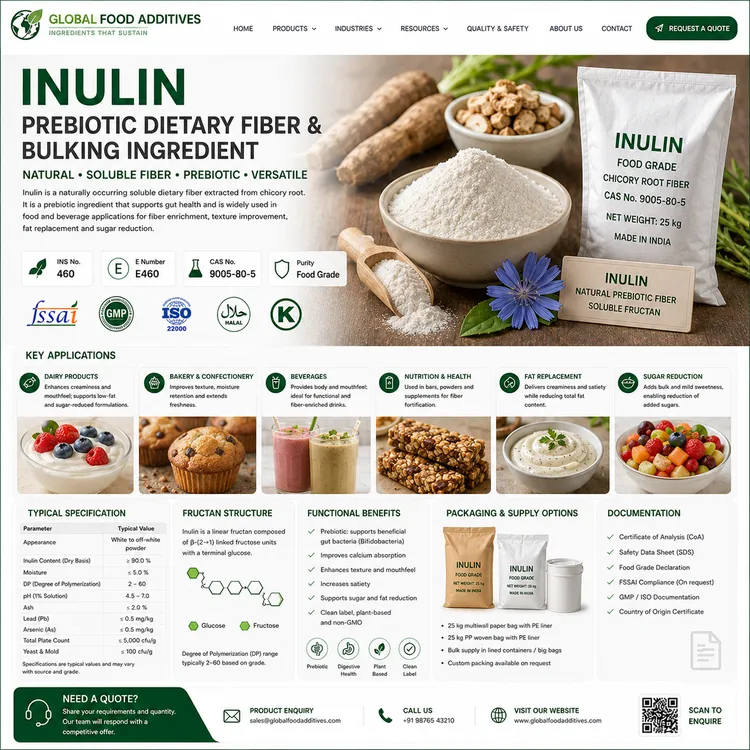
Product identity
| Product | Inulin |
|---|---|
| Category | Dietary Fibers, Prebiotic Fibers & Bulking Ingredients |
| Function | Soluble dietary fiber / prebiotic fiber / bulking ingredient / texture and mouthfeel modifier |
| E / INS number | No universal E-number; confirm dietary fiber, ingredient or additive status by destination-market rules and supplier documents |
| CAS / identity | 9005-80-5 |
| Chemical family | Inulin-type fructan, mainly beta(2→1)-linked fructose units, often with a terminal glucose unit |
| Typical source | Chicory root, Jerusalem artichoke or other botanical sources depending on supplier grade |
| Typical form | Fine powder, agglomerated powder, instantized powder, granule or syrup |
| Functional grade families | Short-chain oligofructose, standard inulin and long-chain or high-performance inulin |
| Key purchasing controls | Dietary fiber content, degree of polymerization, sugars, moisture, solubility, particle size, microbiology, heavy metals, origin, allergen and GMO status |
Application fit
Inulin is selected when formulators need fiber content, clean sweetness support, creaminess, bulking, water binding or a fat-mimetic texture effect without strong color or flavor contribution.
- Yogurt, fermented dairy, milk drinks, spoonable desserts and reduced-fat dairy systems
- Plant-based beverages, vegan desserts, dairy alternatives and protein-fortified products
- Bakery products, biscuits, cakes, muffins, bread, bars and high-fiber cereal systems
- Chocolate, fillings, spreads, creams, confectionery centers and sugar-reduced sweet systems
- Nutritional powders, meal replacements, instant drinks and powdered supplement blends
- Sauces, dressings, soups and culinary systems requiring body and mouthfeel
- Ice cream and frozen desserts where water management and creaminess are important
- Functional foods where fiber enrichment, prebiotic positioning or calorie reduction is targeted
Technical overview for industrial buyers
Inulin is a plant-derived fructan rather than a polyol. It is typically made of fructose units connected mainly by beta(2→1) glycosidic bonds. Commercial grades vary by degree of polymerization, which strongly affects sweetness, solubility, viscosity, texture and process behavior. Shorter-chain products, often positioned as oligofructose or fructooligosaccharide-type ingredients, generally provide more sweetness and faster solubility. Longer-chain inulin grades are usually less sweet and are often chosen for body, creaminess, fat replacement and stable texture.
In manufacturing, inulin can support fiber claims, improve solids balance, replace part of sugar or fat, reduce caloric density and create a smoother mouthfeel. In high-water systems, it can dissolve or disperse depending on grade and process temperature. In certain formulations, long-chain inulin can contribute a fine particle network that gives a creamy or fat-like sensory effect. The correct grade must therefore be selected according to the finished product, target claim, processing temperature, water phase, solids level, pH, shelf-life conditions and label strategy.
Functional performance
- Contributes soluble dietary fiber to finished food and beverage formulations
- Supports prebiotic fiber positioning where legally permitted and scientifically substantiated
- Provides mild sweetness depending on chain length and residual sugar profile
- Improves body, creaminess and mouthfeel in dairy, plant-based and dessert systems
- Helps replace part of sugar, fat or flour while maintaining solids and texture
- Supports water binding and texture stability in selected bakery and filling systems
- Can improve powder blend flow, dispersibility and nutritional formulation balance
- May contribute to reduced-calorie formulations depending on market-specific energy values
Grade selection by chain length
| Oligofructose / short-chain | Higher solubility and more sweetness; often selected for beverages, syrups, fruit preparations and systems needing easier dissolution. |
|---|---|
| Standard inulin | Balanced fiber enrichment, mild sweetness, body and general-purpose use across bakery, dairy, nutrition and confectionery systems. |
| Long-chain inulin | Lower sweetness and stronger texture-building effect; often selected for fat replacement, creaminess and high-performance mouthfeel. |
| Instantized grade | Improved wetting and dispersion; useful in powdered drinks, nutritional blends and applications where lumping must be minimized. |
| Syrup or liquid grade | Useful where liquid dosing, rapid mixing and pumpable processing are preferred, subject to solids, microbiology and storage stability. |
Application-specific guidance
In dairy and plant-based systems, inulin can support body, creaminess and fiber content without a strong taste impact. It is often evaluated in yogurt, drinkable dairy, ice cream, cream cheese-style products, vegan desserts, oat beverages, soy beverages and protein drinks. The final result depends on hydration, homogenization, heat treatment, protein level, stabilizer system, fat content and storage temperature.
In bakery and cereal products, inulin can add fiber and support reduced-sugar or reduced-fat concepts, but it may affect dough water demand, browning, spread, softness and shelf life. In confectionery and fillings, it may improve body and solids balance, but formulators must consider water activity, crystallization behavior, sweetness balance, heat exposure and digestive tolerance at the intended serving size.
Dairy, beverage and dessert systems
- Yogurt and fermented dairy: supports fiber enrichment, body, creaminess and reduced-fat texture.
- Milk drinks and cocoa beverages: can improve mouthfeel and nutritional positioning when solubility is properly matched.
- Ice cream and frozen desserts: helps build creaminess and solids, and may support reduced-fat or reduced-sugar concepts.
- Plant-based products: helps compensate for lower fat or different protein functionality in oat, soy, almond and mixed-base systems.
Bakery, confectionery and nutrition systems
- Bakery products: supports fiber claims and texture control but requires water-balance and browning validation.
- Bars and cereals: improves fiber content, solids balance and eating quality in high-fiber formulations.
- Chocolate and fillings: can support bulking and texture in sugar-reduced or fiber-enriched systems.
- Nutritional powders: contributes soluble fiber and prebiotic positioning while supporting powder blend formulation.
Processing and formulation considerations
Inulin should be introduced in a way that ensures complete wetting and avoids lumping. In powder systems, dry pre-blending with sugar, maltodextrin, proteins, starches or other powders can improve distribution. In liquid systems, the required hydration temperature and mixing time depend on chain length, particle size and supplier processing. Long-chain grades may require more careful hydration than highly soluble short-chain grades.
Formulators should validate inulin under actual plant conditions, including heating, cooling, homogenization, fermentation, freezing, baking, extrusion or filling where relevant. Acidic products, long heat exposure and high moisture systems should be tested for stability because hydrolysis or texture change can occur depending on process severity. Final products should be evaluated across shelf life for viscosity, syneresis, crystallization, sediment, flavor release, water activity and consumer tolerance.
Typical quality parameters
- Appearance, color, odor and taste
- Dietary fiber content and analytical method
- Degree of polymerization or chain-length profile
- Inulin, oligofructose, fructose, glucose and sucrose profile where specified
- Moisture, dry matter and water activity
- pH, ash and conductivity where included in the specification
- Solubility, dispersibility and particle size distribution
- Bulk density, flowability and caking tendency
- Microbiological limits including total plate count, yeast, mold, coliforms and pathogens where applicable
- Heavy metals and contaminants according to destination-market and customer requirements
Common purchasing risks
- Buying only by “inulin” name without confirming chain length and dietary fiber content
- Replacing short-chain oligofructose with long-chain inulin without reformulating sweetness and solubility
- Using long-chain grades in instant beverages without checking wetting and lumping behavior
- Assuming all markets accept the same dietary fiber declaration or prebiotic claim wording
- Ignoring digestive tolerance and serving-size impact in high-fiber products
- Not checking residual sugars when formulating low-sugar or reduced-sugar products
- Approving a supplier without microbiology, heavy-metal, allergen, GMO and origin documentation
Regulatory and labeling notes
Inulin is usually handled commercially as a food ingredient, dietary fiber ingredient, prebiotic fiber or bulking ingredient, depending on market and application. It does not have a single universal E-number comparable to many additives. Regulatory treatment can differ between the European Union, United Kingdom, United States, GCC countries, Turkey, Codex-aligned markets and other destinations.
Buyers should verify whether the intended use supports dietary fiber declaration, nutrition claims, reduced-sugar claims, calorie reduction, prebiotic claims or digestive-health claims in the destination market. Claim wording must be supported by local legislation, analytical methods, serving size, finished-product composition and the buyer's substantiation file. If inulin is used in infant nutrition, supplements, medical foods or products for special dietary use, additional regulatory review is usually required.
Documents to request
- Product specification or technical data sheet with source, grade and chain-length profile
- Certificate of analysis for the available batch or lot
- Dietary fiber content and analytical method used for declaration
- Mono- and disaccharide profile, especially fructose, glucose and sucrose where relevant
- Food-grade statement and destination-market compliance statement
- Origin, manufacturer, production site and botanical source declaration
- Allergen, GMO, vegan, halal and kosher statements where required
- Microbiological specification and recent test results
- Heavy-metal and contaminant declaration
- Shelf-life, storage conditions and retest policy
- Safety data sheet where applicable for industrial handling
- Packaging specification, net weight, pallet configuration and container loading details
- Change-control, non-irradiation, BSE/TSE, pesticide, residual solvent and contaminant statements when required
Packaging, storage and logistics
Inulin is commonly supplied in multiwall paper bags with food-grade inner liners, cartons, drums, big bags or sealed industrial packs depending on grade and volume. Packaging should protect the product from moisture, odor pickup, foreign material and warehouse contamination. For export orders, buyers should confirm net weight, gross weight, pallet type, pallet dimensions, label language, batch coding, country-of-origin marking and whether heat-treated pallets or fumigation documentation are required.
Store in a cool, dry, clean and well-ventilated area away from moisture, strong odors and direct sunlight. Because inulin powders can absorb moisture and form lumps, humidity control and first-expiry-first-out stock rotation are important. Opened bags should be resealed immediately and protected from cross-contamination. For syrup or liquid grades, buyers should confirm microbiological controls, storage temperature, viscosity, pumpability and shelf-life after opening.
Who usually buys Inulin?
- Dairy, yogurt, dessert and ice cream manufacturers
- Plant-based beverage and alternative dairy producers
- Bakery, biscuit, cereal and snack manufacturers
- Chocolate, confectionery, filling and spread producers
- Nutrition powder, bar and supplement manufacturers
- Functional food brands developing fiber-enriched products
- Premix companies, ingredient distributors and private-label suppliers
Information needed for quotation
- Target application and finished product type
- Required function: fiber enrichment, prebiotic positioning, sugar reduction, fat replacement or texture improvement
- Preferred grade: oligofructose, standard inulin, long-chain inulin, instantized powder or syrup
- Required dietary fiber content and analytical method, if specified
- Reference specification, current COA or approved supplier grade
- Destination country and label or claim requirements
- Trial quantity, annual volume and order frequency
- Preferred packaging size and pallet requirements
- Required certificates: halal, kosher, vegan, allergen, GMO, origin or other declarations
- Delivery term, destination port or warehouse address
- Expected shipment date and sample approval timeline
How Global Food Additives supports sourcing
Global Food Additives can help compare inulin options by source, fiber content, chain length, functionality, solubility, residual sugars, packaging, documentation and commercial availability. For industrial customers, the fastest sourcing route is to provide a current specification, certificate of analysis, target application, intended label claim and destination market. This allows supplier options to be compared by performance and regulatory fit, not only by price per kilogram.
For new product development, our team can coordinate sample options and supplier questions around grade selection, processing behavior, hydration, sensory impact, fiber declaration, export documentation and packaging. Final formulation, nutrition calculation, regulatory use, claim wording and finished-product label remain the responsibility of the manufacturer.
How to request this product
Send the product name, target grade or reference specification, application, required fiber content, chain-length preference, quantity, destination country, packaging preference, expected shipment date and required documents. If you already purchase Inulin, attach or describe your existing specification, dietary fiber method, certificate of analysis, label or approved supplier reference so options can be compared accurately.
Useful answers
What is Inulin used for in food manufacturing?
Inulin is used for soluble fiber enrichment, prebiotic fiber positioning, bulking, sugar reduction, fat replacement, creaminess, water binding and mouthfeel improvement. It is commonly evaluated in dairy, bakery, confectionery, nutrition, plant-based, beverage and dessert systems.
Is Inulin a polyol?
No. Inulin is not a polyol or sugar alcohol. It is an inulin-type fructan and is usually positioned as a soluble dietary fiber, prebiotic fiber, bulking ingredient and texture modifier.
What is the difference between Inulin and Oligofructose?
Oligofructose usually has shorter chain length, higher solubility and more sweetness. Long-chain inulin is usually less sweet and is often selected for body, fat-mimetic texture and creamy mouthfeel. Exact definitions depend on supplier specification.
Does Inulin dissolve easily?
Solubility depends on grade, chain length, particle size and processing temperature. Short-chain and instantized grades normally disperse more easily, while long-chain grades may require stronger mixing or warmer processing conditions.
Can Global Food Additives source Inulin?
Global Food Additives can review sourcing options for Inulin according to source, grade, dietary fiber content, chain length, application, quantity, destination, packaging and required documentation.
Which documents should be requested?
Buyers commonly request a technical specification, certificate of analysis, dietary fiber method, source declaration, safety data sheet where applicable, origin statement, allergen and GMO statements, halal or kosher certificates when required, microbiological data, heavy-metal declaration, shelf-life information and packing details.
Is this product permitted in every country?
No. Ingredient status, dietary fiber declaration, claim wording, use level and label requirements depend on destination-market rules, food category and buyer responsibility. Always verify final suitability for the intended application.
Tell us which food additive or ingredient you need.
Send product names, target specifications, quantity, destination country, packaging preference, delivery term, and document requirements. Our team will review your inquiry and respond from orders@foodgradeadditives.com.
Your message has been received. You will be redirected to the home page.