
Invertase E1103
Invertase is a food enzyme used for sucrose inversion: the controlled hydrolysis of sucrose into glucose and fructose. In industrial food manufacturing, it is mainly evaluated for invert sugar syrup production, fondant liquefaction, soft-center confectionery, crystallization control, moisture management and sweetness profile adjustment.
Because invertase is an enzyme, purchasing decisions should focus on activity, assay method, source organism, formulation carrier, process window, storage stability and documentation rather than the product name alone. Global Food Additives supports buyers with grade comparison, document collection, supplier coordination and export-ready quotation communication for food-grade invertase requirements.
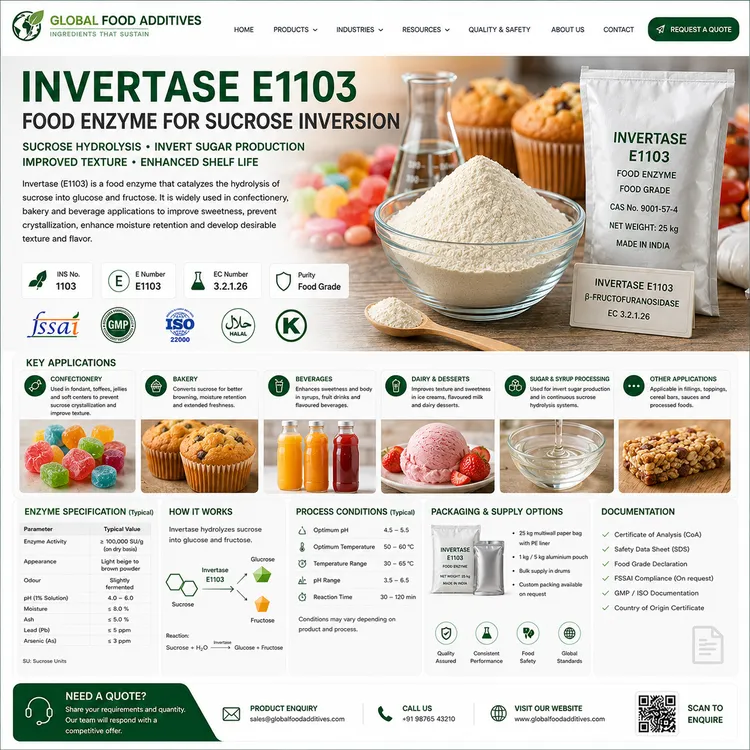
Product identity
| Product | Invertase |
|---|---|
| Category | Enzymes & Processing Aids |
| Function | Food enzyme / sucrose hydrolysis enzyme / processing aid for sugar inversion |
| E / INS number | E1103 |
| CAS / identity | 9001-57-4 |
| Enzyme name | Beta-fructofuranosidase, commonly called invertase |
| EC number | EC 3.2.1.26 |
| Reaction | Sucrose + water → glucose + fructose |
| Typical source | Commonly produced from yeast or microbial fermentation sources, depending on supplier grade |
| Typical form | Liquid enzyme preparation, powder, granulate or application-specific enzyme formulation |
| Key specification controls | Enzyme activity, activity method, pH profile, temperature profile, microbiology, heavy metals, carrier, preservatives, source organism and shelf life |
Application fit
Invertase is most valuable when sucrose must be converted gradually or in-process to change texture, sweetness, crystallization behavior or syrup composition.
- Fondant creams, filled chocolates, cordial centers and soft-center confectionery
- Invert sugar syrup production and sucrose conversion systems
- Confectionery fillings where controlled liquefaction is required after depositing
- Bakery fillings, icings and sweet systems where crystallization control is important
- Fruit preparations, toppings and syrups where sucrose inversion can support texture and sweetness
- Honey-style, syrup-style or high-solids sweetener systems requiring controlled glucose/fructose formation
- Industrial formulation projects requiring delayed softening or water-activity management
Technical overview for industrial buyers
Invertase catalyzes the conversion of sucrose into glucose and fructose, creating invert sugar. This conversion is useful because invert sugar behaves differently from sucrose: it is generally more resistant to crystallization, contributes to humectancy, changes perceived sweetness and can influence water activity, texture and shelf-life behavior in high-sugar systems.
In confectionery manufacturing, invertase is often used in fondant or cream centers. The center may be deposited as a firmer sucrose-based mass, and the enzyme gradually converts part of the sucrose during storage, creating a softer or more liquid center over time. This delayed action is why dosage, storage temperature, water activity and holding time are critical purchasing and process parameters.
Functional performance
- Hydrolyzes sucrose into glucose and fructose
- Supports invert sugar production and syrup standardization
- Reduces sucrose crystallization tendency in high-sugar systems
- Supports delayed liquefaction of fondant and cream centers
- Can improve softness and moisture retention in selected sweet fillings
- Changes sweetness profile and reducing sugar balance
- May influence browning potential where reducing sugars enter heat processing
- Can be heat-inactivated when the process requires reaction control
Key formulation variables
| Enzyme activity | Activity units are method-dependent. Always compare supplier grades using the stated assay method and process-relevant dosage trials. |
|---|---|
| pH | Invertase activity is strongly pH-dependent. Acidic sweet systems often suit many commercial grades, but the exact pH profile must be verified. |
| Temperature | Temperature affects reaction speed and enzyme stability. Excessive heat can reduce activity or fully inactivate the enzyme. |
| Water activity | Low-moisture confectionery systems may slow enzyme action. Product development should test real storage conditions. |
| Sucrose concentration | Substrate concentration affects conversion rate, viscosity, osmotic pressure and final sugar profile. |
| Residence time | Invertase may act during production, maturation, storage and distribution. Time-to-texture should be validated before launch. |
Application-specific guidance
In fondant confectionery, invertase is typically selected to create controlled softening after enrobing or depositing. A manufacturer may need a center that is firm enough for handling but soft enough for the final eating experience. The enzyme dosage must therefore be matched to the target liquefaction time, sugar composition, moisture level, center size, coating barrier and expected storage temperature.
In syrup production, invertase can be used for enzymatic inversion where a controlled glucose-fructose profile is preferred. Compared with acid inversion, enzymatic processing may offer milder conditions and more targeted reaction control, but it requires careful management of enzyme activity, microbial control, residence time, pH and thermal inactivation.
Confectionery and filling systems
- Fondant creams: supports gradual conversion of sucrose and softening of the center during storage.
- Chocolate-filled products: helps create liquid or semi-liquid centers after enrobing when dosage is correctly controlled.
- Cordial centers: supports syrup formation and texture development inside a sealed confectionery shell.
- Icing and sweet fillings: can reduce crystallization and improve softness in selected high-sugar systems.
Syrup and sweetener systems
- Invert sugar syrup: supports hydrolysis of sucrose into glucose and fructose under controlled process conditions.
- Fruit preparations: can adjust sweetness balance and crystallization behavior where permitted and technically suitable.
- Honey-style syrups: may support glucose-fructose composition targets in selected formulated sweetener systems.
- Bakery fillings: can support softness and humectancy in some fillings, glazes or icings after validation.
Processing and handling recommendations
Invertase should be added under conditions that preserve enzyme activity until the desired conversion has occurred. For liquid enzyme preparations, dosing accuracy, mixing distribution and microbial handling are important. For dry forms, dust control, dispersion behavior and carrier compatibility should be reviewed. In all cases, the enzyme should be protected from excessive heat, unsuitable pH, oxidizing agents or preservatives that may reduce activity.
If the enzyme must stop acting after a defined conversion point, the process should include a validated inactivation step or a formulation strategy that limits further activity. If delayed action is required, as in filled confectionery, the product should be tested across the real shelf-life window, including warehouse, transport and retail temperature conditions.
Typical quality parameters
- Appearance, colour and odour
- Declared enzyme activity and activity test method
- Source organism and production strain declaration where available
- Carrier, diluent, preservative and stabilizer declaration
- pH range, temperature range and recommended process window
- Moisture or dry matter for powder grades
- Specific gravity or solids for liquid grades
- Microbiological limits including total plate count, yeast, mold, coliforms, E. coli and Salmonella where applicable
- Heavy metals and elemental impurity limits
- Shelf life, storage temperature and retained activity over time
Common purchasing risks
- Comparing enzyme grades only by price per kilogram instead of activity cost-in-use
- Not checking whether the declared activity units are measured by the same method
- Changing supplier without repeating product texture and shelf-life validation
- Ignoring the effect of storage temperature on delayed confectionery liquefaction
- Using a syrup process without validating microbial control and enzyme inactivation
- Not confirming source organism, allergen status, GMO position or carrier declaration before label review
- Assuming processing-aid status is identical across all export markets
Regulatory and compliance notes
Invertase is commonly identified in food additive and enzyme discussions as E1103, CAS 9001-57-4 and beta-fructofuranosidase / EC 3.2.1.26. However, the commercial and regulatory status of an invertase preparation depends on the source organism, production method, purification level, carrier system, use level, food category and destination-market rules.
Some markets may treat invertase as a food enzyme, some may evaluate the use as a processing aid, and some may require declaration depending on whether the enzyme remains active or functional in the finished product. Buyers should confirm whether the enzyme preparation, including any carrier, preservative or stabilizer, is permitted for the intended application and label position in the country of sale.
Documents to request
- Product specification or technical data sheet with enzyme activity and assay method
- Certificate of analysis for the available batch or lot
- Safety data sheet where applicable for industrial handling
- Food-grade statement and E1103 / enzyme identity declaration
- Source organism, fermentation substrate and production-process declaration where available
- GMO, allergen, vegan, halal and kosher statements when required by the customer
- Carrier, diluent, preservative and stabilizer declaration
- Heavy-metal and elemental impurity declaration
- Microbiological specification and recent test results
- Shelf-life, storage-temperature and retained-activity information
- Packaging details, net weight, pallet configuration and container loading information
- Market-specific compliance statements for the destination country
- Change-control, non-irradiation, BSE/TSE, residual solvent and contaminant statements where required
Packaging, storage and logistics
Invertase may be supplied as a liquid enzyme preparation in sealed drums, jerrycans, bottles or IBCs, or as a powder or granulated enzyme in lined bags, cartons or drums. Packaging should protect the enzyme from moisture, heat, contamination and activity loss. For export orders, buyers should confirm net weight, gross weight, pallet type, temperature-control needs, batch coding, label language, shelf-life at dispatch and whether the shipment requires insulated packaging or special handling.
Storage requirements depend on the supplier grade. Many enzyme preparations require cool, dry storage and protection from direct sunlight. Liquid grades may have specific temperature requirements and should not be frozen unless the supplier approves it. Opened containers should be resealed quickly to protect activity and hygiene. Stock should be rotated by expiry date and retained activity should be checked when material has been stored for long periods.
Who usually buys Invertase?
- Chocolate and filled confectionery manufacturers
- Fondant, cream-center and cordial-center producers
- Invert sugar syrup manufacturers
- Bakery filling, icing and glaze producers
- Fruit preparation and sweet topping manufacturers
- Industrial premix and food enzyme distributors
- Importers, traders and private-label ingredient suppliers
Information needed for quotation
- Target application and finished product type
- Required function: syrup inversion, fondant liquefaction, crystallization control or softness improvement
- Required activity level and preferred activity unit, if known
- Reference specification, current COA or approved supplier grade
- Required form: liquid, powder, granulate or custom preparation
- Destination country and regulatory documentation needs
- Trial quantity, annual quantity and order frequency
- Preferred packaging size and storage-temperature requirement
- Required certificates: halal, kosher, allergen, GMO, vegan, origin or other declarations
- Delivery term, destination port or warehouse address
- Expected shipment date and sample approval timeline
How Global Food Additives supports sourcing
Global Food Additives can help compare Invertase grades by activity, form, source, process compatibility, documentation readiness, packaging and commercial availability. For industrial buyers, the fastest sourcing route is to provide an existing specification, certificate of analysis, supplier reference, desired enzyme activity or target application. This allows supplier options to be compared on real cost-in-use and process performance rather than product name alone.
For development projects, our team can coordinate sample options and supplier questions around activity method, dosage range, pH and temperature profile, storage stability, carrier declaration, export documents and application suitability. The final formulation, processing conditions, regulatory use level and finished-product label remain the responsibility of the manufacturer.
How to request this product
Send the product name, target grade or reference specification, application, desired activity, quantity, destination country, packaging preference, storage requirement, expected shipment date and required documents. If you already purchase Invertase, attach or describe your current specification, activity unit, certificate of analysis, label or process conditions so supplier options can be compared accurately.
Useful answers
What is Invertase used for in food manufacturing?
Invertase is used to convert sucrose into glucose and fructose. It is most commonly evaluated for invert sugar syrup, fondant liquefaction, soft-center confectionery, cordial centers, crystallization control, sweetness profile adjustment and moisture management in high-sugar systems.
How does Invertase work?
Invertase, also called beta-fructofuranosidase, catalyzes sucrose hydrolysis. The reaction changes sucrose into glucose and fructose, producing invert sugar with different crystallization, humectancy and sweetness behavior.
Why is Invertase used in filled chocolates?
It can gradually soften a sucrose-based fondant or cream center after enrobing. This allows the center to be processed firm and then develop a softer or more liquid texture during storage, depending on dosage and product conditions.
Which process conditions affect Invertase activity?
Activity depends on dosage, enzyme unit definition, pH, temperature, water activity, sucrose concentration, mixing, residence time, preservatives, storage temperature and whether the process includes a heat-inactivation step.
Can Global Food Additives source Invertase?
Global Food Additives can review sourcing options for Invertase according to target activity, application, source, grade, quantity, destination, packaging and required documentation.
Which documents should be requested?
Buyers commonly request a technical data sheet, certificate of analysis, activity method, safety data sheet where applicable, food-grade declaration, source organism statement, carrier declaration, allergen and GMO statements, halal or kosher certificates when required, microbiological data, shelf-life information and packing details.
Is this product permitted in every country?
No. Enzyme use depends on destination-market rules, food category, use level, source organism, carrier system, label requirements and buyer responsibility. Always verify final suitability for the intended application.
Tell us which food additive or ingredient you need.
Send product names, target specifications, quantity, destination country, packaging preference, delivery term, and document requirements. Our team will review your inquiry and respond from orders@foodgradeadditives.com.
Your message has been received. You will be redirected to the home page.