
Iron Oxides and Hydroxides E172
Iron Oxides and Hydroxides are food-grade inorganic mineral pigments used to deliver durable red, yellow, black and brown shades in selected food, confectionery, coating, chewing gum, supplement and surface-colouring applications. Because these pigments are generally insoluble, industrial performance depends on shade strength, particle size, dispersion quality, carrier compatibility, processing conditions and the regulatory status of the target market.
Global Food Additives supports manufacturers and distributors with supplier comparison, grade selection, document collection, quotation coordination and export-ready communication for E172 / INS 172 iron oxide pigment requirements.
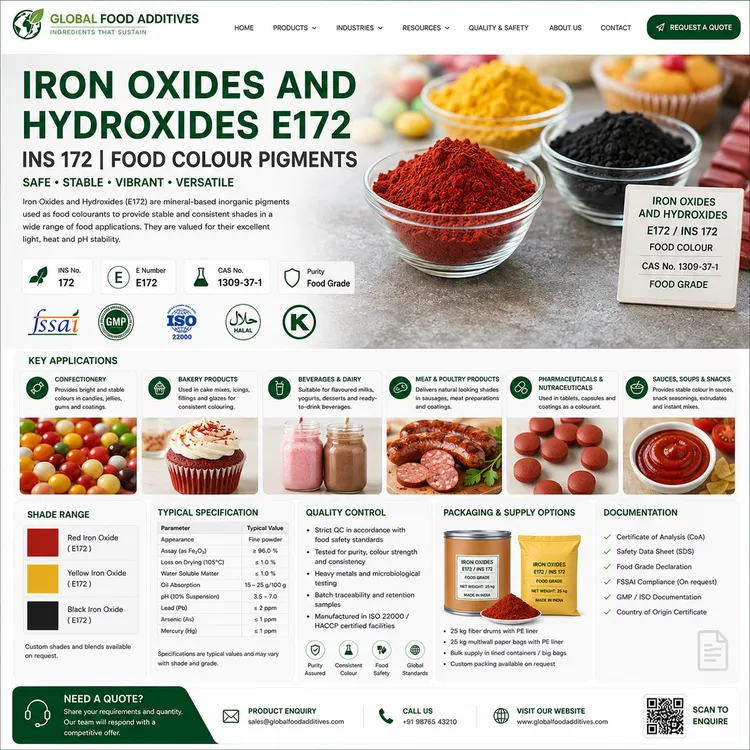
Product identity
| Product | Iron Oxides and Hydroxides |
|---|---|
| Category | Colours & Colouring Foods |
| Function | Insoluble mineral colour pigment / colour standardisation ingredient |
| E / INS number | E172 / INS 172 |
| Typical shade families | Red, yellow, black and brown iron oxide pigment systems |
| Common chemical identity | Iron oxides and hydrated iron oxide / iron oxyhydroxide species; exact identity depends on grade and supplier specification |
| Typical form | Fine powder, micronized powder, dry blend, premix or application-specific dispersion |
| Solubility behavior | Generally insoluble; colour performance is controlled by dispersion, particle size and surface coverage |
| Primary purchasing controls | Shade, colour strength, particle size, purity, heavy metals, carrier system, documentation and destination-market compliance |
Application fit
Iron oxide pigments are typically selected where a stable, opaque, earthy or mineral shade is required and where the customer specification permits an insoluble pigment system.
- Confectionery surfaces, hard candy, mints and chewing gum, subject to local rules
- Tablet, capsule and supplement coating systems where permitted by the destination market
- Bakery decorations, dry toppings, inclusions and visual surface effects where legally allowed
- Snack seasoning blends and dry mixes requiring stable red, yellow, brown or black tones
- Meat-related surface or casing applications where market-specific approvals allow use
- Chocolate compound, fat-based coating or dry premix systems after compatibility testing
- Industrial colour matching projects where batch-to-batch shade consistency is critical
Technical overview for industrial buyers
Iron Oxides and Hydroxides are not used like water-soluble dyes. They are particulate pigments, so the colour result is influenced by the way particles are wetted, dispersed and distributed across the finished matrix. In practical manufacturing, the same nominal dosage can produce different visual results depending on powder particle size, milling level, background colour, fat or water activity, coating thickness, shear, mixing time and the presence of other opacity or whitening agents.
For industrial purchasing, the most valuable supplier comparison should go beyond the product name. A buyer should compare the full technical specification, target colour coordinates or visual standard, particle size distribution, contaminant limits, carrier declaration, production origin, lot traceability, shelf life, recommended storage, regulatory statements and compatibility with the buyer's process.
Shade and pigment selection
| Red iron oxide | Typically used for brick-red, terracotta, reddish-brown or warm mineral shades. Often selected for strong opacity and heat-stable red tones. |
|---|---|
| Yellow iron oxide / hydroxide | Typically used for ochre, mustard, golden-brown or earthy yellow shades. Shade can shift with processing, dosage and background matrix. |
| Black iron oxide | Typically used for grey, black, charcoal and deep brown shade building. It may be blended with red or yellow iron oxide to create custom brown tones. |
| Brown blends | Usually produced by controlled blending of red, yellow and black pigment families to reach a customer-specific shade target. |
| Custom shade matching | Requires reference sample, finished matrix, target dosage range, process conditions and acceptance method such as visual approval or CIELAB limits. |
Performance characteristics
- Excellent light stability compared with many organic colour systems
- High heat stability in many dry, baked, compressed or coated applications
- Good pH stability because colour is pigment-based rather than dye-based
- Strong opacity and covering power at relatively low visual-use levels
- Low migration tendency when properly dispersed into a stable coating or matrix
- Suitable for dry blending, coating dispersion and colour standardisation projects
- Requires process validation because poor dispersion can create speckling, streaking or shade variation
Industrial formulation considerations
The correct grade depends on the finished product and the manufacturing route. Powder pigments may be preferred for dry premixes, seasoning blends and direct powder dosing. Micronized grades may improve smoothness and shade uniformity in thin coatings, compressed products or high-visibility surfaces. Dispersions or premixes may reduce dusting, improve dosing accuracy and shorten production trials, but the carrier system must be checked for regulatory status, allergen position, halal/kosher expectations, vegan requirements, processing compatibility and label impact.
Process compatibility checklist
- Dispersion: confirm whether the pigment disperses better in water, oil, syrup, gum solution, coating suspension or dry carrier.
- Particle size: evaluate fineness, visible speckling, sedimentation risk and mouthfeel impact in the finished product.
- Mixing energy: confirm whether standard plant mixing is sufficient or whether high-shear pre-dispersion is required.
- Thermal exposure: test the pigment through baking, drying, extrusion, panning, coating or sterilisation steps where applicable.
- Matrix interaction: check shade shift caused by cocoa, caramel, proteins, fats, starches, acids, salts or whitening agents.
- Dosage control: establish a practical addition range and a validated weighing or premix procedure for production repeatability.
Common quality parameters
- Appearance, shade and colour strength against approved reference
- Identification and pigment composition according to supplier specification
- Particle size distribution, residue on sieve or fineness of grind
- Moisture, loss on drying or volatile matter where applicable
- Acid-insoluble matter or impurities where included in the specification
- Heavy metals such as arsenic, lead, mercury and cadmium according to market requirements
- Microbiological limits when the grade, carrier or application requires them
- Bulk density, flowability, dusting tendency and packaging integrity
Regulatory and compliance notes
Iron Oxides and Hydroxides are internationally recognised as colour additives under E172 / INS 172 terminology, but this does not mean every use is automatically permitted. Each market can define its own food categories, restrictions, purity criteria, label declarations, carrier permissions and maximum levels.
In the United States, synthetic iron oxide is listed as a colour additive exempt from certification under 21 CFR 73.200, with defined identity, contaminant specifications, use restrictions and labeling requirements. U.S. applications must be checked against the exact federal provision and any customer-specific or state-level requirements before use. For the European Union, United Kingdom, GCC, Turkey, Codex-aligned markets and other destinations, buyers should verify the most current local legislation and the finished food category before placing the ingredient into production.
Recommended documents to request
- Product specification or technical data sheet with identity, shade, physical parameters and purity limits
- Certificate of analysis for the offered batch or representative lot
- Safety data sheet where applicable for industrial handling and storage
- Food-grade statement and destination-market compliance statement
- E172 / INS 172 declaration or relevant additive identity statement
- Heavy-metal declaration including arsenic, lead, mercury, cadmium and any market-specific elements
- Allergen, GMO, vegan, halal and kosher statements where required by the customer
- Origin, manufacturer, production site and traceability information
- Shelf-life, storage conditions and retest policy
- Packaging specification, net weight, pallet configuration and container loading details
- Carrier or processing-aid declaration for premixes, blends or dispersions
- Change-control, non-irradiation, BSE/TSE, nanomaterial and contaminant statements when required by the market
Packaging, storage and logistics
Iron oxide pigments are usually supplied in sealed multiwall bags, fibre drums, cartons with inner liners or other food-grade industrial packs depending on grade and supplier. Packaging should protect the pigment from moisture, contamination, odour pickup and foreign material. For export orders, buyers should confirm net weight, gross weight, pallet type, stacking limits, container loading plan, batch segregation, label language and whether fumigation or heat-treated pallet documentation is required.
Storage is typically recommended in a dry, clean, cool and well-ventilated warehouse away from incompatible materials, strong odours and direct contamination risks. Opened bags should be resealed and used according to the buyer's hygiene and traceability procedure. Because fine powders may create dust, industrial users should evaluate local occupational-safety controls, ventilation, personal protective equipment and spill-management procedures.
Who usually buys this product?
- Confectionery and chewing gum manufacturers
- Supplement, tablet and capsule coating producers
- Food coating, panning and decoration suppliers
- Snack seasoning and dry blend manufacturers
- Industrial premix and colour standardisation companies
- Importers, distributors and private-label food ingredient suppliers
Information needed for quotation
- Target shade: red, yellow, black, brown or custom reference
- Required form: powder, micronized powder, blend, premix or dispersion
- Destination country and finished food category
- Target specification, current COA or existing supplier reference
- Trial quantity, annual volume and order frequency
- Preferred packaging size and pallet requirements
- Required certificates and compliance statements
- Delivery term, destination port or warehouse address
- Expected shipment date and urgency of sample approval
How Global Food Additives supports sourcing
Global Food Additives can help compare available food-grade Iron Oxides and Hydroxides by technical specification, shade target, origin, documentation, packaging, minimum order quantity and shipment route. For industrial customers, the fastest route to an accurate quotation is to send an existing specification, COA, finished-product application and destination-market requirement. When a customer is developing a new product, we can coordinate sample options and supplier questions so the buyer can validate colour performance before commercial ordering.
How to request this product
Send the product name, target shade, grade, application, quantity, destination country, packaging preference, required documents and expected delivery date. If you already purchase Iron Oxides and Hydroxides, attach or describe your existing specification, label, approved colour standard or certificate of analysis so supplier options can be compared more accurately.
Useful answers
What are Iron Oxides and Hydroxides used for in food manufacturing?
They are used as insoluble mineral pigments for stable red, yellow, black and brown shades in selected food, confectionery, coating, chewing gum, supplement and surface-colouring applications. Exact suitability depends on the grade, food category, local legislation, process and customer specification.
Are Iron Oxides and Hydroxides the same as water-soluble food dyes?
No. Iron oxide pigments are generally insoluble particulate colour systems. Their performance depends on dispersion, particle size, carrier compatibility and surface coverage rather than dissolution in the food matrix.
Which shades are normally available?
Commercial options commonly include red iron oxide, yellow iron oxide, black iron oxide and brown blends. Custom shade matching normally requires a reference sample, target matrix, process conditions and acceptance method.
Can Global Food Additives source Iron Oxides and Hydroxides?
Global Food Additives can review sourcing options according to target shade, specification, grade, application, quantity, destination, packaging and required documentation.
Which documents should be requested?
Buyers commonly request a technical specification, certificate of analysis, safety data sheet where applicable, food-grade statement, heavy-metal limits, allergen and GMO declarations, origin statement, shelf-life data, storage instructions, packaging details and market-specific compliance statements.
Is this product permitted in every country?
No. Food additive use depends on destination-market rules, food category, use level, purity criteria, label requirements, carrier permissions and buyer responsibility. Always verify the final application before use.
What causes shade differences between suppliers?
Shade differences can come from pigment species, particle size, milling level, surface treatment, blending ratio, carrier system, production origin, moisture, application matrix and viewing method. For repeat production, an approved reference sample and batch-to-batch colour tolerance are recommended.
Tell us which food additive or ingredient you need.
Send product names, target specifications, quantity, destination country, packaging preference, delivery term, and document requirements. Our team will review your inquiry and respond from [email protected].
Your message has been received. You will be redirected to the home page.