
Isomalt
Isomalt is a food-grade polyol and bulking sweetener used by food manufacturers for sugar-free confectionery, hard candy, chewing gum, compressed tablets, lozenges, chocolate, bakery, dairy desserts, coatings, fillings and reduced-calorie products. It is valued for moderate sweetness, sugar-like bulk, low hygroscopicity, glass stability, thermal resistance, tooth-friendly positioning and clean flavour release in selected sweet systems.
For industrial formulation, Isomalt should be evaluated as both a sweetening ingredient and a physical structuring ingredient. It can replace part or all of sucrose bulk in confectionery systems, but formulation design must account for sweetness level, solubility, crystallization, cooling behaviour, moisture pickup, process temperature, polyol tolerance, regulatory labeling and compatibility with high-intensity sweeteners or other polyols.
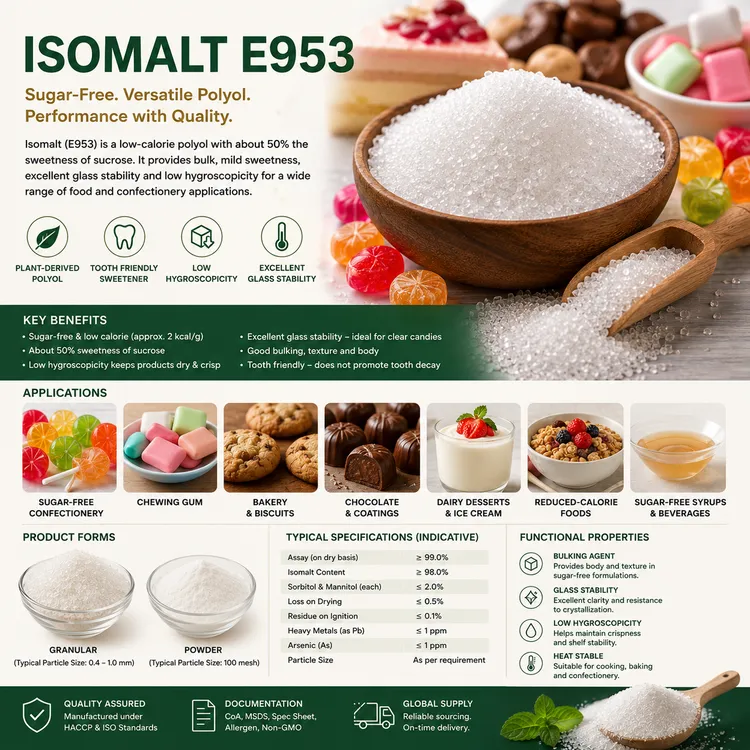
Product identity
| Product | Isomalt |
|---|---|
| Other names | Isomaltitol, hydrogenated isomaltulose, GPS-GPM mixture, E953 |
| Category | Sweeteners & Polyols |
| Function | Sweetener / polyol / bulking ingredient |
| E / INS number | E953 / INS 953 |
| CAS / identity | 64519-82-0 |
| Chemical nature | Mixture of hydrogenated disaccharide alcohols, mainly 6-O-alpha-D-glucopyranosyl-D-sorbitol and 1-O-alpha-D-glucopyranosyl-D-mannitol components |
| Typical source route | Produced from sucrose via isomaltulose followed by catalytic hydrogenation; verify origin and process declarations by supplier |
| Typical form | Crystalline powder, granule, fine powder, coarse crystal, direct-compression grade, coating grade or syrup/liquid grade |
| Typical sweetness | Lower sweetness than sucrose; often combined with high-intensity sweeteners for full sweetness |
| Key technical behaviour | Low hygroscopicity, glass stability, good heat stability, sugar-like bulk, mild cooling effect and clean flavour profile |
Application fit
Potential use areas may include:
- Sugar-free hard candy, boiled sweets, lollipops and deposited confectionery
- Chewing gum centres, gum coatings, pan coating and compressed mints
- Lozenges, tablets, nutraceutical confectionery and medicated confectionery where permitted
- Chocolate, compound coatings, praline fillings and reduced-sugar confectionery
- Bakery fillings, biscuits, wafers, bars and low-sugar baked goods
- Dairy desserts, frozen desserts, creamy fillings and spoonable sweet products
- Decorative sugar art, pulled sugar, blown sugar and confectionery decoration
- Powder blends, sachets and dry mixes requiring bulk and controlled sweetness
Technical overview
Isomalt is a sugar alcohol used when a manufacturer needs sucrose-like bulk with lower sweetness and improved humidity resistance compared with many sugar systems. In confectionery, it is particularly useful because it forms a stable glassy matrix, supports clear hard candy and helps reduce stickiness under moderate humidity. These properties make it important in sugar-free hard candies, lollipops, decorative confectionery, lozenges and pan-coated products.
Because Isomalt is less sweet than sucrose, it is commonly combined with high-intensity sweeteners such as sucralose, acesulfame potassium, aspartame, steviol glycosides or other permitted sweeteners to reach the target sweetness. It may also be blended with other polyols such as maltitol, erythritol, xylitol, sorbitol or lactitol to adjust sweetness, cooling effect, solubility, crystallization, cost, digestive tolerance and texture.
Isomalt should not be treated as a direct one-to-one sucrose replacement in every product. It changes water activity, sweetness perception, crystallization, viscosity, boiling point, glass transition, humectancy, browning behaviour and digestive tolerance. Successful use requires formulation trials under real processing and storage conditions.
Functional benefits in food systems
Sugar-free bulk and structure
Provides solids and structure in sugar-free products where high-intensity sweeteners alone cannot replace sucrose bulk, body, bite or glass formation.
Low hygroscopicity
Helps reduce moisture pickup, stickiness and surface tack in hard candy, pan coating, decorative confectionery and dry applications.
Glass stability and clarity
Supports clear, stable and smooth confectionery systems with good resistance to recrystallization when processed and stored correctly.
Reduced calorie and tooth-friendly positioning
Supports reduced-calorie, sugar-free and tooth-friendly product concepts where permitted by local regulation and supported by correct labeling.
Application engineering guidance
| Application | Typical technical objective | Key formulation review points |
|---|---|---|
| Sugar-free hard candy | Create clear, stable, low-stickiness glass with sugar-free positioning and clean flavour release. | Review cooking temperature, vacuum cooking, residual moisture, acid addition, flavour addition, sweetener blend, cooling rate, depositing temperature and humidity protection. |
| Lollipops and deposited confectionery | Maintain clarity, shape stability, gloss and resistance to stickiness. | Validate mould temperature, deposit viscosity, colour stability, packaging barrier, storage humidity and shelf-life conditions. |
| Chewing gum | Provide bulk, sweetness balance, low cariogenic positioning and coating compatibility. | Check gum base compatibility, polyol blend, cooling effect, coating crunch, recrystallization, flavour release and moisture migration. |
| Pan coating and compressed tablets | Support coating build, crunch, tablet hardness, low hygroscopicity and smooth surface finish. | Review particle size, compressibility, binder system, coating syrup solids, drying air, polishing step and tablet friability. |
| Chocolate and compound coatings | Reduce sugar content while maintaining bulk, mouthfeel and processability. | Evaluate particle size, refining, conching, fat system, viscosity, sweetness booster, cooling effect and grittiness. |
| Bakery and bars | Provide sweetness, bulk and reduced sugar contribution while controlling water activity and texture. | Validate dough handling, browning, spread, texture, moisture migration, polyol labeling and digestive tolerance in serving size. |
| Dairy and frozen desserts | Support sweetness design, solids, freezing behaviour and reduced-sugar formulation. | Check solubility, freezing point depression, lactose interaction, stabilizer system, sweetness blend, mouthfeel and crystallization during storage. |
| Decorative confectionery and sugar art | Create clear, stable and workable glass for pulled, blown or cast decorations. | Control heating, cooling, working temperature, humidity exposure, colour addition, storage packaging and handling safety. |
Formulation strategy
Isomalt performs best when the formulation is built around its physical properties. In hard candy, it can replace sucrose and glucose syrup solids, but cooking conditions, residual water and acid exposure must be optimized. In chocolate and compound coatings, particle size and refining behaviour are critical because Isomalt crystals can create grittiness if not properly processed. In compressed tablets, flowability and compressibility determine tooling performance, tablet hardness and friability.
Because Isomalt has moderate sweetness, sweetener blending is common. The chosen high-intensity sweetener should match the product's pH, heat process, flavour profile and regulatory market. Acidic fruit candies may require careful sweetener selection because acid and heat can reduce the stability of some sweeteners or increase sugar alcohol hydrolysis risks. Mint and menthol systems may emphasize cooling effects, while chocolate systems may require sweetness boosters and flavour masking.
Processing and manufacturing notes
In boiled confectionery, Isomalt is typically dissolved, cooked to the target solids, vacuum concentrated where needed, cooled, blended with acid, flavour and colour, then deposited or formed. Residual moisture and final glass transition behaviour are critical for shelf life. Excess water can create stickiness, while excessive heat or long holding may affect colour, flavour and process consistency.
In dry applications, particle size matters. Fine powder is useful for blending and compression but may dust or cake if humidity is not controlled. Coarse crystals may support texture or decoration. Direct-compression grades may contain controlled particle distribution and flow properties to improve tableting. Syrup or liquid grades should be reviewed for solids, viscosity, microbiological quality, storage temperature and crystallization risk.
Comparison with other polyols
| Polyol | Typical strength | Industrial comparison point |
|---|---|---|
| Isomalt | Low hygroscopicity, good glass stability and excellent fit for hard candy and decorative confectionery. | Less sweet than sucrose, often needs sweetener boosting; useful for humidity-resistant sugar-free systems. |
| Maltitol | Higher sweetness and broad use in chocolate, bakery and confectionery. | More sucrose-like sweetness but may be more hygroscopic depending on grade and application. |
| Sorbitol | Humectancy and moisture retention in soft products. | Useful where softness is desired, but not ideal for low-stickiness hard candy at high humidity. |
| Xylitol | High sweetness, strong cooling effect and dental-positioned chewing gum use. | More expensive and strongly cooling; useful in mint applications. |
| Erythritol | Low calorie contribution and strong cooling effect. | Can crystallize and produce strong cooling; useful in blends but may need texture management. |
| Lactitol | Mild sweetness and bulking in bakery and confectionery systems. | Useful in blends where mild sweetness and stable bulk are needed. |
Specification and quality-control parameters
For industrial purchasing, Isomalt should be compared by assay, component ratio, physical form, particle size, process performance and regulatory documentation. Supplier grades can differ in crystal size, flowability, water content, compressibility, clarity, colour, odour, sweetness profile and suitability for hard candy, compression, coating or chocolate refining.
Identity and assay
- Product name: Isomalt
- E number / INS number: E953 / INS 953
- CAS number: 64519-82-0
- Total hydrogenated disaccharide alcohol content
- 1,6-GPS and 1,1-GPM component ratio where specified
- Reducing sugars and related carbohydrate impurities
Physical properties
- Appearance, colour and odour
- Particle size distribution or mesh size
- Bulk density and tapped density
- Flowability and caking tendency
- Melting behaviour and glass performance where relevant
- Compressibility for tablet or lozenge grades
Chemical limits
- Water content or loss on drying
- Conductivity or ash where specified
- pH of aqueous solution
- Nickel residue where relevant to hydrogenation process
- Heavy metals and elemental impurities
- Residual solvents or processing aids where applicable
Food safety controls
- Total plate count, yeast and mould where applicable
- Specified pathogen absence where required
- Allergen and cross-contact declaration
- GMO status and raw material origin
- Halal, kosher, vegan or vegetarian suitability where commercially required
- Food-grade and destination-market compliance statements
Quality effects to validate
| Quality factor | Possible Isomalt effect | Validation method |
|---|---|---|
| Hard candy glass stability | Can improve resistance to stickiness and support clear glass formation. | Residual moisture, water activity, humidity chamber test, glass transition review and packaging trial. |
| Sweetness profile | Provides moderate sweetness and often needs high-intensity sweetener support. | Sensory panel, sweetness time-intensity test and flavour release comparison. |
| Cooling effect | Can contribute mild cooling compared with some other polyols. | Sensory panel in mint, fruit, chocolate and dairy systems. |
| Moisture pickup | Low hygroscopicity can support shelf life in dry or glassy products. | Accelerated humidity storage, caking test, surface tack measurement and package evaluation. |
| Compression performance | Direct-compression grades can support tablet hardness and low friability. | Tablet hardness, friability, ejection force, flowability and blend uniformity testing. |
| Chocolate texture | Particle size affects mouthfeel, grittiness and viscosity. | Refining trial, particle size analysis, Casson viscosity and sensory texture panel. |
| Digestive tolerance | Polyol intake may cause gastrointestinal effects in sensitive consumers or at high serving sizes. | Serving-size calculation, label warning review and formulation comparison with other polyols. |
Regulatory and labeling review
Isomalt is commonly identified as E953 / INS 953, but permitted use, maximum levels, food categories, label declarations and warning requirements vary by destination market. In many markets, polyol-containing foods may require declarations such as “polyols,” “sugar alcohols,” “sweetener,” “excessive consumption may produce laxative effects,” or other locally defined wording when the finished product exceeds applicable thresholds.
Sugar-free, no-added-sugar, reduced-sugar, calorie-reduced, tooth-friendly, diabetic-friendly or low-glycemic positioning should be reviewed carefully. These claims depend on local definitions, nutrient calculations, serving size, analytical sugar content, total polyol content, energy factors, high-intensity sweetener use and final label wording. The buyer is responsible for verifying the finished product label and claim compliance in each destination market.
Energy factors for polyols vary by jurisdiction. Formulators should confirm which caloric value must be used for nutrition labeling in the target market. Digestive tolerance should also be considered when determining serving size and when blending Isomalt with other polyols.
Industrial purchasing notes
When reviewing Isomalt, compare the supplier specification against the intended food application, process conditions, sweetness target, texture target, label expectations and local rules. For industrial purchasing, the most useful inquiry normally includes target grade, particle size, assay, physical form, packaging size, quantity, destination and required documents.
| Purchasing factor | Why it matters |
|---|---|
| Grade and physical form | Hard candy, compression, coating, syrup and chocolate grades may require different particle size, flow and processing properties. |
| Component ratio | GPS/GPM composition can influence crystallization, solubility and process behaviour. |
| Particle size | Important for dry blending, tableting, coatings, chocolate refining and powder flow. |
| Water content | Critical for hard candy, glass stability, caking and storage life. |
| Sweetener compatibility | Isomalt is commonly blended with high-intensity sweeteners, so taste profile and stability must be validated. |
| Digestive tolerance and serving size | Polyol content affects label warnings and consumer acceptance. |
| Packaging and moisture barrier | Bag construction, inner liner and pallet protection affect storage stability, especially in humid climates. |
| Documentation package | Complete food-grade, allergen, GMO, heavy metal, microbiology, halal, kosher and regulatory documents reduce approval delays. |
Documents to request
- Product specification or technical data sheet with E number, CAS number and grade description
- Certificate of analysis for available batch or lot
- Assay, component ratio and reducing sugar information where available
- Particle size distribution, mesh size, bulk density and flowability data
- Water content, pH, ash, conductivity and colour data where specified
- Nickel residue, heavy metals and elemental impurity limits where relevant
- Microbiological limits for dry or liquid grades
- Food-grade statement and destination-market regulatory declaration
- Safety data sheet where applicable
- Origin, manufacturer, production site and raw material route information
- Allergen, gluten, GMO, irradiation and nanomaterial statements where required
- Halal, kosher, vegan or vegetarian suitability documents where commercially required
- Shelf-life, storage condition and humidity-protection guidance
- Packaging details, net weight, inner liner, pallet configuration and batch coding
- Label declaration guidance, polyol warning guidance and market-specific compliance statement
- Change-control, traceability and supplier quality-system information where required
How to request this product
Send the product name, target grade or reference specification, application, particle size requirement, assay requirement, physical form, quantity, destination country, packaging preference, expected shipment date and required documents. If you already purchase Isomalt, attach or describe your existing specification, label, certificate of analysis, supplier grade, particle-size target, process type or dosage so supplier options can be compared more accurately.
For faster technical review, include the final product type, target sweetness, sugar-free or reduced-sugar claim, high-intensity sweetener system, processing temperature, residual moisture target, packaging format, serving size, required certifications, preferred origin, annual consumption estimate and whether you need a laboratory sample, pilot quantity or commercial shipment.
Useful answers
What is Isomalt used for in food manufacturing?
Isomalt is used for sweetness design, sugar replacement, polyol bulking, reduced-calorie positioning, hard candy glass stability, low hygroscopicity, texture support and confectionery structure. Typical applications include sugar-free hard candy, chewing gum, lozenges, chocolate, bakery, coatings, dairy desserts and decorative confectionery.
Why is Isomalt used in sugar-free hard candy?
Isomalt forms stable glassy structures, has low hygroscopicity and provides sugar-like bulk. These properties help create hard candy with good clarity, shape stability and reduced stickiness when processing and packaging are controlled.
Is Isomalt as sweet as sugar?
No. Isomalt is less sweet than sucrose and is often combined with high-intensity sweeteners to reach the desired sweetness. The final sweetness depends on formulation, flavour, acid level, serving temperature and sweetener blend.
Does Isomalt need a laxative warning?
Many markets require a warning or special label statement when polyol intake from the finished food exceeds defined thresholds. Requirements vary by country, product category and serving size, so label compliance should be checked before launch.
Can Global Food Additives source Isomalt?
Global Food Additives can review sourcing options for Isomalt according to target specification, grade, particle size, physical form, quantity, destination, packaging and required documentation.
Which documents should be requested?
Buyers commonly request a technical data sheet, product specification, certificate of analysis, food-grade statement, safety data sheet where applicable, origin statement, allergen declaration, GMO declaration, particle-size data, shelf-life information and packing details.
Is Isomalt permitted in every country?
No. Food additive use depends on destination-market rules, food category, use level, sweetener regulations, label requirements and buyer responsibility. Final regulatory suitability should be verified before commercial use.
What should be checked before switching Isomalt suppliers?
Check assay, GPS/GPM ratio, particle size, water content, colour, odour, flowability, reducing sugars, heavy metals, nickel residue where applicable, microbiological limits, allergen status, GMO status, regulatory documents, shelf life and finished-product performance.
Tell us which food additive or ingredient you need.
Send product names, target specifications, quantity, destination country, packaging preference, delivery term and document requirements. For Isomalt, please also include the application, grade, particle size, physical form, target sweetness, packaging requirement and required certificates. Our team will review your inquiry and respond from orders@foodgradeadditives.com.
Your message has been received. You will be redirected to the home page.