
Lactase
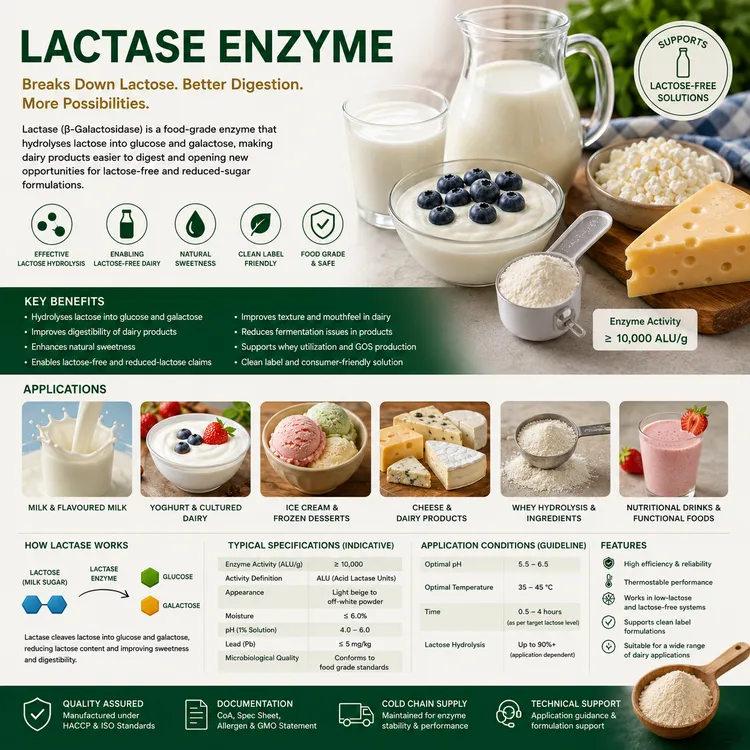
Lactase is a food enzyme, commonly supplied as a beta-galactosidase preparation, used by industrial food manufacturers to hydrolyze lactose into glucose and galactose. It is primarily evaluated for lactose-reduced and lactose-free milk, dairy beverages, yoghurt, cream, ice cream, whey processing, nutrition products and formulated dairy systems where lactose conversion, sweetness adjustment, crystallization control or consumer-friendly dairy positioning is required.
This page is prepared as a technical sourcing guide for R&D teams, QA departments, dairy technologists, production engineers and procurement teams that need to compare enzyme activity, origin, process fit, documentation, storage requirements, regulatory status and commercial quotation details.
Product identity
| Product | Lactase |
|---|---|
| Technical name | Beta-galactosidase / β-galactosidase enzyme preparation |
| Category | Enzymes & Processing Aids |
| Function | Food enzyme / processing aid for lactose hydrolysis and dairy manufacturing performance |
| Main reaction | Lactose + water → glucose + galactose |
| CAS / identity | 9031-11-2; confirm exact enzyme identity and source organism on supplier documentation |
| E / INS number note | Confirm by destination market. Lactase is often handled as a food enzyme or processing aid rather than a conventional food additive number; do not rely on an E-number without supplier and regulatory verification. |
| Typical form | Liquid enzyme, enzyme powder, granulate, tablet or immobilized enzyme system |
| Common sources | Microbial enzyme preparations from selected yeast or fungal production strains, depending on supplier grade and regulatory approval |
Application fit
Potential use areas may include:
- Lactose-free and lactose-reduced milk
- Dairy beverages, UHT milk, ESL milk and flavoured milk
- Yoghurt, fermented milk, drinking yoghurt and cultured dairy products
- Ice cream, frozen desserts and sweet dairy systems
- Whey, whey permeate, dairy powders and ingredient processing
- Cream, condensed milk, evaporated milk and recombined dairy systems
- Nutrition products, infant-related ingredients and medical or sports nutrition formulations where regulations permit
Technical overview
Lactase catalyzes the hydrolysis of lactose, the main disaccharide in milk, into the monosaccharides glucose and galactose. This conversion is central to the production of lactose-reduced and lactose-free dairy products. In addition to reducing lactose content, the reaction can increase perceived sweetness because glucose and galactose are sweeter than lactose. It can also reduce lactose crystallization risk in frozen desserts, condensed dairy products and high-solids dairy systems.
Commercial lactase grades vary significantly. Important differences include enzyme source, activity unit definition, pH optimum, temperature optimum, thermal stability, side activities, purity, preservative system, carrier composition, liquid or dry format, storage temperature, Kosher or Halal status, GMO declaration and regulatory acceptance in the target market. A grade that works well in cold milk may not be the best choice for acidic yoghurt, high-solids whey, UHT processing or immobilized enzyme systems.
How Lactase creates value in dairy production
Lactose reduction
Enables production of lactose-reduced or lactose-free dairy products by converting lactose into glucose and galactose. Final lactose targets depend on local definitions, analytical method and process validation.
Sweetness optimization
Hydrolysis can increase perceived sweetness without adding sucrose or other sweeteners. This is useful in flavoured milk, drinking yoghurt, ice cream and reduced-sugar dairy formulations.
Crystallization control
Reducing lactose can help limit sandy or gritty texture caused by lactose crystallization in ice cream, condensed milk, dulce de leche-style products and high-solids dairy systems.
Ingredient flexibility
Lactase can improve the usability of milk, whey, permeate or dairy solids in formulations where lactose level, solubility, sweetness, browning or digestive positioning must be controlled.
Application engineering guidance
| Application | Typical technical objective | Key process review points |
|---|---|---|
| Lactose-free milk | Reduce lactose to the target market threshold while maintaining clean flavour, shelf life and process efficiency. | Review enzyme dose, contact time, holding temperature, pre- or post-pasteurization addition, microbial risk, residual activity, UHT compatibility and final lactose testing method. |
| UHT and ESL dairy beverages | Achieve lactose hydrolysis before heat treatment or during controlled refrigerated storage depending on process design. | Validate enzyme inactivation, Maillard browning risk, sweetness change, protein stability, sedimentation, flavour development and aseptic process compatibility. |
| Yoghurt and fermented milk | Improve lactose conversion, sweetness, fermentation behaviour and consumer-friendly positioning. | Choose neutral or acid lactase according to process pH. Check starter culture compatibility, fermentation time, post-acidification, viscosity, syneresis and final lactose level. |
| Ice cream and frozen desserts | Control lactose crystallization, improve smoothness and adjust sweetness in high-solids dairy systems. | Evaluate mix aging, heat treatment, hydrolysis degree, freezing point depression, overrun, meltdown, sweetness balance and storage stability. |
| Whey and whey permeate | Hydrolyze lactose for ingredient conversion, sweetness modification or downstream fermentation and concentration processes. | Review solids level, mineral load, pH, temperature, enzyme inhibition, concentration step, membrane process, microbial control and target carbohydrate profile. |
| Condensed and high-solids dairy | Reduce lactose crystallization and control texture in high dry-matter products. | Check viscosity, water activity, heat load, browning, storage temperature, shear conditions and final crystal profile. |
| Galacto-oligosaccharide development | Use selected beta-galactosidase grades under controlled conditions to support transgalactosylation and GOS formation. | Requires grade-specific validation, high lactose concentration, defined water activity, controlled reaction time and detailed carbohydrate profiling. |
Neutral Lactase vs. Acid Lactase
Different lactase grades are designed for different pH and temperature windows. Neutral lactase is commonly evaluated for milk, cream, whey and many dairy processes close to neutral pH. Acid lactase is commonly evaluated for lower-pH conditions such as fermented dairy systems or digestive-positioned applications. The correct choice depends on the product matrix, processing temperature, desired reaction time, target hydrolysis level and regulatory status of the production organism.
| Selection factor | Neutral lactase | Acid lactase |
|---|---|---|
| Typical pH fit | Near-neutral dairy systems such as milk, cream, whey and many dairy beverages. | Lower-pH systems such as fermented dairy, acidic matrices or digestive-oriented applications. |
| Typical use case | Lactose-free milk, UHT milk, ESL milk, whey hydrolysis, ice cream mix and dairy ingredients. | Fermented milk, yoghurt-style products, acidic dairy systems and some supplement or tablet concepts. |
| Process design | Often used before heat treatment, during refrigerated storage or in controlled batch holding. | Often selected where activity is needed under lower pH conditions. |
| Buyer check | Confirm activity at actual milk pH, operating temperature, lactose concentration and desired contact time. | Confirm activity at final product pH, acid environment, storage temperature and target hydrolysis level. |
Specification and quality-control parameters
For industrial purchasing, the most valuable comparison is not only enzyme price but enzyme performance per unit of finished product. Lactase specifications should define activity, identity, purity, process fit, storage stability and food-safety documentation clearly enough for QA approval and repeat production.
Identity and activity
- Enzyme name: lactase / beta-galactosidase
- CAS number or identity statement
- Activity units and analytical method used by the supplier
- Activity per gram, per millilitre or per declared unit
- Recommended dosage range for target application
- Source organism and production strain statement where required
Process performance
- pH activity curve and optimum pH
- Temperature activity curve and optimum temperature
- Thermal stability and inactivation conditions
- Reaction time required for target lactose conversion
- Performance in milk, whey, cream, yoghurt or high-solids systems
- Potential side activities or off-flavour risk
Safety and purity
- Food-grade statement
- Microbiological limits and pathogen absence where applicable
- Heavy metals and contaminant limits
- Residual production organism statement where required
- Antibiotic activity absence statement where required
- Allergen, gluten, GMO and animal-origin declarations
Commercial handling
- Liquid, powder, granulate, tablet or immobilized form
- Carrier, stabilizer or preservative system
- Packaging size and dose format
- Storage temperature and shelf life
- Temperature excursion tolerance during transport
- Halal, kosher, vegan or vegetarian suitability where required
Processing and incorporation notes
Lactase can be added at different points depending on plant design and product objective. In batch systems, the enzyme may be added to milk or whey and held at a controlled temperature until the desired lactose conversion is achieved. In cold hydrolysis, lower temperature can support microbial control but requires longer contact time. In warm hydrolysis, reaction time can be shorter but microbial and thermal-control requirements are stricter. In UHT or ESL products, manufacturers must determine whether enzyme addition occurs before heat treatment, after pasteurization or during controlled storage.
Key process variables include lactose concentration, temperature, pH, enzyme dose, residence time, mixing, microbial load, heat-treatment sequence, final lactose target, residual enzyme activity and analytical release criteria. In high-solids dairy systems, viscosity and diffusion limitations can slow hydrolysis, so trial work should be performed in the real product matrix rather than water or low-solids milk only.
Effects on product quality
| Quality factor | Possible effect of lactase treatment | Control recommendation |
|---|---|---|
| Sweetness | Glucose and galactose increase perceived sweetness compared with lactose. | Rebalance sugar, flavour and cocoa or fruit systems after hydrolysis trials. |
| Browning | Higher reducing sugar content may increase Maillard browning risk in heat-treated products. | Monitor heat load, storage temperature, colour development and flavour stability. |
| Crystallization | Reduced lactose level may decrease sandy texture in frozen or concentrated dairy systems. | Validate with storage tests, microscopy or sensory panel where relevant. |
| Fermentation | Hydrolysis changes sugar profile and may influence starter culture behaviour. | Check fermentation time, final pH, post-acidification, viscosity and syneresis. |
| Shelf life | Residual enzyme activity, microbial quality and sugar profile can affect stability. | Define heat-inactivation, storage and finished-product release specifications. |
Analytical and validation approach
Industrial lactase approval should include a defined lactose-measurement method. Depending on product and market, buyers may use enzymatic assay kits, HPLC, ion chromatography, FTIR calibration, internal rapid methods or external accredited laboratory testing. The selected method should be suitable for the product matrix and final claim threshold.
Recommended validation work includes enzyme dosage screening, hydrolysis curve development, residual lactose testing, sensory evaluation, thermal inactivation confirmation, microbial monitoring, shelf-life testing, colour monitoring, sweetness adjustment and repeated pilot or plant trials. For lactose-free claims, the buyer should confirm the regulatory threshold and analytical method accepted in the destination market.
Regulatory and labeling review
Lactase is commonly evaluated as a food enzyme or processing aid, but regulatory treatment varies by country. Some markets may require food-enzyme authorization, production organism review, enzyme preparation specification, processing-aid assessment or label declaration depending on whether the enzyme remains active in the final food and how the product is marketed. Buyers should also verify whether claims such as “lactose-free,” “lactose-reduced,” “suitable for lactose intolerance” or “easier to digest” are permitted and what analytical evidence is required.
The E / INS number status should be checked carefully. Some supplier or database references may list legacy or incorrect additive-number information. For lactase purchasing, the more important approval basis is usually the enzyme identity, source organism, production method, food-enzyme status, carrier ingredients and destination-market compliance statement supplied by the manufacturer.
Industrial purchasing notes
When reviewing Lactase, compare the supplier specification against the intended food application, process pH, temperature, target lactose conversion, label expectations and local rules. For industrial purchasing, the most useful inquiry normally includes target product, lactose level, desired hydrolysis time, operating temperature, pH, required activity unit, packaging size, quantity, destination and documentation requirements.
| Purchasing factor | Why it matters |
|---|---|
| Activity unit and test method | Different suppliers may use different activity units, so direct price comparison can be misleading unless dosage and performance are normalized. |
| Enzyme source | Source organism and production method affect regulatory approval, customer acceptance, allergen review and GMO declaration. |
| pH and temperature fit | A grade with high activity in one process may underperform in acidic, cold, high-solids or heat-treated systems. |
| Storage and shelf life | Liquid and dry enzyme preparations may have different cold-chain, humidity and activity-retention requirements. |
| Documentation package | Complete technical, safety, food-grade, regulatory, allergen, GMO, halal and kosher documentation reduces approval delays. |
| Application support | Supplier guidance can reduce trial time for dosage, hydrolysis curve, inactivation, sweetness adjustment and lactose-release testing. |
Documents to request
- Product specification or technical data sheet with enzyme identity and application guidance
- Certificate of analysis for available batch or lot
- Activity declaration, including unit definition and analytical method
- Source organism and production strain statement where required
- Food-grade statement and food-enzyme or processing-aid regulatory declaration
- Safety data sheet where applicable
- Allergen, gluten, GMO, irradiation and nanomaterial statements where required
- Residual production organism and antibiotic activity absence statements where required
- Heavy metals, microbiological limits and contaminant statements
- Halal, kosher, vegetarian or vegan suitability documents where commercially required
- Origin, manufacturer, production site and change-control information
- Shelf-life, storage temperature and transport-condition information
- Packaging details, net weight, pallet configuration and batch coding
- Label declaration guidance and destination-market compliance statement
- Application protocol, dosage recommendation and hydrolysis-performance data
How to request this product
Send the product name, target application, required enzyme activity, physical form, quantity, destination country, packaging preference, delivery term, expected shipment date and required documents. If you already purchase Lactase, attach or describe your existing specification, enzyme activity unit, supplier grade, certificate of analysis or dosage recommendation so alternative options can be compared accurately.
For faster technical review, include the product matrix, lactose content, target residual lactose, process pH, process temperature, desired hydrolysis time, heat-treatment conditions, storage temperature, final label claim, required certificates and whether you need liquid, powder, granulated, tablet or immobilized enzyme format.
Useful answers
What is Lactase used for in food manufacturing?
Lactase is primarily used for lactose hydrolysis. It helps produce lactose-reduced and lactose-free milk, dairy beverages, yoghurt, cream, ice cream, whey ingredients and formulated dairy products. It may also influence sweetness, lactose crystallization, freezing behaviour and process consistency.
Is Lactase the same as beta-galactosidase?
Commercial food lactase preparations are commonly described as beta-galactosidase or β-galactosidase preparations because they catalyze the hydrolysis of lactose into glucose and galactose. Exact identity, activity and source organism should be confirmed on supplier documentation.
Can Global Food Additives source Lactase?
Global Food Additives can review sourcing options for Lactase according to target application, enzyme activity, source organism, physical form, process pH, process temperature, quantity, destination, packaging and required documentation.
Which documents should be requested?
Buyers commonly request a technical data sheet, product specification, certificate of analysis, activity declaration, source organism statement, food-grade statement, safety data sheet where applicable, allergen declaration, GMO declaration, origin statement, shelf-life information, storage conditions, label guidance and packing details.
Is this product permitted in every country?
No. Food enzyme use depends on destination-market rules, source organism, production method, food category, processing-aid status, label requirements and buyer responsibility. Final suitability must be verified before commercial use.
What should be checked before switching Lactase suppliers?
Check activity unit, dosage equivalence, pH and temperature profile, hydrolysis curve, residual lactose result, sensory effect, heat-inactivation behaviour, microbial specification, allergen and GMO status, regulatory documents, shelf life and storage conditions.
Does Lactase make dairy products sweeter?
It can. Lactase breaks lactose into glucose and galactose, which are perceived as sweeter than lactose. Formula adjustment may be needed in flavoured milk, yoghurt, ice cream and high-solids dairy products.
Can Lactase help prevent sandy texture in ice cream?
Yes, lactase treatment can reduce lactose crystallization risk in selected frozen desserts and high-solids dairy systems. The effect should be validated through storage, sensory and texture testing in the final formulation.
Tell us which food additive or ingredient you need.
Send product names, target specifications, quantity, destination country, packaging preference, delivery term and document requirements. For Lactase, please also include the application, required activity, process pH, process temperature, target lactose reduction, desired form and required certificates. Our team will review your inquiry and respond from orders@foodgradeadditives.com.
Your message has been received. You will be redirected to the home page.