
Lactitol
Lactitol is a lactose-derived polyol sweetener and bulking ingredient used by manufacturers for reduced-sugar, sugar-free and calorie-reduced food systems. It provides mild sweetness, bulk, texture support, humectancy, crystallization control and good process stability in confectionery, chewing gum, chocolate, bakery, dairy desserts, fillings, tablets and powder blends. Because Lactitol is less sweet than sucrose, it is often used with high-intensity sweeteners or flavour systems when a full sugar-like sweetness profile is required.
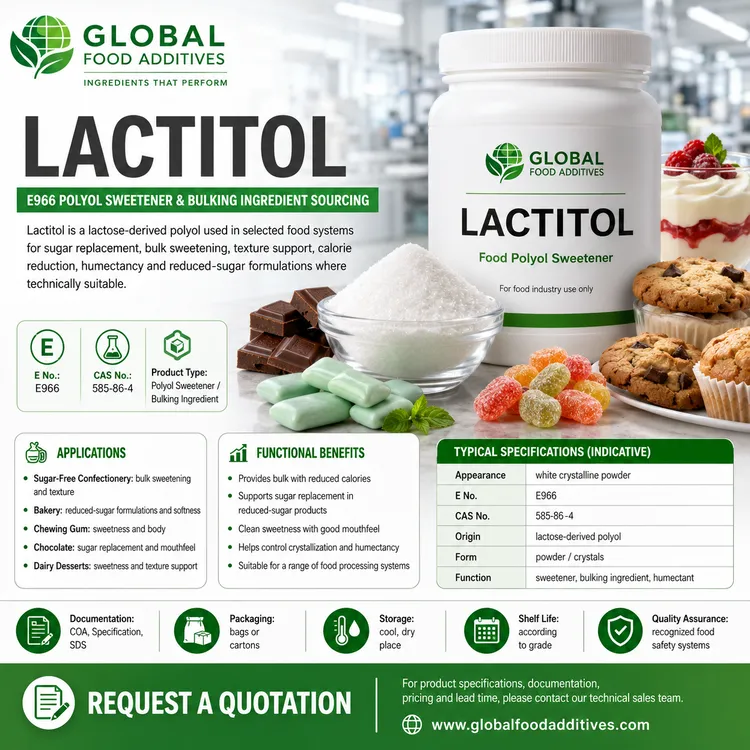
Product identity
| Product | Lactitol |
|---|---|
| Common names | Lactitol Monohydrate, Lactitol Dihydrate, Lactitol Anhydrous, Lactose-derived Polyol, Polyol Sweetener, Sugar Alcohol |
| Category | Sweeteners & Polyols |
| Function | Sweetener, polyol, bulking ingredient, humectant, texture-support ingredient, crystallization modifier and carrier for high-intensity sweeteners |
| E / INS number | E966 where permitted and applicable |
| CAS / identity | 585-86-4 |
| Typical source | Produced from lactose by hydrogenation; supplier documentation should confirm lactose source, grade, residual lactose limits and allergen position |
| Typical hydrate forms | Anhydrous, monohydrate or dihydrate forms depending on supplier, crystallization process and target application |
| Typical form | Crystalline powder, granule, fine powder, direct-compression grade, syrup or liquid grade |
| Industrial buying focus | Assay, hydrate form, moisture, particle size, bulk density, reducing sugars, residual lactose, related polyols, solubility, pH, colour, microbiology, heavy metals, allergen status, GMO status, packaging, shelf life and batch traceability |
Application fit
Lactitol is selected when a product requires sugar replacement with bulk, low sweetness, process stability and a clean sweet profile. It is particularly useful when the formula needs solids and texture rather than only sweetness.
- Sugar-free hard candy, chewy candy, tablets and compressed confectionery
- Chewing gum centres, coating systems and polyol blends
- Chocolate, compound coatings and reduced-sugar confectionery fillings
- Biscuits, cookies, wafers, cakes, breakfast products and reduced-sugar bakery
- Dairy desserts, frozen desserts, puddings, creams and spoonable products
- Powder blends, tabletop sweeteners and high-intensity sweetener carriers
- Nutritional bars, fibre systems and calorie-reduced snack formats
- Specialty products requiring mild sweetness, bulk and controlled humectancy
Technical purchasing notes
When reviewing Lactitol, compare the supplier specification against the intended food application, sweetness target, solids target, water activity, crystallization requirement, processing temperature, desired texture, label expectations and destination-market rules. For industrial purchasing, the most useful inquiry includes target grade, hydrate form, particle size, assay, physical form, packaging size, quantity, destination and document requirements.
Lactitol provides bulk and mild sweetness, but it does not behave exactly like sucrose. It has different solubility, crystallization, cooling effect, hygroscopicity, browning behaviour, sweetness intensity and digestive tolerance. In reduced-sugar formulations, it is commonly balanced with intense sweeteners, fibres, polyols such as maltitol or erythritol, bulking agents, acids, flavours and hydrocolloids to achieve the required sweetness curve, mouthfeel and shelf stability.
Specification parameters to compare
| Parameter | Why it matters industrially | What to request from supplier |
|---|---|---|
| Assay / purity | Controls sweetness contribution, solids replacement, nutritional calculation, processing consistency and customer specification compliance. | Assay percentage, analytical method, basis of calculation and COA result. |
| Hydrate form | Anhydrous, monohydrate and dihydrate forms differ in moisture contribution, melting behaviour, molecular weight basis, stability and process performance. | Hydrate form declaration, moisture range, water of crystallization and recommended application guidance. |
| Particle size distribution | Particle size affects dissolving speed, mouthfeel, tableting, dusting, flowability, dry blending and coating uniformity. | Mesh size, D10/D50/D90 values, fines level, sieve analysis and application recommendation. |
| Bulk density | Important for volumetric dosing, dry-blend uniformity, packaging size, tablet compression and hopper flow. | Loose and tapped bulk density, flowability data and packing density. |
| Moisture / loss on drying | Controls caking risk, shelf life, water activity, crystallization and formula water balance. | Moisture or loss-on-drying specification, method and COA result. |
| Reducing sugars | Residual reducing sugars may affect browning, flavour, heat stability and reduced-sugar label calculations. | Reducing sugar limit, method and lot result. |
| Residual lactose | Important for allergen review, lactose-sensitive claims, dairy-origin declaration and customer requirements. | Residual lactose specification, source statement and allergen declaration. |
| Related polyols / impurities | Related carbohydrates and polyols can influence sweetness, crystallization, digestive tolerance and analytical compliance. | Profile of related substances, sorbitol or other polyol limits where applicable and chromatographic method. |
| Solubility | Affects beverage use, syrup preparation, confectionery cooking, crystallization control and dry mix dissolution. | Solubility information by temperature and recommended dissolution procedure. |
| pH of solution | pH affects flavour system compatibility, process stability and interaction with acids, buffers or minerals. | pH range at defined concentration and test method. |
| Ash / conductivity | Mineral residues can affect taste, conductivity, solution clarity and customer specifications. | Ash limit, conductivity value where available and COA data. |
| Colour and clarity | Important for clear syrups, white tablets, dairy desserts, beverages and mild-flavour applications. | Colour standard, solution clarity, haze data and sensory suitability statement. |
| Microbiological status | Important for dry blends, confectionery, tablets, dairy systems and ready-to-eat applications. | Total plate count, yeast and mould, coliforms, E. coli, Salmonella and microbial specification. |
| Heavy metals and contaminants | Required for food safety, customer approval, regulatory review and import documentation. | Lead, arsenic, cadmium, mercury and other relevant contaminant limits with COA or declaration. |
| Allergen and GMO status | Lactitol is lactose-derived, so dairy allergen and lactose-origin declarations may be required; fermentation or processing inputs may also require GMO review. | Allergen declaration, dairy-origin statement, GMO statement and customer-specific dietary declarations. |
| Batch traceability | Essential for supplier approval, audits, complaint handling, export documentation and recall systems. | Lot number, production date, expiry or retest date, manufacturer name, origin and packing list. |
Application guidance by industry
| Industry / application | Technical role | Key validation points |
|---|---|---|
| Sugar-free confectionery | Provides bulk, mild sweetness, crystallization control and texture in hard candy, chewy candy, tablets and deposited systems. | Cooking temperature, water activity, crystallization, cooling profile, stickiness, glass transition, graining, shelf life and digestive tolerance labelling. |
| Chewing gum | Acts as a bulk polyol for sweetness, body, coating texture and controlled release of flavours or high-intensity sweeteners. | Particle size, coating uniformity, crunch, centre texture, flavour release, humectancy, gum-base compatibility and total polyol load. |
| Chocolate and compound coatings | Supports reduced-sugar bulk and texture where particle size, moisture and fat compatibility are carefully controlled. | Refining behaviour, particle size, viscosity, yield value, fat phase compatibility, bloom risk, cooling profile and sensory balance. |
| Bakery and biscuits | Contributes bulk, sweetness reduction, moisture control and texture support in cookies, wafers, biscuits, cakes and breakfast products. | Browning, spread, water activity, humectancy, crumb texture, crispness, softness retention, dough handling and sweetness balance. |
| Dairy desserts and frozen desserts | Provides solids, sweetness modulation, freezing point contribution and texture support in reduced-sugar desserts. | Freezing point, ice crystal control, sweetness blend, stabilizer interaction, mouthfeel, lactose/dairy labelling and storage stability. |
| Powder blends and tabletop sweeteners | Functions as a mild-sweet bulk carrier for intense sweeteners, flavours, acids, fibres and functional ingredients. | Blend uniformity, particle size matching, flowability, caking, dissolution, sachet filling and sweetness delivery. |
| Nutritional bars and snacks | Provides sugar replacement, humectancy and texture support in bars and snack systems when balanced with fibres, syrups and fats. | Water activity, bar hardening, stickiness, protein interaction, syrup phase, shelf-life texture and digestive tolerance. |
| Pharmaceutical-style food tablets and lozenges | May provide compressible bulk, mild sweetness and low cariogenic positioning in tablets, lozenges and compressed formats. | Compressibility, friability, hardness, dissolution, particle size, lubricant compatibility and dusting. |
Processing and formulation considerations
- Define the sugar-replacement target. Confirm whether Lactitol is being used for bulk, sweetness, calorie reduction, texture, water activity, crystallization, humectancy or intense-sweetener carrying.
- Balance sweetness profile. Because Lactitol is less sweet than sucrose, many formulations require sucralose, stevia, acesulfame K, aspartame or another approved sweetener system for full sweetness intensity.
- Control water and hydrate contribution. Anhydrous, monohydrate and dihydrate forms can affect formula moisture and processing behaviour. Account for water of crystallization in technical calculations.
- Select particle size by application. Fine grades dissolve faster and suit tablets or coatings, while coarser crystalline grades may provide better flow or lower dust in large-scale blending.
- Validate heat processing. Test cooking, baking, extrusion or drying conditions because browning, crystallization, moisture migration and texture differ from sucrose.
- Manage total polyol load. Combine Lactitol with other polyols carefully. Sorbitol, maltitol, isomalt, xylitol, erythritol and polydextrose can change sweetness, cooling effect, tolerance and water activity.
- Review digestive tolerance and labelling. Serving size, total polyol content and consumption pattern determine whether warning statements or customer-specific labelling controls are required.
- Confirm regulatory and nutrition claims. Verify permitted use, calorie calculation, sugar-free claim, no-added-sugar claim, dental claim, glycemic claim and final label wording in the destination market.
For R&D teams
Request samples from multiple hydrate and particle-size grades. Test sweetness balance, crystallization, water activity, processing stability, texture, dissolution, caking, sensory profile and compatibility with intense sweeteners, acids, fibres and flavours.
For QA teams
Build an approval file covering E966 status, CAS identity, assay, hydrate form, moisture, reducing sugars, residual lactose, particle size, microbiology, heavy metals, allergens, GMO status and traceability.
For procurement teams
Compare offers by grade, hydrate form, particle size, assay, application support, documentation quality, packaging, minimum order quantity, lead time, shelf life, supply continuity and total cost-in-use.
For production teams
Confirm powder flow, dust control, storage humidity, dry blending, syrup preparation, dissolution temperature, hopper design, sieve requirement, packaging protection and cleaning procedure before scale-up.
Quality-control and incoming inspection
A practical incoming inspection plan for Lactitol should include document review, packaging inspection, lot number verification, appearance check, odour check, particle-size review, moisture review and a functionality check in the target application. For sugar-free confectionery, chocolate, tablets and powder blends, particle size and moisture are often as important as chemical purity.
- Visual check: confirm white to off-white crystalline powder or granule, absence of foreign matter, caking, moisture damage and packaging defects.
- Odour and taste check: evaluate for clean mild sweetness and absence of burnt, fermented, dairy-off, musty or chemical odours.
- Particle-size check: compare sieve or PSD results with the approved grade, especially for tablets, chocolate and dry blends.
- Moisture check: verify moisture or loss-on-drying against specification to avoid caking, stickiness or formula-water imbalance.
- Dissolution check: test dissolution rate and solution clarity in the intended concentration and temperature range.
- Application check: test crystallization, sweetness, water activity, coating behaviour, tablet compression or texture against an approved reference lot.
Recommended documentation package
A complete industrial sourcing file for Lactitol should support supplier approval, import clearance, customer documentation, allergen and lactose-origin review, regulatory assessment and batch release.
- Product specification or technical data sheet
- Certificate of analysis for offered batch or representative lot
- Food-grade declaration
- E966 regulatory statement where applicable
- CAS 585-86-4 identity confirmation
- Hydrate form declaration: anhydrous, monohydrate or dihydrate
- Assay and purity data
- Moisture or loss-on-drying value
- Reducing sugars and residual lactose data
- Related polyols or impurities profile
- Particle size distribution or mesh data
- Bulk density and flowability data where available
- Solubility and solution clarity information
- pH, ash, chloride and sulfate data where specified
- Heavy metals and contaminant statement
- Microbiological specification
- Safety data sheet where applicable
- Allergen declaration and dairy-origin statement
- GMO statement
- Halal certificate where required
- Kosher certificate where required
- Vegan or vegetarian statement when needed
- Origin and manufacturer statement
- Shelf-life and storage recommendation
- Label draft and packaging details
- Pallet configuration and net/gross weight
- Country-of-origin and export documentation
- Market-specific polyol warning or digestive-tolerance statement where required
Storage, handling and packaging
Lactitol should be stored in original sealed packaging in a clean, dry and odour-free warehouse. Protect the product from moisture, condensation, direct sunlight, excessive heat, pests and strong odour sources. Although Lactitol is generally handled as a stable crystalline polyol, poor humidity control can cause caking, reduced flowability, weighing errors and inconsistent dissolution.
Typical packaging may include PE-lined paper bags, cartons, fibre drums, boxes, sachets, pails, big bags or palletized export units depending on grade and order size. For industrial shipments, buyers should confirm bag weight, inner liner, pallet dimensions, container loading quantity, shelf life at dispatch, batch coding, moisture-barrier requirements, warehouse temperature limits and whether customer-specific declarations are required for the destination country.
How to request this product
Send the product name, target grade, hydrate form, particle size, application, desired technical effect, reference specification, quantity, destination country, packaging preference, expected shipment date and required documents. If you already purchase Lactitol, attach your current specification, certificate of analysis, label, application test results or supplier reference so alternatives can be compared more accurately.
Recommended inquiry details
- Product identity: Lactitol, E966, Lactitol Monohydrate, Lactitol Dihydrate, Lactitol Anhydrous or the exact name used in your formula.
- Application: sugar-free candy, chewing gum, chocolate, bakery, dairy dessert, frozen dessert, powder blend, nutritional bar, tablet, lozenge or reduced-sugar formulation.
- Required grade: fine powder, crystalline powder, granule, direct-compression grade, coating grade, syrup, anhydrous, monohydrate, dihydrate or customer-specific grade.
- Specification target: assay, hydrate form, moisture, particle size, bulk density, residual lactose, reducing sugars, related polyols, microbiology and heavy metals.
- Process conditions: cooking temperature, baking profile, dissolution method, tableting pressure, coating process, water activity target and sweetness system.
- Quantity: laboratory sample, pilot order, monthly demand, annual contract, pallet quantity or container volume.
- Destination: country, port, Incoterms, required import documents and delivery schedule.
- Compliance needs: E966 declaration, halal, kosher, allergen, dairy-origin, GMO, vegan, origin, contaminant, microbiology or customer-specific declarations.
Useful answers
What is Lactitol used for in food manufacturing?
Lactitol is used as a polyol sweetener and bulking ingredient for reduced-sugar and sugar-free foods. Typical review areas include confectionery, chewing gum, chocolate, bakery, dairy desserts, frozen desserts, powder blends, tablets and nutritional products.
Is Lactitol the same as E966?
Lactitol is associated with E966 where permitted and applicable. Buyers should still confirm grade, hydrate form, particle size, documentation and destination-market rules before commercial use.
Is Lactitol as sweet as sugar?
No. Lactitol is less sweet than sucrose. It is valued for bulk, mild sweetness, texture and process stability, and is often blended with high-intensity sweeteners when a full sweetness profile is required.
Is Lactitol lactose-free?
Lactitol is produced from lactose. Residual lactose level and dairy-origin status depend on supplier specification and process. Buyers should request allergen and residual lactose documentation when lactose-free, dairy-free, vegan or allergen-sensitive positioning is important.
Can Lactitol cause digestive effects?
Like many polyols, Lactitol may cause digestive discomfort or laxative effects at higher intake levels. Final product labelling should be reviewed according to destination-market rules, serving size and total polyol content.
Which specification parameters are most important?
Key parameters include assay, hydrate form, moisture, particle size, bulk density, residual lactose, reducing sugars, related polyols, solubility, pH, colour, microbiology, heavy metals, allergen status, GMO status, shelf life and batch traceability.
Can Global Food Additives source Lactitol?
Global Food Additives can review sourcing options for Lactitol according to target specification, hydrate form, particle size, physical form, application, quantity, destination country, packaging preference, shipment schedule and documentation requirements.
Which documents should be requested?
Buyers commonly request a technical data sheet, certificate of analysis, food-grade declaration, E966 statement where applicable, CAS identity confirmation, hydrate form declaration, residual lactose data, allergen declaration, GMO statement, halal or kosher certificates when required, microbiological specification, shelf-life information, label details and packing list.
Is this product permitted in every country?
No. Food additive use depends on destination-market rules, exact grade, food category, maximum use level, label requirements, polyol warning statements and buyer responsibility. The final manufacturer should confirm compliance before commercial production.
What information should I send for a quotation?
Send the product name, E number, hydrate form, particle size, physical form, application, target functionality, reference specification, quantity, destination country, packaging preference, Incoterms, expected shipment date and required documents. Sharing an existing COA or supplier specification helps compare alternatives faster.
Tell us which food additive or ingredient you need.
Send product names, target specifications, quantity, destination country, packaging preference, delivery term, and document requirements. Our team will review your inquiry and respond from orders@foodgradeadditives.com.
Your message has been received. You will be redirected to the home page.